
Emma Hartley has rented the same two-bed flat in Sheffield for three years. Every twelve months she braced for the renewal letter: the landlord could raise the rent by whatever he liked, or hand her a Section 21 notice and two months to leave for no reason at all. The Renters’ Rights Act 2025 was written for tenants exactly like Emma.
If that sounds familiar, this guide is for you. The Renters’ Rights Act 2025 — the biggest overhaul of private renting in England in over 35 years — rewrote almost every part of Emma’s tenancy on 1 May 2026. This is the complete tenant’s overview: what the Act is, what’s already in force, what comes later, what you should do about it — and a pointer to our dedicated guide for each change.
Quick Answer: The Renters’ Rights Act 2025 received Royal Assent on 27 October 2025. Its core reforms took effect on 1 May 2026 in England: Section 21 gone, periodic tenancies, rent can rise only once every 52 weeks with at least two months’ notice, landlords cannot ask for, encourage or accept offers above the advertised rent, rent in advance is capped at one month, tenants gained a right to request a pet that cannot be unreasonably refused, and refusing tenants for receiving benefits or having children is illegal. A national landlord register rolls out from 15 December 2026 (£65 per property per year); a Landlord Ombudsman, Awaab’s Law and the Decent Homes Standard follow later.
What is the Renters’ Rights Act 2025, in plain terms?
The Renters’ Rights Act 2025 ended the assured shorthold tenancy (AST) system that had governed private renting in England since 1988. Under that system the standard deal was one-sided: a fixed-term contract of six or twelve months, after which your landlord could raise the rent at will or serve a Section 21 notice giving you two months to leave without giving any reason.
The Act replaces it with a single, open-ended tenancy type — the assured periodic tenancy. No fixed end date. You stay as long as you want and leave when you choose by giving two months’ notice. Your landlord can only end the tenancy by proving one of a set of legal grounds in court. Around that core sit new rules on rent increases, upfront costs, pets, discrimination and — in later phases — a landlord register, a redress scheme and minimum standards.
Which Renters’ Rights Act 2025 dates actually matter?
| Date | What happened |
|---|---|
| 27 October 2025 | Royal Assent — the Bill became the Renters’ Rights Act 2025 |
| 27 December 2025 | Councils gained stronger investigatory powers against rogue landlords |
| 1 May 2026 | Phase 1 — Section 21 abolished, tenancies become periodic, new rules on rent rises, bidding, upfront costs, pets and discrimination take effect |
| 31 May 2026 | Deadline for landlords to give existing tenants the government’s Information Sheet |
| 31 July 2026 | Final deadline for court action on Section 21 notices served before 1 May 2026 |
| From 15 December 2026 | Phase 2 begins — the landlord register (“Register your rental property”) rolls out region by region, starting in the West Midlands |
| Late 2026 onwards | Landlord Ombudsman — mandatory membership date still to be confirmed |
| Not before 2035 | Phase 3 — Decent Homes Standard and Awaab’s Law extended to private renting |
The dates that shape your daily life are the ones already past: since 1 May 2026 you have lived under the new system whether or not you signed anything new.
Does the Renters’ Rights Act 2025 apply where you live?
The Act is an England-only law for private rented tenancies. Wales, Scotland and Northern Ireland each run their own systems:
| Nation | What applies |
|---|---|
| England | The Renters’ Rights Act 2025 — everything in this guide |
| Wales | The Renting Homes (Wales) Act 2016 — occupation contracts, with no-fault eviction already restricted |
| Scotland | The Private Residential Tenancy, since December 2017 — open-ended tenancies, no-fault eviction already abolished |
| Northern Ireland | Separate private-tenancy rules under NI housing law |
Lodgers, council tenants and most students in purpose-built accommodation under a recognised code are also outside the core reforms. If you rent privately in England under what used to be an AST, this guide is for you.
Worth knowing: Scotland and Wales moved to similar systems years earlier, so the English reforms partly bring England into line with the rest of Britain. If you’ve rented in Edinburgh or Cardiff, periodic tenancies and the end of fixed terms will feel familiar.
What happened to Section 21 no-fault evictions?
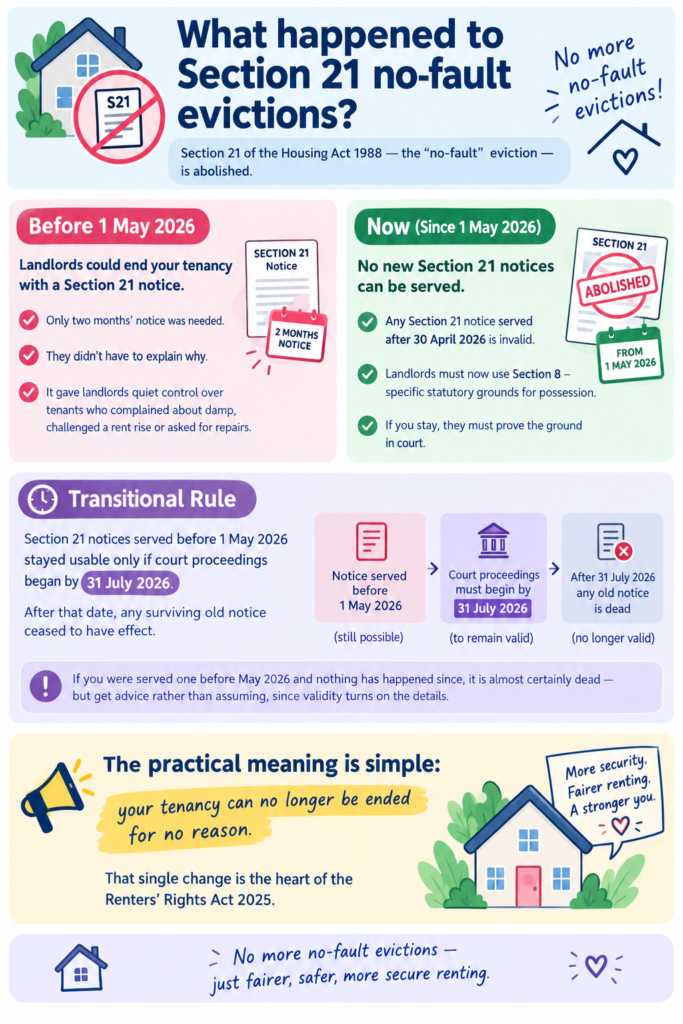
Section 21 of the Housing Act 1988 — the “no-fault” eviction — is abolished. Before 1 May 2026, a landlord could end your tenancy with two months’ notice and never explain why — a quiet form of control over anyone who complained about damp, challenged a rent rise or asked for repairs. Its abolition is a centrepiece of the Renters’ Rights Act 2025.
Since 1 May 2026, no new Section 21 notice can be served, and any served after 30 April 2026 is invalid. Landlords must now use Section 8 — specific statutory grounds for possession — and, if you stay, prove the ground in court.
Transitional rule: Section 21 notices served before 1 May 2026 stayed usable only if court proceedings began by 31 July 2026. After that date any surviving old notice ceased to have effect. If you were served one before May 2026 and nothing has happened since, it is almost certainly dead — but get advice rather than assuming, since validity turns on the details.
The practical meaning is simple: your tenancy can no longer be ended for no reason. That single change is the heart of the Renters’ Rights Act 2025.
What does the end of fixed-term tenancies mean for you?
Since 1 May 2026, fixed-term assured tenancies no longer exist in England. Every qualifying tenancy is an assured periodic tenancy — a rolling agreement, usually month-to-month, with no end date.
- Existing tenancies converted automatically. If your AST was running on 1 May 2026, it became periodic that day — no new signature needed, and any fixed-term clause in your old agreement has no legal effect.
- New tenancies are periodic from the start. A landlord cannot offer a six- or twelve-month fixed term; any agreement that tries is unenforceable.
- Rent periods cannot exceed one month, and the tenancy period and rent period must match.
- You can leave with two months’ notice at any time, in writing, expiring on the last day of a tenancy period — if your two months lands mid-period, it rolls to the next period end.
Under the Renters’ Rights Act 2025, you gained security — no end-of-term cliff edge, no renewal pressure to accept a rent hike. And you can move whenever you like rather than waiting out a fixed term. Just watch the notice timing: get the date wrong and you can owe extra rent.
How can a landlord evict you now?
With Section 21 gone under the Renters’ Rights Act 2025, every eviction goes through Section 8: the landlord serves notice stating a statutory ground, and if you stay, must prove it in court.
| Ground | Notice and conditions |
|---|---|
| Serious rent arrears | Mandatory ground now needs 3 months’ arrears (up from 2), with 4 weeks’ notice (up from 2 weeks) |
| Repeated arrears | Discretionary ground for persistent late payment, even if arrears are later cleared |
| Anti-social behaviour | Serious or repeated noise, harassment of neighbours, or damage to the property |
| Selling the property | Not available in the first 12 months of a tenancy; then 4 months’ notice |
| Landlord or family moving in | Not available in the first 12 months of a tenancy; then 4 months’ notice |
Two details matter. First, the 12-month protected period: tenancies begun on or after 1 May 2026 cannot be ended on selling or moving-in grounds during their first year — a full year of genuine security from day one. Second, re-letting restrictions apply after possession on those grounds: the property cannot simply go straight back on the market, and councils can penalise landlords who evict under false pretences.
If you are struggling with rent, read our rent arrears guide — it explains what to do the moment you fall behind and which help to claim first. The new thresholds give you more breathing room than before, but arrears remain a ground for eviction, so act early.
What are the new rules on rent increases?
The Act does not cap rents. It replaces every informal, contractual way of raising rent with one statutory procedure — and gives you the right to challenge the result.
- Once every 52 weeks, maximum — and not at all during the first 52 weeks of a new tenancy, even if your old agreement said otherwise.
- Two months’ written notice via a Section 13 notice (the form private landlords use is Form 4A) before the new rent starts.
- Market rent is the ceiling — what a comparable property would achieve if newly advertised in your area, not an arbitrary percentage or a pass-through of the landlord’s costs.
- You can challenge it at the First-tier Tribunal (Property Chamber) before the new rent takes effect, and you keep paying your current rent until it decides. The government intends to move these determinations to the Valuation Office Agency in future, but that has not happened yet.
Worked example: challenging a rent increase
The figures below are fictional and illustrative.
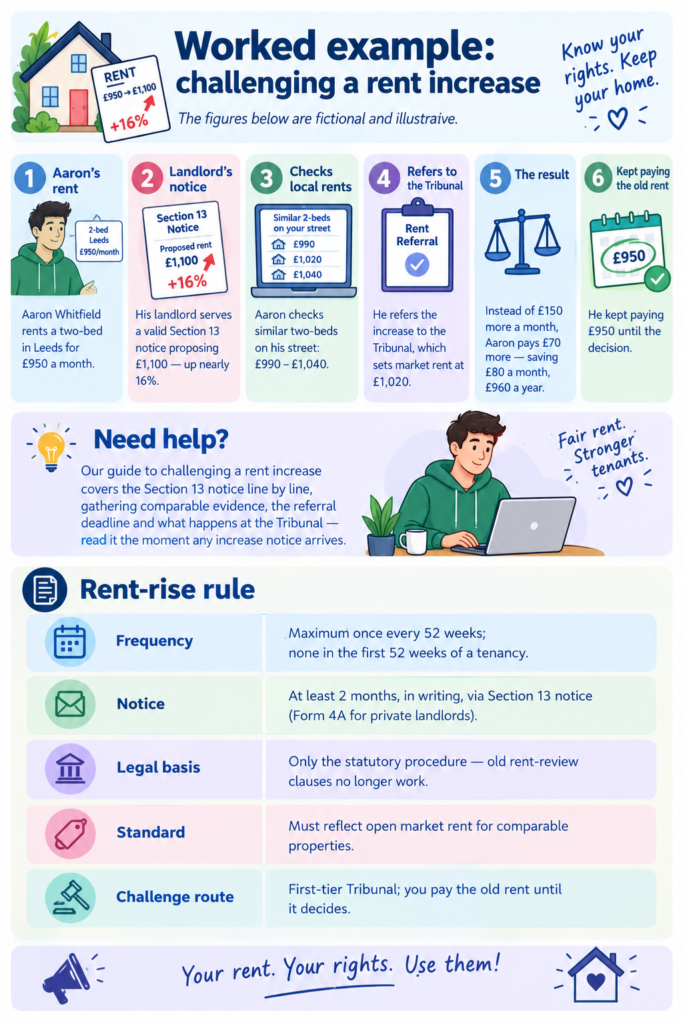
Aaron Whitfield rents a two-bed in Leeds for £950 a month. His landlord serves a valid Section 13 notice proposing £1,100 — up nearly 16%. Aaron checks similar two-beds on his street: £990–£1,040. He refers the increase to the Tribunal, which sets market rent at £1,020. Instead of £150 more a month, Aaron pays £70 more — saving £80 a month, £960 a year — and he kept paying £950 until the decision.
Our guide to challenging a rent increase covers the Section 13 notice line by line, gathering comparable evidence, the referral deadline and what happens at the Tribunal — read it the moment any increase notice arrives.
| Rent-rise rule | Detail |
|---|---|
| Frequency | Maximum once every 52 weeks; none in the first 52 weeks of a tenancy |
| Notice | At least 2 months, in writing, via Section 13 notice (Form 4A for private landlords) |
| Legal basis | Only the statutory procedure — old rent-review clauses no longer work |
| Standard | Must reflect open market rent for comparable properties |
| Challenge route | First-tier Tribunal; you pay the old rent until it decides |
What changed about moving-in costs?
Two of the most expensive parts of moving were reformed at once. The bidding ban: landlords and agents must publish an asking rent and are prohibited from asking for, encouraging or accepting offers above it — if you are asked to bid, that is now unlawful, and you should report it to the council. The one-month cap on rent in advance: no rent can be demanded before you sign, and after signing a landlord cannot require more than one month’s rent before the tenancy starts. Demands for six or twelve months upfront are unenforceable.
Worked example: what moving in costs now
The figures below are fictional and illustrative.
Leila Begum is moving into a £1,250-a-month flat in Manchester:
| Moving-in cost | What the Act changed |
|---|---|
| Rent in advance demanded | Was routinely up to 6 months (£7,500) — now capped at 1 month (£1,250) |
| Bidding above the asking rent | Was common and encouraged — now banned; the advertised rent is the rent |
| Total cash needed on day one (rent + 5-week deposit) | Could exceed £8,900 — now around £2,690 |
The deposit itself is unchanged — still capped at five weeks’ rent and still protected under the rules in our tenancy deposit protection guide.
Can you keep a pet now?
You have a statutory right to request permission to keep a pet, and your landlord cannot unreasonably refuse. Blanket “no pets” clauses no longer settle it: each request must be considered on its merits, and a refusal needs a reasonable ground relating to the animal, the property, or a genuine restriction such as a superior landlord’s lease terms.
Your landlord normally has 28 days to respond to a written request, and may require pet damage insurance. Our renting with pets guide explains how to write the request, what counts as an unreasonable refusal, and what to do if your landlord ignores you.
Can you still be turned down for benefits or children?
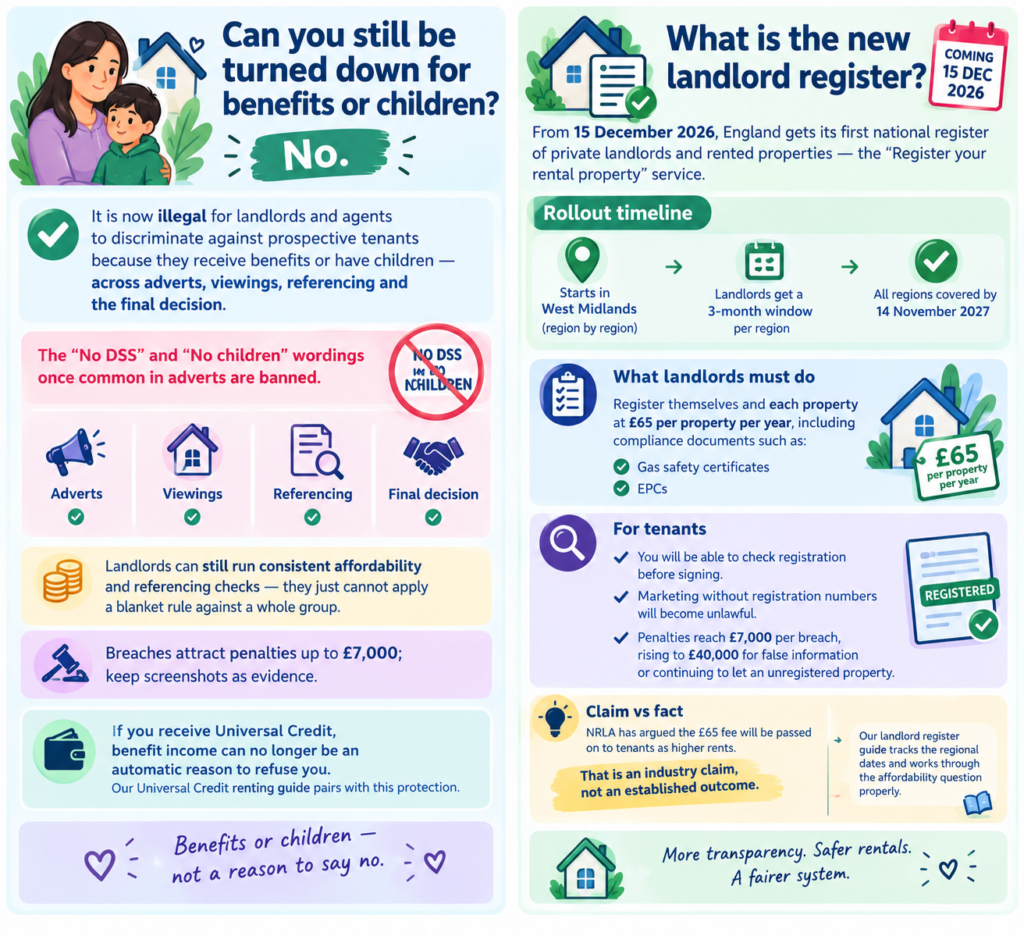
No. It is now illegal for landlords and agents to discriminate against prospective tenants because they receive benefits or have children — across adverts, viewings, referencing and the final decision. The “No DSS” and “No children” wordings once common in adverts are banned.
Landlords can still run consistent affordability and referencing checks — they just cannot apply a blanket rule against a whole group. Breaches attract penalties up to £7,000; keep screenshots as evidence. If you receive Universal Credit, our Universal Credit renting guide pairs with this protection: benefit income can no longer be an automatic reason to refuse you.
What is the new landlord register?
From 15 December 2026, England gets its first national register of private landlords and rented properties — the “Register your rental property” service. It rolls out region by region from the West Midlands, with landlords given a three-month window per region and all regions covered by 14 November 2027.
For tenants: landlords must register themselves and each property at £65 per property per year, including compliance documents such as gas safety certificates and EPCs. Once fully live, you will be able to check registration before signing — marketing without registration numbers will itself become unlawful. Penalties reach £7,000 per breach, rising to £40,000 for false information or continuing to let an unregistered property.
Claim vs fact: the landlord body NRLA has argued the £65 fee will be passed on to tenants as higher rents. That is an industry claim, not an established outcome — worth knowing about, but not a fact. Our landlord register guide tracks the regional dates and works through the affordability question properly.
What about the Ombudsman, Awaab’s Law and the Decent Homes Standard?
These three are still on the horizon — and honesty about their timing is part of an overview’s job. The Landlord Ombudsman (Phase 2): every private landlord will eventually have to belong to a new redress scheme, giving tenants free, binding decisions — apologies, remedial action, compensation — without court. The mandatory start date is not confirmed; estimates point to 2027–2028. Awaab’s Law (Phase 3, not before 2035): strict timeframes for investigating and fixing serious hazards like damp and mould, named after two-year-old Awaab Ishak. It already applies to social landlords; the private-sector timeframes are still to be set. The Decent Homes Standard (Phase 3, not before 2035): a minimum quality benchmark for private rented homes, with consultation expected around 2035–2037.
The honest summary: promises with a long tail. Your existing repair rights are unchanged in the meantime — the Renters’ Rights Act 2025 phases in the new deadlines later.
What should you do now? Four practical steps
1. Check your tenancy converted correctly. If your agreement still says “assured shorthold” or names a fixed term, that wording is legally dead — but make sure your landlord treats it that way. If they mention “renewal”, “a new fixed term” or Section 21, point them at the government’s Information Sheet, which they were supposed to give you by 31 May 2026. New tenancies must come with a written statement of terms before you agree to them.
2. Learn the two notices that govern your money. The Section 13 rent-increase notice and your own two-month notice to leave are the documents that matter most now. Read our rent increase guide before any rise arrives, and remember your notice to leave must be in writing and timed to end on the last day of a tenancy period — get the date wrong and you can owe extra rent.
3. Use the new rights at the application stage. The bidding ban, the one-month upfront cap, the discrimination ban and the pet-request right all bite when you are house-hunting. Expect the advertised rent to be the actual rent and no “no DSS” screening. If an agent breaks these rules, screenshot everything and report them — enforcement only works if breaches are reported.
4. Run your affordability numbers. Periodic tenancies and once-a-year rent rises make housing costs more predictable than ever. Our rent affordability rules guide sets your maximum rent from your income, and the rent to income ratio calculator tests any property against the 30% band. Keep your own file too: notices, rent letters, pet requests, repair reports and replies.
How do the changes work together?
The Renters’ Rights Act 2025’s provisions were designed as a system. Security makes every other right usable — the end of Section 21 is the foundation, because challenging a rent rise or reporting damp is only safe when the landlord cannot end your tenancy for it. The application-stage reforms work as a set — the bidding ban, upfront cap and discrimination ban all bite when you are house-hunting, so the advertised rent is real and your benefits or children cannot screen you out.
Predictability compounds — one challengeable rent rise a year plus a tenancy with no end date turns renting from twelve-month gambles into something plannable. And enforcement has teeth: council powers live since December 2025, penalties up to £7,000, strengthened rent repayment orders, and a coming register that makes non-compliant landlords visible.
What hasn’t changed under the Renters’ Rights Act 2025?
| Area | What still applies |
|---|---|
| Deposit protection | Still capped at 5 weeks’ rent, still must be protected in a scheme |
| Letting agent fees | The Tenant Fees Act ban stands — most fees remain illegal |
| Council tax | Still your responsibility as the occupier in most cases |
| Repair obligations | Your landlord’s existing repairing duties are unchanged; Awaab’s Law deadlines arrive in Phase 3 |
| Affordability checks | Landlords can still reference-check — they just cannot apply blanket bans on benefits or children |
The Act changed the structure of tenancies and the process around them far more than the day-to-day duties inside them. Your landlord still has to repair the boiler; you still have to pay the rent. What changed is what happens when things go wrong — and how much power each side holds when they do.
Frequently asked questions
-
When did the Renters’ Rights Act 2025 come into force?
Royal Assent was 27 October 2025; the core reforms — Section 21 abolition, periodic tenancies, rent-rise rules, the bidding ban, pet rights and the discrimination ban — took effect on 1 May 2026. The landlord register rolls out from 15 December 2026; Awaab’s Law and the Decent Homes Standard are not expected before 2035.
-
Does the Renters’ Rights Act apply in Scotland or Wales?
No — it is England-only. Wales has the Renting Homes (Wales) Act 2016 and Scotland the Private Residential Tenancy (since 2017), both already providing open-ended tenancies and restricting no-fault eviction. Northern Ireland has its own rules.
-
I signed a 12-month fixed-term contract before May 2026. Is it still valid?
The fixed-term element is not. If your AST was running on 1 May 2026, it automatically became a periodic assured tenancy that day — the end date in your old contract has no legal effect. (Exception: a valid Section 21 or Section 8 served before 1 May 2026 — get advice if that is you.)
-
How much notice do I need to give to leave now?
Two months’ written notice, served at any time, expiring on the last day of a tenancy period. If your two months would end mid-period, the notice rolls to the next period end. Your landlord can agree a shorter period in writing.
-
Can my landlord still evict me to sell the property?
Yes, but only on the reformed Section 8 selling ground: not in the first 12 months of a tenancy begun on or after 1 May 2026, then only with 4 months’ notice — proved in court if you stay. Re-letting restrictions apply afterwards.
-
How often can my landlord increase the rent?
At most once every 52 weeks, with at least two months’ written notice via a Section 13 notice — and not at all in the first 52 weeks of a new tenancy. The increase must reflect open market rent, and you can challenge it at the First-tier Tribunal.
-
Can I be asked to pay six months’ rent upfront anymore?
No. No rent can be demanded before you sign, and after signing a landlord cannot require more than one month’s rent before the tenancy starts.
-
Is it legal for a landlord to refuse me because I receive benefits?
No. Refusing tenants for receiving benefits or having children is illegal across adverts, viewings, referencing and letting decisions, with penalties up to £7,000 per breach. Fair, consistent affordability checks are still allowed.
-
What is the landlord register and when does it start?
The “Register your rental property” service is England’s new national register of private landlords and rented properties. Rollout begins in the West Midlands on 15 December 2026, region by region, with all regions covered by 14 November 2027. Landlords pay £65 per property per year.
-
When will the Ombudsman, Awaab’s Law and the Decent Homes Standard apply to me?
The Ombudsman’s mandatory start date is not confirmed (estimates point to 2027–2028). Awaab’s Law and the Decent Homes Standard are Phase 3, not expected before 2035. Existing repair rights are unchanged meanwhile.
-
Do I need to sign a new tenancy agreement?
No. Landlords did not have to re-issue agreements for tenancies converting on 1 May 2026; they had to give existing tenants the government’s Information Sheet by 31 May 2026 instead. New tenancies must come with a written statement of terms.
-
Where can I get help if my landlord breaks the new rules?
Report breaches to your local council, which has held enhanced investigatory powers since December 2025 and can issue civil penalties. Shelter England and Citizens Advice publish up-to-date guidance, and free advice is available from Shelter’s helpline and your local Citizens Advice.
Final Thoughts
The Renters’ Rights Act 2025 is the most tenant-friendly rewrite of English renting law in a generation, and its core is already in force. Three facts to carry with you: no one can evict you without proving a legal ground in court, your rent can rise at most once a year and you can challenge the figure, and your tenancy has no end date unless you choose to end it. The later phases — the landlord register from December 2026, the Ombudsman, and eventually Awaab’s Law and the Decent Homes Standard — add accountability on top of that foundation.
The strongest position under the new system is an informed one with honest numbers. Start with our rent affordability rules guide to set your maximum rent, test any property with the rent-to-income ratio calculator, and if you are weighing renting against buying, run the rent vs buy calculator. Bookmark the dedicated guides linked through this article — the rent-rise challenge, pets, the landlord register, arrears and deposits — so the full playbook is one click away when any issue lands on your doormat.
Further Reading
- GOV.UK — Renting is changing: information for tenants — the government’s official tenant hub explaining the reforms.
- Shelter England — The Renters’ Rights Act — Shelter’s campaign page and tenant guidance on what the Act means for private renters.
- Citizens Advice — top tips for private renters as the Renters’ Rights Act comes into force — practical advice on the changes now in effect.