
Tom has lived in his two-bed flat in Chorlton, Manchester, for three years. He pays his rent on time, the flat is spotless, and his landlord has never had a single complaint about him. Then, one rainy Saturday in October, Tom adopted Biscuit — a gentle, slightly anxious rescue lurcher — and his perfect tenancy hit a wall. His agreement has a “no pets” clause, and the letting agent’s answer was instant: no. It was the standard experience of renting with pets before the 2026 rule change.
“I’d lived there longer than some of the staff at the agency,” Tom told his sister. “One dog, and suddenly I’m the problem tenant.”
If you are renting with pets in the UK — or hoping to — Tom’s story will feel familiar. For years, “no pets” clauses were the end of the conversation. But the rules changed in 2026, and this guide explains exactly where you stand now: your new legal right to request a pet, how to ask properly, what your landlord can and cannot charge you, and what to do if they say no.
Quick answer: Since 1 May 2026, tenants in England have a legal right to request permission to keep a pet — your landlord must consider the request on its merits, respond in writing (normally within 28 days), and cannot refuse without a good reason. A blanket “no pets” policy is no longer enough. Your landlord cannot charge a pet deposit, demand pet insurance, or bill you for professional cleaning as a condition of consent — but they can agree a higher overall rent with you upfront, and charge up to £50 (or their reasonable costs) to amend the tenancy agreement. Assistance animals are different: under the Equality Act 2010, landlords must permit them as a reasonable adjustment and cannot charge extra at all. The new right is England-only; Scotland, Wales and Northern Ireland still work on negotiation — see the four-nation comparison below.
This guide reflects the position in England as of October 2026. It is general information, not legal advice. Rules on pets changed substantially with the Renters’ Rights Act — see the four-nation section for how Scotland, Wales and Northern Ireland differ. Wherever you are renting with pets in the UK, the written-request habit described in this guide still helps.
What Changed in 2026 for Renting with Pets: Your New Right to Request
Until 2026, a “no pets” clause in a tenancy agreement was usually the final word. Landlords could refuse pets for any reason — or no reason — and tenants had no formal route to challenge it. That changed when the pet provisions of the Renters’ Rights Act 2025 took effect in England on 1 May 2026 (Section 11 of the Act).
Here is the new position in England, in plain terms:
- You have a legal right to ask — in writing — for permission to keep a pet. The request should describe the animal: species, breed, size, age, and anything relevant about its temperament.
- Your landlord must consider the request on its own merits. They cannot operate a blanket “no pets” rule, and they cannot refuse you because they simply do not like animals or had a bad experience with a previous tenant’s pet.
- They must reply in writing, normally within 28 days. If they reasonably need more information about the pet first, the process allows extra time — some guidance describes a further seven days once that information arrives.
- Any refusal must be on reasonable grounds, tied to the specific request, the property, or a genuine restriction — not a vague worry about possible damage.
There is one important limit on this right: it is a right to request, not a right to keep. There is no automatic entitlement to a pet — the landlord gets to judge each case fairly. And the right belongs to tenants, not applicants: a landlord can still advertise a property as “no pets”, and you cannot use the Act to force consent before a tenancy exists. Once you are a tenant, though, the dynamic flips. Once the tenancy exists, tenants renting with pets can use the request process this guide describes.
Important: Do not simply move a pet in without permission. Breaking a “no pets” clause is still a breach of your tenancy agreement, and breaching it can be used as a ground for eviction. Always make the written request first and wait for the decision.
How to Ask: What Goes in Your Written Request
A good request makes your landlord’s decision easy. Landlords refuse pets mostly out of fear of the unknown — damage, noise, smells, complaints from neighbours. Your job, when you are renting with pets, is to replace the unknown with specifics. Put your request in an email or letter so you have a written record, and include:
| Include | Why it helps |
|---|---|
| The pet’s details — species, breed, age, size, weight | Shows this is a specific, real animal, not a vague idea |
| How the pet is cared for — who walks/feeds it, daytime arrangements | Answers the “who looks after it when you’re at work?” worry |
| House training and behaviour — house-trained, crate-trained, vet references | Directly addresses the damage concern |
| A vet or previous-landlord reference | Third-party proof you are a responsible pet owner |
| Voluntary pet insurance — confirm you will insure the pet yourself | Shows financial responsibility (they cannot require this, but volunteering it strengthens your case) |
| A “pet CV” photo | A calm, well-kept animal in a photo is worth a paragraph of reassurance |
You do not need legal language. When you are renting with pets, something like this is enough:
“Dear [landlord/agent], I am writing to request permission to keep a pet at [address], as provided for under the Renters’ Rights Act. The pet is Biscuit, a four-year-old neutered lurcher (around 22kg), fully housetrained and vaccinated. He is walked twice daily, is never left alone for more than four hours, and stays with my sister when I am away overnight. My previous landlord of two years can confirm there was no pet damage at that property. I am happy to take out pet liability insurance voluntarily. I would be grateful for your written decision. Kind regards, Tom.”
Keep a copy. If the request is ever disputed, your written request and their written reply are the evidence — the same reason you should always get a landlord’s decision in writing too. Tenants renting with pets should treat this paper trail as part of the process, not an afterthought.
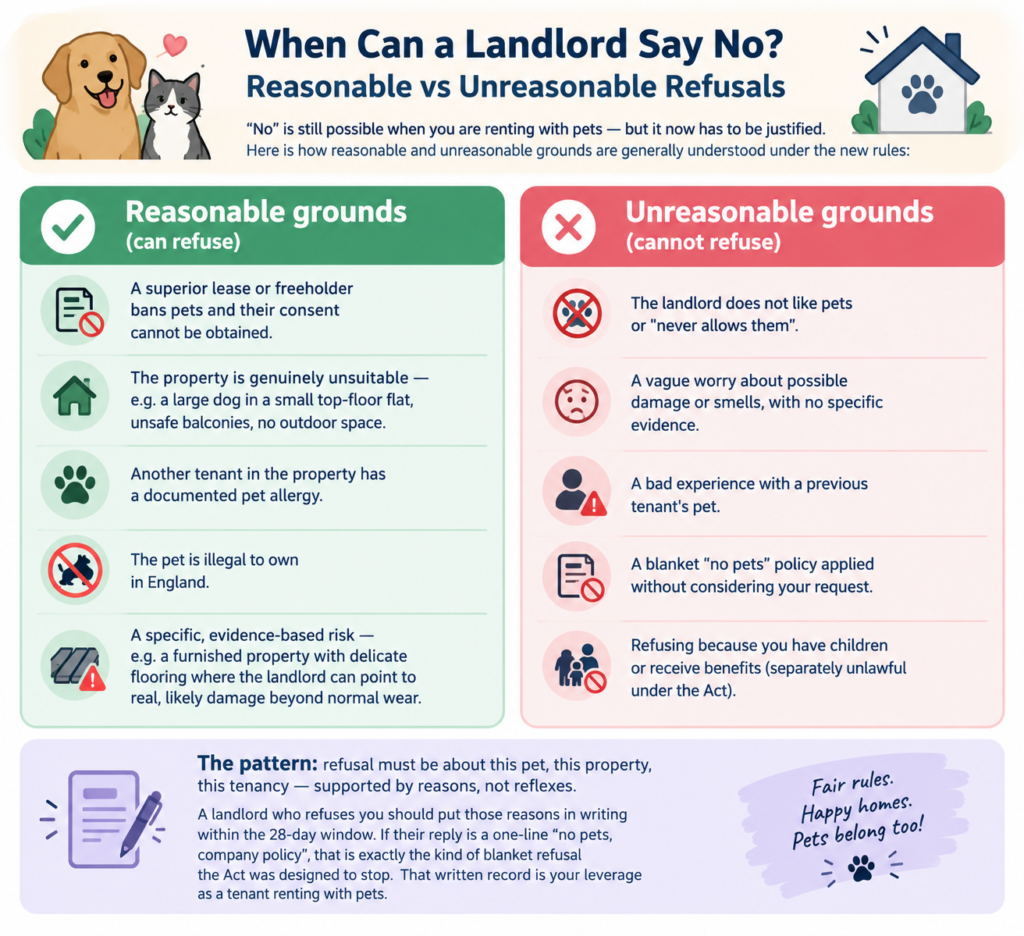
When Can a Landlord Say No? Reasonable vs Unreasonable Refusals
“No” is still possible when you are renting with pets — but it now has to be justified. Here is how reasonable and unreasonable grounds are generally understood under the new rules:
| Reasonable grounds (can refuse) | Unreasonable grounds (cannot refuse) |
|---|---|
| A superior lease or freeholder bans pets, and their consent cannot be obtained | The landlord does not like pets or “never allows them” |
| The property is genuinely unsuitable — e.g. a large dog in a small top-floor flat, unsafe balconies, no outdoor space | A vague worry about possible damage or smells, with no specific evidence |
| Another tenant in the property has a documented pet allergy | A bad experience with a previous tenant’s pet |
| The pet is illegal to own in England | A blanket “no pets” policy applied without considering your request |
| A specific, evidence-based risk — e.g. a furnished property with delicate flooring where the landlord can point to real, likely damage beyond normal wear | Refusing because you have children or receive benefits (separately unlawful under the Act) |
The pattern: refusal must be about this pet, this property, this tenancy — supported by reasons, not reflexes. A landlord who refuses you should put those reasons in writing within the 28-day window. If their reply is a one-line “no pets, company policy”, that is exactly the kind of blanket refusal the Act was designed to stop. That written record is your leverage as a tenant renting with pets.
Renting with Pets: What Can Your Landlord Charge?
This is where tenants get confused — and where some landlords and agents still get it wrong. The Tenant Fees Act 2019 strictly limits what can be charged in connection with a tenancy in England, and the pet rules of the Renters’ Rights Act did not create any new pet-specific charges. Here is the full picture:
| Charge | Allowed? | Detail |
|---|---|---|
| A higher overall rent, agreed upfront | Yes | A landlord can set a higher rent for a pet-friendly tenancy, as long as it is the agreed rent stated clearly in the tenancy agreement |
| A separate “pet rent” surcharge or pet fee on top of the rent | No | Extra recurring charges specifically for the pet are prohibited payments under the Tenant Fees Act |
| A pet deposit (extra deposit for the animal) | No | Government tenant guidance is explicit: there are “no special provisions or exemptions if you have a pet” — the standard deposit cap applies |
| A fee to amend the tenancy agreement to allow a pet | Yes — up to £50 | Where you request a change (e.g. permission to keep a pet), the landlord or agent can charge up to £50, or their reasonable costs if higher |
| Mandatory pet insurance, or charging you for it | No | A proposal that would have let landlords require pet-damage insurance was removed before the Act passed; making insurance a condition of consent would be a prohibited payment. You may insure voluntarily |
| Forced professional cleaning or de-flea treatment at the end of the tenancy | No | Requiring professional cleaning as a condition is a prohibited payment — though you must still return the property in the same condition as at the start |
One more nuance: none of this stops a landlord from deducting the actual cost of pet damage from your standard deposit at the end of the tenancy — chewed door frames, scratched floors, ruined carpets. The deposit is still the landlord’s protection against real damage; the law simply stops them charging you in advance for damage that has not happened.
Illustrative example — Tom’s numbers. Tom’s flat is £950 a month (£11,400 a year). His landlord agrees to the dog and sets the renewed rent at £975 — £25 a month (£300 a year) more, clearly stated in the agreement. That is lawful. What would not be lawful: the agent demanding a £400 “pet deposit” on top of Tom’s standard deposit, or a £150 “pet administration fee”. Tom checks the maths on the deposit too: five weeks’ rent at £975 a month is £1,125 — and that is the absolute maximum anyone can ask him for.
Deposits and Pet Damage, Worked Out
Deposit rules are the part landlords most often misstate when tenants are renting with pets, so here they are plainly, for England:
- The tenancy deposit is capped at five weeks’ rent where the annual rent is under £50,000 (six weeks’ where it is £50,000 or more).
- There is no pet exception to the cap. The government’s own tenant guidance says so directly.
- Any deposit must be protected in a tenancy deposit scheme, and you must be given the prescribed information.
- If your pet causes damage, the landlord claims for the actual, evidenced cost at the end of the tenancy — through the deposit scheme’s dispute process if you disagree.
Worked example at £1,200 a month:
| Step | Calculation | Result |
|---|---|---|
| Annual rent | £1,200 × 12 | £14,400 |
| Weekly rent | £14,400 ÷ 52 | £276.92 |
| Maximum deposit (5 weeks) | £276.92 × 5 | £1,384.62 |
If a landlord or agent asks for £1,384.62 plus £500 “for the dog”, the total is over the legal cap — refuse, and report it. Our tenancy deposit protection guide explains how to check your deposit is protected and what to do if it is not.
Practical protection when you are renting with pets — for you as well as the landlord: take dated photos of the property (especially floors, doors and garden) at move-in, keep vet and vaccination records, and keep receipts for any pet-related cleaning you do. If a deposit deduction is ever disputed, the tenant with evidence wins far more often than the tenant without it.
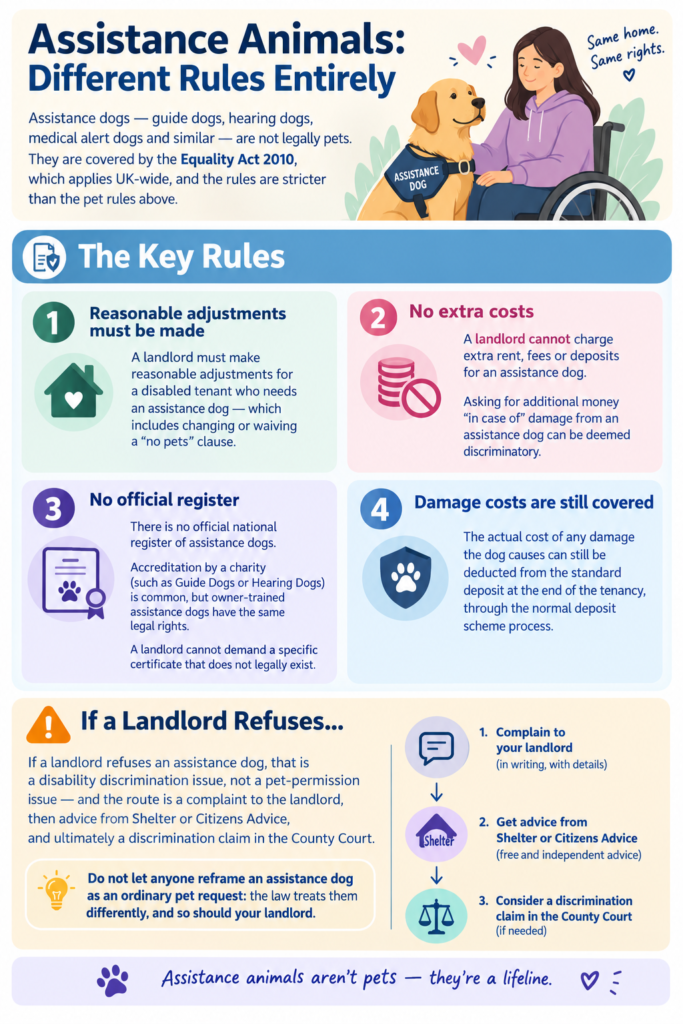
Assistance Animals: Different Rules Entirely
Assistance dogs — guide dogs, hearing dogs, medical alert dogs and similar — are not legally pets. They are covered by the Equality Act 2010, which applies UK-wide, and the rules are stricter than the pet rules above:
- A landlord must make reasonable adjustments for a disabled tenant who needs an assistance dog — which includes changing or waiving a “no pets” clause.
- A landlord cannot charge extra rent, fees or deposits for an assistance dog. Asking for additional money “in case of” damage from an assistance dog can be deemed discriminatory.
- There is no official national register of assistance dogs — accreditation by a charity (such as Guide Dogs or Hearing Dogs) is common, but owner-trained assistance dogs have the same legal rights. A landlord cannot demand a specific certificate that does not legally exist.
- The actual cost of any damage the dog causes can still be deducted from the standard deposit at the end of the tenancy, through the normal deposit scheme process.
If a landlord refuses an assistance dog, that is a disability discrimination issue, not a pet-permission issue — and the route is a complaint to the landlord, then advice from Shelter or Citizens Advice, and ultimately a discrimination claim in the County Court. Do not let anyone reframe an assistance dog as an ordinary pet request: the law treats them differently, and so should your landlord.
Does This Apply in Scotland, Wales and Northern Ireland?
No — the Renters’ Rights Act pet right is England only. The other nations have not introduced an equivalent statutory right, so there the position is still negotiation under the tenancy agreement:
| Nation | Statutory right to request a pet? | Deposit position for pet owners |
|---|---|---|
| England | Yes — since 1 May 2026 (Renters’ Rights Act, Section 11); written request, 28-day response, no unreasonable refusal | Capped at 5 weeks’ rent (6 if ≥£50k/yr); no pet deposit allowed |
| Scotland | No — permission depends on the tenancy agreement; ask in writing and negotiate | Capped at 2 months’ rent total, including any additional amounts agreed |
| Wales | No — no equivalent duty on landlords; the agreement decides | Guidance (including TDS) notes landlords may still ask for an additional pet deposit — unlike England; take advice before agreeing |
| Northern Ireland | No — permission is by agreement with the landlord | Since 1 April 2023, all deposits for new tenancies are limited to one month’s rent, including any pet element |
Two points apply everywhere in the UK: assistance animals are protected UK-wide under the Equality Act 2010 (see above), and never move a pet in without written permission — breaching a no-pets clause can be grounds for eviction in any nation.
If Your Request Is Refused
If you are in England and you believe a refusal was unreasonable — a one-line “no”, a blanket policy, or reasons that do not stand up — you have options:
- Reply in writing, restating your request and asking for the specific reasons. Sometimes a refusal is just a letting agent’s habit, and a firm, polite letter referencing the Renters’ Rights Act resolves it.
- Complain formally to the landlord (or the agency’s complaints process). Keep every email and letter.
- Take it to court. If the landlord does not respond within 28 days, or unreasonably refuses, the tenant can apply to the court, which can enforce the rules. This is the current route while the new redress system beds in.
- The PRS Landlord Ombudsman. The Renters’ Rights Act creates a new ombudsman for the private rented sector, which will handle disputes like refused pet requests — but mandatory landlord membership is not expected until 2028, so for now the court is the enforcement route.
- Get free advice first. Shelter and Citizens Advice deal with pet disputes regularly and will tell you honestly whether your case is strong before you spend money or escalate.
Do not withhold rent or move the pet in as leverage when you are renting with pets — both weaken your position badly.
Finding a Pet-Friendly Rental
The new right helps tenants who already have a home, but finding a new one with a pet is still harder than without. A few things that genuinely work:
- Search with pet filters on the big portals, and treat “pets considered” as a real signal — but remember that in England a “no pets” advert does not stop you from requesting once you are a tenant.
- Lead with your pet CV: the written-request checklist above doubles as a viewing pack. Agents pass strong applications to landlords; a calm, documented pet beats a vague promise.
- Offer what you legally can: you cannot offer a bigger deposit in England (it is capped), but you can offer voluntary pet insurance, a trial meeting with the animal, and references.
- Budget for the pet premium honestly: if pet-friendly homes in your area rent for £30–£50 a month more, that is £360–£600 a year — check it against your budget before you fall in love with a flat. Our rent-to-income ratio calculator shows what rent your income supports, and the average rent guide benchmarks your city.
And a reassuring statistic for the nervous: a Tenancy Deposit Scheme survey of 1,500 landlords found that half had never had any damage from pets in their rental properties, and a YouGov survey for Cats Protection found 75% of cat-friendly private landlords report no problems at all from cats. Responsible pet owners are the norm, not the exception — your request is reasonable, and the law now agrees. If you are renting with pets and feeling nervous about asking, these are numbers worth quoting in your request.

FAQs
Can my landlord refuse my pet in 2026?
In England, since 1 May 2026 your landlord cannot unreasonably refuse a written request to keep a pet (Renters’ Rights Act, Section 11). They must consider it on its merits, reply in writing within about 28 days, and give specific reasons if they refuse — such as a superior lease that bans pets or a property genuinely unsuitable for the animal. A blanket “no pets” policy is no longer enough. In Scotland, Wales and Northern Ireland there is no equivalent statutory right, so permission is by negotiation.
Do I have an automatic right to keep a pet in rented accommodation?
No — and this matters. The law gives you a right to request a pet, not a right to keep one. Your landlord considers each request fairly and can refuse on reasonable grounds. The change is that “because I said so” is no longer a lawful refusal in England.
How do I ask my landlord for permission to keep a pet?
Put it in writing (email is fine): describe the pet (species, breed, age, size), explain how it is cared for during the day, confirm house-training, attach a vet or previous landlord reference, and say you will insure the pet voluntarily. Keep a copy of your request and insist on a written reply — these are your evidence if the decision is disputed.
How long does my landlord have to respond to a pet request?
Normally 28 days, in writing. If the landlord reasonably needs more information about the pet first, the process allows extra time. If they do not respond within 28 days, you can apply to the court to enforce the rules.
Can my landlord charge me extra for having a pet?
They can agree a higher overall rent with you upfront, clearly stated in the tenancy agreement. They cannot charge a separate “pet rent” surcharge, a pet deposit, a pet fee, mandatory pet insurance, or forced professional cleaning — these are prohibited payments under the Tenant Fees Act 2019. They can charge up to £50 (or their reasonable costs) to amend the tenancy agreement to allow the pet.
Can my landlord ask for a bigger deposit because I have a pet?
In England, no. Government guidance states there are “no special provisions or exemptions if you have a pet” — the standard cap of five weeks’ rent (six weeks’ where annual rent is £50,000 or more) applies. In Wales, guidance notes an additional pet deposit is still possible; in Scotland the total deposit is capped at two months’ rent; in Northern Ireland at one month’s rent.
Can my landlord make me get pet insurance?
No. A proposal that would have allowed landlords to require pet-damage insurance was removed before the Renters’ Rights Act passed. Making insurance a condition of consent would be a prohibited payment under the Tenant Fees Act. You can — and probably should — insure your pet voluntarily, and saying so strengthens a request.
What if my tenancy agreement already says “no pets”?
In England, the new law overrides a blanket clause: your landlord must still consider a written request fairly and cannot rely on the clause alone to refuse. Do not ignore the clause and move a pet in anyway — breaching it can be grounds for eviction. Make the request, get the decision in writing, and challenge an unreasonable refusal.
Are assistance dogs treated as pets?
No. Assistance dogs are protected UK-wide under the Equality Act 2010 — landlords must permit them as a reasonable adjustment and cannot charge any extra rent, fees or deposit for them. There is no official national register of assistance dogs, and a landlord cannot demand a certificate that does not legally exist. Actual damage can still be deducted from the standard deposit.
Can a landlord advertise a property as “no pets”?
Yes — the right to request belongs to tenants, not applicants. A landlord can still market a property as unsuitable for pets. The protection kicks in once you hold the tenancy: then you can make a written request that must be fairly considered.
What happens if my pet damages the property?
You are liable for the actual, evidenced cost of the damage, which the landlord can deduct from your standard deposit at the end of the tenancy (disputed deductions go through the deposit scheme’s adjudication). Take dated move-in photos of floors, doors and gardens, and keep vet and cleaning receipts — evidence decides disputes.
Where can I get free advice about a pet dispute with my landlord?
Shelter (England and Scotland) and Citizens Advice give free, confidential housing advice and deal with pet disputes regularly. Speak to an adviser before escalating a refusal to court — they will tell you honestly how strong your case is.
Final Thoughts on Renting with Pets
For decades, renting with a pet in England meant hoping for a kind landlord and dreading the “no pets” clause. The 2026 rules do not give you an automatic right to a menagerie — but they do something almost as valuable: they make the decision fair, written and challengeable. A landlord who wants to say no must now say why, on the record, within 28 days — and “just because” no longer counts. For anyone renting with pets, that shift — from favour to right — is the whole story.
Your side of the bargain is straightforward: ask in writing, make the case well, never move a pet in without permission, and know the money rules cold — no pet deposits, no pet fees, no forced insurance in England, whatever an agent tells you. Do that, and Tom’s story gets a better ending: Biscuit on the sofa, tenancy intact, and a landlord who never had anything to worry about. That is what successful renting with pets looks like in practice.
Before you commit to a pet-friendly home, run the numbers: our rent-to-income ratio calculator checks the rent against your income, the rent budget after bills planner keeps the full monthly picture in view, and the rent upfront cost calculator totals what moving day really costs. If a pet means a higher rent, the rent increase affordability checker models exactly what that rise costs you over a year.
Further Reading
- Renting With Pets: Can a Landlord Refuse? (2026 Rules) — LettingaProperty
- Can Landlords Refuse Pets: A Guide for Renters — Move iQ
- Tenant Fees Act — Tenant Guidance (GOV.UK, PDF)
- Citizens Advice publishes step-by-step guidance on renting rights and deposits — search “renting with pets” or “tenancy deposits” on citizensadvice.org.uk for their current advice pages.