
Rachel had been scrolling through Birmingham listings for three weeks when a two-bedroom flat popped up at £1,050 a month. It ticked every box: close to the station, a proper kitchen, a living room big enough for her desk. But flats on the same street had recently been listed at £975 and £1,000 — so instead of just accepting the figure, she decided to negotiate rent, asked for less, and got it.
Most renters treat the advertised rent as a fixed price. It usually isn’t. Landlords would often rather take slightly less from a reliable tenant than gamble on the next applicant, and the rules governing the whole conversation changed significantly in 2026. This guide shows you how to negotiate rent before you sign, what’s legal, what works, and where the line is.
Quick Answer: Yes, you can negotiate rent in the UK before you sign — but since 1 May 2026, negotiation in England works downwards only. The Renters’ Rights Act 2025 bans rental bidding: landlords and agents must advertise a fixed rent and cannot accept offers above it. Your best route: compare similar local listings, time your move for slow periods, present yourself as a reliable tenant, make one clear written offer, and get the agreement into the written statement of terms before you sign.
Can You Negotiate Rent Below the Asking Price?
In most cases, yes. An advertised rent is an asking price, not a court order. Landlords set it based on what they hope the market will bear, and many build in a small margin because they expect tenants to negotiate rent.
What has changed is the direction of negotiation. Before May 2026, hot properties attracted bidding wars, with tenants offering over the asking price. That era is over in England. The advertised figure is now a ceiling, and the only direction you can move it is down.
That doesn’t mean landlords roll over for every offer when you negotiate rent. But a polite, well-evidenced offer costs you nothing, and plenty of landlords accept modest reductions to secure a good tenant quickly rather than wait weeks for full price.
What the 2026 Bidding Ban Means for Your Negotiation
Since 1 May 2026, the Renters’ Rights Act 2025 has banned rental bidding in England. Under sections 56–57, landlords, agents and anyone acting for the landlord must state the proposed rent in writing on any advert — and must not invite, encourage or accept any offer above that figure.
This has three practical consequences:
- You cannot offer above the advertised rent. The landlord or agent breaks the law if they accept it. First breaches can draw a civil penalty of up to £7,000, rising to £40,000 for repeat offences.
- “Offers over” listings are effectively dead. Any written advert must name a specific proposed rent.
- The old tiebreaker is gone. Applicants are now judged on reliability, references and timing — not on who waves the most cash.
If an agent hints that “another applicant has offered more,” treat it as a red flag and report it to your local council, which can investigate and impose penalties. Tenants cannot be held liable for a bidding breach — the obligation sits entirely on the landlord and agent.
One more rule worth knowing: in England you have a backstop. If you sign and later discover the rent is well above the local market rate, you can ask the First-tier Tribunal to set the initial rent within the first six months of your tenancy. The tribunal compares it with the open market rent for similar local homes and can reduce it — though never above what you agreed. For a full rundown of the Act’s wider changes, see our Renters’ Rights Act 2025 guide.
Key point: In England, the advertised rent is the maximum anyone can pay for a new tenancy. Negotiation now means finding a fair way to agree something below that figure — not outbidding anyone.
Research Comparables Before You Say a Word
Never try to negotiate rent armed only with a feeling that the rent “seems high.” Landlords respond to evidence, not hunches.
Add official data to sharpen your case. The ONS rental price index (published September 2026) puts the average UK private rent at £1,400 a month, up 3.8% on the year — £1,459 in England, £846 in Wales, £1,013 in Scotland and £874 in Northern Ireland. Our average UK rent 2026 guide breaks down rental prices by city.
| Source | What to record |
|---|---|
| Rightmove / Zoopla listings | Asking rent, bedroom count, postcode, days listed, condition |
| ONS rental price index | National and regional averages to sanity-check your figures |
| Local letting agents | Ask what similar flats nearby actually let for, not just what’s advertised |
| Your viewing notes | Wear, fittings, parking, transport links, anything that justifies a lower figure |
Aim for three to five comparables at a lower figure: “similar two-beds on this street are listed at £975–£1,000” beats hope every time.
Why Timing Is Your Biggest Lever
Here’s the maths most renters never consider: an empty property costs a landlord money every day. Every week without a tenant is rent that never comes back, plus re-advertising and referencing costs. A small discount that fills the flat today usually beats holding out for full price next month.
| Monthly rent | Cost of 2 weeks sitting empty |
|---|---|
| £1,000 | £462 |
| £1,500 | £692 |
| £2,000 | £923 |
This is why properties listed for several weeks are the easiest wins: the landlord’s position weakens daily, and your offer starts to look like the sensible option. January and February are typically the slowest months for letting, while late November and early December are quiet too. By contrast, June to September is peak season, when landlords have little reason to budge.
Marcus in London: a worked example
Marcus was looking at a one-bedroom flat in Stratford, advertised at £1,850 a month and listed for nearly a month, with comparable one-beds nearby at £1,750–£1,800. He offered £1,775 to negotiate the rent down, citing the comparables and the month-long listing.
The maths for both sides:
- Marcus’s saving: £75 a month × 12 = £900 a year
- Landlord’s cost of two more empty weeks: £1,850 × 12 ÷ 52 × 2 = £853.85
- The same £900 a year equals roughly 14.8 days of the flat sitting empty
The landlord accepted at £1,775: a year of guaranteed rent beat another fortnight of nothing. The offer worked because it was timed well, evidenced, and smaller than the landlord’s cost of waiting.
Your Leverage as a Reliable Tenant
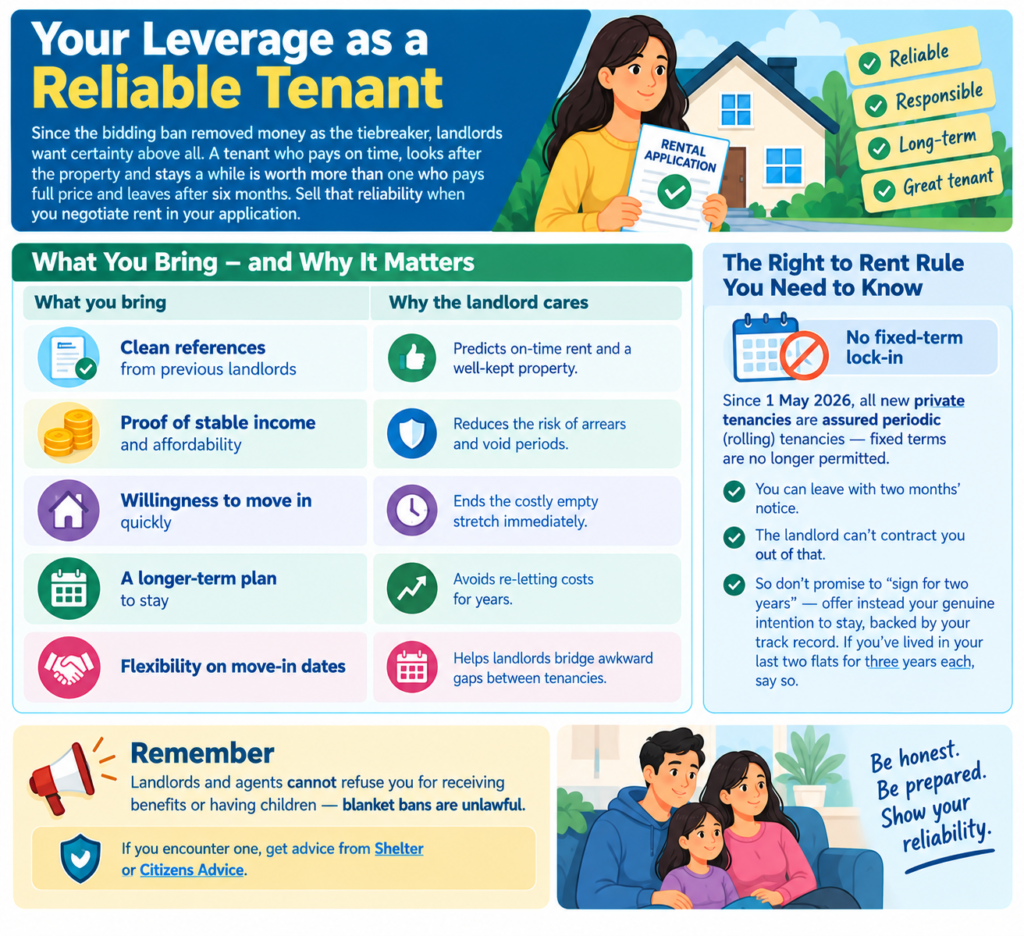
Since the bidding ban removed money as the tiebreaker, landlords want certainty above all. A tenant who pays on time, looks after the property and stays a while is worth more than one who pays full price and leaves after six months. Sell that reliability when you negotiate rent in your application.
| What you bring | Why the landlord cares |
|---|---|
| Clean references from previous landlords | Predicts on-time rent and a well-kept property |
| Proof of stable income and affordability | Reduces the risk of arrears and void periods |
| Willingness to move in quickly | Ends the costly empty stretch immediately |
| A longer-term plan to stay | Avoids re-letting costs for years |
| Flexibility on move-in dates | Helps landlords bridge awkward gaps between tenancies |
One thing you cannot offer in England: a fixed-term lock-in. Since 1 May 2026, all new private tenancies are assured periodic (rolling) tenancies — fixed terms are no longer permitted. You can leave with two months’ notice, and the landlord can’t contract you out of that. So don’t promise to “sign for two years” — offer instead your genuine intention to stay, backed by your track record. If you’ve lived in your last two flats for three years each, say so.
Remember: Landlords and agents cannot refuse you for receiving benefits or having children — blanket bans are unlawful. If you encounter one, get advice from Shelter or Citizens Advice.
Tactics to Negotiate Rent That Actually Work
These tactics to negotiate rent consistently work:
- Anchor with evidence, not emotion. Lead with your comparables: “Similar one-beds on this street are listed at £1,750–£1,800, so I’d like to offer £1,775.” Aim for roughly 5–10% below the asking rent — that’s the realistic negotiating zone. Evidence gives the landlord a reason to say yes that they can explain to themselves.
- Ask politely, and negotiate with the decision-maker. “Would you consider £1,775?” keeps the door open — ultimatums make landlords defensive. And ask the agent to put your full offer, evidence included, directly to the landlord, since every relay dilutes your case.
- Make one clear offer. Repeated back-and-forth signals you’re not serious and tires the other side. Research, decide your number, offer it once, and give the landlord a reasonable deadline.
- Know your walk-away number. Decide in advance the maximum you’ll pay. If the landlord won’t meet it, walk away calmly. Needing the flat too badly is the one thing that kills every negotiation.
The single most powerful line when you negotiate rent: “I’m ready to proceed immediately at £X.” Speed plus certainty plus a reasonable number beats almost everything else.
How to Make the Offer — and What to Put in Writing
However good your tactics, the offer needs to be written down. Verbal agreements about rent get misremembered or disputed. Email your offer so there’s a dated record, and make sure the final agreed figure ends up in the tenancy paperwork. For example:
Subject: Offer on [property address] — £1,775 pcm
Dear [name],
Thank you for showing me the flat. I’d like to offer £1,775 per month — similar one-beds nearby are listed at £1,750–£1,800, and this property has been available for four weeks. I can provide excellent references from my landlord of three years plus proof of income, and I’m ready to move in on [date] with the holding deposit available.
Please let me know by [date] if this works.
Kind regards,
[Your name]
| Element | What to include |
|---|---|
| The exact figure | State the monthly rent clearly — no vague ranges |
| Your evidence | One or two comparables, briefly, with sources |
| Your reliability | References, income stability, move-in readiness |
| A deadline | Two to three working days keeps things moving |
| Tone | Polite and professional throughout |
Once the landlord agrees, don’t treat it as done. In England, landlords must give you a written statement of the tenancy terms before the tenancy is entered into. Check it shows the rent you agreed, the payment dates, the deposit, how rent can be changed (via Section 13), and the notice periods. If the number on the page differs from what you agreed, stop and ask — a tenancy agreement that doesn’t match your offer is worth exactly the argument you’ll have later. For more on what a proper agreement should contain, see our tenancy agreement guide.
When the Rent Won’t Budge, Negotiate the Extras
Sometimes the landlord genuinely won’t move on the headline rent. That doesn’t end your attempt to negotiate rent — everything around the rent is negotiable too, and the extras can be worth as much as a rent cut.
Things you can ask for instead:
- Bills included or capped — ask for council tax, water or broadband to be folded into the rent, or for an energy allowance
- White goods supplied — a washing machine and fridge-freezer save you £400–£600 in a single purchase
- Redecoration or repairs before you move in — fresh paint, new carpets, a serviced boiler or replaced kitchen taps
- Parking — a dedicated space or permit, especially in cities where parking costs £50+ a month
- A pet agreement in writing — since landlords must now consider pet requests reasonably, get the permission recorded
Zainab in Manchester: a worked example
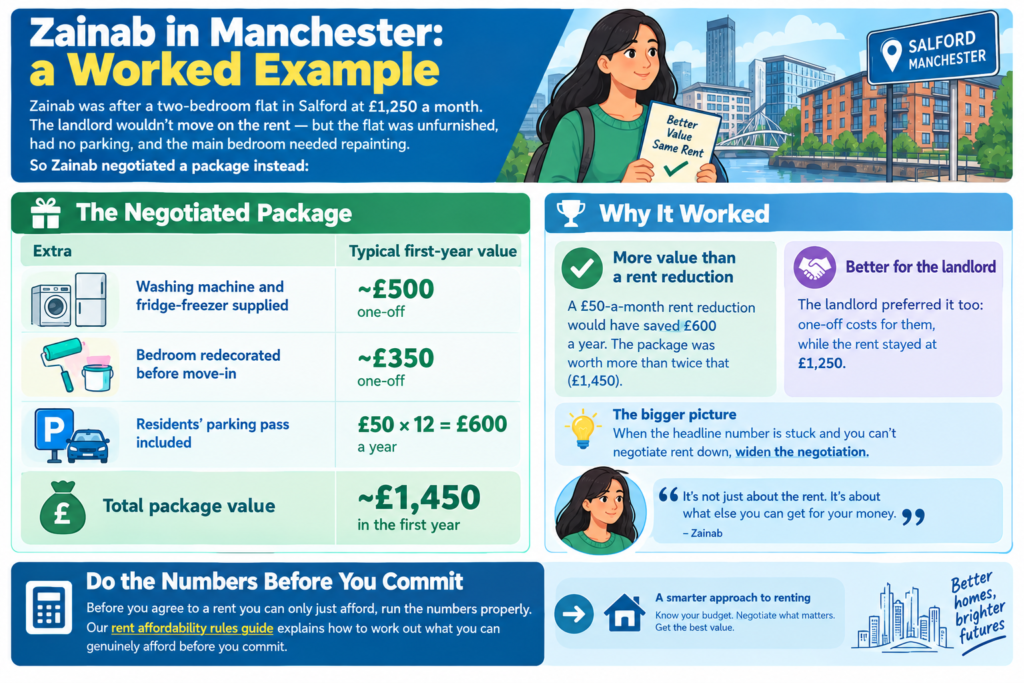
Zainab was after a two-bedroom flat in Salford at £1,250 a month. The landlord wouldn’t move on the rent — but the flat was unfurnished, had no parking, and the main bedroom needed repainting. So Zainab negotiated a package instead:
| Extra | Typical first-year value |
|---|---|
| Washing machine and fridge-freezer supplied | ~£500 one-off |
| Bedroom redecorated before move-in | ~£350 one-off |
| Residents’ parking pass included | £50 × 12 = £600 a year |
| Total package value | ~£1,450 in the first year |
That package was worth more than twice what a £50-a-month rent reduction would have saved (£600 a year). The landlord preferred it too: one-off costs for them, while the rent stayed at £1,250. When the headline number is stuck, and you can’t negotiate rent down, widen the negotiation.
Before you agree to a rent you can only just afford, run the numbers properly. Our rent affordability rules guide explains how to work out what you can genuinely afford before you commit.
Negotiating at Renewal Is a Different Game
Everything so far has been about how to negotiate rent before you sign. Renewals work differently — and since 1 May 2026 the law is stricter too.
In England, rent can now only be increased through the Section 13 process: a valid notice (Form 4A), at least two months’ notice, and no more than once per 52 weeks. Rent-review clauses in old agreements have no legal effect. If your landlord tries to raise the rent by text or phone call, that isn’t valid — ask them to serve the proper notice.
Your leverage at renewal is strong: you’re a proven tenant with a payment history, and replacing you costs the landlord a void plus re-letting expenses. When the Section 13 notice lands, negotiate — respond in writing, point out your record, cite comparables, and propose a smaller or phased increase. If you can’t agree, you can challenge at the First-tier Tribunal, which cannot set the rent higher than the landlord proposed. Our challenging a rent increase guide covers that process — this article is about the rent you agree before you sign.
The Holding Deposit and Your Offer
One common question: should you negotiate before or after paying a holding deposit? Always before. A holding deposit reserves the property and signals commitment — paying it first and then haggling puts you in a weak position.
In England, a holding deposit is capped at one week’s rent under the Tenant Fees Act 2019. Once paid, both sides have 15 days for the tenancy agreement to be entered into (unless an extension is agreed in writing), and the deposit must be refunded within 7 days of the tenancy starting, or applied to your first rent or tenancy deposit with your consent.
| Payment | England cap (new tenancies) |
|---|---|
| Holding deposit | One week’s rent maximum |
| Tenancy deposit | Five weeks’ rent (six weeks if annual rent is £50,000+) |
| Rent in advance | None before the agreement is signed; max one month after signing |
The rent-in-advance rule changed in 2026. Under the Renters’ Rights Act, landlords cannot ask for or accept any rent before the tenancy agreement is signed. After signing, they can require no more than one month’s rent in advance (28 days’ rent for shorter rental periods). Demands for six or twelve months upfront — once common with students or renters without a UK credit history — are no longer enforceable for new tenancies. You can still pay more voluntarily once the tenancy has started, but it can’t be a condition of getting the property. Our holding deposit calculator works out the legal maximum for any rent figure.
Negotiation order: agree the rent first, get it in writing, then pay the holding deposit based on that agreed figure. Never the other way round.
How Negotiation Differs Across the UK
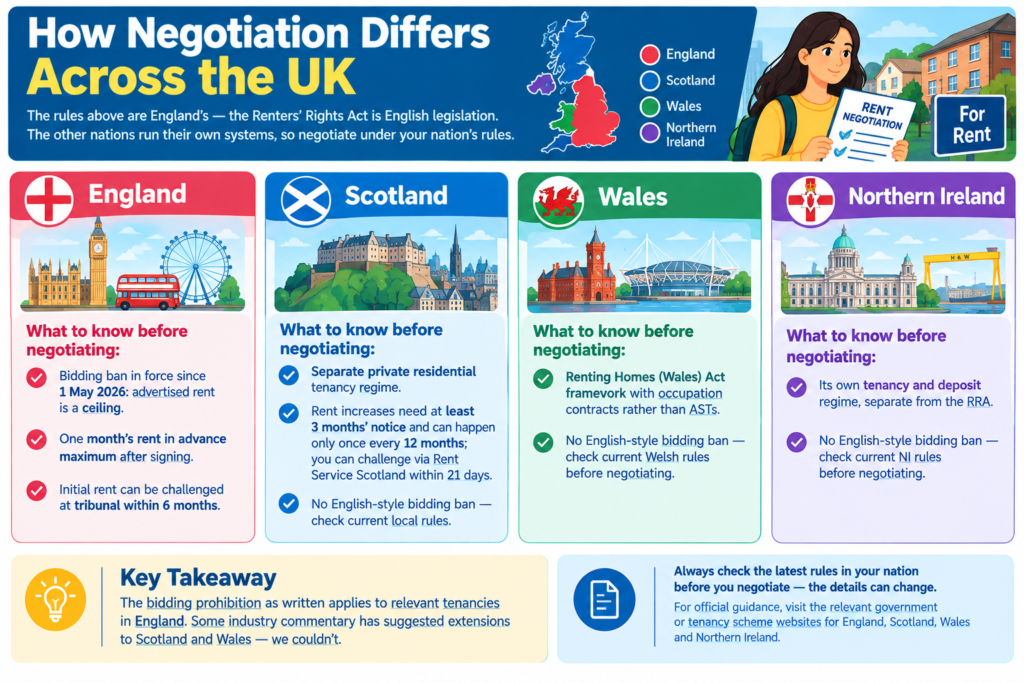
The rules above are England’s — the Renters’ Rights Act is English legislation. The other nations run their own systems, so negotiate under your nation’s rules.
| Nation | What to know before negotiating |
|---|---|
| England | Bidding ban in force since 1 May 2026: advertised rent is a ceiling. One month’s rent in advance maximum after signing. Initial rent can be challenged at tribunal within 6 months. |
| Scotland | Separate private residential tenancy regime. Rent increases need at least 3 months’ notice and can happen only once every 12 months; you can challenge via Rent Service Scotland within 21 days. No English-style bidding ban — check current local rules. |
| Wales | Renting Homes (Wales) Act framework with occupation contracts rather than ASTs. No English-style bidding ban — check current Welsh rules before negotiating. |
| Northern Ireland | Its own tenancy and deposit regime, separate from the RRA. No English-style bidding ban — check current NI rules before negotiating. |
The bidding prohibition as written applies to relevant tenancies in England. Some industry commentary has suggested extensions to Scotland and Wales — we couldn’t verify an equivalent bidding ban in force there, so treat those claims with caution and check with Shelter or Citizens Advice for your nation.
When to Walk Away
Not every negotiation deserves to continue. Walk away — calmly, in writing — if you spot any of these:
| Red flag | What it tells you |
|---|---|
| Agent hints another applicant offered more | Possible bidding-ban breach in England — report to the council |
| Asked for more than 1 month’s rent in advance | Unlawful for new English tenancies since May 2026 |
| Holding deposit above one week’s rent | Prohibited payment under the Tenant Fees Act |
| Refusal because of benefits or children | Unlawful discrimination — get advice, don’t just negotiate |
| Pressure to pay cash, skip referencing or sign immediately | Classic scam markers — see our rental scams guide |
| Agreed rent differs from the written terms | The paperwork, not the conversation, is what binds you |
Walking away isn’t losing. Every week spent negotiating with a landlord who ignores the law is a week you could have spent finding one who follows it.
FAQs
Is it rude to negotiate rent in the UK?
No. Asking for a lower rent before you sign is normal in many areas — a polite, evidence-based offer is just business. There’s no obligation for landlords to accept, and in a hot market many won’t, but a single well-prepared offer is never rude.
Does the bidding ban mean I can’t offer more to secure a property I love?
Correct — in England, since 1 May 2026, landlords and agents cannot accept an offer above the advertised rent, even if you volunteer it. Offering more doesn’t help you and puts the landlord or agent at risk of a penalty of up to £7,000. Compete on reliability and speed instead.
How much lower than the asking rent should I offer?
Most successful negotiations land 5–10% below the asking rent. Much less rarely justifies the effort; much more usually gets dismissed. Base your number on comparable local listings and always be able to explain it in one sentence.
When is the best time of year to negotiate rent?
January and February are typically the slowest months, giving tenants the most leverage — fewer competing applicants and landlords keen to fill voids. Late November and early December are also quiet, while summer (June to September) is peak season, when landlords have the least incentive to discount. Whatever the season, a property listed for several weeks is always more negotiable than a fresh listing.
Should I negotiate before or after paying the holding deposit?
Before, always. Agree the rent first, get it in writing, then pay the holding deposit based on that figure. Paying first signals you’ve accepted the advertised rent and weakens your position. In England, the holding deposit is capped at one week’s rent.
Can I negotiate a rent increase at renewal?
Yes. When your landlord proposes an increase, respond in writing with your evidence and counter-proposal — your track record as a proven tenant is strong leverage. In England, increases must follow the Section 13 process (proper notice, at least two months, once per 52 weeks), and you can challenge at the First-tier Tribunal if you can’t agree. See our guide to challenging rent increases for the full process.
Can the tribunal reduce my rent after I’ve already signed?
In England, yes — within the first six months of a new tenancy, you can ask the First-tier Tribunal for an “initial rent determination.” The tribunal compares your rent with the open market rent for similar local homes and can reduce it (never above what you agreed). A useful backstop if you overpaid — but negotiating before signing is always better.
Do the same negotiation rules apply in Scotland, Wales and Northern Ireland?
The Renters’ Rights Act bidding ban and rent-in-advance cap are English law. The other nations have their own frameworks — Scotland requires at least 3 months’ notice for rent increases, allows them only once every 12 months, and lets tenants challenge via Rent Service Scotland within 21 days. Check Shelter or Citizens Advice for your nation before negotiating.
Should I put my offer in writing?
Yes, always. Email your offer with the exact figure, your evidence and a short deadline, and keep copies of every message. When the landlord agrees, check the agreed figure appears correctly in the written statement of terms you’re given before signing — that’s the document that binds both sides.
What should I do if an agent pressures me to offer above the advertised rent?
In England, that’s unlawful. Since 1 May 2026, agents must not invite, encourage or accept offers above the advertised rent — breaches can bring penalties of up to £7,000, rising for repeat offences. Note what was said, keep any messages, and report the agent to your local council. Shelter and Citizens Advice offer free help.
Final Thoughts
Negotiating rent isn’t about tricking anyone — it’s about showing a landlord that a slightly lower rent from a reliable tenant, agreed quickly, beats a higher rent that may never arrive. Since 2026, the bidding ban has made the game fairer: the advertised rent is the ceiling, evidence wins arguments, and reliability is the currency that matters.
Start every search with comparables, time your move for quiet periods, make one clear written offer, and never pay a holding deposit or sign anything until the agreed figure is in the written statement of terms. If the rent won’t move, negotiate the package around it — the extras can be worth more than the discount.
Before your next viewing, run the numbers with our rent affordability calculator so you know exactly what you can afford, check the legal maximum upfront with our holding deposit calculator, and know what agents can and can’t charge with our letting agent fees guide.
Further Reading
GOV.UK: Guide to the Renters’ Rights Act — the government’s official guidance on the 2026 reforms
Shelter England: Can you negotiate rent with a landlord? — free, independent advice on negotiating before you sign
GOV.UK campaign: Private renting is changing — official overview of renters’ new rights in England