
When Holly’s boyfriend started staying over five nights a week, she asked the question thousands of UK renters ask every year: can my partner move in? It felt silly to keep paying for two homes — her one-bedroom flat in Manchester had room for both of them, her landlord seemed easy-going, and neither of them wanted a formal joint tenancy just yet. So he moved his things in — and neither of them told the landlord.
Six weeks later the letting agent emailed about an “unauthorised occupant”, quoting a clause in Holly’s tenancy agreement she had never noticed. She’d never asked herself ‘can my partner move in?’ as a legal question — but it turned out to be one, with real consequences for her tenancy, her benefits, and her council tax bill.
This guide answers the question UK renters ask in huge numbers every year: can my partner move in to my rented home? It covers when you need permission, what a “permitted occupier” is, how it affects your money, what changes if you marry, and the different rules in England, Scotland, Wales and Northern Ireland.
Quick answer: In most cases your partner can move in, but you should check your tenancy agreement first and get your landlord’s written permission before they move in. Moving someone in without permission can breach your tenancy and, in England, lead to a two-week eviction notice under Ground 12. In England the landlord must also run a Right to Rent check on any adult moving in. Your benefits and council tax will almost certainly change too.
The short answer to ‘can my partner move in?’ depends on where you live: rules differ between England, Scotland, Wales and Northern Ireland, and some changed in 2026. This guide reflects the position as of October 2026 and is general information, not legal advice.
Can My Partner Move In? Start by Reading Your Tenancy Agreement
Before anything else, find your tenancy agreement and look for the clauses about who may live in the property. Many agreements say the property is let to the named tenant(s) only, or that you need the landlord’s written consent before anyone else moves in. Some flats — especially studios let on a “single occupancy” basis or homes with planning restrictions — may not allow a second occupant at all.
If your agreement requires consent and you move your partner in without it, you are in breach of your tenancy. That breach alone can be used against you: in England, a landlord can serve notice under Ground 12 (breach of a tenancy obligation, other than rent arrears) with two weeks’ notice, although the court must still agree it is reasonable to grant possession. That is the most common way a simple ‘can my partner move in?’ question turns into a real dispute.
If the agreement says nothing about additional occupants, the answer to ‘can my partner move in?’ is usually yes — unless the property would become statutorily overcrowded (see below). Either way, telling your landlord in writing is the safe move.
The golden rule: get permission in writing before your partner moves in, not after. An email saying “yes, that’s fine” is enough — but keep it somewhere safe.
What Is a Permitted Occupier?
A permitted occupier is someone your landlord allows to live in the property who is not named on the tenancy agreement. This is the arrangement most people mean when they ask ‘can my partner move in?’ — living together without the partner becoming a joint tenant. Understanding the category matters, because it defines everyone’s rights:
| Named tenant | Permitted occupier | |
|---|---|---|
| Named on the tenancy agreement | Yes | No |
| Liable for the rent | Yes | No |
| Has tenancy rights (e.g. security of tenure) | Yes | No — their right to be there ends when your tenancy ends |
| Can demand repairs from the landlord | Yes | No — only the tenant can |
| Needs a Right to Rent check (England) | Yes | Yes — every adult occupier, named or not |
A permitted occupier is not the same as a subtenant or a lodger: subtenants and lodgers pay rent and have their own (limited) legal relationship with the property. A permitted occupier pays nothing to the landlord and has no direct legal relationship with them at all.
Two practical warnings. First, do not let your partner pay rent directly to the landlord — accepting rent from someone can accidentally create a new tenancy with them, which is a legal tangle nobody wants. Keep all rent payments flowing from the named tenant. Second, permitted occupiers count towards occupancy limits, so they matter for overcrowding and licensing calculations.
To record the arrangement properly, your landlord should add a clause to the tenancy agreement naming your partner as a permitted occupier and stating that their right to occupy ends when your tenancy ends. If you later split up, the landlord is under no obligation to grant your ex-partner a new tenancy. For most couples asking ‘can my partner move in?’, this simple clause is all that is needed to keep things official.
Can My Partner Move In Without Landlord Permission?
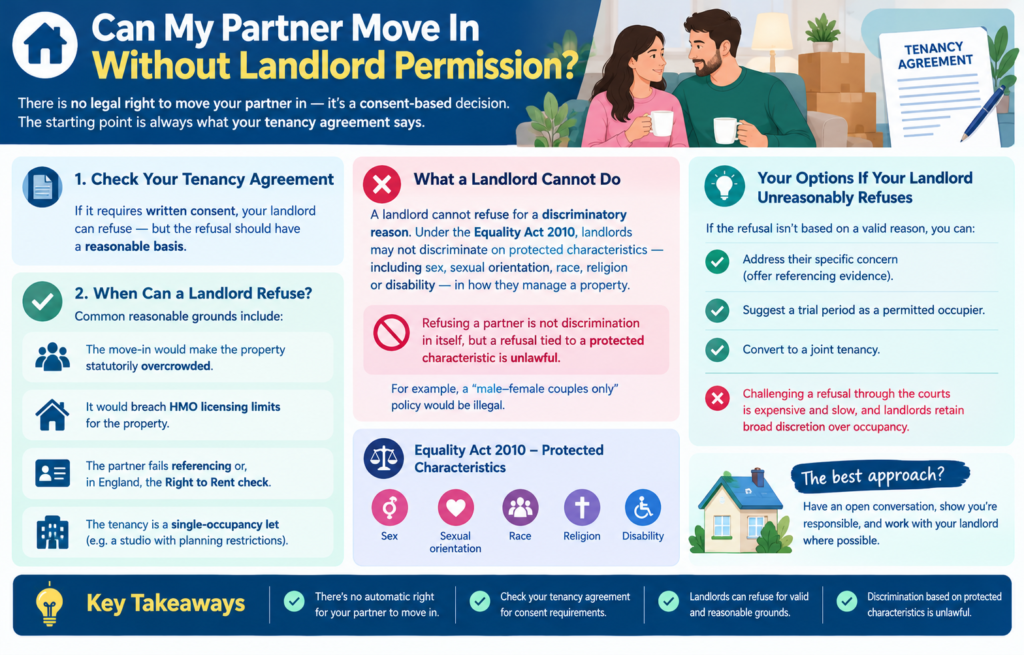
There is no legal right behind the question ‘can my partner move in?’ — it is a consent-based decision. The starting point is always what your tenancy agreement says. If it requires written consent, the landlord can refuse, but the refusal should have a reasonable basis. Common reasonable grounds include:
- The move-in would make the property statutorily overcrowded
- It would breach HMO licensing limits for the property
- The partner fails referencing or, in England, the Right to Rent check
- The tenancy is a single-occupancy let (e.g. a studio with planning restrictions)
What a landlord cannot do is refuse for a discriminatory reason. Under the Equality Act 2010, landlords may not discriminate on protected characteristics — including sex, sexual orientation, race, religion or disability — in how they manage a property. Refusing a partner is not discrimination in itself, but a refusal tied to a protected characteristic is: a “male–female couples only” policy, for example, would be unlawful.
If your landlord unreasonably refuses, your realistic options are to address their specific concern (offer referencing evidence, a trial period as a permitted occupier, or converting to a joint tenancy), or to accept it and look for a home that suits you both. Challenging a refusal through the courts is expensive and slow, and landlords retain broad discretion over occupancy.
Right to Rent Checks: Every Adult Moving In (England Only)
In England, your landlord or letting agent must check the immigration status of every adult aged 18 or over who will use the property as their only or main home — whether or not they are named on the tenancy agreement. That includes your partner as a permitted occupier. Anyone asking ‘can my partner move in?’ in England must make sure this check happens before they move.
| What | Detail |
|---|---|
| Who gets checked | Every adult (18+) moving in, named on the agreement or not |
| When | Before they move in — the check must happen first |
| How (from 1 October 2026) | Home Office online check, manual document check, or a digital check via a registered Right to Rent verification provider |
| Penalty for landlords who skip it | Up to £10,000 per occupier for a first breach; £20,000 per occupier for a repeat breach within 3 years |
This is one of the biggest 2026 changes in this area: a new Right to Rent Code of Practice took effect on 1 October 2026, updating how checks are done (including expanded use of eVisas and digital documents). If your landlord was relaxed about checks before, the new code is a reason they may now insist on paperwork for your partner. Right to Rent does not apply in Scotland, Wales or Northern Ireland. Our right to rent checks guide explains the documents your partner will need.
Can My Partner Move In as a Joint Tenant Instead?
So if ‘can my partner move in?’ is your question, there are two legal routes: as a permitted occupier (simpler, fewer rights for them) or as a joint tenant (full rights and full rent liability for both of you). Neither is automatically better — it depends on your relationship and finances.
Many people asking ‘can my partner move in?’ assume you can just add a name to the agreement. The key thing to know is that you cannot just write your partner’s name onto your existing agreement. Adding a joint tenant means creating a new tenancy — the standard route is a surrender and re-grant: your current tenancy ends on an agreed date and a brand-new agreement is granted to both of you.
In England, any new agreement granted now must be an assured periodic tenancy (fixed terms were abolished for new tenancies on 1 May 2026 under the Renters’ Rights Act 2025). Your landlord must also:
- Re-protect the deposit and re-serve the prescribed information within 30 days — because the parties to the tenancy have changed, this counts as a new deposit even if the money never moved
- Issue the current compliance documents (gas safety record, electrical safety certificate, EPC and a written statement of terms)
Under the Tenant Fees Act 2019, your landlord or agent may charge for a tenancy variation you requested — such as adding a joint tenant — but the charge is capped at £50 unless they can evidence higher reasonable costs with invoices.
Worked example — Gareth’s joint tenancy: Gareth rents a two-bedroom flat in Leeds for £950 a month. When his partner moves in as a joint tenant, the landlord ends the old agreement and grants a new one to both of them. The £1,096 deposit is re-protected within 30 days, the agent charges the £50 variation fee (not the £200 they first suggested — Gareth knew the cap), and both partners are now jointly liable for the full £950. If one of them stops paying, the landlord can pursue either of them for all of it.
For a detailed walkthrough of how joint tenancies work — including what happens when one person wants to leave — see our joint tenancy guide and the rules on ending a tenancy early.
Married or in a Civil Partnership: Your Extra Rights
If you are married or in a civil partnership, the law gives your partner significant extra protection in England and Wales:
- Home rights (Family Law Act 1996, s.30): if one spouse is the tenant, the other has a legal right to occupy the home. The tenant spouse cannot evict or exclude them without a court order — even if they are not named on the tenancy agreement.
- Succession (Housing Act 1988, s.17): if the sole tenant dies, the tenancy automatically passes to their spouse or civil partner, provided the spouse was living there as their only or principal home. Someone living with the tenant as if married is treated as a spouse for this purpose.
- One-succession rule: there is only one statutory succession per tenancy. If the tenant was already a successor, the right does not pass on again.
- On divorce: the court can transfer the tenancy from one spouse to the other as part of the settlement.
These rights apply whether or not your spouse is named on the agreement — but they work best when the landlord knows your partner lives there, which is another reason to notify them in writing.
Not Married? What Unmarried Partners Need to Know
For unmarried couples asking ‘can my partner move in?’, the honest position is this: if you are not married or in a civil partnership and your partner is not named on the tenancy agreement, your partner has no automatic legal right to stay in the property. The arrangement depends entirely on your tenancy continuing and your relationship continuing.
That does not mean you are powerless — it means you should plan:
- Consider a cohabitation agreement. This is a written agreement between you covering who pays what, how much notice either of you must give to leave, and what happens to shared belongings. Solicitors strongly recommend one before moving in together.
- On a break-up, the sole named tenant can ask their partner to leave. The partner cannot force their way back in through tenancy law (unlike a married spouse, who needs a court order to be excluded). They can ask the landlord for a new tenancy in their own name — the landlord does not have to agree.
- On death, an unmarried partner who lived with the tenant as if married does have the statutory succession right under s.17 (see above) — but only if the one-succession rule has not already been used up.
If you have children together, a parent can apply to the court for the right to stay in the property to care for the children, even without tenancy rights of their own.
The Money Impact: Benefits and Council Tax
Once you’ve worked out whether ‘can my partner move in?’ gets a legal yes, turn to the money — this is the section most guides skip, and it is where a partner moving in can cost (or save) you the most money. Before your partner moves in, work through all three:
Universal Credit: you must claim as a couple
If you live together as a couple, you must claim Universal Credit as a couple — married or not. If you both already claim UC, you must report the change and link your claims. Your partner’s earnings are then assessed jointly: earnings above the work allowance reduce your UC by 55p for every £1 earned. From April 2026, the work allowance is £427 a month if your claim includes help with housing costs, or £710 a month if it does not.
If your partner earns too much, your UC — including the housing element that helps with rent — can stop entirely. Housing help for private renters is capped at your Local Housing Allowance rate, so check what rate applies to your household before assuming your rent is covered.
Worked example — Imogen’s UC change: Imogen claims Universal Credit in Bristol, including £850 a month towards her £950 rent. Her partner moves in earning £1,400 a month. They must now claim as a couple. After the £427 work allowance, £973 of earnings counts — reducing their UC by 55% of £973, which is £535.15 a month. Their housing help drops sharply, and the £100 rent shortfall they used to manage becomes a £635 shortfall. They only discovered this after the move — checking first would have let them budget for it.
Housing Benefit: a partner is not a “non-dependant”
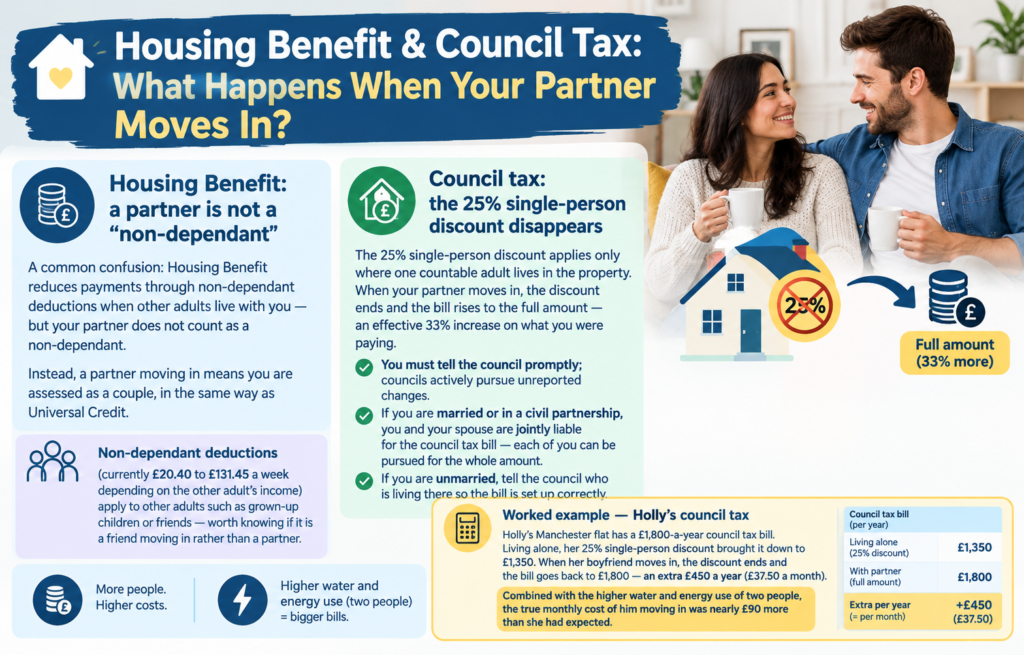
A common confusion: Housing Benefit reduces payments through non-dependant deductions when other adults live with you — but your partner does not count as a non-dependant. Instead, a partner moving in means you are assessed as a couple, in the same way as Universal Credit. Non-dependant deductions (currently £20.40 to £131.45 a week depending on the other adult’s income) apply to other adults such as grown-up children or friends — worth knowing if it is a friend moving in rather than a partner.
Council tax: the 25% single-person discount disappears
The 25% single-person discount applies only where one countable adult lives in the property. When your partner moves in, the discount ends and the bill rises to the full amount — an effective 33% increase on what you were paying. You must tell the council promptly; councils actively pursue unreported changes.
If you are married or in a civil partnership, you and your spouse are jointly liable for the council tax bill — each of you can be pursued for the whole amount. If you are unmarried, tell the council who is living there so the bill is set up correctly.
Worked example — Holly’s council tax: Holly’s Manchester flat has a £1,800-a-year council tax bill. Living alone, her 25% single-person discount brought it down to £1,350. When her boyfriend moves in, the discount ends and the bill goes back to £1,800 — an extra £450 a year (£37.50 a month). Combined with the higher water and energy use of two people, the true monthly cost of him moving in was nearly £90 more than she had expected.
Guests, Long Stays and Subletting: Where Is the Line?
Not everyone moving in is a partner — and the law draws lines between guests, occupiers and subtenants. Before you ask ‘can my partner move in?’, check which category applies:
| Guest | Permitted occupier (partner) | Subtenant | |
|---|---|---|---|
| Typical stay | A few nights | Lives there indefinitely | Lives there, pays the tenant rent |
| Landlord can forbid it | No — banning guests may be an unfair term | Needs landlord’s permission | Almost always needs written permission |
| Pays rent to anyone | No | No (to the landlord) | Yes — to the tenant |
| Legal rights | None | None independent of the tenant | Limited subtenancy rights |
Your landlord cannot stop you having friends or family stay over for a few nights — the property is your home, and a tenancy term banning guests may be an unfair term. But there is no fixed legal line for when a long-term “guest” becomes an occupier: it is a question of fact — how permanent the arrangement is, whether they receive post there, whether they contribute to costs. There is no ‘can my partner move in as a guest?’ loophole — if someone appears to be living at the property, your landlord is entitled to ask questions.
One thing to be careful about: if your partner starts paying you a fixed amount that looks like rent for exclusive use of part of the property, the arrangement can start to resemble a sublet — which needs written permission and is otherwise a breach. Keep it simple: one household, one rent payment from the named tenant. Our subletting guide explains the consent rules in full.
A final practical point: a partner moving in does not turn your home into an HMO — a cohabiting couple counts as a single household, and an HMO needs at least three people forming two or more households. And do tell your contents insurer about the additional occupant: undisclosed occupants can invalidate both tenant and landlord insurance policies.
The Rules in Scotland, Wales and Northern Ireland
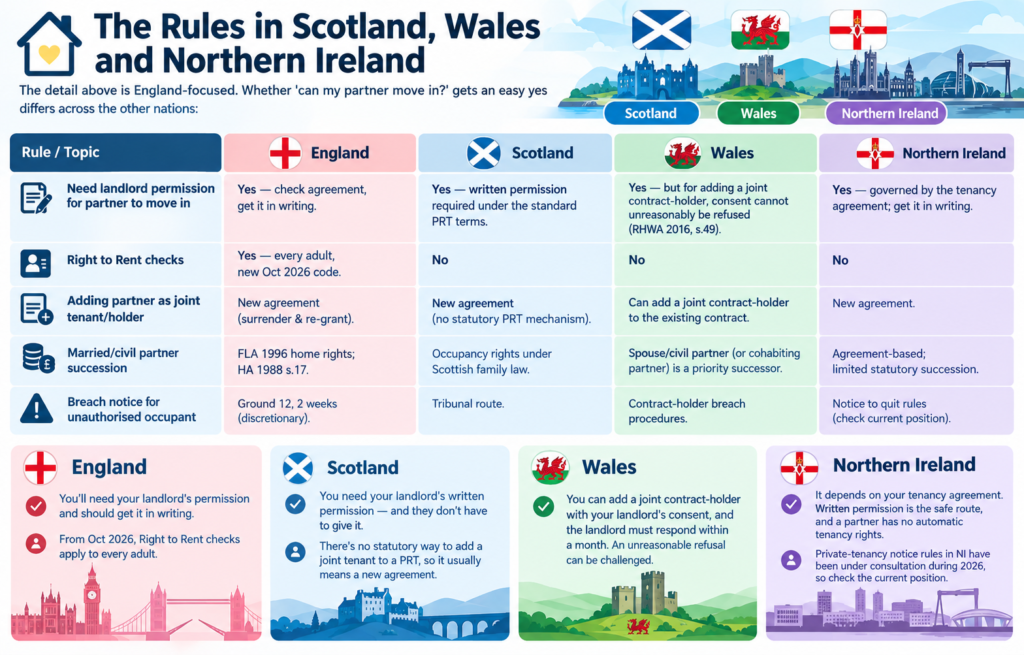
The detail above is England-focused. Whether ‘can my partner move in?’ gets an easy yes differs across the other nations:
| England | Scotland | Wales | Northern Ireland | |
|---|---|---|---|---|
| Need landlord permission for partner to move in | Yes — check agreement, get it in writing | Yes — written permission required under the standard PRT terms | Yes — but for adding a joint contract-holder, consent cannot unreasonably be refused (RHWA 2016, s.49) | Yes — governed by the tenancy agreement; get it in writing |
| Right to Rent checks | Yes — every adult, new Oct 2026 code | No | No | No |
| Adding partner as joint tenant/holder | New agreement (surrender & re-grant) | New agreement (no statutory PRT mechanism) | Can add a joint contract-holder to the existing contract | New agreement |
| Married/civil partner succession | FLA 1996 home rights; HA 1988 s.17 | Occupancy rights under Scottish family law | Spouse/civil partner (or cohabiting partner) is a priority successor | Agreement-based; limited statutory succession |
| Breach notice for unauthorised occupant | Ground 12, 2 weeks (discretionary) | Tribunal route | Contract-holder breach procedures | Notice to quit rules (check current position) |
If you’re asking ‘can my partner move in?’ in Wales, the answer is the friendliest in the UK: under the Renting Homes (Wales) Act 2016, a sole contract-holder can add a joint contract-holder with the landlord’s consent; the landlord must respond within a month, and an unreasonable refusal can be challenged. The new joint contract-holder gets full rights and obligations from the day they join.
Scotland: the standard Private Residential Tenancy terms require the landlord’s written permission before anyone else lives in the property as their only or main home — and the landlord does not have to give it. There is no statutory mechanism for adding a joint tenant to a PRT; in practice it means a new agreement.
Northern Ireland: occupancy is governed by your tenancy agreement — written permission is the safe route, and a partner has no automatic tenancy rights. In short, the answer to ‘can my partner move in?’ in Northern Ireland depends entirely on what your agreement says. Note that private-tenancy notice rules in NI have been under consultation during 2026, so check the current position before relying on notice periods.
Can My Partner Move In If the Landlord Says No?
A refusal is not the end of the road. Work through it in this order:
- Ask why, in writing. A vague “no” is hard to address; a specific concern (referencing, overcrowding, insurance) can be solved.
- Offer evidence. Provide your partner’s referencing, ID for the Right to Rent check, and proof of income. Many landlords refuse from caution, not principle.
- Propose a trial as a permitted occupier. A time-limited arrangement with a review date is easier for a nervous landlord to accept than an open-ended commitment.
- Offer a joint tenancy. Some landlords prefer this — it gives them two people liable for the rent instead of one.
- Know where you stand legally. If the refusal looks discriminatory (linked to a protected characteristic), that is unlawful — Citizens Advice or Shelter can advise. But a landlord acting on genuine, reasonable grounds is within their rights.
- Consider your options. If the answer is a firm no and your agreement requires consent, moving your partner in anyway risks a Ground 12 notice. Sometimes the right answer is a property that suits you both.
Can my partner move in without being on the tenancy agreement?
Usually yes, as a permitted occupier — but check your tenancy agreement first and get your landlord’s written permission before they move in. In England, your landlord must also complete a Right to Rent check on them. Your partner will have no independent tenancy rights and will not be liable for the rent.
Can my landlord refuse to let my partner move in?
There is no legal right for a partner to move in; the landlord’s consent is generally needed and they can refuse for reasonable grounds such as overcrowding, HMO licensing limits, or a failed Right to Rent check. They cannot refuse for discriminatory reasons linked to a protected characteristic under the Equality Act 2010.
What happens if I move my partner in without telling my landlord?
If your tenancy agreement requires consent, you are in breach of your tenancy. In England your landlord can serve a Ground 12 notice giving two weeks’ notice (the court must still agree possession is reasonable). It can also invalidate insurance policies and cause problems with benefits if the change is not reported.
Does my partner need a Right to Rent check?
In England, yes — every adult aged 18 or over who will use the property as their only or main home must be checked before moving in, even if they are not named on the tenancy agreement. A new Code of Practice has applied since 1 October 2026. Right to Rent does not apply in Scotland, Wales or Northern Ireland.
How do I add my partner to my tenancy agreement?
You cannot simply add a name to an existing agreement — adding a joint tenant means granting a new tenancy (usually by surrendering the old one and re-granting to both of you). In England, the deposit must be re-protected and the prescribed information re-served within 30 days, and any agent fee for the change is capped at £50. In Wales, a joint contract-holder can be added to the existing contract with the landlord’s consent.
Will my Universal Credit change if my partner moves in?
Yes — you must claim Universal Credit as a couple if you live together, married or not. Your partner’s earnings are assessed jointly, reducing your award by 55p for every £1 earned above the work allowance (£427 a month from April 2026 if your claim includes housing costs). Your housing help is capped at the Local Housing Allowance rate.
Will I lose my single-person council tax discount?
Yes — the 25% discount applies only where one countable adult lives in the property. When your partner moves in, the bill rises to the full amount (a 33% increase on what you were paying). You must tell the council. If you are married or in a civil partnership, you are jointly liable for the whole bill.
Does my partner get any rights if we’re not married?
An unmarried partner who is not named on the tenancy agreement has no automatic legal right to stay in the property. Consider a cohabitation agreement before moving in together. The main exception is on death: a partner who lived with the tenant as if married can inherit the tenancy under succession rules (subject to the one-succession rule).
What rights does my spouse have if they’re not on the tenancy?
In England and Wales, a married spouse or civil partner has “home rights” under the Family Law Act 1996 — they cannot be evicted or excluded without a court order — and can inherit the tenancy on the tenant’s death under succession rules. These rights apply even if they are not named on the agreement, as long as the landlord knows they live there.
Does my partner moving in make my home an HMO?
No — a cohabiting couple counts as a single household, and an HMO requires at least three people forming two or more households. However, your partner does count as an occupant for overcrowding calculations, so a very small property could still breach statutory overcrowding rules.
Can my landlord evict me for having overnight guests?
No — your landlord cannot stop you having friends or family stay over for a few nights, and a tenancy term banning guests may be an unfair term. But if a “guest” is effectively living at the property long-term, the landlord can treat them as an unauthorised occupier and act on the breach.
Do I need to tell my insurer my partner moved in?
Yes — tell your contents insurer (and make sure your landlord’s buildings insurer is informed) about any additional adult occupant. Undisclosed occupants can invalidate insurance policies, leaving you uncovered if something goes wrong.
Final Thoughts
Most partners move in without drama — but the ones who hit trouble almost always skipped one of three steps: checking the agreement, getting written permission, or doing the money maths on benefits and council tax. ‘Can my partner move in?’ is one of the most searched renting questions in the UK — and for most renters the answer is yes, provided you check the agreement, ask in writing and do the money maths. Get those three right and the rest is straightforward.
Before your partner moves in, it is worth running the numbers properly. Our rent affordability rules guide shows how to budget rent against two incomes, the council tax for renters guide explains discounts and liability in detail, and if money is already tight, the rent arrears guide sets out your options before problems start.
Further Reading
- GOV.UK – Private renting: your rights and responsibilities — the official overview of tenant rights in England.
- Shelter England – Living with your partner — detailed guidance on partners, tenancy rights and relationship breakdown.
- Citizens Advice – Renting a home — free advice on tenancy agreements, repairs and disputes.