

Elliot had lived happily in a three-bedroom flat in Manchester with his two mates for eighteen months. Then Sian, one of his housemates, announced she was moving to London next month. “Great news,” Elliot said. “You’ll just tell the landlord, right?” Sian assumed the tenancy would carry on smoothly for the two of them. The landlord assumed Sian would keep paying rent until the three of them sorted something out. Nobody was quite right. If you share a rental, this is the single most important thing to know: in England, one joint tenant’s notice to leave ends the entire tenancy for everyone. It was his first lesson in joint tenancy UK reality.
Quick answer: In a joint tenancy in England, any one joint tenant can end the whole tenancy for everyone by giving the landlord written notice — no one else’s permission is needed. Those who stay have no right to remain; they must agree a new tenancy with the landlord. The leaver keeps paying rent during the notice period, the deposit is not divisible, and guarantors can still be chased for the full debt. Wales, Scotland and Northern Ireland play by different rules, explained below.
Joint Tenancy UK: What Is It, Exactly?
A joint tenancy is a single tenancy agreement signed by two or more people who rent the same property together. You are not renting separate rooms — you are renting the whole home together as one legal unit, with one agreement between the landlord and all of you as a group. Everything is shared: the rent liability, the deposit protection, the notice periods and every obligation in the agreement. That is why one person leaving can shake the whole arrangement. This is the standard joint tenancy UK setup for sharers, couples and friends renting together.
What Does “Jointly and Severally Liable” Actually Mean?
Almost every joint tenancy agreement contains the phrase “jointly and severally liable” — the most important clause in your contract. It means each of you is individually responsible for the entire rent and every obligation in the agreement. If the rent is £1,500 a month and your housemate pays nothing, the landlord can legally demand the full £1,500 from you — not just “your” £750. Your private rent-split arrangement is invisible to the landlord — it does not bind them. In a joint tenancy UK, this clause is what makes housemates financially responsible for each other.
| What the landlord sees | Your private arrangement | Who can be chased? |
|---|---|---|
| One tenancy, £1,500 rent | Hugo pays £750, Ivy pays £750 | Either — for the full £1,500 |
| One tenancy, £3,000 arrears | “I only ever paid my half” | Any tenant — for the full £3,000 |
| One agreement, carpet damage | “Wren did it, not me” | Any tenant — for the repair cost |
This liability does not end when someone stops sleeping there. It ends when the tenancy ends, or when a new agreement no longer names them. A joint tenancy UK does not pause when someone moves out — it ends only when the tenancy itself ends.
Warning: “I only paid my share” is not a defence. If your housemate stops paying, the landlord can pursue you for the shortfall — and county court judgments can damage your credit history. Our guide on rent arrears explains how arrears escalate and what to do early.
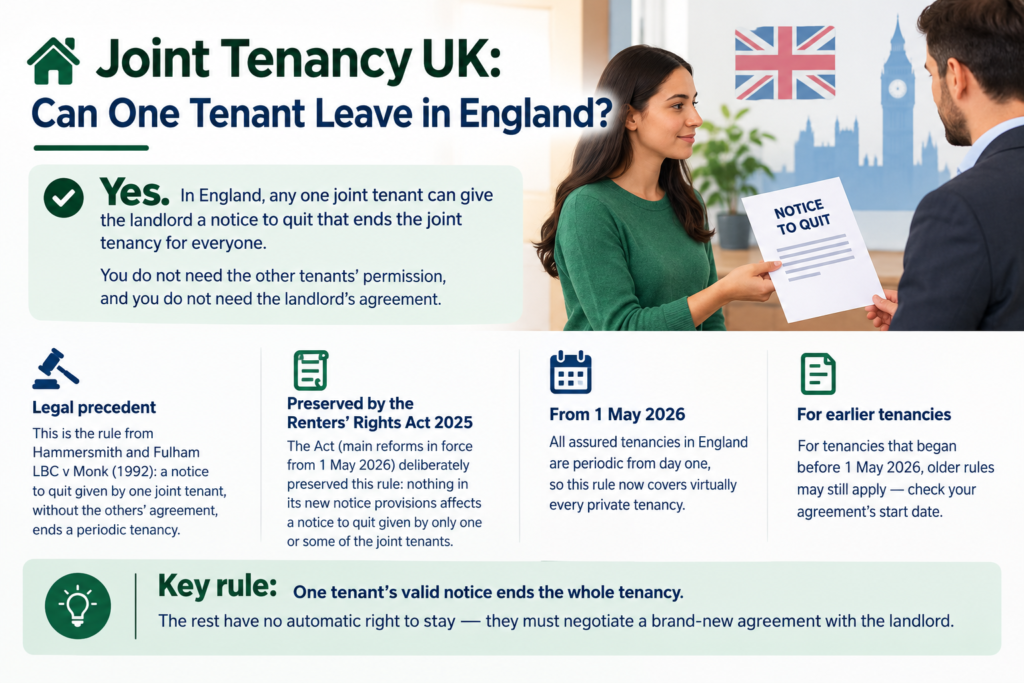
Joint Tenancy UK: Can One Tenant Leave in England?
Yes. In England, any one joint tenant can give the landlord a notice to quit that ends the joint tenancy for everyone. You do not need the other tenants’ permission, and you do not need the landlord’s agreement. No joint tenancy UK guide should skip this rule — it surprises almost everyone.
This is the rule from Hammersmith and Fulham LBC v Monk (1992): a notice to quit given by one joint tenant, without the others’ agreement, ends a periodic tenancy. The Renters’ Rights Act 2025 (main reforms in force from 1 May 2026) deliberately preserved this rule: nothing in its new notice provisions affects a notice to quit given by only one or some of the joint tenants. Every joint tenancy UK guide returns to this rule — it is the starting point for leaving.
Since 1 May 2026, all assured tenancies in England are periodic from day one, so this rule now covers virtually every private tenancy. For tenancies that began before 1 May 2026, older rules may still apply — check your agreement’s start date.
Key rule: One tenant’s valid notice ends the whole tenancy. The rest have no automatic right to stay — they must negotiate a brand-new agreement with the landlord.
How to Give a Valid Notice to Leave in England
Each requirement matters — get one wrong and the notice may not count, leaving you liable for more rent.
| Requirement | The rule |
|---|---|
| Length | 2 months max; the default is 2 months unless the landlord agreed a shorter period in writing. A shorter period binds a joint tenancy only if ALL joint tenants agreed to it. |
| In writing | Letter, email or text all count — the landlord cannot dictate the means. |
| Expiry date | Must expire on a rent-due day, or the day before. |
| Rent during notice | Keep paying throughout, even if you move out early (unless the landlord agrees otherwise in writing). |
So if your rent is due on the 1st of each month, your notice should expire on the 1st or the last day of the previous month. Send it in writing, keep proof of sending, and keep paying rent until the expiry date. For the full step-by-step mechanics, see our guide to ending your tenancy.
Tenancies that started before 1 May 2026 may still have fixed-term rules: a single tenant’s notice does not end a fixed term, a break clause normally needs all joint tenants, and a surrender is only effective if all agree.
What Happens to the Tenants Who Stay Behind?
When one joint tenant’s notice takes effect, the tenancy ends for everyone — including the tenants who wanted to stay. They do not inherit the property or “take over” the agreement. For the stayers, a joint tenancy UK ending this way means negotiating a fresh start with the landlord.
In practice, the landlord will usually offer the remaining tenants a new tenancy — with just them or with a replacement housemate added —, but it is a brand-new agreement: the rent may go up, new conditions such as a fresh guarantor or reference checks may apply, and a fee of up to £50 can be charged to change names (a permitted payment under the Tenant Fees Act 2019 in England). In short, the stayers don’t continue the old joint tenancy UK — they start a new one.
The landlord is not obliged to offer a new tenancy at all — and cannot do the opposite either: they cannot terminate only part of a joint tenancy at one tenant’s request. It is all or nothing.
If you’re the one staying: the moment you learn a housemate is giving notice, talk to the landlord immediately. Do not assume you can quietly carry on paying “your half” — without a new agreement, your legal right to be there has ended.
Joint Tenancy UK: What Happens to the Rent and Arrears?
During the notice period, the whole rent stays due from the joint tenants collectively — if the leaver stops paying their “share”, the rest must cover it. In a joint tenancy UK, the rent due during the notice period is collective, not split per person.
Old arrears don’t vanish: the landlord can pursue any former joint tenant for the full amount, including one who moved out months ago.
Worked example — Hugo and Ivy
Hugo and Ivy share a flat in Leeds at £1,500 a month, splitting it £750 each. In November, Ivy loses her job and pays nothing for two months. The landlord pursues them both for £3,000 of arrears. Hugo says, “I paid my £1,500.” The answer: under joint and several liability, Hugo is liable for the full £3,000. He pays the shortfall to protect his credit record, then has to chase Ivy privately.
The lesson: in a joint tenancy, your housemate’s financial problems become your financial problems. Before moving in with anyone, check whether you could cover the whole rent alone — our rent-to-income ratio calculator can help.
What Happens to the Deposit When One Tenant Leaves?
The deposit is not divisible while the tenancy it protects is still running — legally, it is one deposit protecting one tenancy, not “£600 each”. When the tenancy ends, and a new one is granted, there are two standard routes: That single-deposit logic applies to every joint tenancy UK, whatever the housemates agreed privately.
| Route | How it works | Watch out for |
|---|---|---|
| New tenancy, new deposit | Landlord returns the old deposit and protects a fresh one for the new tenancy | Protection deadlines apply to the new deposit |
| Replacement pays the leaver | The incoming tenant pays the departing tenant their share directly | A private arrangement — get it in writing |
Whichever route is used, the old deposit cannot simply be “split” while the old tenancy still exists. If you are sorting this out, read our full guide to tenancy deposit protection first.
Worked example — Rowan’s £1,800 deposit
Rowan shares a three-bed house in Bristol with two friends. The protected deposit is £1,800 — £600 each in practice. Rowan gives notice, the tenancy ends, and the landlord agrees a new tenancy with the two remaining friends plus newcomer Elsie. Two clean options: the landlord returns the £1,800 and protects a new £1,800 deposit; or Elsie pays Rowan £600 directly and the landlord re-protects the deposit in the new tenants’ names.

What Happens to the Guarantor?
A guarantor of one joint tenant can be pursued for the full rent and debts owed by any or all of the tenants — not just the tenant they agreed to back. Guarantors often miss this: backing one person in a joint tenancy UK can mean backing the whole rent.
When a new agreement is signed, the old guarantee does not automatically carry over — it depends on the wording. Guarantors should read the document, not assume.
Warning for guarantors: check the guarantee wording before signing anything new. A landlord who wants your guarantee to continue should put it in writing — and you can say no to guaranteeing a stranger.
How Do Council Tax, Bills and Universal Credit Change?
Joint tenants are jointly and severally liable for council tax, just as for rent — the council can pursue any one of them for the whole bill. Full-time students are “disregarded” and cannot be jointly liable. Council tax works the same in any joint tenancy UK: the bill is joint, whoever actually pays it.
| Situation | Council tax effect |
|---|---|
| Non-student housemate moves out, one adult remains | Tell the council — the remaining adult may get the 25% single-person discount from the move-out date |
| Student moves out, no students remain | The disregard ends; the bill is recalculated for the remaining adults |
| Everyone in the home is a full-time student | No council tax due |
| Property empty between tenancies | Liability reverts to the landlord |
Utility bills work the same way: joint tenants are jointly responsible to the supplier, so take final meter readings and sort account names on moving day.
Universal Credit and the “untidy tenancy”. UC normally splits the rent equally between joint tenants for the housing element. When a joint tenant leaves but remains named on the agreement, DWP calls this an “untidy tenancy” — and the remaining claimant may receive only their 50% share, even though they are legally liable for 100% of the rent. You can ask DWP to pay on the full rent if equal splitting would be unreasonable — but report the change of circumstances promptly.
Practical tip: the day a housemate leaves, do three things: (1) give the council the move-out date in writing, (2) photograph the final meter readings, (3) report the change to DWP if anyone claims Universal Credit. Admin delays cost real money.
Joint Tenancy UK: How to Leave Cleanly — A Checklist
- Check your tenancy start date and type. Post–1 May 2026 assured tenancies in England are periodic; older tenancies may have fixed-term rules.
- Talk to your housemates early. You don’t legally need their permission in England, but a surprise notice ends everyone’s home.
- Talk to the landlord about a new agreement for the stayers and whether a replacement tenant is welcome.
- Give written notice correctly — two months, expiring on or the day before a rent-due day, with proof of sending.
- Keep paying rent until the notice expires, even if you move out early.
- Clear any arrears and get written confirmation of a zero balance if possible.
- Sort the deposit in writing — landlord returns and re-protects it, or the replacement pays you directly.
- Hand back keys and photograph the property’s condition on your last day.
- Update the council, utilities and DWP with the move-out date, and tell your guarantor what happened.
Can You Withdraw a Notice Once You’ve Served It?
Yes — but only if everyone agrees, in writing. A served notice can be withdrawn before it takes effect, but the withdrawal needs the written agreement of the landlord and, for a joint tenancy, all of the tenants. One person can end the tenancy alone, but one person cannot un-send the ending alone. Withdrawing notice is one thing a joint tenancy UK does not let a single tenant do alone.
What If Your Housemate Won’t Pay Their Share?
The uncomfortable truth is that the landlord is not your referee:
- Talk first, in writing. Set out what is owed and by when — written records matter if this escalates.
- Do not withhold your own rent in protest. Your arrears are legally indistinguishable from theirs. (See our guide: can I withhold rent.)
- Pay the shortfall if you can, then recover it privately — a county court claim (e.g. Money Claims Online), keeping every message and bank statement as evidence.
Worked example — Jude’s exit
Jude shares a two-bed in Sheffield at £950 a month with his friend Caleb — £475 each in practice. Caleb stops paying his share in August and again in September: £950 of arrears. Jude pays the £950 shortfall himself to protect his own record, then serves a two-month written notice on 14 October, expiring 30 November (the day before the 1 December rent-due day). The tenancy ends for both of them. Jude stays liable for rent up to 30 November — £1,900 for October and November — but nothing after. He then pursues Caleb privately for the £950 he covered.
Break-Ups: When Couples Split in a Joint Tenancy
Couples who rent together are in a joint tenancy like any other sharers — but the stakes make the legal position harsher:
- Either partner can end the whole tenancy with a notice to quit in England, even if the other wants to stay — also the escape route for survivors of domestic abuse, since it ends rent liability too.
- Neither partner can force the other out mid-tenancy — that needs a court order or a genuine agreement.
- Married couples and civil partners have “home rights” under the Family Law Act 1996 to live in the family home, and neither can exclude the other without a court order.
If you are leaving because of abuse, Shelter and Citizens Advice have specialist guidance — and the notice-to-quit route means your rent liability can end with the tenancy. Do not stay in a dangerous situation because you fear the rent.
Can You Replace Yourself With a New Tenant?
Often, yes — with everyone’s agreement. Find a replacement, and the landlord agrees to a new tenancy naming the remaining tenants plus the newcomer: agreement from ALL joint tenants and the landlord, a NEW agreement naming everyone, and the deposit sorted (returned and re-protected, or the newcomer pays the leaver directly). The leaver is not responsible for rent under the new agreement — but can still owe arrears from the old one. The landlord may charge up to £50 to change the names. A replacement starts a brand-new joint tenancy UK — the old one still has to end properly first.
What you must not do is move a replacement in without the landlord’s agreement: the original leaver remains a tenant and remains liable for rent, while the newcomer has far fewer rights.
Assignment is an alternative: with the landlord’s consent, a tenant transfers their interest via a formal deed so the original tenancy continues untouched. For most sharers, the new-agreement route above is simpler.
Subletting is not the same thing. Letting someone live in your room while you stay on the tenancy is subletting, with its own rules and risks — see our guide on whether you can sublet your rented home.
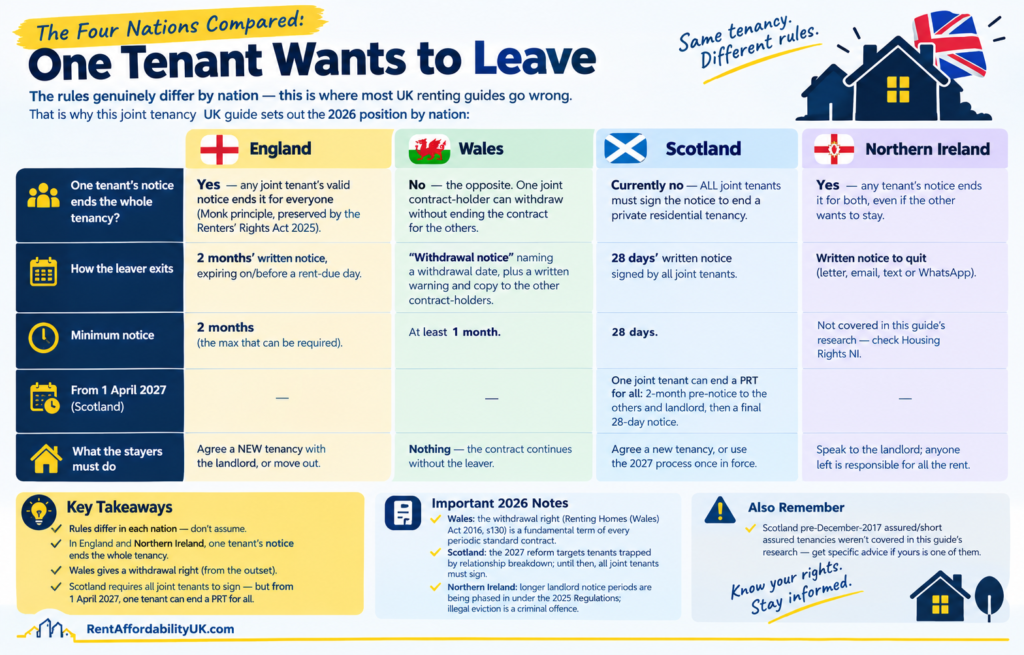
The Four Nations Compared: One Tenant Wants to Leave
The rules genuinely differ by nation — this is where most UK renting guides go wrong. That is why this joint tenancy UK guide sets out the 2026 position by nation:
| England | Wales | Scotland | Northern Ireland | |
|---|---|---|---|---|
| One tenant’s notice ends the whole tenancy? | Yes — any joint tenant’s valid notice ends it for everyone (Monk principle, preserved by the Renters’ Rights Act 2025) | No — the opposite. One joint contract-holder can withdraw without ending the contract for the others | Currently no — ALL joint tenants must sign the notice to end a private residential tenancy | Yes — any tenant’s notice ends it for both, even if the other wants to stay |
| How the leaver exits | 2 months’ written notice, expiring on/before a rent-due day | “Withdrawal notice” naming a withdrawal date, plus a written warning and copy to the other contract-holders | 28 days’ written notice signed by all joint tenants | Written notice to quit (letter, email, text or WhatsApp) |
| Minimum notice | 2 months (the max that can be required) | At least 1 month | 28 days | Not covered in this guide’s research — check Housing Rights NI |
| From 1 April 2027 (Scotland) | — | — | One joint tenant can end a PRT for all: 2-month pre-notice to the others and landlord, then a final 28-day notice | — |
| What the stayers must do | Agree a NEW tenancy with the landlord, or move out | Nothing — the contract continues without the leaver | Agree a new tenancy, or use the 2027 process once in force | Speak to the landlord; anyone left is responsible for all the rent |
Wales: the withdrawal right (Renting Homes (Wales) Act 2016, s130) is a fundamental term of every periodic standard contract. Scotland: the 2027 reform targets tenants trapped by relationship breakdown; until then, all joint tenants must sign. Northern Ireland: longer landlord notice periods are being phased in under the 2025 Regulations; illegal eviction is a criminal offence. (Scotland pre-December-2017 assured/short assured tenancies weren’t covered in this guide’s research — get specific advice if yours is one.)
What NOT to Do: The Risks of Just Moving Out
The single biggest mistake is moving out without serving notice — assuming that leaving ends your responsibility. It does not: the tenancy continues, and so does the liability. Moving out silently is the classic joint tenancy UK trap: the tenancy — and the liability — carries on.
| The mistake | What actually happens |
|---|---|
| Moving out without notice, stopping rent | You remain a joint tenant; arrears build in your name; the landlord can pursue you for the full rent |
| A “private deal” with housemates that you’re out | Private deals don’t bind the landlord — you’re still liable until the tenancy ends or is replaced |
| Letting a friend move into your room informally | You’re still the tenant and still liable; the friend has few rights |
| Withholding rent to pressure a non-paying housemate | Your arrears are legally the same debt — you damage your own position |
| Assuming the deposit comes back automatically | It is not divisible mid-tenancy; it must be formally returned or re-protected |
Unpaid rent can lead to formal eviction proceedings against all joint tenants — including a Section 8 notice for arrears. Illegal eviction is never the landlord’s lawful route — only a court can end a tenancy.
FAQs
Can one person end a joint tenancy in the UK?
In England, yes — one joint tenant’s valid notice ends the whole tenancy for everyone. Northern Ireland is similar. Wales is the opposite: one joint contract-holder can withdraw without ending the contract for the others. In Scotland, all joint tenants must currently sign, though a 1 April 2027 reform will let one tenant end a private residential tenancy for all.
How much notice does a joint tenant have to give in England?
Two months — the default and the maximum that can be required. It must be in writing and expire on a rent-due day or the day before.
Do the other tenants have to agree before I give notice?
In England, no — the Monk principle, explicitly preserved by the Renters’ Rights Act 2025. In Scotland, currently yes: all joint tenants must sign.
Can my housemate’s unpaid rent become my problem?
Yes. Under joint and several liability, each tenant is individually liable for the whole rent, and your private agreement to split it does not bind the landlord.
What happens to our deposit when one of us leaves?
It is not divisible mid-tenancy. When a new tenancy is granted, the landlord should return the old deposit and protect a new one, or the replacement tenant pays the leaver their share directly. Get it in writing.
Am I still liable for rent if I move out but don’t give notice?
Yes. Moving out does not end a joint tenancy — only a valid notice, a surrender agreed by all tenants, or a new agreement does.
Can I get my name taken off a joint tenancy without ending it?
In England, there is no unilateral “name removal”. Either serve notice ending the whole tenancy (with a new agreement for the stayers), or get all tenants and the landlord to agree a new tenancy or an assignment. In Wales, a joint contract-holder can withdraw individually.
What happens to my guarantor when I leave a joint tenancy?
A guarantor of a joint tenant can be pursued for the full rent and debts of any or all tenants. A new agreement does not automatically carry the old guarantee over — check the wording and get any continuation or ending in writing.
Can I withdraw a notice to quit after serving it?
Only with everyone’s written agreement — the landlord’s and, for a joint tenancy, all tenants’. One tenant can end the tenancy alone but cannot un-send the ending alone.
How does leaving affect Universal Credit housing help?
UC normally splits rent equally between joint tenants. If a leaver stays named on the agreement (an “untidy tenancy”), the remaining claimant may get only their 50% share despite being liable for all the rent. Ask DWP to use the full rent if equal splitting would be unreasonable, and report the change promptly.
What should I do if my partner and I split up but share a tenancy?
Either of you can end the whole tenancy with a notice to quit in England — also the escape route for survivors of domestic abuse, since it ends rent liability too. Neither partner can force the other out mid-tenancy; that needs a court order or agreement. Married couples and civil partners have extra “home rights”. Get advice from Shelter or Citizens Advice first.
Does the 2-month notice rule apply in Scotland, Wales and Northern Ireland?
No — it is an England rule. Wales uses a minimum 1-month withdrawal notice; Scotland currently requires 28 days signed by all joint tenants; Northern Ireland tenant notice periods were not covered in this guide’s research, so check Housing Rights NI before acting.
Final Thoughts
A joint tenancy is a team sport with team liability: one signature ends the game for everyone, one missing rent payment lands on everyone’s shoulders, and one deposit cannot be sliced up mid-match. The tenants who come through housemate changes unscathed act early — proper written notice, talking to the landlord before positions harden, and every new arrangement documented. Remember that the next time a joint tenancy UK agreement lands in your inbox.
Before you sign your next joint tenancy, be honest about the maths. Could you cover the full rent alone for a month or two if a housemate stopped paying? Check what is genuinely affordable with our rent affordability rules guide and the rent-to-income ratio calculator — because in a joint tenancy, “your share” is a private hope, and the full rent is your legal reality.