

When Victor reported damp spreading across his bedroom wall, his letting agent promised to “chase the landlord” — fourteen times, over four months. Each time the reply was a variation on “we’re looking into it.” The mould kept growing, Victor’s shirts started smelling of it, and nobody ever chased anything. When he finally asked how to make a formal complaint, the agent went quiet for three weeks. Like Victor, you have every right to learn how to complain about a letting agent — and this guide shows you how.
Victor assumed he had no real options: the agent worked for the landlord, not for him. He was wrong. Every letting agent in England must belong to a government-approved redress scheme; those schemes can order agents to pay compensation of up to £25,000, and in 2024 they awarded £1.49 million to consumers — with 71% of fully investigated cases decided in the consumer’s favour.
This guide explains how to complain about a letting agent the right way — the full complaint ladder: complaining to the agent, when to escalate to the redress scheme, what compensation you can get, where banned fees and missing money go instead, and the different systems in Scotland, Wales and Northern Ireland.
Quick answer: Complain to the letting agent in writing first (use the word “complaint”) and ask for their complaints procedure. If they don’t resolve it within 8 weeks or you reject their final response, escalate free to their redress scheme — The Property Ombudsman or the Property Redress Scheme. You have 12 months from the agent’s final response to do this. The scheme can order an apology, corrective action and compensation of up to £25,000. Banned fees go to Trading Standards instead, and missing client money goes to the Client Money Protection scheme.
Rules differ between England, Scotland, Wales and Northern Ireland. This guide reflects the position as of October 2026 and is general information, not legal advice.
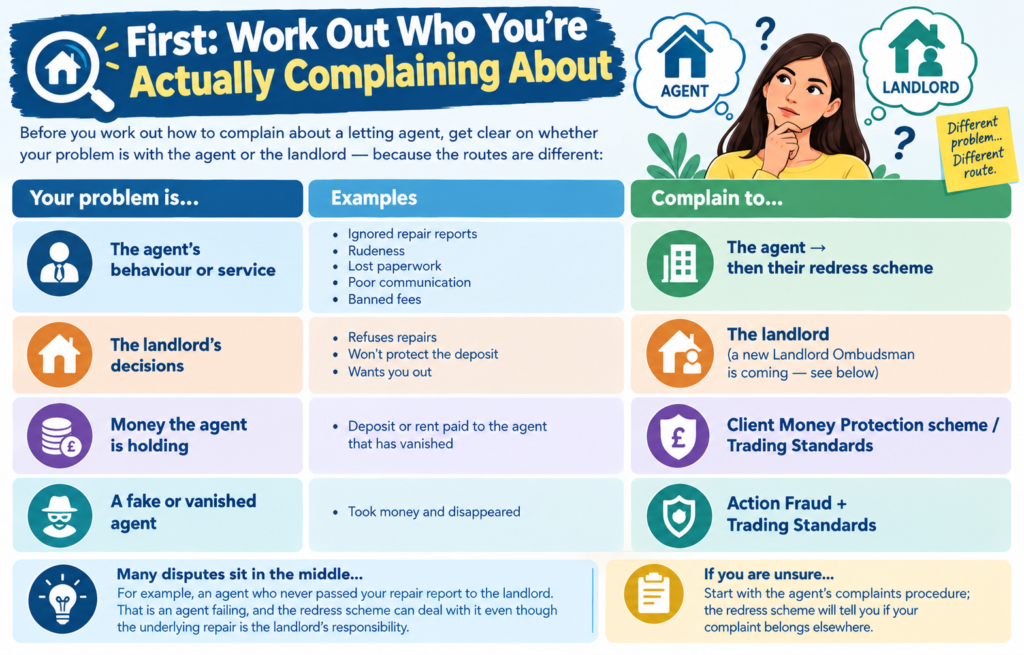
First: Work Out Who You’re Actually Complaining About
Before you work out how to complain about a letting agent, get clear on whether your problem is with the agent or the landlord — because the routes are different:
| Your problem is… | Examples | Complain to… |
|---|---|---|
| The agent’s behaviour or service | Ignored repair reports, rudeness, lost paperwork, poor communication, banned fees | The agent → then their redress scheme |
| The landlord’s decisions | Refuses repairs, won’t protect the deposit, wants you out | The landlord (a new Landlord Ombudsman is coming — see below) |
| Money the agent is holding | Deposit or rent paid to the agent that has vanished | Client Money Protection scheme / Trading Standards |
| A fake or vanished agent | Took money and disappeared | Action Fraud + Trading Standards |
Many disputes sit in the middle — for example, an agent who never passed your repair report to the landlord. That is an agent failing, and the redress scheme can deal with it even though the underlying repair is the landlord’s responsibility. If you are unsure, start with the agent’s complaints procedure; the redress scheme will tell you if your complaint belongs elsewhere.
Step 1: Complain to the Agent in Writing
Every agent must operate a written in-house complaints procedure — ask for a copy if they have not given you one. When you’re working out how to complain about a letting agent in writing, make the letter count:
- Use the word “complaint” explicitly — “I am making a formal complaint” — so it enters their official process rather than being treated as a casual grumble.
- Set out the facts with dates: what went wrong, when, and who you dealt with.
- Say what you want: an apology, a specific action, or a specific sum of money.
- Attach your evidence: emails, texts, photos, receipts (see the evidence checklist below).
- Send it to a senior person or head office, keep copies of everything, and note the date you sent it.
If the first response is inadequate, escalate internally — part of knowing how to complain about a letting agent is refusing to accept the first brush-off. Most agents have a two-stage process ending with a final viewpoint letter (sometimes called a deadlock letter). That letter is your ticket to the next stage: once you have it, or once 8 weeks have passed since your original written complaint, you can go to the redress scheme.
Do not skip this step. The redress schemes will not accept your complaint until you have given the agent a chance to resolve it first — either through their final response or the 8-week window.
Evidence checklist
Gather these before you escalate — strong complaints are won on paperwork:
- Every written communication (emails, texts, portal messages) in date order
- A short dated timeline of what happened
- Dated photographs of any property issues
- Receipts or bank statements for any costs you incurred
- Your tenancy agreement
- The agent’s complaints procedure and their final viewpoint letter
Step 2: Escalate to the Redress Scheme (Free)
If you’re unsure how to complain about a letting agent directly, the law gives you a free escalation route. Since 1 October 2014, every letting agent and property manager in England must by law belong to a government-approved redress scheme. There are two:
| The Property Ombudsman (TPO) | Property Redress Scheme (PRS) | |
|---|---|---|
| Size | The larger scheme — ~19,500 offices registered | Smaller, growing fast |
| Process | Investigation and formal decision | Tries negotiated resolution first (~50% settle early), then a formal decision |
| Max award | £25,000 | £25,000 |
| 2024 volume | 73,035 consumer contacts (+27%) | 2,861 complaint enquiries (+20%) |
| 2024 awards | £1.49m total (£511,583 in lettings) | £1.68m combined |
When you’re learning how to complain about a letting agent, start with this: your agent must tell you which scheme they belong to — and must display the scheme’s name in their office and on their website. If they refuse to say, both schemes have online member checkers. A council can fine an agent up to £5,000 just for not belonging to a scheme.
The process once you complain:
- Submit online on the scheme’s website, attaching your complaint letters and the agent’s final response.
- Deadline: with TPO, you must complain within 12 months of the date of the agent’s final viewpoint letter — miss it and your complaint will normally be rejected.
- The scheme investigates on paper, taking evidence from both sides.
- You get a decision. If you accept it, the agent is bound by it and must pay any award (usually within 28 days). If you reject it, the decision lapses and you keep every other legal route, including court.
That last point is widely misunderstood: the decision binds the agent if you accept it — it does not bind you unless you choose to accept. Accepting is full and final settlement of that complaint.
Worked example — Victor’s complaint: Once the 8-week window passed with no resolution, Victor submitted his damp-report timeline to The Property Ombudsman: 14 dated emails, photos of the mould, and the agent’s non-existent complaints procedure. The Ombudsman found the agent had failed to pass on his reports or follow its own process, ordered a written apology, and awarded Victor £450 for distress and inconvenience plus £80 for the dehumidifier he had bought himself. The agent paid within 28 days. TPO’s published figures show awards for distress and inconvenience are typically modest (£50–£500), but awards for real financial loss can run far higher — its highest 2023 award was £23,850.
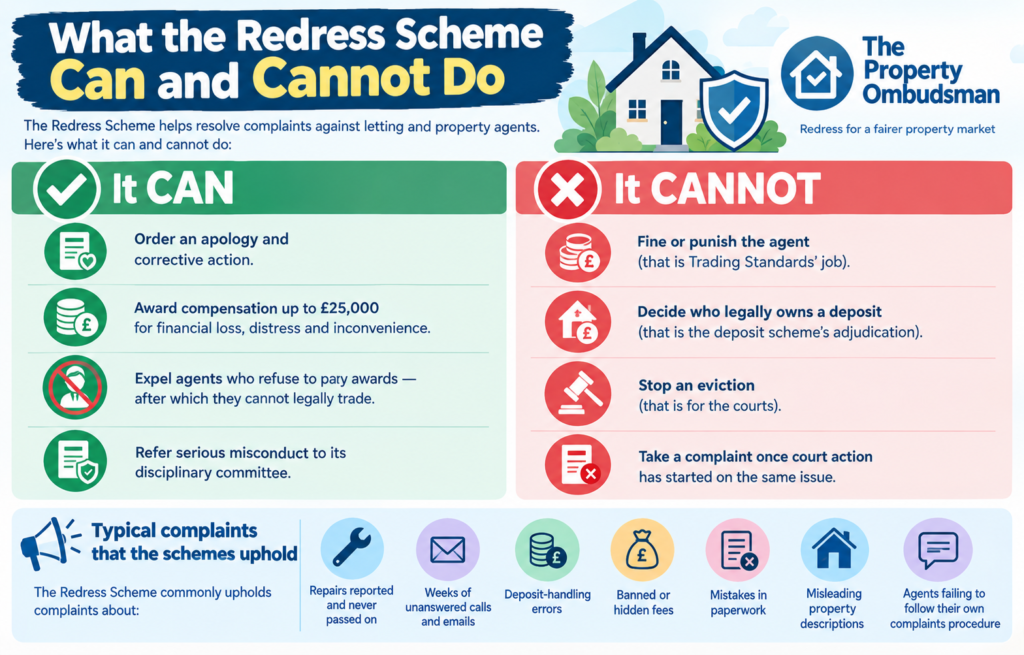
What the Redress Scheme Can and Cannot Do
| It CAN | It CANNOT |
|---|---|
| Order an apology and corrective action | Fine or punish the agent (that is Trading Standards’ job) |
| Award compensation up to £25,000 for financial loss, distress and inconvenience | Decide who legally owns a deposit (that is the deposit scheme’s adjudication) |
| Expel agents who refuse to pay awards — after which they cannot legally trade | Stop an eviction (that is for the courts) |
| Refer serious misconduct to its disciplinary committee | Take a complaint once court action has started on the same issue |
Typical complaints the schemes uphold include: repairs reported and never passed on, weeks of unanswered calls and emails, deposit-handling errors, banned or hidden fees, mistakes in paperwork, misleading property descriptions, and agents failing to follow their own complaints procedure.
How to Complain About a Letting Agent’s Banned Fees: Report to Trading Standards
If you need to know how to complain about a letting agent’s fees — an admin fee, renewal fee, referencing fee, or any charge that is not on the short list of permitted payments — the enforcement route is different. Under the Tenant Fees Act 2019:
- Report the agent to your council’s Trading Standards team (via the Citizens Advice consumer service, which routes reports to them).
- The council can impose a civil penalty of up to £5,000 for a first breach and up to £30,000 for a second or subsequent breach within 5 years.
- You can also apply to the First-tier Tribunal to recover the banned payment plus interest.
Watch out for a common confusion — including on some agent websites. The £40,000 penalty figure you may see belongs to the Renters’ Rights Act 2025, not the Tenant Fees Act:
| Law | Offence | Maximum penalty |
|---|---|---|
| Tenant Fees Act 2019 | Banned fee, first breach | £5,000 |
| Tenant Fees Act 2019 | Banned fee, repeat breach within 5 years | £30,000 |
| Renters’ Rights Act 2025 | Breach of PRS Database / specified RRA offences | £40,000 |
| Redress scheme rules | Agent not in a redress scheme | £5,000 (council fine) |
| Client Money Protection rules | Agent not in a CMP scheme | £30,000 |
Since 1 May 2026, the Renters’ Rights Act has also made pre-tenancy rent payments a banned payment and capped rent in advance at one month — so “six months’ rent upfront” demands are now in Trading Standards territory too. Our letting agent fees guide lists exactly which payments are banned and which are still allowed.
Worked example — Naomi’s banned fee: Naomi’s agent charged her a £250 “tenancy renewal admin fee” when her fixed term ended — a prohibited payment under the Tenant Fees Act. She reported it to Trading Standards and applied to the First-tier Tribunal, which ordered the agent to repay the £250 plus interest. The council separately fined the agent £5,000. One report protected Naomi and every future tenant that agent deals with.
Your Money Is Missing? Client Money Protection
If the agent is holding your money — rent you paid in advance, a deposit, or funds that should have been passed to the landlord — and you’re working out how to complain about a letting agent that won’t pay up: since 1 April 2019, every property agent in England that handles client money must by law:
- Belong to an approved Client Money Protection (CMP) scheme
- Hold client money in a separate, ring-fenced client account
- Display their CMP certificate in the office and on their website
A council can fine an agent up to £30,000 for not belonging to a CMP scheme, and up to £5,000 for not displaying the certificate.
To claim: apply to the CMP scheme (details on the agent’s certificate or website) within 12 months of the scheme being notified of the problem. You do not need to prove fraud — just evidence that you were not paid money you were legally entitled to, such as your tenancy agreement, deposit certificate and bank statements. And your cover runs for the whole period of the agent’s membership: if the money went missing while they were a member, you are covered even if they have since left.
One reassurance on deposits specifically: if your deposit is in a custodial deposit scheme, the scheme itself holds the money — an agent going bust does not touch it. Our deposit protection guide explains how to check yours in minutes.
Worked example — Dominic’s missing rent: Dominic paid £950 rent a month in advance to his agent. Two weeks later the agency’s office was empty and the phone disconnected. Because the agent had belonged to a CMP scheme when the money was taken, Dominic claimed through the scheme with his tenancy agreement and bank statement — and recovered the full £950 without having to prove what the agent did with it.
The New Landlord Ombudsman (2026): What It Is — and Isn’t
You may have seen headlines about a new ombudsman under the Renters’ Rights Act 2025. Here is the crucial detail most summaries bury: the new Private Rented Sector Ombudsman will cover landlords only — not letting agents.
- Confirmed by ministerial statement: the scheme fills the gap “specifically where the responsibility for an issue lies with the landlord rather than the agent.”
- TPO and the PRS continue to handle agent complaints — nothing changes there.
- Membership is expected to become mandatory for landlords from 2028, with compensation of up to £25,000 — deliberately aligned with the agent schemes.
- As of October 2026, the scheme is not yet operational — further regulations are still needed.
So for now: agent problem → TPO/PRS. Landlord problem → complain to the landlord, then the council or court as appropriate — and watch for the new ombudsman launching. Our Renters’ Rights Act guide tracks the rollout as each phase goes live.
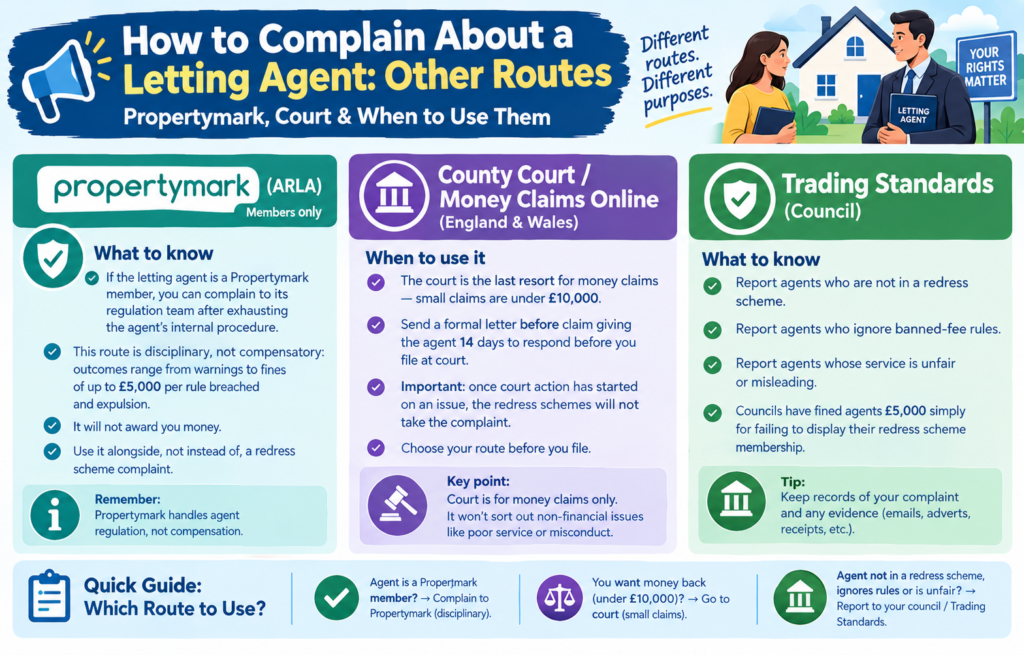
How to Complain About a Letting Agent: Other Routes — Propertymark, Court & When to Use Them
Propertymark (ARLA) — members only. If you’re working out how to complain about a letting agent that is a Propertymark member, you can complain to its regulation team after exhausting the agent’s internal procedure. Be aware this route is disciplinary, not compensatory: outcomes range from warnings to fines of up to £5,000 per rule breached and expulsion — but it will not award you money. Use it alongside, not instead of, a redress scheme complaint.
County court / Money Claims Online (England & Wales). If you’re weighing up how to complain about a letting agent through court rather than the ombudsman, know that court is the last resort for money claims — small claims are claims under £10,000. Send a formal letter before claim, giving the agent 14 days to respond before you file. Important: once court action has started on an issue, the redress schemes will not take the complaint — so choose your route before you file.
Trading Standards (council). Another route for how to complain about a letting agent: report agents who are not in a redress scheme, who ignore banned-fee rules, or whose service is unfair. Councils have fined agents £5,000 simply for failing to display their redress scheme membership.
How to Complain About a Letting Agent With No Scheme — or One That Has Vanished
Part of knowing how to complain about a letting agent is knowing what to do when they dodge the rules entirely: if your agent is not a member of either redress scheme, they are breaking the law — report them to Trading Standards. Check Companies House (free) for the company’s trading history and registered details.
If it is outright fraud — a fake agent who took your money and disappeared — treat it as a crime: report to Action Fraud for a police crime reference number, and read our rental scams guide on fake listings, Land Registry checks and getting money back. Never pay money before viewing a property with the agent or landlord, and never hand over cash without a tenancy agreement and receipts.
How to Complain About a Letting Agent in Scotland, Wales and Northern Ireland
The systems above are England-focused. The other nations run their own regimes:
| England | Scotland | Wales | Northern Ireland | |
|---|---|---|---|---|
| Agent redress route | TPO or PRS (mandatory since 2014) | First-tier Tribunal (Housing and Property Chamber) — free | Redress scheme via Rent Smart Wales licence conditions | No mandatory scheme — TPO covers NI agents voluntarily |
| Agent regulation | Redress + CMP membership | Mandatory register + statutory Code of Practice | Rent Smart Wales licensing (training + fit-and-proper) | None specific to agents |
| Key penalty | £5,000 (no redress membership) | £50,000 / 6 months’ prison for unregistered agency work | Licence revocation | Trading Standards enforcement |
| Tenant fees | Banned (TFA 2019) | Banned | Banned since 1 Sept 2019 | Check current position |
If you need to know how to complain about a letting agent in Scotland, the good news is it has the toughest agent regime in the UK: letting agents must be on the mandatory register, follow the statutory Letting Agent Code of Practice, and tenants complain free to the First-tier Tribunal, which can issue enforcement orders and award compensation. Doing letting-agency work unregistered is a criminal offence carrying up to £50,000 and six months’ imprisonment. Cite the Code’s paragraph numbers in your complaint to the agent first.
For how to complain about a letting agent in Wales: anyone doing letting or management work must hold a Rent Smart Wales licence (approved training, fit-and-proper test), and licence conditions require redress-scheme membership, client money protection and a written complaints procedure. Tenant fees have been banned since 1 September 2019.
If you’re wondering how to complain about a letting agent in Northern Ireland, note it has no mandatory redress scheme or agent register — a reform proposal exists but is not law. Routes are the agent’s voluntary scheme membership (TPO covers NI), Trading Standards via Consumerline, free advice from Housing Rights, or the county court.
How do I complain about a letting agent?
To complain about a letting agent, start by complaining to the agent in writing, using the word complaint, and ask for their complaints procedure. If they do not resolve it within 8 weeks or you reject their final response, escalate free to their redress scheme — The Property Ombudsman or the Property Redress Scheme — within 12 months of the final response.
Do letting agents have to belong to an ombudsman scheme?
Yes — since 1 October 2014, every letting agent and property manager in England must by law belong to a government-approved redress scheme (The Property Ombudsman or the Property Redress Scheme). Councils can fine agents up to £5,000 for not belonging to one.
What can the Property Ombudsman do?
The Ombudsman can order an apology, require the agent to put things right, and award compensation of up to £25,000 for financial loss, distress and inconvenience. It cannot fine or punish the agent — that is Trading Standards’ job. Its decision binds the agent only if you accept it.
How long do I have to complain to the ombudsman?
For The Property Ombudsman, you must complain within 12 months of the date of the agent’s final viewpoint letter. You can escalate once you have that letter or once 8 weeks have passed since your original written complaint — whichever comes first.
How much compensation can I get from a letting agent complaint?
Redress schemes can award up to £25,000. Awards for distress and inconvenience alone are typically modest (£50–£500), but awards for real financial loss can be much higher — The Property Ombudsman’s highest 2023 award was £23,850, and its average lettings award is around £500.
Where do I report a letting agent charging banned fees?
Report them to your council’s Trading Standards team (via the Citizens Advice consumer service). Councils can fine agents up to £5,000 for a first Tenant Fees Act breach and up to £30,000 for repeat breaches. You can also apply to the First-tier Tribunal to recover the banned payment plus interest.
What is the fine for charging tenant fees illegally?
Under the Tenant Fees Act 2019, the penalty is up to £5,000 for a first breach and up to £30,000 for a second or subsequent breach within 5 years. The £40,000 figure sometimes quoted belongs to the Renters’ Rights Act 2025, which covers different offences.
What happens if my letting agent goes bust with my money?
Claim through the agent’s Client Money Protection scheme — membership has been mandatory in England since 1 April 2019. Apply within 12 months of the scheme being notified, with your tenancy agreement and bank statements. You do not need to prove fraud. Deposits held in custodial deposit schemes are safe regardless.
Does the new Renters’ Rights Act ombudsman cover letting agents?
No — the new Private Rented Sector Ombudsman will cover landlords only, not letting agents. The Property Ombudsman and Property Redress Scheme continue to handle agent complaints. The new scheme is expected to become mandatory for landlords from 2028 and is not yet operational.
Can I complain about a letting agent in Scotland?
Yes — Scotland has its own system. Letting agents must be on the mandatory register and follow the statutory Code of Practice. Complain to the agent citing the Code, then apply free to the First-tier Tribunal for Scotland (Housing and Property Chamber), which can issue enforcement orders and award compensation.
What if my letting agent isn’t in a redress scheme?
They are breaking the law — report them to Trading Standards, who can fine them up to £5,000. Check Companies House for their trading history. If they took your money fraudulently, report to Action Fraud for a police crime reference number.
Should I go to court or the ombudsman about my letting agent?
Try the redress scheme first — it is free, and you keep your right to go to court if you reject its decision. Once court action has started on an issue, the schemes will not take the complaint, so choose before you file. For money claims under £10,000, the small claims track via Money Claims Online is the usual court route, starting with a 14-day letter before claim.
Final Thoughts
Victor’s story ended well because he followed the right steps for how to complain about a letting agent: he complained in writing, he kept every email, and he escalated when the 8 weeks ran out. Most agent complaints that fail do so for the opposite reasons — a phone call nobody recorded, no written complaint, and giving up before the redress scheme stage.
If you’re wondering how to complain about a letting agent, remember the ladder: written complaint → final response or 8 weeks → redress scheme (within 12 months) → decision you can accept or reject. Banned fees go to Trading Standards, missing money goes to Client Money Protection, and landlord problems will soon have their own ombudsman. If repairs are at the heart of your dispute, our landlord repairs guide sets out what your landlord must fix and how fast — useful ammunition for any complaint.
Further Reading
- GOV.UK – Which government-approved redress scheme does your letting agent belong to? — the official guidance on agents’ redress duties.
- Shelter England – Letting agent redress schemes — how the schemes work and how to use them.
- Citizens Advice – Renting a home — free advice on tenancy problems and where to report them.