
Nia picked up the keys to her one-bedroom flat in Birmingham one afternoon. The agent handed her a thick document, pointed at the last page and said, “Just sign here — it’s only a formality.” She was running late, so she signed. Eighteen months later, £650 of claims landed on her £1,269.23 deposit — “deep cleaning”, “wall marks” and a carpet stain she was sure had been there all along. At the dispute, the adjudicator asked the one question she could not answer: what did the flat look like when you moved in? The document she had signed unread was her inventory — and she had agreed to a version of her flat that was not quite hers.
A tenancy inventory is the single most important document in any deposit dispute. It is not the most exciting part of moving house, but it is the one that decides who keeps your money. This guide explains exactly what a tenancy inventory is, how check-in and check-out reports work, what to photograph, what to do when there is no inventory at all, and how to use all of it to protect your deposit.
Quick Answer: A tenancy inventory is a detailed written record of a property’s condition and contents at the start of a tenancy, usually paired with check-in and check-out reports and dated photographs. It is not legally required in England or Wales, but deposit scheme adjudicators decide disputes on evidence — and the inventory is the evidence that matters most. Without a signed, accurate inventory, a landlord struggles to justify deductions, and without your own records you struggle to challenge them. Always check the inventory before you sign it, photograph everything, and keep a copy.
What Is a Tenancy Inventory — and How Does It Differ From a Check-In Report?
Strictly speaking, an inventory is a list of a property’s items — furniture, appliances, fittings and fixtures — with each one’s condition described. In practice, the word is used loosely: most agents use “inventory”, “schedule of condition” and “check-in report” interchangeably, and adjudicators care about content, not labels.
A schedule of condition records the decorative and structural state of the property: the walls, ceilings, floors, paintwork, windows and doors, and how clean everything is. A check-in report is the document produced on move-in day confirming the inventory and schedule of condition, usually signed by the tenant. A check-out report is its mirror image, produced when you leave, comparing the property’s final condition against the check-in record and noting every change.
| Document | When it is made | What it records |
|---|---|---|
| Inventory | Before or on move-in day | Contents of the property and their condition |
| Schedule of condition | Before or on move-in day | Decorative state: walls, floors, paintwork, cleanliness |
| Check-in report | Move-in day | Tenant’s agreement to the inventory and condition |
| Check-out report | Moving-out day | Condition at the end, compared against the check-in record |
What matters for your deposit is having all four functions covered: what was there, what it looked like, who agreed, and what changed. Whether that lives in one combined document or four separate ones makes no difference to an adjudicator.
Is a Tenancy Inventory a Legal Requirement?
No. In England and Wales, no Act of Parliament requires a landlord to prepare an inventory, a schedule of condition, a check-in report or a check-out report. Shelter is direct on the point: asked “does my landlord have to do an inventory?”, their answer is “they do not have to.”
This surprises many tenants, because inventories feel official. They are best practice with teeth: every deposit scheme’s dispute process expects the landlord to evidence any deduction, and the inventory is the foundation of that evidence. Without a signed check-in inventory and a comparable check-out report, most damage claims fail at adjudication.
One more point of law: under the Tenant Fees Act 2019, landlords and agents in England cannot charge you for the inventory, the check-in or the check-out — the cost sits with the landlord. If your agreement tries to bill you an “inventory fee” or “check-out fee”, that is a prohibited payment. Challenge it in writing.
Do not repeat the internet myth: some websites claim the Deregulation Act 2015 requires landlords to provide a written inventory within seven days of the agreement. We could not verify this on legislation.gov.uk, and no reliable authority we checked supports it. Treat the claim as unproven and do not rely on it.
| Claim you may read online | The actual position |
|---|---|
| “Inventories are a legal requirement” | No — best practice, not statute (Shelter) |
| “The Deregulation Act 2015 requires one within 7 days” | Unverified — treat it as a myth |
| “The Renters’ Rights Act 2025 made them compulsory” | No such provision found in the Act |
| “Your landlord can charge you for the inventory” | No — a prohibited payment under the Tenant Fees Act 2019 |
| “No inventory means no deductions are possible” | Not quite — the landlord can still claim, but has no baseline to prove it |
Why Inventories Decide Deposit Disputes
Deposit adjudication runs on a single structural principle: the deposit is your money throughout the tenancy. The landlord claiming a deduction must prove the claim. You do not have to prove the property was fine; the landlord has to prove it was not.
Adjudicators never visit the property. They never meet either party. They decide on paper, asking three questions of every damage or cleaning claim:
- What evidence shows the condition at the start?
- What evidence shows the condition at the end?
- Does the comparison support the amount claimed?
A dated check-in inventory signed by the tenant answers the first question. A check-out report prepared against the same document answers the second. Quotes, invoices and receipts answer the third.
| What must be proved | Whose job it is | With what |
|---|---|---|
| Condition at the start | The landlord | Signed, dated check-in inventory with photographs |
| Condition at the end | The landlord | Check-out report compared against the check-in record |
| The amount claimed | The landlord | Invoices, quotes or receipts — not figures from memory |
| That damage predates you | You, if you assert it | Your own dated photographs and your amended inventory |
Without the first document, the comparison collapses — a clear photograph of a damaged carpet at check-out proves nothing about whether it was already damaged at check-in. This is why schemes describe the inventory as the strongest evidence a landlord can have, and why its absence hurts landlords most.
For tenants, the lesson is the mirror image. You cannot control whether your landlord bothers with an inventory, but you can control whether you have your own evidence. Read the full deposit protection guide to see how the dispute process fits together.
What a Good Inventory Contains
A useful inventory describes the whole property, not just the furniture. Shelter’s guidance says it should cover the walls, ceiling and floors, the paintwork, carpets and curtains, any furniture and appliances, fittings such as cupboards, and windows and doors — plus whether smoke alarms and carbon monoxide detectors are present and working.
Beyond that checklist, a strong inventory records cleanliness room by room (“professionally cleaned”, “light dust”, “oven greasy” — stated plainly), specific marks and damage with measurements and locations (“12 cm scuff on living-room wall, 40 cm above skirting, behind door”), appliance ages and conditions, and the garden, fences, shed and bin storage. Photographs should be referenced to the text and dated.
Watch out for opinion language. Adjudicators give little weight to inventories that say rooms are in “good condition” or “fair condition” without explaining what that means. What you want is evidence language: colours, measurements, locations and cleanliness, all specific enough that a stranger could compare the words to the photos and agree.
| Vague wording (weak) | Evidence wording (strong) |
|---|---|
| “Kitchen in good condition” | “Kitchen: white gloss units, worktops unmarked, oven interior lightly soiled” |
| “Carpet worn” | “Bedroom carpet, beige, worn patch 30 cm across beside the door, photographed” |
| “Bathroom clean” | “Bathroom: sealant intact, light limescale on shower head, mirror unmarked” |
Deposit schemes are explicit that inventories should be impartial, contemporaneous (made at the start and end, not written up weeks later from memory), comprehensive and corroborated with dated photographs. The TDS also advises having the tenant sign the check-in and check-out reports, because a signature shows the record was agreed, not imposed.

How to Check and Agree to the Check-In Inventory
The check-in inventory usually arrives in one of two ways: the clerk walks through it with you on move-in day, or you are sent a copy with a deadline to respond. Either way, check it properly before you sign.
Industry standard practice is seven to ten days to return amendments. MyDeposits advises agents to tell tenants to check the inventory and advise amendments “within a reasonable time (seven to 10 days is the industry standard)”. Your tenancy agreement may set its own deadline — check it. Let the deadline pass without comment, and the inventory is generally taken as accepted.
Work through it room by room with the property in front of you: open every cupboard, drawer and appliance; run the taps; flick every light switch; try the extractor fan. Add anything missing, correct anything wrong — unlisted damage, wrong meter readings, an appliance described as working that is not. Write your amendments on the document itself, sign and date it, and keep a copy. And take your own dated photographs of every crack, mark and scratch, even ones already in the inventory.
Never sign a document you have not read. And never let anyone rush you: Nia’s story at the top of this guide is the cautionary tale. A signature means you agree with the record. If the record is wrong and you signed it, the adjudicator will hold you to it.
What to Photograph at Check-In (and How)
Your phone is your second inventory. Adjudicators are explicit: they want corroboration — dated photographs supporting the written record. A photograph on its own proves little; a photograph that matches a written description, both dated to move-in day, proves a great deal.
The shot list. For each room: one wide shot from each corner, close-ups of every defect the inventory mentions, plus any it missed. Then the detail shots adjudicators ask about most:
| Area | Photograph this |
|---|---|
| Kitchen | Oven interior and door glass, hob, extractor filter, worktop joins, inside fridge and freezer, sink and taps |
| Bathroom | Sealant around bath and shower, grout lines, toilet base, mirror, extractor fan, any limescale or staining |
| Carpets and flooring | Close-ups of stains, burns, worn patches, plus one wide shot showing overall condition |
| Walls and paintwork | Scuffs, nail holes, picture-hook marks, Blu-Tack residue, areas needing redecoration |
| Windows and doors | Handles, locks, glazing cracks, frame condition, curtain rails and blinds |
| Outside | Garden boundaries, fences, shed interior, patio or decking, bins provided |
The technique matters. Make sure your phone’s date and time are correct — the metadata is the timestamp the adjudicator trusts. Photograph before you unpack, so nothing you own appears in shot. Use natural daylight where possible, and the flash for dark cupboards. Short video walk-throughs help too: they are harder to dispute and capture the general standard of cleanliness that stills sometimes miss.
Dirty is hard to photograph. The degree of dirt does not show well in pictures, so if the property is not properly clean on move-in day, write it down explicitly — “oven greasy, hob sticky, bathroom sealant mouldy” — rather than relying on photographs to speak for themselves.
Do not forget the boring bits. The inventory is also the place for meter readings (check them against the actual meters, photograph each meter showing the reading and serial number, and correct any errors within your amendment window), a count of every key, fob and remote handed over, and the energy-account handover — submit your readings to the supplier within a day or two. Our guide to what bills you pay when renting explains which accounts are yours to manage.
Mid-Tenancy Inspections — What to Expect
Most agreements let the landlord or agent inspect during the tenancy, typically every three to six months. Inspections are not inventories, but their notes and photographs build a timeline of the property’s condition that can matter in a dispute.
Your agreement should set the notice period — 24 hours’ written notice is the common standard, and entry without proper notice is not something you have to accept (see our guide on whether your landlord can enter without permission). Attend when you can, ask for a copy of the inspection notes, and report any repair issues in writing on the spot — there is then no argument about when the landlord knew. If the inspection reveals problems the landlord should fix, our landlord repairs guide tells you what to do next.
Keep your own file during the tenancy. Every repair request, inspection note and message about the property’s condition — keep copies. Dated correspondence is evidence adjudicators trust.
The Check-Out Report — Your Last Chance to Protect Your Money
When you move out, the landlord or agent produces a check-out report: the same inventory walked through again, every change noted. Shelter’s advice is simple — try to be there. Watch what the clerk records, make sure disagreements are written in, and bring your check-in photographs so you can show on the spot that damage predates your tenancy.
Sign and date the check-out report if you are happy with it, and keep a copy. If you are not, say so in writing on the document itself — a recorded disagreement with your evidence attached beats silence.
Do a final meter reading on the day you leave, photograph the meters, and hand back every key. Then clean — genuinely clean. Cleaning is the most disputed deduction category and the one entirely within your control. If the inventory said “professionally cleaned” at check-in, the adjudicator will expect the same standard at check-out.
No Inventory? Here Is What to Do
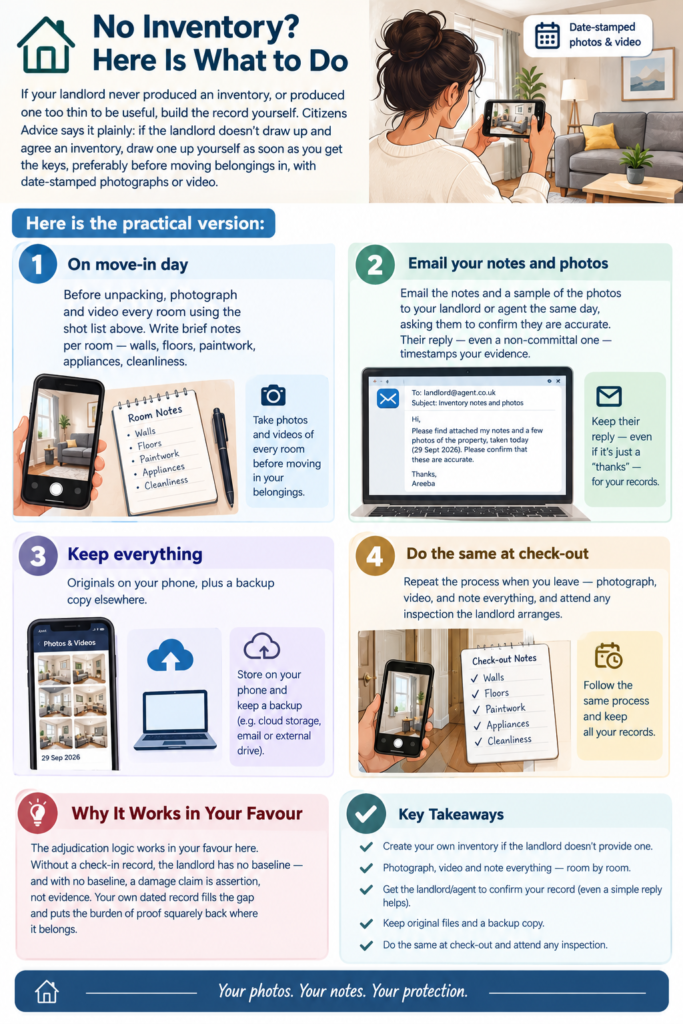
If your landlord never produced an inventory, or produced one too thin to be useful, build the record yourself. Citizens Advice says it plainly: if the landlord doesn’t draw up and agree an inventory, draw one up yourself as soon as you get the keys, preferably before moving belongings in, with date-stamped photographs or video.
Here is the practical version:
- On move-in day, before unpacking, photograph and video every room using the shot list above. Write brief notes per room — walls, floors, paintwork, appliances, cleanliness.
- Email the notes and a sample of the photos to your landlord or agent the same day, asking them to confirm they are accurate. Their reply — even a non-committal one — timestamps your evidence.
- Keep everything. Originals on your phone, plus a backup copy elsewhere.
- Do the same at check-out, and attend any inspection the landlord arranges.
The adjudication logic works in your favour here. Without a check-in record, the landlord has no baseline — and with no baseline, a damage claim is assertion, not evidence. Your own dated record fills the gap and puts the burden of proof squarely back where it belongs.
Challenging Deductions: Using Your Inventory in a Dispute
When the landlord proposes deductions, ask for the breakdown in writing: what is claimed, for which item, and how the figure was calculated. Then test each line against your evidence:
- Was the damage there at check-in? Your signed inventory and photographs are the answer. If the stain predates you, the claim fails.
- Is it fair wear and tear? A landlord cannot charge for natural ageing through normal use. Tenancy length, item age and number of occupants all matter — our fair wear and tear guide shows how adjudicators draw the line.
- Is the amount reasonable? No full replacement cost for something that could be cleaned or repaired, and no new-for-old on an ageing item. Ask for quotes or invoices — a figure from memory will not satisfy an adjudicator.
- Did you admit anything? Signed check-out reports and messages where you agreed something was damaged count. Honesty at check-out can still be cheaper than a lost dispute.
If you cannot agree, raise a dispute with the deposit scheme that protects your deposit — the service is free, and both sides submit evidence to an independent adjudicator whose decision is final. GOV.UK notes there may be a time limit for raising a dispute, so do not sit on it. Ask for the undisputed portion of your deposit to be returned while the disputed amount stays protected.
Fraser’s story: the four-year tenancy in Glasgow
Fraser rented a two-bedroom flat in Glasgow for four years at £950 a month. His deposit was £1,900 — the maximum two months’ rent allowed in Scotland. At check-out, the agent claimed £320 for “full redecoration of living room and hallway” because of scuffed walls. Fraser’s signed, photographed check-in inventory described the paintwork as “magnolia emulsion, fair condition, minor scuffs throughout” — and four years of normal living adds a normal amount of wear.
Fraser disputed through the scheme. The adjudicator agreed the walls were worse than at check-in, but four years of occupation means substantial fair wear and tear, and the paintwork was only “fair” at the start. The award: £40 for one genuinely damaged patch behind a door, £280 returned. Fraser got £1,860 of his £1,900 back — because his inventory recorded the starting point honestly.
Poppy’s story: the pre-existing stain in London
Poppy’s one-bedroom in London cost £1,500 a month, so her deposit was the five-week maximum: £1,730.77. At check-out the agent proposed two deductions: £95 for a professional oven clean and £145 to replace a stained section of bedroom carpet.
| Deduction proposed | Amount | Poppy’s evidence | Outcome |
|---|---|---|---|
| Professional oven clean | £95 | Inventory said “good condition, light use marks” — fair claim | Accepted: £95 |
| Carpet stain replacement | £145 | Inventory recorded the stain as pre-existing, with a dated photo | Struck out: £0 |
| Returned to Poppy | £1,730.77 − £95 | £1,635.77 |
Her signed check-in inventory said the oven was “good condition, light use marks” — so the £95 cleaning claim was fair and she accepted it. But the same inventory described the bedroom carpet as “cream carpet, visible tea-coloured stain approx. 20 cm near window, photographed” — the very stain she was being charged for. She sent the inventory page and the dated photograph to the scheme, and the adjudicator struck out the £145 entirely. Poppy got £1,635.77 of her £1,730.77 back — the stain was never hers to pay for.
Nia’s story: what signing unread costs the tenant
Back in Birmingham: Nia’s deposit was £1,269.23 (five weeks on £1,100 a month). She had signed the inventory unread, kept no photographs, and skipped the check-out. The agent claimed £450 for cleaning and £200 for wall marks. Nia disputed, but she had no baseline of her own — and the inventory she had signed described the flat as clean with unmarked walls. The cleaning claim failed for lack of check-out comparison, but the wall-marks claim stood at a reduced £75. She recovered £1,194.23 — the price of a signature given unread.
Scotland, Wales and Northern Ireland: Where the Rules Differ
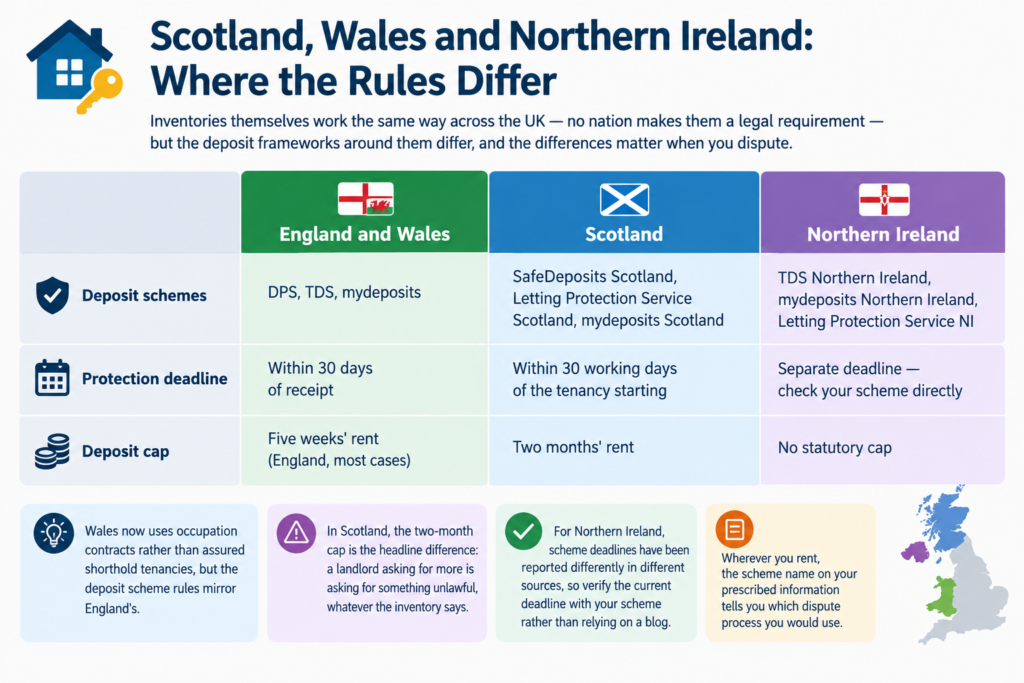
Inventories themselves work the same way across the UK — no nation makes them a legal requirement — but the deposit frameworks around them differ, and the differences matter when you dispute.
| England and Wales | Scotland | Northern Ireland | |
|---|---|---|---|
| Deposit schemes | DPS, TDS, mydeposits | SafeDeposits Scotland, Letting Protection Service Scotland, mydeposits Scotland | TDS Northern Ireland, mydeposits Northern Ireland, Letting Protection Service NI |
| Protection deadline | Within 30 days of receipt | Within 30 working days of the tenancy starting | Separate deadline — check your scheme directly |
| Deposit cap | Five weeks’ rent (England, most cases) | Two months’ rent | No statutory cap |
Wales now uses occupation contracts rather than assured shorthold tenancies, but the deposit scheme rules mirror England’s. In Scotland, the two-month cap is the headline difference: a landlord asking for more is asking for something unlawful, whatever the inventory says. For Northern Ireland, scheme deadlines have been reported differently in different sources, so verify the current deadline with your scheme rather than relying on a blog. Wherever you rent, the scheme name on your prescribed information tells you which dispute process you would use.
The Renters’ Rights Act 2025: Does It Change Anything About Inventories?
The Renters’ Rights Act became law in October 2025 — the biggest shake-up of English renting law in a generation, ending no-fault evictions and moving tenancies to rolling periodic agreements. Does it finally make inventories compulsory?
To be plain: we found no provision in the Act that creates a statutory duty to prepare an inventory. What the Act does is raise the stakes around evidence. With Section 21 gone, landlords seeking possession for damage or breach must prove their case under the revised Section 8 grounds, and the new landlord ombudsman will expect complaints to be evidenced. Industry commentators call professional inventories “no longer optional” — commercial advice, not statute, but the direction is real: in a more regulated system, the landlord who cannot produce a baseline is the landlord who loses.
For tenants, the practical takeaway is unchanged and simple: keep your own evidence regardless of what the law requires of your landlord.
FAQs
Does my landlord legally have to provide an inventory?
No. In England and Wales, no statute requires a landlord to prepare an inventory, schedule of condition or check-in report — Shelter confirms this directly. It is best practice, and adjudicators expect landlords to evidence deductions, which makes a good inventory essential for them in practice. If yours will not provide one, make your own with dated photographs.
How long do I have to check the inventory after moving in?
Seven to ten days is the industry standard for reviewing the check-in inventory and returning amendments, and your tenancy agreement may set its own deadline. Check the agreement, diarise the date, and return your signed, amended copy within it. Miss the deadline without comment, and the inventory is generally treated as accepted.
Can my landlord charge me for the inventory or check-out?
In England, no. The Tenant Fees Act 2019 bans most payments beyond rent, the deposit and a short list of permitted charges, and inventory, check-in and check-out fees are not on it. The landlord bears the cost — challenge any such charge in writing.
What should I do if the inventory is wrong?
Correct it before you sign. Add missing items, record unlisted damage, fix wrong meter readings and note anything not working. Write the amendments on the document, sign and date it, keep a copy, and photograph everything you changed. A signed inventory is treated as agreed — never sign one you know is inaccurate.
There was no inventory at all. Can my landlord still deduct from my deposit?
They can propose deductions, but without a check-in record they have no baseline — and the burden of proof is on them. Build your own record: dated photographs and notes from move-in day, emailed to the landlord or agent so they are timestamped. Schemes say openly that without evidence of condition at both the start and end, it is difficult to show the condition changed.
Should I be present at the check-out inspection?
Yes — try to be there. Shelter advises attending the checkout inspection, recording any disagreements, and signing and dating the report if you are happy with it, keeping a copy. Bring your check-in photographs so you can show on the spot that damage predates your tenancy.
Do photographs really matter to adjudicators?
Yes, as corroboration. Schemes want evidence that is impartial, contemporaneous, comprehensive and corroborated with dated photos. A photograph matched to a written description, both dated to move-in day, is far stronger than either alone. Check that your phone’s date and time are correct so the metadata is trustworthy.
What is the difference between an inventory and a schedule of condition?
An inventory lists the property’s contents and their condition; a schedule of condition records the decorative and structural state — walls, floors, paintwork, cleanliness. Agents often combine them, and adjudicators care about content, not the label. What matters is that both are covered and the tenant has signed.
Can I use video instead of photographs?
Video is excellent supporting evidence — a dated walk-through captures the general standard of cleanliness that stills sometimes miss — but use it alongside photographs, not instead of them. Adjudicators work from documents, and stills referenced to written descriptions are easier to assess. Do both.
How do mid-tenancy inspections relate to the inventory?
Inspections create a dated timeline of condition between check-in and check-out, and anything you report becomes part of the record. Your agreement should set the notice period (24 hours’ written notice is the common standard). Attend when you can, ask for copies of the notes, and report repair issues in writing.
What if I disagree with the check-out report?
Record your disagreement on the report itself, in writing, with your evidence attached — a documented dispute beats silence. Negotiate using your check-in inventory and photographs. If you cannot agree, raise a free dispute with your deposit protection scheme; both sides submit evidence, and the adjudicator’s decision is final.
Does the Renters’ Rights Act 2025 require inventories?
We found no provision in the Act creating a statutory inventory duty. It does raise evidential expectations — no-fault evictions are gone, possession claims must be proved, and a new ombudsman will expect documented evidence — which makes good inventories more important in practice. But the legal position is unchanged: best practice, not a statutory requirement.
Final Thoughts
An inventory is the least glamorous document in your tenancy and the most valuable in a dispute. The whole system — the burden of proof, paper-based adjudication, start-against-end comparison — assumes someone recorded what the property looked like on day one. Make sure that someone is you, or at least that you checked their homework.
If you are moving in soon, read our viewing checklist before you sign anything, protect your money with the deposit protection guide, and understand the line between damage and ageing in our fair wear and tear guide. When the tenancy ends, our ending your tenancy guide walks you through notice, check-out and getting your deposit back. And if the inspection that produced your inventory also revealed things the landlord should fix, the landlord repairs guide tells you exactly what to do next.
Nia signs inventories properly now. She photographs everything, returns her amendments within the week, and keeps a folder for every tenancy — about an hour on move-in day. The last time a landlord proposed a £300 deduction, her folder ended the argument in a single email. Be like the second Nia, not the first.
Further Reading
- Tenancy deposit protection — GOV.UK — the official rules on deposit schemes, deadlines and dispute resolution.
- How to check and agree an inventory — Shelter England — Shelter’s step-by-step guide to checking, amending and signing your inventory.
- Getting your tenancy deposit back — Citizens Advice — evidence to gather before you leave and how to challenge deductions.