
Letting Agent Affordability Checks are an important part of the UK rental process, and understanding them can make finding the perfect rental property much easier.
Finding the perfect rental property in the UK can be exciting, but many renters are surprised when a letting agent says they need to complete an affordability check before their application can be approved.
If you’re renting your first apartment, moving for work, or moving to a larger home, understanding how letting agents check affordability in the UK can greatly improve your chances of getting approved.
An affordability check helps a property owner or letting agent determine if your income is high enough to comfortably cover the monthly rent while also allowing you to manage your everyday living expenses. It’s one of the most important parts of the renter reference process and is designed to reduce the risk of missed rent payments.
The good news is that affordability checks are not as Complex as they may look. Once you understand the calculations, the documents required, and what letting agents are looking for, you can prepare in advance and avoid unneeded Slowdowns or rejections.
A note on how this guide was put together: The formulas and limits in this instruction reflect standard practice among UK letting agents and referring companies, and they match general Advice published by bodies such as the National Landlord Association and Right to Rent checks. Individual property owner and agents set their own exact Requirements, so always confirm the specific requirement for a property before applying.
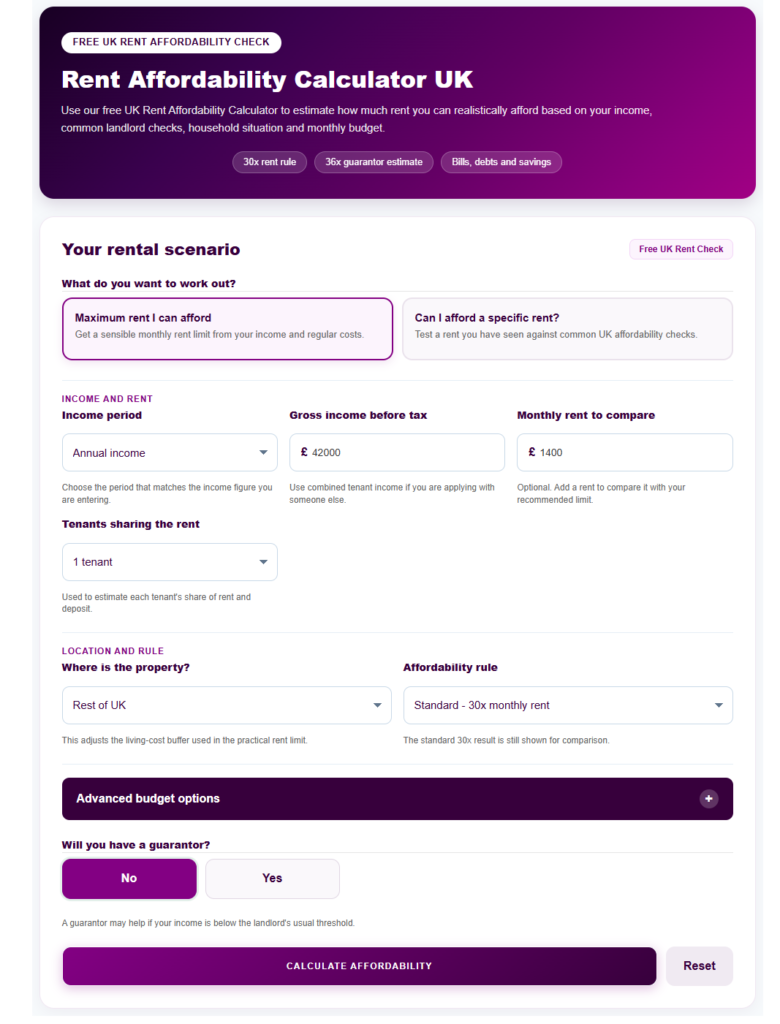
Click Here:Rent Affordability Calculator UK
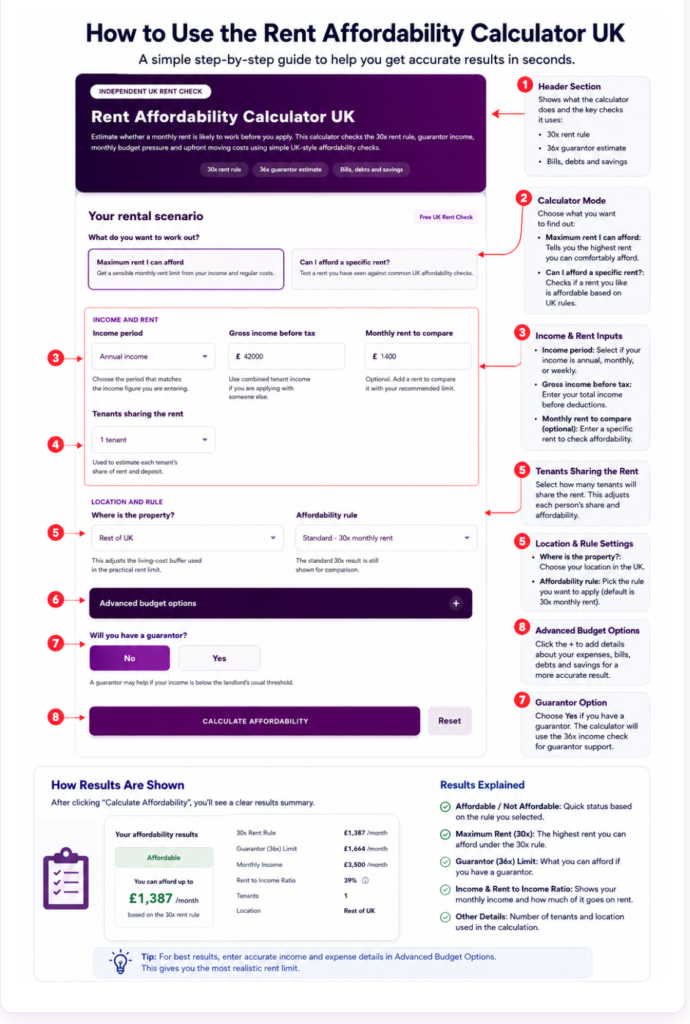
How to Use the Rent Affordability Calculator UK
What Is an Affordability Check?
Letting Agent Affordability Checks are financial assessments carried out by a letting agent or landlord to decide whether you can realistically afford the rent.
An affordability check is a financial assessment carried out by a letting agent or landlord to decide whether you can realistically afford the rent.
Rather than simply asking whether you have a job, they assess your financial situation by comparing your income against the rent.
Read more: Degree Percentage Calculator – Convert Module Marks into Final PercentageWhy Do Letting Agents Check Affordability?
From a landlord’s perspective, rental income is often used to cover:
- Mortgage payments
- Property maintenance
- Insurance
- Service charges
- Repairs
- Taxes
How Do Letting Agents Check Affordability in the UK?
Most letting agents follow a straightforward process.
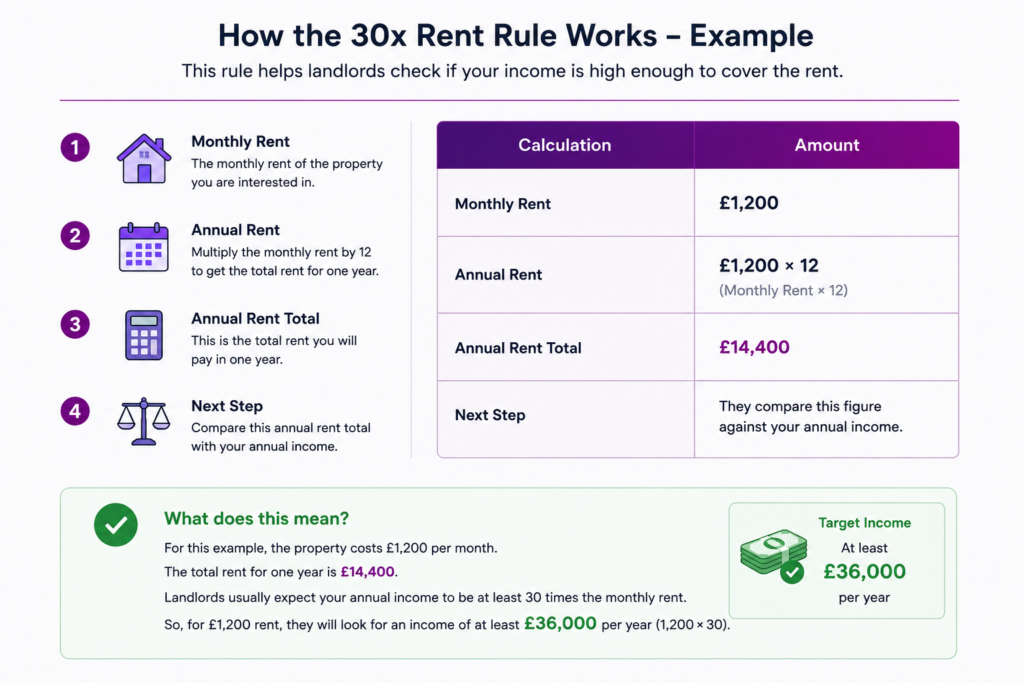
Step 1: Calculate the Annual Rent
First, they calculate the property’s yearly rent.
Example
| Calculation | Amount |
|---|---|
| Monthly Rent | £1,200 |
| Annual Rent | £1,200 × 12 |
| Annual Rent Total | £14,400 |
| Next Step | They compare this figure against your annual income. |
Step 2: Apply Their Affordability Formula
Different companies have slightly different rules.
The most common affordability ratios include:
- 2.5× Annual Rent
- 2.75× Annual Rent
- 3× Annual Rent
Some agencies instead use the well-known 30× monthly rent or 36× monthly rent rule.
All of these methods are simply different ways of checking if your income is high enough.
The Most Common Affordability Rule (30× Rent Rule)
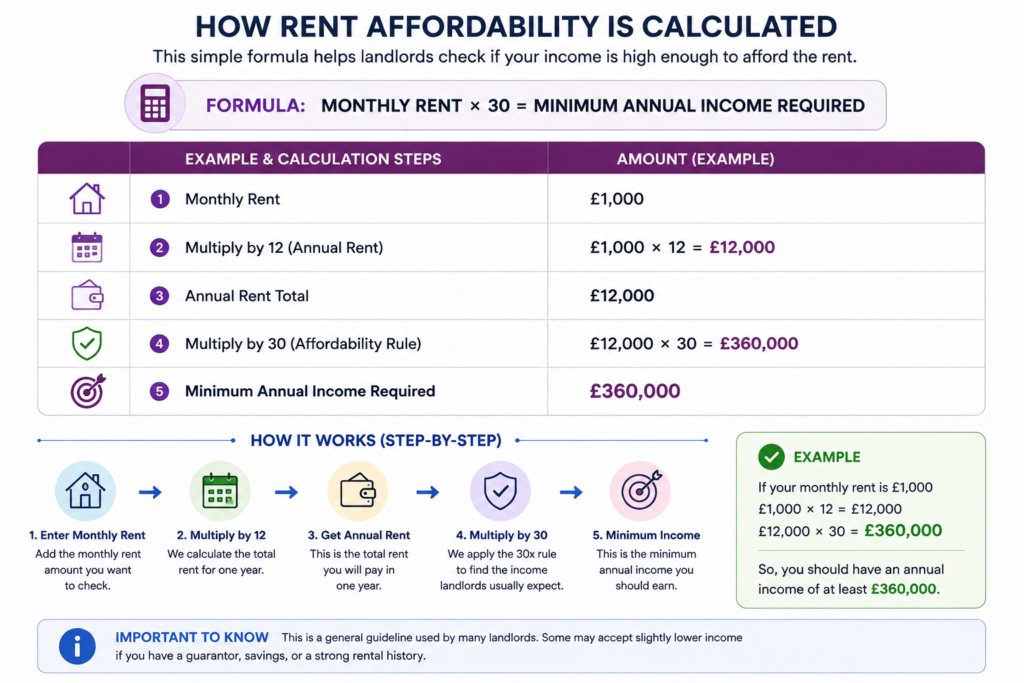
Many UK letting agents require your annual income to be at least 30 times your monthly rent.
Formula
Required Annual Salary = Monthly Rent × 30
Example
| Calculation | Amount |
|---|---|
| Monthly Rent | £900 |
| Calculation | £900 × 30 |
| Required Annual Income | £27,000 |
| Explanation | This means you’ll usually need to earn around £27,000 per year before tax. |
Higher Rent Example
| Calculation | Amount |
|---|---|
| Monthly Rent | £2,000 |
| Calculation | £2,000 × 30 |
| Required Annual Salary | £60,000 |
The 36× Rent Rule
Some premium letting agencies are stricter.
Instead of multiplying rent by 30, they multiply it by 36.
Formula
Annual Salary = Monthly Rent × 36
Example
| Calculation | Amount |
|---|---|
| Monthly Rent | £1,000 |
| Calculation | £1,000 × 36 |
| Required Annual Salary | £36,000 |
This creates a larger financial safety margin for landlords.
Read more: Can You Rent Without a Guarantor in the UK? Complete Guide (2026)Understanding the 2.5× Annual Rent Rule
Some agencies calculate affordability differently.
Instead of using monthly rent, they multiply the annual rent.
Formula
Annual Salary
=
Annual Rent × 2.5
Example
| Calculation | Amount |
|---|---|
| Monthly Rent | £950 |
| Annual Rent | £950 × 12 |
| Annual Rent Total | £11,400 |
| Salary Needed | £11,400 × 2.5 |
| Required Annual Salary | £28,500 |
Comparing the Different Affordability Formulas
Because agencies don’t all use the same method, it helps to see them side by side using the same rent figure.
| Formula | Calculation (on £1,200/month rent) | Required Annual Income | Typically Used By |
| 30× monthly rent | £1,200 × 30 | £36,000 | Most high-street letting agents |
| 36× monthly rent | £1,200 × 36 | £43,200 | Premium agencies, guarantor checks |
| 2.5× annual rent | (£1,200 × 12) × 2.5 | £36,000 | Referencing companies |
| 2.75× annual rent | (£1,200 × 12) × 2.75 | £39,600 | Some corporate landlords |
Real-Life Example: Sarah Renting Her First Apartment
Sarah has recently accepted a marketing job in Manchester.
Her annual salary is:
£32,000
She finds a flat costing:
£1,000 per month
The letting agent uses the 30× rule.
| Calculation | Amount |
|---|---|
| Calculation | £1,000 × 30 |
| Required Annual Salary | £30,000 |
| Applicant’s Salary | £32,000 (Sarah earns £32,000.) |
Since her salary is above the required £30,000 threshold, she comfortably passes the affordability check.
Her application proceeds to the referencing stage.
Real-Life Example: Ahmed Doesn’t Meet the Requirement
Ahmed works part-time and earns:
£22,000 annually
He wants to rent a property costing:
£950 per month
The agency requires:
950 × 30
=
£28,500 annual income.
Ahmed’s salary falls short by:
£28,500 − £22,000
=
£6,500
Although he has an excellent rental history, the letting agent asks him to provide a guarantor.
Without one, his application may not be approved.
Example: Joint Applicants
Many couples apply together.
Letting agents usually combine both incomes.
Example
| Details | Amount |
|---|---|
| Emily’s Salary | £24,000 |
| James’s Salary | £21,000 |
| Combined Income | £45,000 |
| Property Rent | £1,350 per month |
| Required Salary Calculation | £1,350 × 30 |
| Required Annual Salary | £40,500 |
Since their combined income is greater than the required amount, they successfully pass the affordability assessment.
Do Letting Agents Use Gross or Net Income?
One of the most common questions tenants ask is whether affordability is based on gross income (before tax) or net income (after tax).
In most cases, UK letting agents use gross annual income because it provides a standard way to compare applicants regardless of their tax code or personal circumstances.
For example, if your employment contract states an annual salary of £38,000, the agent will generally use that figure; on the other hand, the amount that reaches your bank account each month after tax and National Insurance cuts.
However, some independent property owners may also look at your monthly take-home pay to make sure you have enough disposable income after paying rent and other regular costs. This is more common when reviewing applicants with variable earnings or self-employment income.
What Income Counts Towards an Affordability Check?
A salary from full-time employment is the most straightforward form of income, but it isn’t the only type that may be considered.
| Income Source |
|---|
| Full-time employment salary |
| Part-time employment income |
| Self-employed profits |
| Pension income |
| Freelance earnings |
| Commission (if consistent) |
| Bonuses (sometimes averaged over several months) |
| Overtime (where regular) |
| Investment income |
| Certain benefits, such as Universal Credit or Housing Benefit, where accepted by the landlord |
The key factor is that the income should be verifiable, regular, and sustainable. Letting agents will usually ask for documents to prove each source of income, which we’ll cover in the next section of this guide.
Read more: Ultimate 30x Rent Rule UK Guide – What It Means and How Letting Agents Calculate AffordabilityAffordability Calculation Examples
The table below shows how much annual income is typically required under the common 30× rent rule.
| Monthly Rent | Approximate Annual Salary Required |
| £600 | £18,000 |
| £700 | £21,000 |
| £800 | £24,000 |
| £900 | £27,000 |
| £1,000 | £30,000 |
| £1,100 | £33,000 |
| £1,200 | £36,000 |
| £1,300 | £39,000 |
| £1,400 | £42,000 |
| £1,500 | £45,000 |
| £1,800 | £54,000 |
| £2,000 | £60,000 |
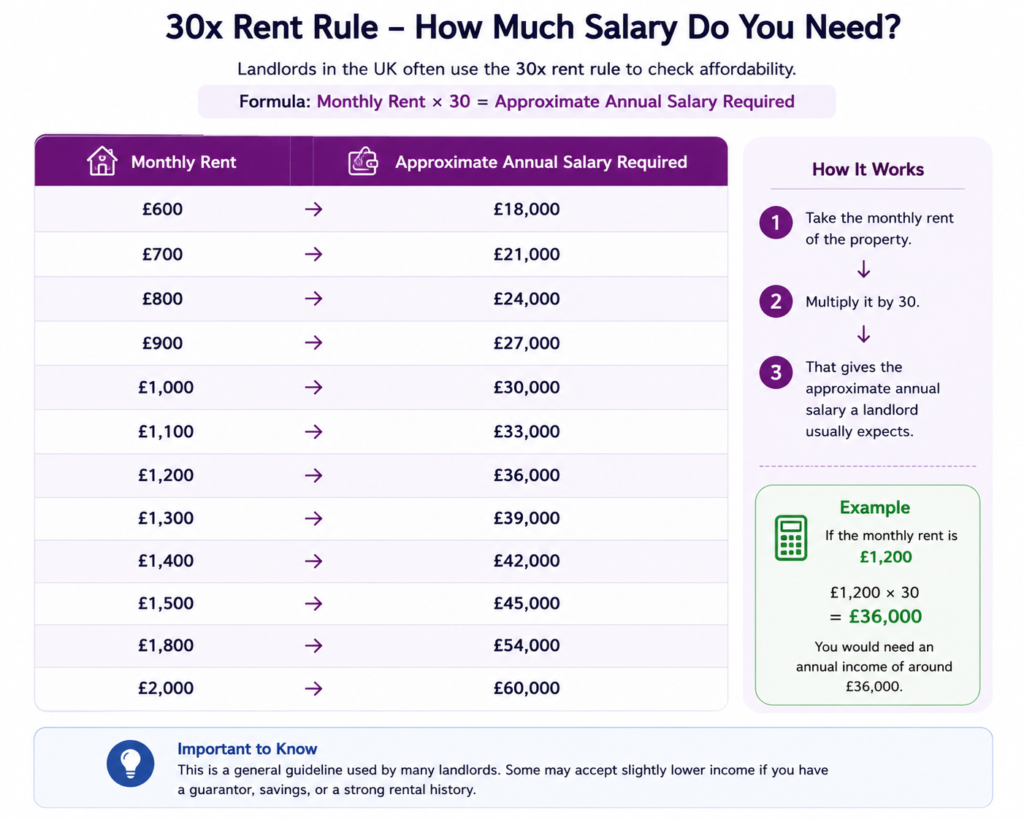
Tip: These figures are illustrative. Some letting agents use different affordability ratios, so always check the specific requirements before applying for a property.
What Documents Do Letting Agents Ask For?
An affordability check isn’t based solely on the salary number you mention in your application. Letting agents need evidence that your income is Real, stable, and likely to continue throughout the rental agreement.
Proof of Identity
| To confirm your Proof of Identity and satisfy legal requirements, you may be asked to provide: |
|---|
| Passport |
| UK Driver’s Permit |
| Biometric Residence Permit (if applicable) |
| Other government-issued photo identification |
This is often completed alongside the Right to Rent check for tenants in England
2. Recent Payslips
For employed applicants, payslips are one of the most important documents.
Most letting agents request:
- Last 3 months’ payslips
- Sometimes the last 6 months for additional verification
These help confirm:
- Your salary
- Employer
- Regular income
- Bonuses
- Overtime
- Deductions
3. Bank Statements
Many agents also ask for recent bank statements.
| Bank Statements Required |
|---|
| Usually: Last 3 months |
| Occasionally: 6 months |
Bank statements allow them to verify that:
- Your salary is actually being paid
- Income matches your payslips
- There are no frequent unpaid direct debits or financial warning signs
4. Employment Reference
| Your employer may be contacted to confirm: |
|---|
| Your position |
| Annual salary |
| Employment status |
| Contract type |
| Start date |
| If your employment is expected to continue |
This gives the property owner confidence that your income is likely to remain stable during the rental agreement.
5. Credit Check
Although affordability and credit history are separate checks, they are usually completed together.
A credit check helps identify:
- County Court Judgments (CCJs)
- Individual Voluntary Arrangements (IVAs)
- Bankruptcies
- Missed credit payments
- Outstanding debt issues
Having a low credit score doesn’t automatically mean you’ll be rejected, but serious financial issues may affect the landlord’s decision.
“Employment income is the most common scenario, but affordability checks look quite different once you factor in self-employment.”
How Are Self-Employed Tenants Assessed?
Being self-employed doesn’t prevent you from renting a property, but the affordability process is often more detailed because your income may fluctuate.
| Instead of monthly payslips, letting agents usually request evidence such as: |
|---|
| SA302 tax calculations |
| Tax Year Overview |
| Certified accounts |
| Accountant’s reference |
| Business bank statements |
| Personal bank statement |
Many agencies prefer to see at least one or two years of trading history, although some landlords are willing to consider newer businesses if the income is high and well documented.
Real-Life Example: Self-Employed Graphic Designer
Ali is a freelance graphic designer who works with clients across the UK.
His average annual profit is:
£42,000
He wants to rent a house costing:
£1,250 per month
Required salary using the 30× rule:
£1,250 × 30 = £37,500
Ali exceeds the affordability requirement.
| To support his application, he provides: |
|---|
| Two years of tax returns |
| SA302 forms |
| Business bank statements |
| Accountant’s confirmation letter |
Even though he doesn’t receive a monthly salary, his documented income demonstrates affordability, and his application is approved.
“Students present another common exception, since most haven’t built up a salary history at all.”
How Do Letting Agents Assess Students?
Students often have little or no employment income, so affordability is assessed differently.
A landlord may ask for:
- A UK-based guarantor
- Rent paid several months in advance
- Proof of student finance
- Scholarship evidence
- Sponsorship letters
- Evidence of parental financial support
Student accommodation providers may have their own criteria, but affordability checks are still commonly used.
Real-Life Example: International Student
Maria is moving to London to study for a graduate degree
She doesn’t have a UK salary, but her parents will offer financial support to her.
| Property & Supporting Documents | Details |
|---|---|
| Property Cost | £900 per month |
| Accepted Instead of Maria’s Personal Income | Her father’s proof of income |
| Supporting Document | Bank statements |
| Additional Requirement | A guarantor agreement |
As a result, the tenancy is approved.
Real-Life Example: Retired Tenant on a Pension
Margaret is retiring and wants to downsize to a one-bedroom flat costing £850 per month.
| Income & Affordability Details | Amount / Details |
|---|---|
| Private Pension | £19,000 per year |
| State Pension | £11,500 per year |
| Combined Annual Income | £30,500 |
| Required Income (30× Rule) | £850 × 30 = £25,500 |
Margaret’s pension income comfortably exceeds the threshold. The letting agent treats her pension statements the same way they would treat payslips as proof of regular, verifiable income — and her application proceeds without needing a guarantor.
Why: Pensioners are a common tenant group with a distinct income type, and this scenario is missing. It also reinforces the earlier claim that pension income counts, with a worked example instead of just a bullet point.
How Are Joint Applicants Assessed?
Many couples, friends, or family members rent together.
Instead of reviewing each person’s salary individually, letting agents usually combine everyone’s income.
Example
| Income & Affordability Details | Amount / Details |
|---|---|
| Tenant A’s Salary | £26,000 |
| Tenant B’s Salary | £18,000 |
| Combined Salary | £44,000 |
| Monthly Rent | £1,300 |
| Required Salary | £1,300 × 30 = £39,000 |
Combined income exceeds the requirement, so they pass the affordability check.
This approach often helps applicants qualify for properties that would be unaffordable individually.
“When income alone doesn’t meet the threshold, a guarantor is usually the first solution a letting agent will suggest — so it’s worth understanding exactly what that involves.”
What Is a Guarantor?
If your income doesn’t meet the affordability requirement, a property owner may ask for a guarantor.
A guarantor is someone who Supports to cover your rent if you’re unable to pay.
Think of a guarantor as a financial safety net for the property owner.
If you stop paying rent or breach your tenancy agreement, the property owner may legally pursue the guarantor for the outstanding rent
How Is a Guarantor’s Affordability Checked?
Guarantors often need to satisfy even stricter financial requirements than tenants.
Many referencing companies expect a guarantor to earn:
- 36× annual rent
- Sometimes 40× annual rent
Example
| Guarantor Affordability Calculation | Amount / Details |
|---|---|
| Monthly Rent | £1,200 |
| Guarantor Affordability Calculation | £1,200 × 36 |
| Required Annual Income | £43,200 |
If the guarantor earns £50,000 per year, they comfortably satisfy the affordability requirement.
A Practical Checklist Before You Apply for a Rental Property
Before you submit a rental application, it is worth doing your own affordability check first. This can save you time and help you avoid applying for properties that are unlikely to meet the letting agent’s requirements.
Start by checking the monthly rent and multiply it by 30 to get a quick estimate of the annual income that may be required. For example, if the rent is £1,100 per month, the 30× calculation would be £33,000 per year. If your income is close to this figure, don’t assume you will automatically pass because the letting agent may use a different affordability ratio.
Next, make a simple folder containing your recent payslips, bank statements, proof of identity, employment details and any other income evidence you may need. If you are self-employed, keep your tax documents and accountant’s details ready. Having these documents available can make the referencing process much quicker.
It is also useful to check your employment details before applying. Make sure your salary, job title, employment status and start date are correct. If you have recently changed jobs, started a new position or have variable income, tell the letting agent early rather than waiting for them to discover the difference during referencing.
Finally, have a backup plan. If your income is slightly below the required amount, find out whether the landlord accepts a guarantor, joint applicant, savings evidence or rent in advance. Knowing your options before you apply can prevent unnecessary delays and help you decide whether the property is financially realistic for you.
Quick Self-Check
Before applying, ask yourself:
- Does my gross annual income meet the agent’s affordability formula?
- Can I provide recent proof of my income?
- Is my employment or income information easy to verify?
- Do I have the required documents ready?
- If I fall short, do I have another acceptable option such as a guarantor or joint applicant?
This simple check does not guarantee approval, but it can give you a much clearer idea of whether you are ready to apply.
What Happens If You Fail an Affordability Check?
Failing an affordability check doesn’t necessarily mean you can’t rent the property.
Instead, the property owner may provide alternative solutions.
These could include:
Option 1: Provide a Guarantor
This is the most common solution.
Option 2: Pay Rent in Advance
| Some landlords accept: |
|---|
| 3 months’ rent upfront |
| 6 months’ rent upfront |
| 12 months’ rent upfront |
This reduces their financial risk.
Option 3: Add a Joint Tenant
Adding another Candidate increases the combined household income.
Option 4: Choose a More Affordable Property
Sometimes reducing your monthly rent by £100–£200 is enough to satisfy the affordability calculation.
Real-Life Example: Paying Rent in Advance
Daniel recently started a new job.
His annual salary is:
£31,000
The letting agent requires the candidate to have been in employment for at least six months, but Daniel has only been with his employer for one month.
Instead of rejecting the application, the property owner agrees to proceed if Daniel pays six months’ rent in advance. Daniel accepts, providing reassurance to the landlord while he builds a longer employment history.
Read more:Rent Affordability Rules UK – 8 How Much Rent Can You Afford?Common Reasons People Fail Affordability Checks
Many applicants assume they were rejected because of their salary, but affordability checks take several factors into account.
| Some of the most common Causes include: |
|---|
| Income below the required threshold |
| Recently changed jobs |
| Temporary employment with no guaranteed hours |
| Inconsistent self-employed income |
| Poor credit history |
| Large existing debts |
| Missing documents |
| Unverifiable income |
| Failed employment reference |
| Wrong information on the application form |
Being honest and Structured from the start can greatly improve your chances.
Tips to Improve Your Chances of Passing an Affordability Check
Preparation can make the Complete rental process much smoother. Before applying, consider the following:
- Check the property’s affordability requirements before providing an application.
- Collect your payslips, bank statements, and identification in advance.
- Ensure your credit report is Correct and resolve any errors if possible.
- Avoid taking on great new debt before applying.
- If you’re self-employed, keep your tax records and accounts up to date.
- Be ready with a guarantor if you think you earning may be close to the minimum requirement.
- Respond quickly to requests from the letting broker, as Slowdowns in providing documents can slow down or even risk your application.
A prepared candidate regularly stands out, even in Challenging rental markets.
Real-Life Scenario: A Couple Successfully Passes an Affordability Check
Let’s look at a practical example.
Tom and Sophie want to rent a two-bedroom apartment in Birmingham.
Property Details
| Rent Details | Amount |
|---|---|
| Monthly Rent | £1,350 |
The letting agent requires applicants to earn 30 times the monthly rent.
Step 1: Calculate the Required Income
£1,350 × 30 = £40,500
Step 2: Calculate Their Combined Income
| Income Details | Amount |
|---|---|
| Tom’s Salary | £24,000 |
| Sophie’s Salary | £20,000 |
| Combined Income | £44,000 |
Because their combined annual salary is higher than the required £40,500, they comfortably pass the affordability assessment.
Real-Life Scenario: New Employee with a High Salary
Emma has recently secured a new position with an annual salary of £48,000.
She wants to rent a flat costing £1,400 per month.
Affordability Calculation
£1,400 × 30 = £42,000
Emma clearly earns enough.
However, she only started her new job two weeks ago.
Because she hasn’t yet built a history of monthly payslips, the letting agent requests:
- Her signed employment contract
- A letter from her employer confirming the role is permanent
- Her first payslip once it becomes available
Some landlords may also request a few months’ rent in advance until a longer employment history is established.
This shows that affordability isn’t just about how much you earn—it’s also about how stable and verifiable your income is.
Common Myths About Affordability Checks
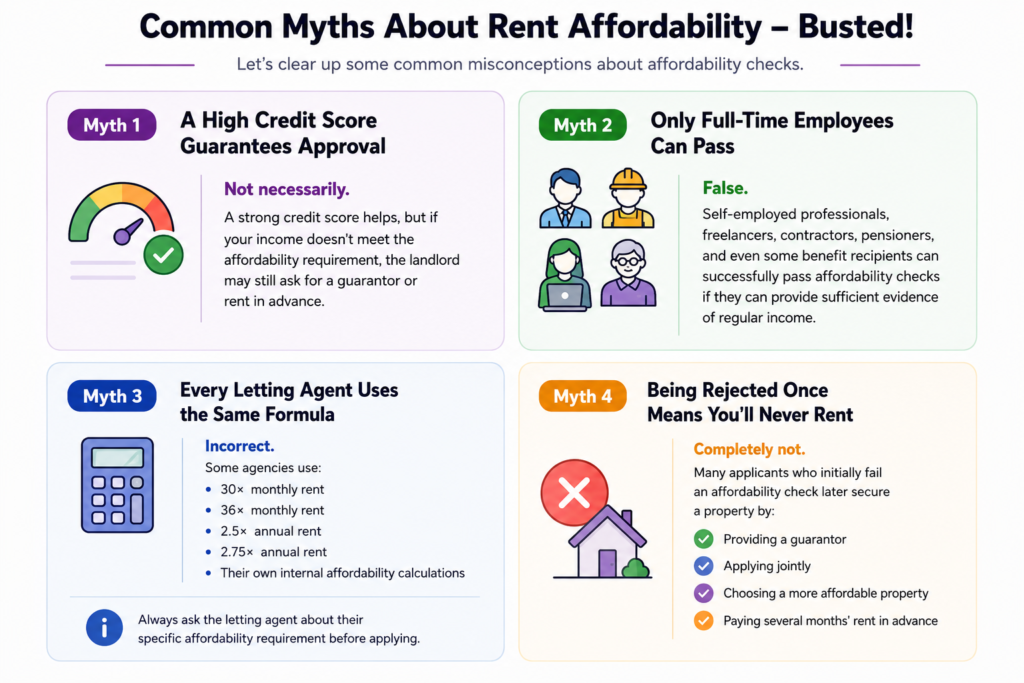
Many renters misunderstand how reasonable price checks work. We can break down a few common myths.
Myth 1: A High Credit Score Guarantees Approval
Not necessarily.
A strong credit score helps, but if your income doesn’t meet the affordability requirement, the landlord may still ask for a guarantor or rent in advance.
Myth 2: Only Full-Time Employees Can Pass
False.
Self-employed professionals, freelancers, contractors, pensioners, and even some benefit recipients can successfully pass affordability checks if they can provide sufficient evidence of regular income.
Myth 3: Every Letting Agent Uses the Same Formula
Incorrect.
| Some agencies use: |
|---|
| 30× monthly rent |
| 36× monthly rent |
| 2.5× annual rent |
| 2.75× annual rent |
| Their own internal affordability calculations |
Always ask the letting agent about their specific affordability requirement before applying.
Myth 4: Being Rejected Once Means You’ll Never Rent
Completely not.
Many applicants who initially fail an affordability check later secure a property by:
- Providing a guarantor
- Applying jointly
- Choosing a more affordable property
- Paying several months’ rent in advance
Affordability Check vs. Credit Check vs. Reference Check: What’s the Difference?
These three checks are often confused, but they test different things:
- Affordability check — assesses whether your income is high enough to cover the rent comfortably.
- Credit check — looks at your credit history, including any CCJs, missed payments, or IVAs.
- Reference check — verifies your identity, employment, and previous landlord history through documents and phone/email confirmation.
A tenant can pass one and fail another — for example, earning well above the affordability threshold but still being asked for a guarantor because of a poor credit history. Landlords and agents typically run all three together as part of the overall referencing process.
Why: This is a distinct, high-intent search query (“affordability check vs credit check”) that isn’t addressed anywhere in the current draft, despite the article touching on both topics separately.
Read more: Rent to Income Ratio Calculator UK – 7 Easy Ways to Save MoneyHow do letting agents calculate affordability in the UK?
Most letting agents compare your gross annual income with the property’s annual rent. A common method is requiring your annual salary to be at least 30 times the monthly rent, although some agencies use different affordability ratios
Do letting agents use gross or net salary?
In most cases, they use your gross annual salary (before tax) because it provides a consistent way to assess applicants.
Can overtime and bonuses count as income?
Yes, many letting agents will include regular overtime, commission, or bonuses if they are consistent and can be verified through payslips or employer references.
Can I rent if I’m self-employed?
Yes. Self-employed applicants are commonly accepted, provided they can demonstrate stable income through documents such as SA302 forms, tax returns, certified accounts, or accountant references.
What happens if I don’t earn enough?
If your income doesn’t meet the affordability requirement, the landlord may ask for:
A guarantor
Rent paid in advance
A joint tenant
Additional evidence of income
Will Universal Credit affect my application?
Receiving Universal Credit doesn’t automatically prevent you from renting. Some landlords accept benefit income as part of the affordability assessment, while others may require a guarantor or additional financial evidence.
Do letting agents contact my employer?
Yes, in many cases they contact your employer to confirm your employment status, salary, and whether your position is expected to continue.
How long does an affordability check take?
Most affordability and referencing checks are completed within 2 to 7 working days, although complex applications or delays in receiving references can extend the process.
What is a good rent-to-income ratio in the UK?
As a general guide, rent should ideally take up no more than 30–35% of your gross income. This lines up closely with the 30× monthly rent rule used by most letting agents.
Is there a legal minimum affordability requirement in the UK?
No. Affordability ratios are set by individual letting agents, referencing companies, and landlords there’s no government-mandated formula. This is why requirements can vary between properties.
Can savings be used to pass an affordability check if my income is low?
Some landlords will accept proof of substantial savings, or ask for a larger rent-in-advance payment, as an alternative to meeting the income threshold. This isn’t universal, so it’s worth asking the agent directly.
Do affordability rules differ across England, Scotland, Wales, and Northern Ireland?
The affordability calculation itself is generally consistent across the UK, but related processes differ — for example, Right to Rent checks are a legal requirement in England but do not apply in Scotland, Wales, or Northern Ireland. Deposit protection schemes also vary by nation.
Final Thoughts
Learning how letting agents check affordability in the UK can make the rental process far less stressful. While every company has its own policies, the Basic goal is the same: to ensure that tenants can comfortably manage their rent throughout the rental agreement.
Preparing in advance is the best way to improve your chances. Before applying for a property, calculate if your income meets the required reasonable cost ratio, gather your financial documents, and be ready to provide additional information if requested.
If your income falls slightly below the required limit, don’t assume you’ll automatically be rejected. Many property owners are Ready to consider alternatives such as a guarantor, a joint application, or several months’ rent paid in advance.
By understanding the affordability process and planning, you’ll be in a much stronger position to secure the rental property that’s right for you.