
Rent Affordability Rules UK often determine whether you can successfully rent a property. Imagine finding the perfect rented property. The location is ideal, the price looks sensible, and you can already picture yourself living there.
But when you send your application, the property owners reject it because you fail the affordability checks required under the Rent Affordability Rules UK.
This situation surprises thousands of renters across the UK every year.
Many people focus only on whether they can make the monthly rent payment. However, landlords and letting brokers look at much more than that. They want proof that tenants can comfortably afford the property without struggling financially.
Understanding the Rent Affordability Rules UK before starting your property search can save time, reduce stress, and improve your chances of approval.
This guide reflects standard UK letting industry practice as of 2026, including affordability benchmarks commonly cited by referencing agencies and organisations such as Shelter and the National Residential Landlords Association (NRLA). Individual landlord criteria vary, so always confirm specific requirements with the letting agent before applying.
Let’s explore how the Rent Affordability Rules UK work in the UK and how you can calculate a rental budget that suits your finances.
Read more:Rent vs Buy Calculator UK – Should You Rent or Buy a HomeWhat Are Rent Affordability Rules in the UK?
Rent affordability rules are guidelines used by property owners, letting agents, and referencing companies to Judge whether a renter can comfortably afford a rental property.
These checks are designed to reduce the risk of missed rent payments and ensure that tenants are not financially overloaded
In simple terms, affordability checks compare a tenant’s income with the cost of rent to see if the rental is practically manageable, together with other living expenses such as bills, food, transport, and Loan payments
A commonly used rule in the UK states that a tenant’s annual earnings should be at least 30 times the rent per month.
- Income Requirement: For example, if the rent is £800 per month, the tenant would typically need an annual income of at least £24,000.
- 30%–40% Income Rule: Another widely used benchmark is that rent should not exceed 30% to 40% of a tenant’s monthly income.
- 2.5–3 Times Rent Rule: Many letting agents also apply a “2.5 to 3 times monthly rent” rule, meaning your gross monthly income should be at least 2.5–3 times the rent amount.
- Affordability Assessment: In addition to income checks, landlords often carry out full affordability assessments, which may include reviewing bank statements, credit history, employment status, and existing financial commitments.
- Stress Test: Some agencies also apply a “stress test” to ensure tenants can still afford rent if their expenses increase.
- This also checks whether they could manage if their income drops slightly.
Read more:Rent Affordability Rules UK – How Much Rent Can You Afford| Monthly Rent | Recommended Annual Income |
|---|---|
| £800 | £24,000 |
| £1,000 | £30,000 |
| £1,200 | £36,000 |
| £1,500 | £45,000 |
This method helps reduce the risk of missed payments and financial difficulties for both renters and landlords.
Why Do Rent Affordability Rules Matter?
| Benefit | Description |
|---|---|
| Prevent financial stress | Help renters avoid taking on rent that is too high for their income under the Rent Affordability Rules UK. |
| Reduce late or missed rent payments | Ensure rent is set at a level that renters can practically afford each month. |
| Encourage responsible budgeting | Helps renters plan their income and expenses more successfully. |
| Improve financial security | Supports both tenants and property owners by reducing investment risk. |
| Support better money management | Inspires stronger spending habits and financial planning through the Rent Affordability Rules UK. |
| Reduce the likelihood of debt problems | Prevents tenants from falling into arrears or borrowing to pay rent. |
| Create a safer tenancy experience | Makes renting more stable and less stressful for renters. |
| Help landlords select reliable tenants | Assist property owners and letting agents in choosing renters who are financially capable of paying rent regularly. |
| Avoid long-term financial difficulties | Avoid tenants from entering into contracts they may struggle to maintain later under the Rent Affordability Rules UK. |
| Promote stable rental agreements | Leads to longer, more secure rental agreements for both parties. |
Read More: Rent to Income Ratio Calculator UK – 7 Easy Ways to Save MoneyCommon Rent Affordability Rules Used in the UK
Different landlords and agencies may use different criteria, but several affordability checks are commonly applied.
Income Requirements
Most landlords require proof that your income is sufficient to cover rental payments comfortably.
Rent-to-Income Ratio
The proportion of your income spent on rent is carefully assessed.
Employment Verification
Applicants are often asked to provide proof of Job or a stable income source.
Credit History Check
A credit check helps landlords assess financial dependability and payment history.
Guarantor Requirement
If affordability requirements are not met, a Surety may be required to support the tenancy.
Click Here:Rent Affordability Rules UK
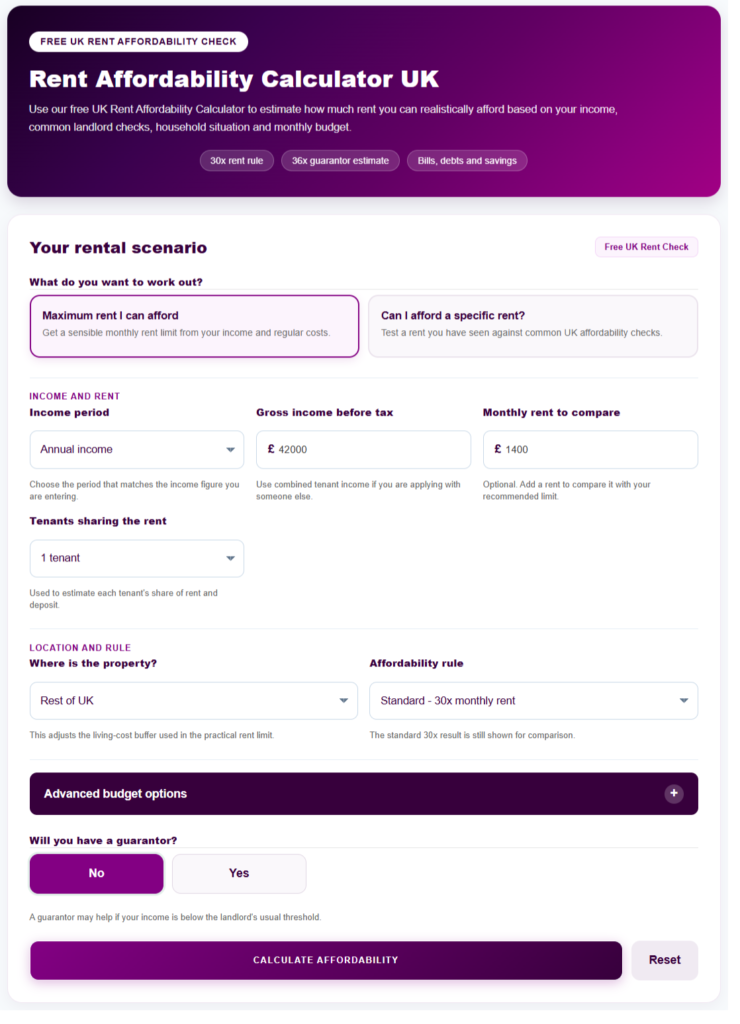
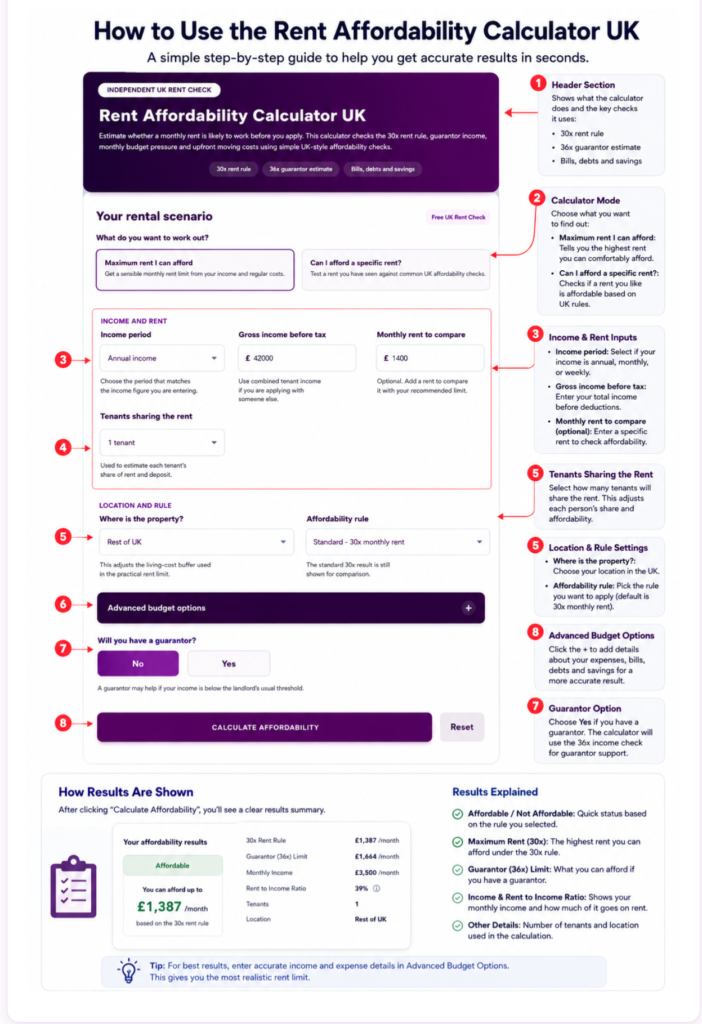
How to Use the Rent Affordability Calculator UK
Existing Financial Commitments
Landlords may consider:
- Personal loans
- Credit card balances
- Car finance agreements
- Student loans
Additional Income Sources
Some landlords may accept:
- Pension income
- Government benefits
- Freelance earnings
- Savings income
Read More: University Average CalculatorThe 30% Income Rule
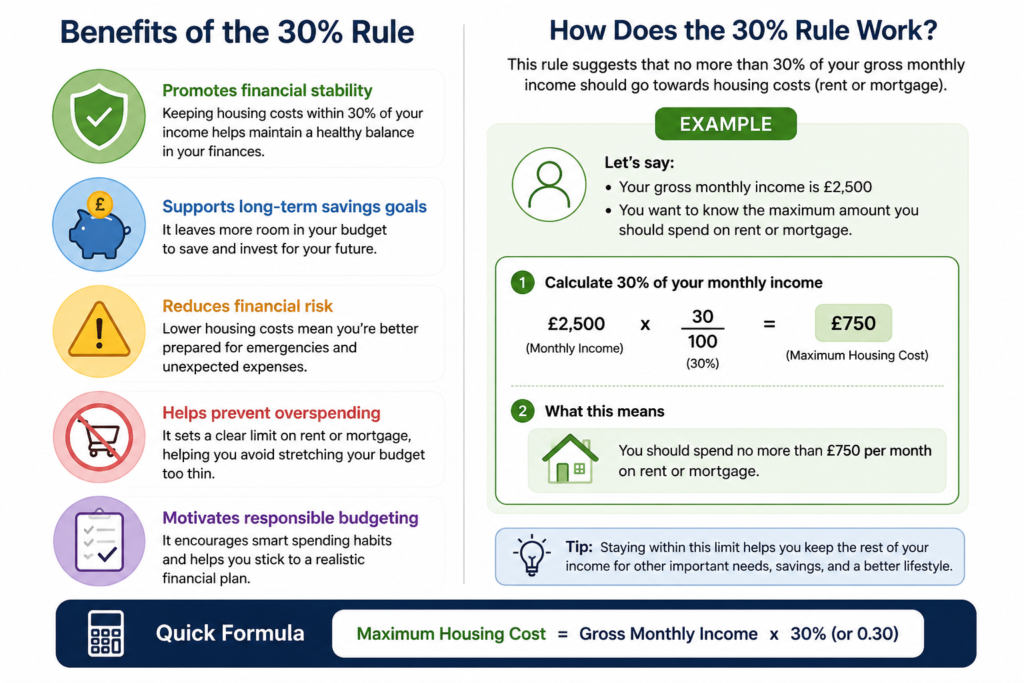
What Is the 30% Rule?
One of the most popular payability rules suggests spending no more than 30% of your income on rent and housing costs.
The goal is simple: ensure sufficient income remains available for daily expenses, savings, and emergencies.
| Monthly Income | 30% Rent Budget |
|---|---|
| £2,000 | £600 |
| £2,500 | £750 |
| £3,000 | £900 |
| £4,000 | £1,200 |
This rule is widely used because it provides a Simple way to determine reasonable rent levels.
Benefits of the 30% Rule
- Promotes financial stability
- Supports long-term savings goals
- Reduces financial risk
- Helps prevent overspending
- Motivates responsible budgeting
It is important to remember that this instruction is not a legal requirement. It simply serves as a practical Standard
The 50/30/20 Budget Rule
While the 30% rule focuses on housing costs, the 50/30/20 rule provides a broader budgeting framework.
| Budget Allocation | What It Includes |
|---|---|
| 50% for Needs | Rent, Utilities, Food, Transportation, Healthcare |
| 30% for Wants | Entertainment, Dining out, Hobbies, Shopping |
| 20% for Savings and Debt Repayment | Emergency funds, Investments, Savings accounts, Loan repayments |
While budgeting rules like the 30% and 50/30/20 methods help you set a personal ceiling, letting agents apply their own, often stricter, formulas when assessing your application and it’s worth knowing these before you view a property.
The 50/30/20 method helps renters maintain balance between spending and saving.
Letting Agent Income Requirements
Many letting agents use strict affordability formulas before approving an application.
Typical requirements include:
- Proof of employment
- Payslips
- Bank statements
- Income verification documents
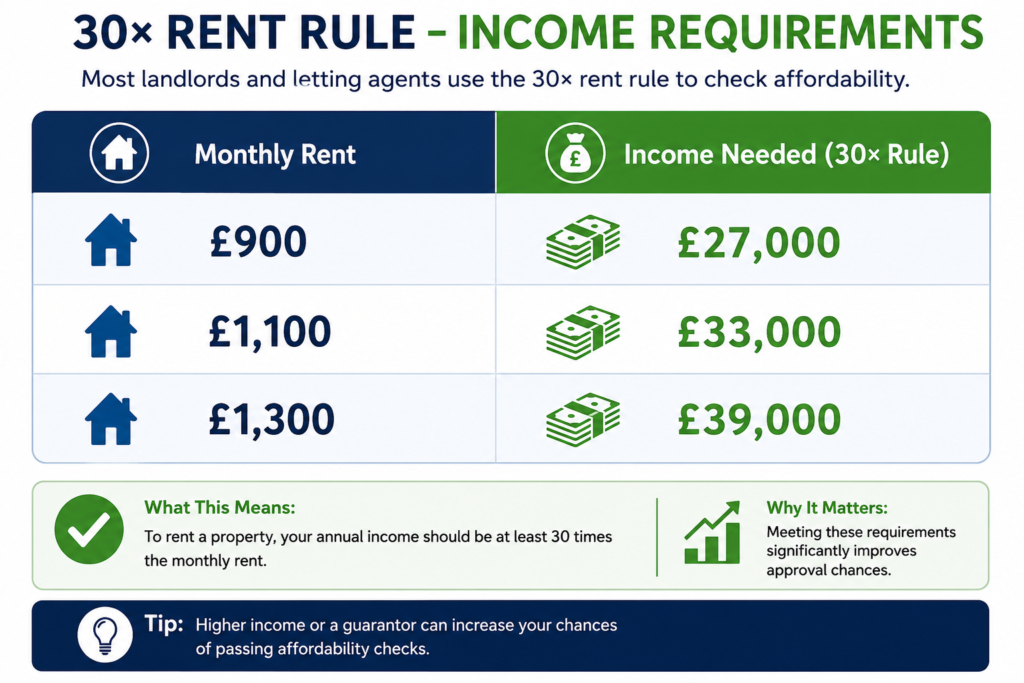
Some agencies require annual earnings equal to 30 to 36 times the monthly rent.
For example:
| Monthly Rent | Income Needed (30× Rule) |
|---|---|
| £900 | £27,000 |
| £1,100 | £33,000 |
| £1,300 | £39,000 |
Meeting these requirements significantly improves approval chances.
Affordability Checks for Self-Employed Renters and Benefit Claimants
| Income Type / Situation | How Affordability Is Usually Assessed |
|---|---|
| Fixed Monthly Payslip | Not every renter has a fixed monthly payslip, and landlords assess affordability differently depending on income type. |
| Self-Employed Applicants | Self-employed applicants are usually asked for 2–3 years of SA302 tax calculations or an accountant’s reference, plus recent business bank statements, since income can fluctuate year to year. |
| Universal Credit or Housing Benefit Claimants | Universal Credit or Housing Benefit claimants can still pass affordability checks, though some landlords ask for a guarantor if the housing element doesn’t fully cover the rent. Under the Equality Act 2010, landlords and agents cannot refuse an applicant purely for receiving benefits; a “No DSS” blanket policy has been found unlawful in UK courts. |
| Pension or Investment Income | Pension or investment income is typically averaged over the past 3–6 months of bank statements rather than judged on a single payslip. |
| Income Doesn’t Meet the Standard 30x Rule | If your income doesn’t fit the standard 30x rule, a guarantor earning roughly 36x the monthly rent annually (or holding sufficient savings) is the most common workaround letting agents accept. |
Affordability Checks by Landlords
Income Assessment
Landlords review whether your earnings can comfortably support rent payments.
Employment Verification
Stable employment often strengthens an application.
Document Review
Commonly requested documents include:
- Payslips
- Bank statements
- Employment contracts
Credit Checks
Credit reports help assess financial responsibility.
Financial Stability Review
Some landlords also evaluate overall financial health, including debts and regular monthly obligations.
How to Calculate Affordable Rent (Climax Section)
This is where affordability becomes practical.
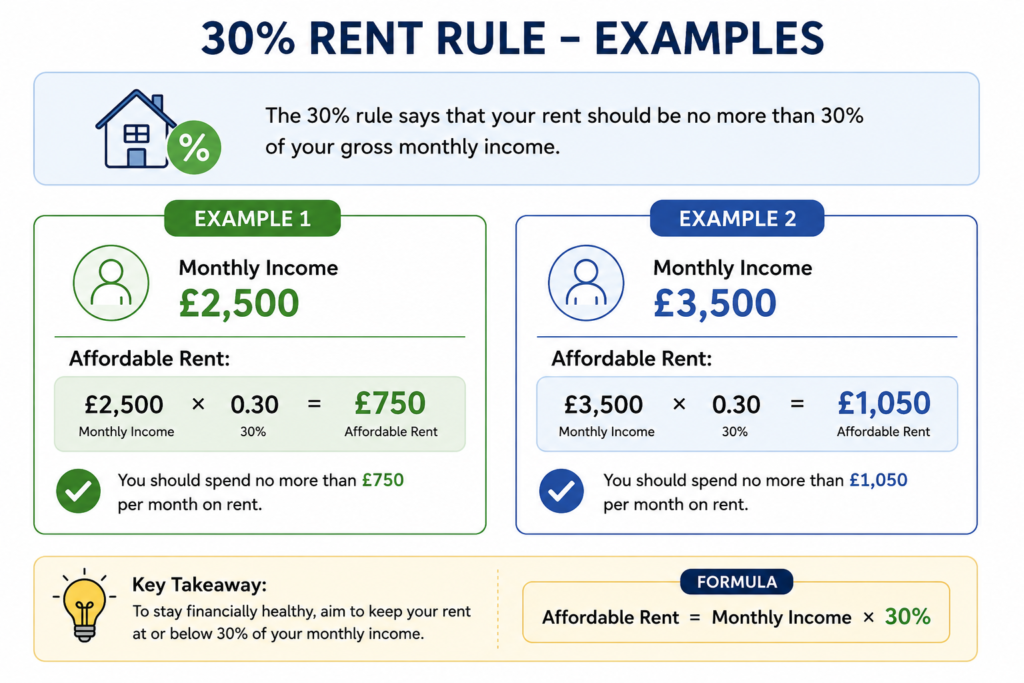
Use the following formula:
Affordable Monthly Rent = Monthly Income × 30%
Example 1
Monthly Income = £2,500
Affordable Rent:
£2,500 × 0.30 = £750
Example 2
Monthly Income = £3,500
Affordable Rent:
£3,500 × 0.30 = £1,050
Example 3
Monthly Income = £4,500
Affordable Rent:
£4,500 × 0.30 = £1,350
Practical Scenario
| Scenario | Details |
|---|---|
| Name | Priya |
| Monthly Income (After Tax) | £2,800 a month after tax. |
| Recommended Rent Budget (30% Rule) | Using the 30% rule, her recommended rent budget is £840. |
| Rent of the Chosen Flat | She finds a flat at £950/month — over budget by £110. |
| Monthly Outgoings | Before ruling it out, she checks her outgoings: £150/month in mobile and streaming subscriptions, no existing debt, and £3,000 in savings. |
| Adjustment Made | By trimming £100/month in discretionary spending, she brings her effective affordability closer to £940, just under the asking rent. |
| Letting Agent Affordability Check | She still passes the letting agent’s 30x annual income check (£2,800 × 12 = £33,600, well above the £28,500 needed for £950 rent). |
| Key Takeaway | This shows why the 30% rule is a starting point, not a hard cutoff — it works alongside your actual spending and savings buffer. |
Why the Same Salary Can Mean a Different Affordable Rent
Two people earning the same salary may not have the same realistic rent budget. For example, someone earning £36,000 a year with a short commute, no loan repayments and a good emergency fund may have more flexibility than another person earning the same amount but paying for a car, commuting daily and supporting a larger household. This is why a rent affordability check should not stop at the 30× income test. The income rule can help determine whether you may meet a landlord’s referencing requirement, while your personal budget tells you whether the rent is actually comfortable for you. Before choosing a property, compare the proposed rent with your take-home income, regular commitments and the amount you can still keep aside each month after paying your essential costs.
Quick Affordability Table
| Monthly Income | Recommended Rent |
| £2,000 | £600 |
| £2,500 | £750 |
| £3,000 | £900 |
| £3,500 | £1,050 |
| £4,000 | £1,200 |
| £5,000 | £1,500 |
This calculation provides a practical starting point before taking into account additional living expenses.
Check Your Rental Budget Before Applying
Before you start applying for rental properties, it is worth working out what you can realistically afford each month. Don’t look at the rent alone. Take your monthly income and consider the costs you already have, such as council tax, utilities, travel, loan repayments and other regular expenses. Once you know how much money you have left after these essentials, you can decide whether the rent would be comfortable rather than simply possible.
This can make your property search much easier. Instead of applying for homes that may stretch your budget, you can focus on properties within a rent range that you are more likely to manage comfortably. It also gives you a better idea of whether you would still have enough money left each month for savings, unexpected expenses and other day-to-day costs.
Factors That Affect Rent Affordability
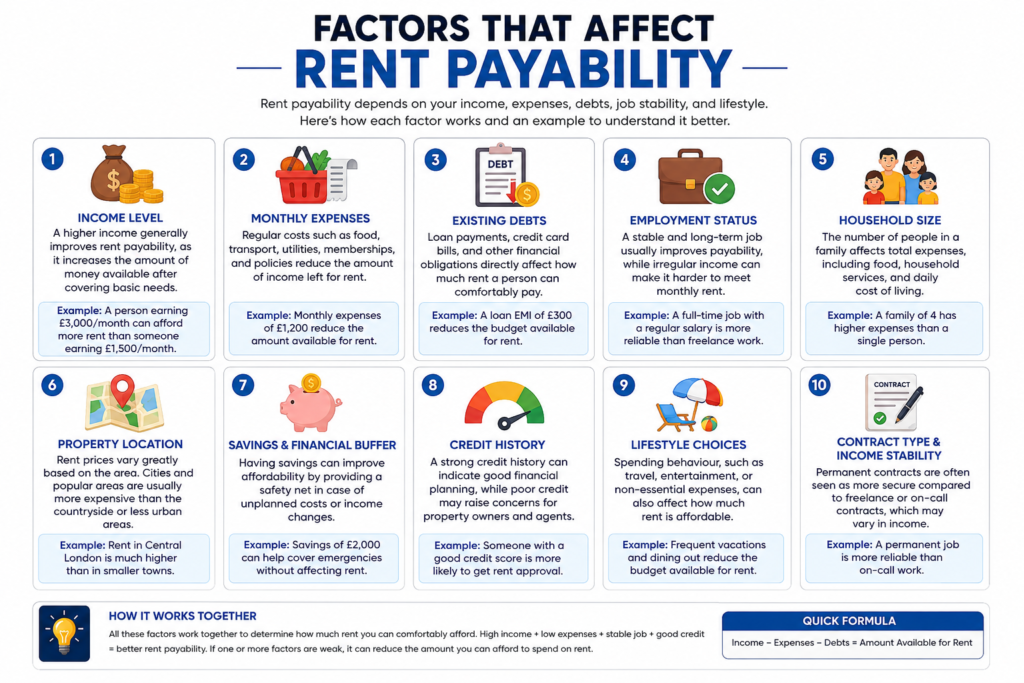
Several personal and financial conditions can influence how much rent is really affordable for a tenant. These factors are usually reviewed during payability checks to ensure the rent matches the tenant’s real financial situation.
Income Level
A higher income generally improves rent payability, as it increases the amount of money available after covering basic needs.
Monthly Expenses
Regular costs such as food, transport, utilities, Memberships, and policies reduce the amount of income left for rent.
Existing Debts
Loan payments, Credit card payments, and other financial obligations directly affect how much rent a person can comfortably pay
Employment Status
A stable and long-term job usually improves payability, while Irregular income can make it harder to meet monthly rent
Household Size
The number of people in a family affects total expenses, including food, Household services, and the daily cost of living
Property Location
Rent prices vary greatly based on the area. Cities and Popular areas are usually more expensive than the countryside or less Urban areas
Savings and Financial Buffer
Having savings can improve affordability by providing a safety net in case of unplanned costs or income changes.
Credit History
A strong credit history can indicate good financial planning, while poor credit may express concerns for property owners and agents.
Lifestyle Choices
Spending behaviour, such as travel, entertainment, or non-essential expenses, can also affect how much rent is affordable.
Contract Type and Income Stability
Permanent contracts are often seen as more secure compared to freelance or On-call contracts, which may vary in income.
Debt and Loan Payments
Debt duties can greatly affect affordability calculations.
Examples include:
- Personal loans
- Mortgage repayments
- Student loans
- Car finance agreements
- Credit card repayments
Before choosing a rental property, ensure these commitments are factored into your budget.
Location and Cost of Living
Location can dramatically influence housing affordability.
In many UK cities:
- Rent levels differ significantly
- Utility costs vary
- Transportation expenses change
- Daily living costs Change
A property that seems affordable in one area may be financially difficult in another.
Tips to Improve Rent Affordability
Improving the ability to pay. Monthly payment often does not require major changes. With limited income growth and better decisions, you can significantly increase your ability to pay rent on time comfortably.
| Tip | Description |
|---|---|
| Increase income through additional work | Getting a half-time job or self-employed work can help increase total monthly income. |
| Reduce unnecessary spending | Decreasing extra costs such as entertainment or unused plans can free up extra money for rent. |
| Follow a monthly budget | Creating and sticking to a clear budget helps record earnings and expenses more successfully. |
| Pay down existing debt | Reducing loan or payment card balances lowers monthly financial pressure and improves overall payability. |
| Choose a lower-cost property | Choosing a more reasonable home can make it easier to stay within a comfortable income-to-rent ratio. |
| Consider shared accommodation | Renting with others can greatly reduce individual rent and household bills. |
| Build an emergency savings fund | Having savings provides an emergency fund for unexpected expenses and helps maintain rent payments during tough months. |
| Avoid lifestyle inflation | Keeping spending habits under control when income increases helps maintain long-term financial ability. |
| Improve financial planning habits | Regularly checking expenses and changing your financial plan can help maintain better control over your financial situation. |
| Compare rental options carefully | Searching different areas and property types can help you find better value for money without compromising basic needs. |
Common Mistakes When Calculating Affordable Rent
Excluding Council Tax,
Local taxes can greatly impact overall housing costs.
Underestimating Living Costs
Daily expenses are often higher than expected.
Ignoring Existing Debt
Debt repayments reduce available disposable income.
Choosing Rent Above Budget
Overstretching financially increases risk.
Not Saving for Emergencies
Unexpected costs can create financial pressure.
Using Gross Income Instead of Net Income
Take-home pay provides a more realistic affordability calculation.
Forgetting Future Expenses
Financial plans should consider future obligations.
Not Comparing Rental Options
Researching multiple properties often reveals better value.
Read more:Rent Affordability Calculator London – How Much Rent Can You Afford in LondonWhat is the 30× rent rule in the UK?
The 30× rent rule is a commonly used affordability benchmark where a tenant’s gross annual income is expected to be around 30 times the monthly rent. For example, a property costing £1,000 per month would require an annual income of approximately £30,000 under this calculation. However, this is not a universal legal requirement, and individual landlords, letting agents and referencing providers may use different criteria.
Is the 30% rent rule a legal requirement in the UK?
No. The 30% rule is a budgeting guideline rather than a legal requirement. It suggests keeping rent around 30% of monthly income, helping renters leave enough money for other essential expenses, savings and unexpected costs. A landlord or letting agent may use a different affordability test when assessing an application.
How do landlords check rent affordability?
Landlords and letting agents may assess income, employment status, payslips, bank statements, credit history and existing financial commitments. The exact checks vary between providers. Some applicants may also need to provide additional evidence of income or a guarantor.
What income do I need to afford £1,000 rent?
Using the commonly used 30× benchmark, £1,000 monthly rent would correspond to approximately £30,000 gross annual income. However, passing this calculation does not guarantee approval because a letting agent may consider other financial circumstances as part of its affordability assessment.
Can I rent a property if I spend more than 30% of my income on rent?
Yes. Spending more than 30% of your income on rent is not automatically a reason you cannot rent a property. The 30% figure is a budgeting guideline, while landlords and letting agents may use their own affordability criteria. However, a higher rent-to-income ratio can leave less money available for other household expenses.
What happens if I do not meet the landlord’s income requirement?
If your income does not meet a landlord’s affordability criteria, the landlord or letting agent may consider other evidence depending on their policy. This could include additional income, savings or a guarantor. Requirements vary, so it is best to ask the letting agent what alternatives they accept before applying.
Can Universal Credit or other benefits count towards rent affordability?
Benefit income may be considered as part of an affordability assessment, although the exact approach varies between landlords and letting agents. Applicants receiving benefits may sometimes be asked for additional evidence or a guarantor. A landlord can still assess whether the rent is affordable, but should not simply assume that benefit income cannot be considered.
Do landlords consider existing debts when checking affordability?
They may. Existing financial commitments such as personal loans, credit card repayments, car finance and other regular payments can affect your overall financial position. Even if your income meets an income multiple, these commitments can reduce the amount of money you have available for rent and other living costs.
Should I use gross income or take-home income when calculating affordable rent?
It depends on what you are trying to measure. Letting agents commonly use gross annual income when applying an income-multiple affordability test, while take-home income gives you a more realistic picture of the money available for your monthly household budget. For personal budgeting, looking at your actual take-home income and regular expenses can provide a more useful affordability check.
Are rent affordability calculators accurate?
A rent affordability calculator can provide a useful estimate, but it cannot guarantee that a landlord or letting agent will approve your application. Different calculators and referencing providers may use different assumptions, and your actual affordability can also depend on debts, bills, household circumstances and other income.
What should I check before applying for a rental property?
Before applying, compare the proposed rent with your income and regular expenses, check the landlord or letting agent’s affordability criteria, and make sure you have the required income and financial documents available. Checking your budget first can help you avoid applying for properties that are outside your realistic price range.
Conclusion
Learning about rental property is about more than simply covering the monthly earnings.
By understanding UK rent ability-to-pay rules, applying the 30% guideline, and thinking about your full financial picture, you can choose a property that supports both your lifestyle and permanent financial balance.
Financial capacity is not a one-time calculation, either. Your income, costs, and life show change, and it’s worth revisiting your rent-to-income ratio every time your salary changes, before a repayable rental agreement, or whenever your monthly outgoings shift greatly. A property that was comfortably payable last year may feel more limited after a cost increase or new financial requirements.
The safest method is to treat the 30% rule as a starting point, not a final answer. Layer it with a real look at your bank statements, your existing loan, and a small savings buffer for urgent situations. Property owners and letting agents will run their own checks anyway, so doing this groundwork yourself means reduced surprises, reduced rejected applications, and a rental financial plan you can actually support— not just qualify for on paper.
Want me to also add a short closing call-to-action line (e.g., pointing readers to try a rent affordability calculator or check their numbers before applying)?