

Overtime, rent affordability can be difficult to work out if your payslip looks different every month. Working out whether you can afford a rental property isn’t as simple as adding up your annual earnings and dividing by twelve.
Most UK employees earning a fixed salary already know exactly what a landlord will see on their affordability check. But if part of your earnings comes from overtime, bonuses, commission, or shift Benefits, the answer to “will this count?” is a simple yes or no — and getting it wrong can mean applying for a property you’re later turned down for, or overlooking the importance of what you can actually manage.
This raises an important question:
Do additional hours, Rewards, and Performance-based pay count when a property owner or letting agent checks whether you can manage the cost?
No single rule applies across all property owners and referencing companies. Some affordability checks focus mainly on guaranteed contractual income, while others may consider a reliable history of variable earnings if you can provide evidence.
Understanding how your income may be assessed can help you choose a realistic rental budget, prepare your documents, and avoid surprises during the referencing process.
This guide explains how overtime, bonuses, and commission can affect rent affordability in the UK, what evidence may be requested, and how you can calculate your affordability more realistically.
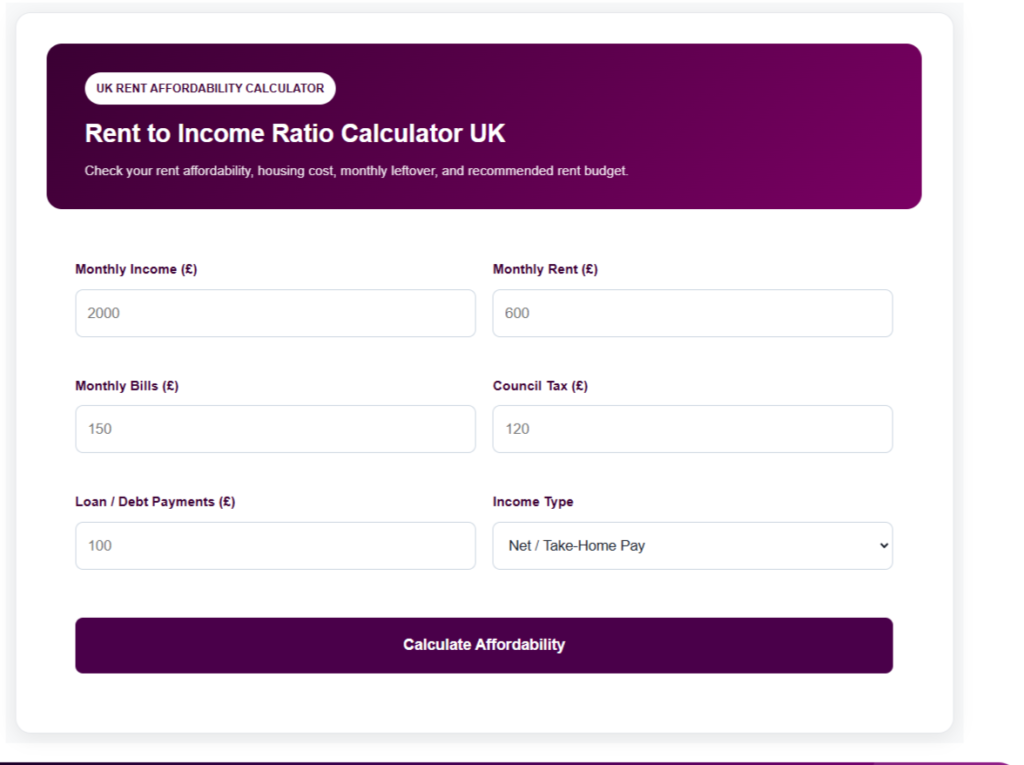
Click Here :Rent to Income Ratio Calculator UK
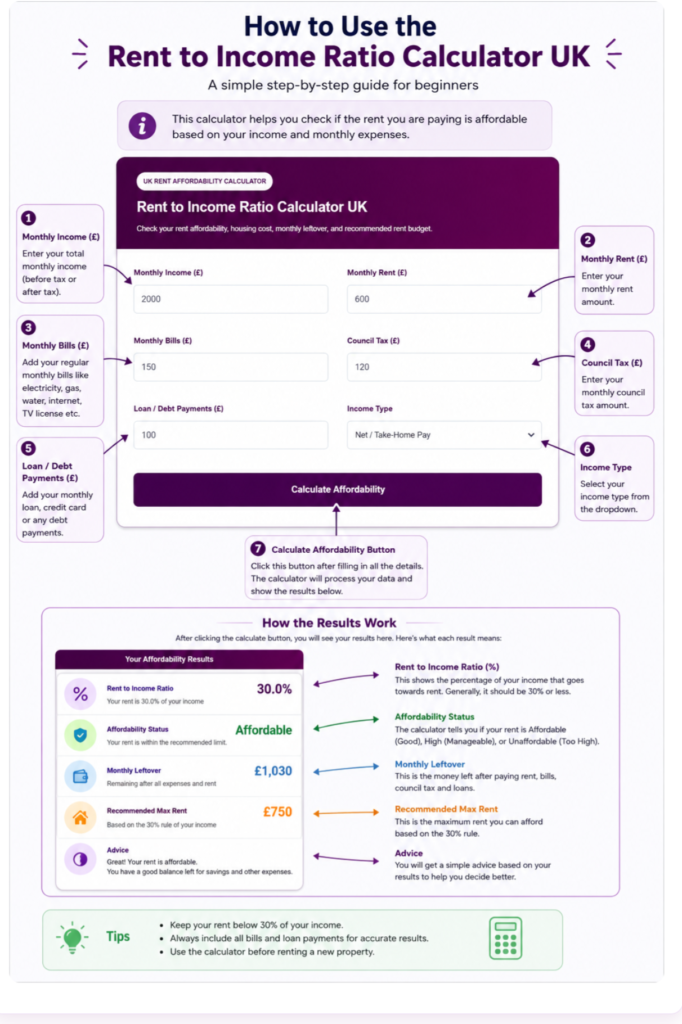
How to Use the Rent to Income Ratio Calculator UK
At a glance:
| Income type | Commonly counted? | What usually helps |
| Basic/contractual salary | Yes, almost always | Payslip, contract |
| Guaranteed shift allowance | Usually | Contract clause showing it’s fixed |
| Regular overtime (2+ years) | Sometimes | Multiple payslips or P60s showing a pattern |
| Occasional/one-off overtime | Rarely | Employer letter confirming it isn’t guaranteed to continue |
| Contractual bonus | Sometimes | Contract stating the guaranteed amount |
| Discretionary bonus | Rarely | History of consistent payments, if any weight is given at all |
| Regular commission | Sometimes | 6–12 months of payslips or bank statements |
Treatment varies by referencing provider, so use this as a starting point, not an assurance.
Tip: If you’re unsure how your income will be reviewed, ask the letting agent directly which referencing company they use (e.g., Homelet, Rightmove Referencing, Goodlord, or OpenRent) before you apply. Each provider publishes slightly different affordability criteria, and agents can usually tell you in advance whether they consider variable income.
Read more:1 Degree Calculator – Check If You Are on Track for Upper Second ClassWhat Is Rent Affordability?
Rent affordability is an assessment of whether your income is sufficient to cover the rent you are applying for.
Overtime Rent Affordability considers how overtime income can affect your ability to cover rent. Landlords and letting agents may use an affordability calculation as part of tenant referencing. The exact method varies, but a commonly used benchmark is that a tenant’s gross annual income should be around 2.5 times the annual rent.
| Calculation | Result |
|---|---|
| £1,000 × 12 = Annual rent | £12,000 |
| £12,000 × 2.5 = Required annual income | £30,000 |
So, a tenant may need a gross annual income of approximately £30,000 to meet that particular affordability benchmark.
OpenRent, for example, currently states that its standard affordability assessment uses 2.5 times the annual rent for tenants, although other factors can affect the overall referencing result.
The key point: what counts as “income” varies between referencing systems. Your basic salary is usually easy to verify. Overtime, bonuses, and commission are harder to pin down because they can change from one month or year to the next.
However, the important point is that what counts as income can vary between referencing systems.
Your basic salary may be easy to verify. Overtime, bonuses, and commission can be more complicated because they may change from one month or year to another.
Why Variable Income Can Be Complicated
Imagine two people who both earn £35,000 per year.
| Person A | Person B | |
|---|---|---|
| Guaranteed / Basic Salary | £35,000 | £27,000 |
| Overtime | £0 | £5,000 |
| Commission | £0 | £3,000 |
| Performance Bonus | £0 | £0 |
| Total Earnings | £35,000 | £35,000 |
On paper, both people earn £35,000.
But from a landlord’s perspective, their income may not carry the same level of certainty.
Person A has a contractual salary of £35,000.
Person B may earn £35,000 in a typical year, but some of the additional £8,000 depends on working extra hours and earning commission.
If the overtime disappears or commission falls, Person B’s income could decrease.
This is one of the main reasons variable income can receive different treatment during referencing.
Does Overtime Count as Income for Renting?
Overtime can count toward your income, but whether it is included depends on the referencing criteria and how consistent the overtime is.
Regular overtime is generally easier to demonstrate than occasional overtime.
For example, suppose your employment contract gives you a basic salary of £28,000.
During the last two years, you have consistently earned around £4,000 to £5,000 in overtime each year.
You may be able to provide evidence showing that the additional income is not a one-off payment.
However, if you earned £10,000 in overtime last year because your employer temporarily had an unusually large workload, a referencing company may be less willing to treat the full £10,000 as reliable future income.
The issue is not necessarily whether the money was genuinely earned.
The issue is whether the income is expected to continue.
Some referencing policies specifically exclude income that is not guaranteed, including overtime. Others may take a wider view depending on their assessment process.
For this reason, you should not automatically assume that your total annual earnings shown on a payslip or P60 will be treated as your qualifying rental income.
Regular Overtime vs Occasional Overtime
The difference between regular and occasional overtime is particularly important.
Regular overtime
Suppose your basic salary is £30,000.
You have worked approximately £5,000 of overtime every year for the past three years.
Your total annual earnings have been:
| Year | Annual Income |
|---|---|
| Year 1 | £34,800 |
| Year 2 | £35,200 |
| Year 3 | £35,100 |
This creates a useful record showing that overtime has been a consistent part of your earnings.
“A landlord or referencing company may be more comfortable considering some or all of this income — though two referencing companies can reach different conclusions from the same payslips.”
Occasional overtime
Now imagine another employee with a £30,000 salary.
They earned £8,000 of overtime last year but only £1,000 the year before.
The income is much less predictable.
A landlord may reasonably want to know whether the applicant can still afford the rent using their basic salary if the overtime falls.
This is why a history of earnings can sometimes be more useful than simply looking at the largest amount earned in a single year.
Read more: How Much Savings Should You Have Before Renting in the UK? (2026 Guide)Do Bonuses Count for Rent Affordability?
Bonuses are another form of variable income.
| Bonus Type |
|---|
| Annual |
| Quarterly |
| Performance-related |
| Company-related |
| Contractually guaranteed |
| Discretionary |
| Based on sales or targets |
These differences matter.
A guaranteed contractual bonus may be treated differently from a discretionary performance bonus.
For example, imagine your employment contract states that you receive a guaranteed annual payment of £2,000.
That is easier to verify than a bonus that your employer may or may not award depending on company performance.
If your bonus is discretionary, there is no certainty that you will receive the same amount next year.
This makes it harder to rely on the bonus when assessing long-term rent affordability.
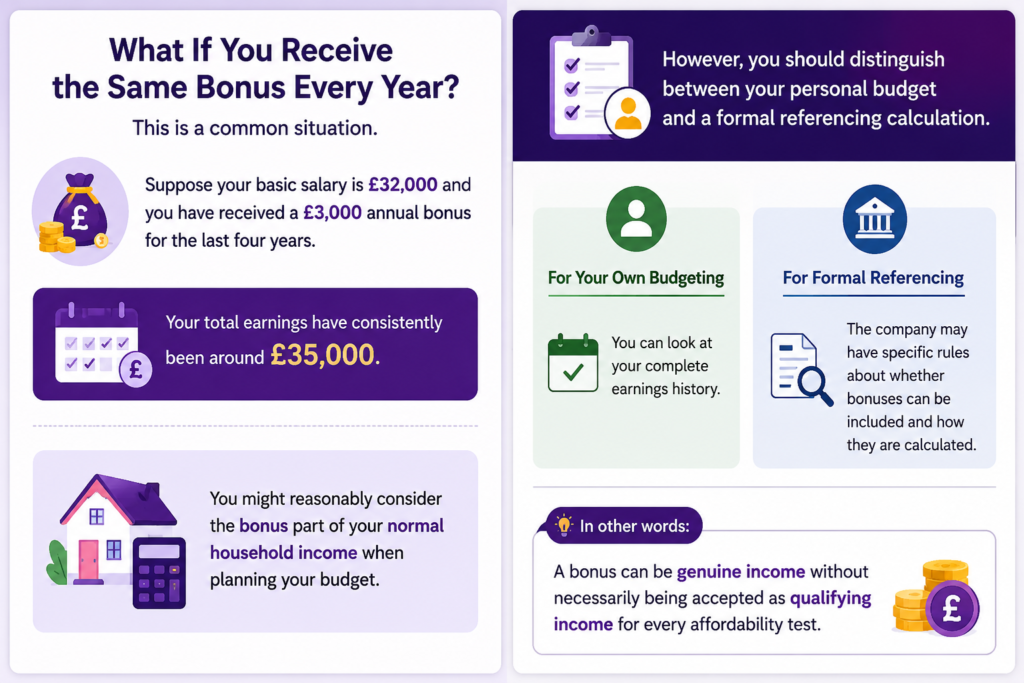
What If You Receive the Same Bonus Every Year?
This is a common situation.
Suppose your basic salary is £32,000 and you have received a £3,000 annual bonus for the last four years.
Your total earnings have consistently been around £35,000.
You might reasonably consider the bonus part of your normal household income when planning your budget.
However, you should distinguish between your personal budget and a formal referencing calculation.
For your own budgeting, you can look at your complete earnings history.
For formal referencing, the company may have specific rules about whether bonuses can be included and how they are calculated.
In other words:
A bonus can be genuine income without necessarily being accepted as qualifying income for every affordability test.
Does Commission Count as Income?
Commission can also count in some affordability assessments, but it can be one of the more difficult types of income to assess.
This is because commission can change significantly.
For example, a sales employee might earn:
| Year | Basic Salary | Commission | Total Earnings |
|---|---|---|---|
| Year 1 | £25,000 | £8,000 | £33,000 |
| Year 2 | £25,000 | £12,000 | £37,000 |
| Year 3 | £25,000 | £6,000 | £31,000 |
The employee’s total earnings vary between £31,000 and £37,000.
A referencing company may therefore look for evidence of the commission history rather than simply accepting the highest annual figure.
Some employers can confirm salary and variable earnings. Payslips and other employment records may also help establish the pattern of income.
The exact evidence required depends on the referencing provider and landlord.
Why Landlords Care About Guaranteed Income
Rent is usually due every month.
Your landlord therefore needs to be confident that you can make the payment consistently.
Consider two applicants.
| Basic Salary | Variable Income | Total Income | |
|---|---|---|---|
| Applicant A | £36,000 | £0 | £36,000 |
| Applicant B | £27,000 | £9,000 | £36,000 |
Both may earn around £36,000 in a good year.
But Applicant B’s income depends partly on commission.
If sales are lower next year, their income could fall.
That does not automatically mean Applicant B cannot afford the property. It simply means the landlord or referencing company may want stronger evidence.
This is why affordability assessments often focus on income reliability, not simply the largest possible income figure.
How Tenant Referencing Usually Looks at Income
Tenant referencing can involve several different checks.
| Tenant Screening Check |
|---|
| Employment verification |
| Income verification |
| Credit information |
| Previous landlord references |
| Rental history |
| Right to Rent checks where applicable |
| Affordability calculations |
OpenRent says its referencing process can include credit information, affordability, income and employment checks, and previous landlord information.
Shelter also advises renters that landlords and letting agents commonly check income and credit information when assessing whether a property is affordable.
The important point is that passing an income calculation does not necessarily guarantee acceptance.
Likewise, failing one affordability calculation does not always mean you cannot rent the property.
The final decision can depend on the landlord’s criteria, the referencing provider, and the circumstances of the application.
What Documents Can Help Prove Variable Income?
If overtime, bonuses, or commission are an important part of your earnings, having good documentation can make your income easier to understand.
Depending on the referencing process, you may be asked for evidence such as:
Recent payslips
Payslips can show:
- Basic salary
- Overtime
- Commission
- Bonuses
- Gross earnings
- Net earnings
If variable income appears regularly, several payslips can help demonstrate the pattern.
| Document | Details |
|---|---|
| Employment contract | Your employment contract can show your basic salary and whether certain payments are contractual. This can be particularly useful when an employer provides a fixed salary plus additional payments. |
| Employer reference | An employer may be asked to confirm your employment and income. This can help verify information supplied during the application. |
| P60 | A P60 can show your total taxable pay for the tax year. It may help demonstrate your overall earnings history, although the referencing company decides what income it will use for its affordability calculation. |
| Bank statements | Some landlords or referencing processes may request financial evidence, although requirements differ. Do not suppose that every landlord will require the same documents. |
Should You Include Overtime in Your Own Affordability Calculation?
Yes, but it is sensible to be conservative.
When you calculate how much rent you can personally afford, you should not build your entire housing budget around income that may disappear.
Suppose your income is:
| Income Type | Amount |
|---|---|
| Basic salary | £30,000 |
| Typical overtime | £4,000 |
| Possible annual bonus | £2,000 |
| Total potential income | £36,000 |
But if your overtime and bonus are not guaranteed, it may be safer to test the rent against your basic income first.
Then consider whether your normal variable income makes the budget more comfortable.
This gives you two useful figures:
Guaranteed-income affordability
and
Typical-income affordability
The difference between the two can tell you how dependent your budget is on overtime or bonuses.
Read more:Rent Affordability Calculator Leeds – Calculate Your Rental Budget (2026)Example: Calculating Rent Affordability With Overtime
Let’s say Sarah earns:
| Income Type | Amount |
|---|---|
| Basic salary | £30,000 |
| Regular overtime | £4,800 per year |
| Annual bonus | £1,200 |
| Total annual income | £36,000 |
Her total typical earnings are:
£30,000 + £4,800 + £1,200 = £36,000
Now suppose the annual rent is £12,000.
Using a 2.5-times income benchmark:
£12,000 × 2.5 = £30,000
Sarah’s basic salary alone is £30,000, so she meets that example threshold without relying on overtime or her bonus.
This is a stronger position than an applicant whose basic salary is only £24,000 and who needs £6,000 of uncertain overtime and commission to reach £30,000.
The lesson is simple:
Do not assume variable income will rescue an otherwise unaffordable rental application.
Example: When Variable Income Makes a Difference
Now consider James.
His income is:
| Income Type | Amount |
|---|---|
| Basic salary | £25,000 |
| Overtime | £4,000 |
| Commission | £5,000 |
| Total annual income | £34,000 |
Total typical income:
£34,000
He wants to rent a property for £1,000 per month.
Annual rent:
£1,000 × 12 = £12,000
At 2.5 times the annual rent:
£12,000 × 2.5 = £30,000
James earns more than £30,000 when his overtime and commission are included.
But his basic salary is only £25,000.
If the referencing company only accepts guaranteed income, he could fall short of its affordability requirement.
If the company accepts documented variable income, his position may be different.
This example shows why knowing the landlord’s or referencing provider’s criteria before applying can save time and frustration.
What If You Are Paid Commission Every Month?
Monthly commission can be easier to demonstrate when it has been consistent over a long period.
For example:
| Month | Commission |
| January | £450 |
| February | £510 |
| March | £480 |
| April | £530 |
| May | £495 |
| June | £520 |

This pattern shows regular additional income.
However, consistency does not automatically mean that every referencing company will count the commission.
The company may have its own rules about variable earnings, averaging periods, or acceptable evidence.
The best approach is to ask the letting agent or referencing provider before relying on commission to meet an affordability threshold.
What About Zero-Hours Contracts, Probation Periods, or New Jobs?
Variable income becomes even harder to assess if you’re newly employed, still on probation, or working a zero-hours contract.
If you’ve been in a job for less than 3–6 months, most referencing providers won’t have enough payslip history to establish a reliable pattern of overtime or commission — even if your employer confirms the role is permanent. In these cases:
A guarantor is often requested regardless of your total income
Your basic contracted hours (if any) are usually the only figure used
An employer reference confirming your start date, role, and expected earnings can help, but rarely replaces payslip history entirely
Zero-hours contract income is typically treated as unpredictable by default, even if you’ve worked consistent hours for years. If this applies to you, ask the letting agent early whether they’ll accept bank statements or an employer letter as an alternative to payslip averaging.
What If Your Overtime Is Guaranteed?
Some jobs include contractual additional hours or fixed allowances.
For example, an employee might have:
| Income Type | Amount |
|---|---|
| Basic salary | £28,000 |
| Contractual shift allowance | £3,000 |
| Guaranteed annual income | £31,000 |
This is different from someone who simply chooses to work extra hours whenever they are available.
The more clearly an income component is guaranteed under the employment arrangement, the easier it may be to verify.
“However, the exact treatment regularly comes down to how that specific provider defines ‘guaranteed’ income.”
Always check how the particular provider defines qualifying income.
What Happens If You Fail the Affordability Check?
Failing an affordability check does not necessarily mean the end of your rental application.
There may be other possibilities depending on the landlord’s policies and your circumstances.
| Factors a landlord may consider |
|---|
| A guarantor |
| A joint tenant’s income |
| Documented savings |
| Strong rental history |
| Additional evidence of variable income |
OpenRent notes that savings can be used in its referencing process, although savings are treated separately from regular income.
The available options will depend on the landlord, letting agent, referencing provider and property.
You should ask what alternatives are accepted rather than assuming one solution applies to every rental.
Joint Applications and Variable Income
If two people are renting together, household income may be considered.
| Income | Person A | Person B | Combined |
|---|---|---|---|
| Basic salary | £30,000 | £24,000 | £54,000 |
| Overtime | £3,000 | — | £3,000 |
| Commission | — | £2,000 | £2,000 |
| Total typical income | £33,000 | £26,000 | £59,000 |
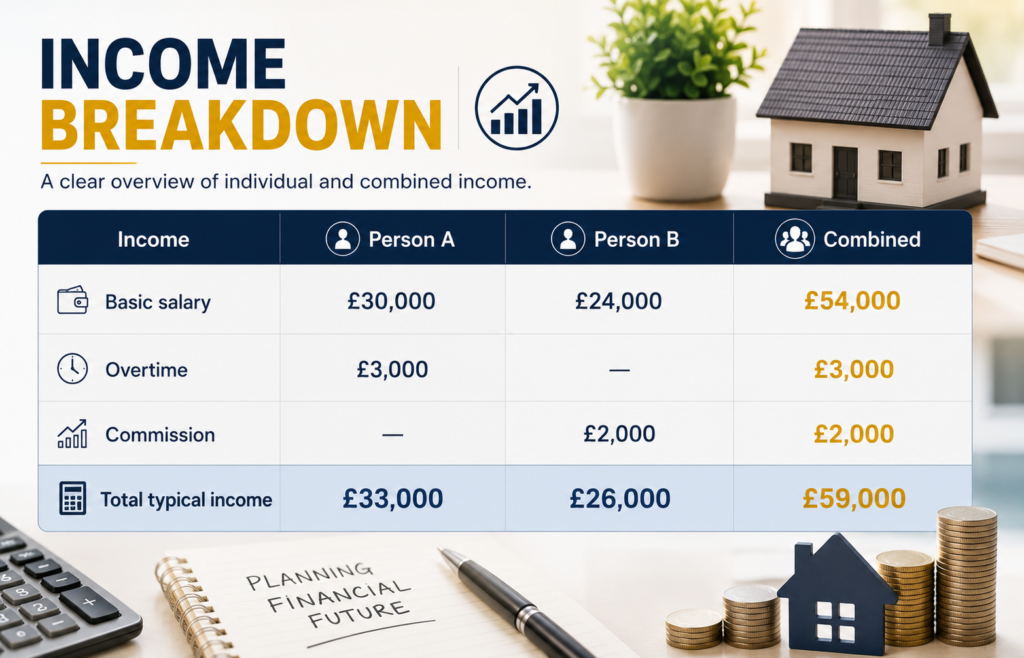
This can improve their overall affordability.
“However, once again, whether the £5,000 of variable income is included isn’t something you can assume — it’s worth confirming before you rely on it.”
For joint renters, it is useful to calculate affordability using both:
- Guaranteed income
- Guaranteed income plus reliable variable income
This gives a more realistic picture of the household’s financial position.
The Difference Between Affordability and Budgeting
This is one of the most important points to understand.
A referencing calculation asks whether you meet a particular set of criteria.
A personal budget asks whether you can comfortably afford the property in real life.
These are not always the same thing.
| Regular Expense |
|---|
| Council tax |
| Energy |
| Water |
| Broadband |
| Transport |
| Food |
| Insurance |
| Mobile phone costs |
| Debt payments |
| Other regular expenses |
Shelter highlights rent, utilities, council tax, and upfront rental costs as important parts of the overall cost of renting.
Therefore, passing a 2.5-times income calculation should not automatically be treated as proof that a property is comfortable for your personal budget.
A Simple Monthly Rent Stress Test
Passing a rental affordability check is only one part of the decision. Before choosing a property, it can be useful to test what your monthly budget would look like after the rent has actually been paid.
Start with your usual take-home income rather than your gross annual salary. Then subtract the costs that you expect to pay every month, including rent, council tax, energy, water, broadband, transport, food, insurance, debt repayments, and other regular household expenses.
For example, imagine your monthly take-home income is £2,400, and the rent is £900.
| Monthly Item | Amount |
|---|---|
| Take-home income | £2,400 |
| Rent | £900 |
| Council tax | £150 |
| Energy and water | £180 |
| Broadband and mobile | £50 |
| Transport | £200 |
| Food and household costs | £350 |
| Debt repayments | £150 |
| Other regular costs | £120 |
| Money left | £300 |
In this example, £300 remains after the listed expenses. That does not automatically mean the property is affordable, because unexpected costs can still arise. However, it gives you a more realistic picture than looking at salary alone.
You can also repeat the same calculation using a lower-income month. If your overtime or commission falls, ask yourself whether you could still cover the rent and essential bills without relying on credit or using your savings every month.
This is particularly useful for people whose earnings change from month to month. Instead of asking only, “Can I pass the affordability check?”, ask:
“What would my budget look like in a normal month, and what would happen in a weaker month?”
If the rent only works when overtime, commission, or bonuses are unusually high, that is an important part of your budgeting picture. If you can cover the essential costs from your regular income and still have some money available for unexpected expenses, you have a clearer basis for deciding whether the rent fits your circumstances.
Remember that this is a personal budgeting test, not a formal tenant-referencing rule. A landlord or referencing provider may use a completely different method when assessing your application.
A Better Way to Calculate Your Own Rent Budget
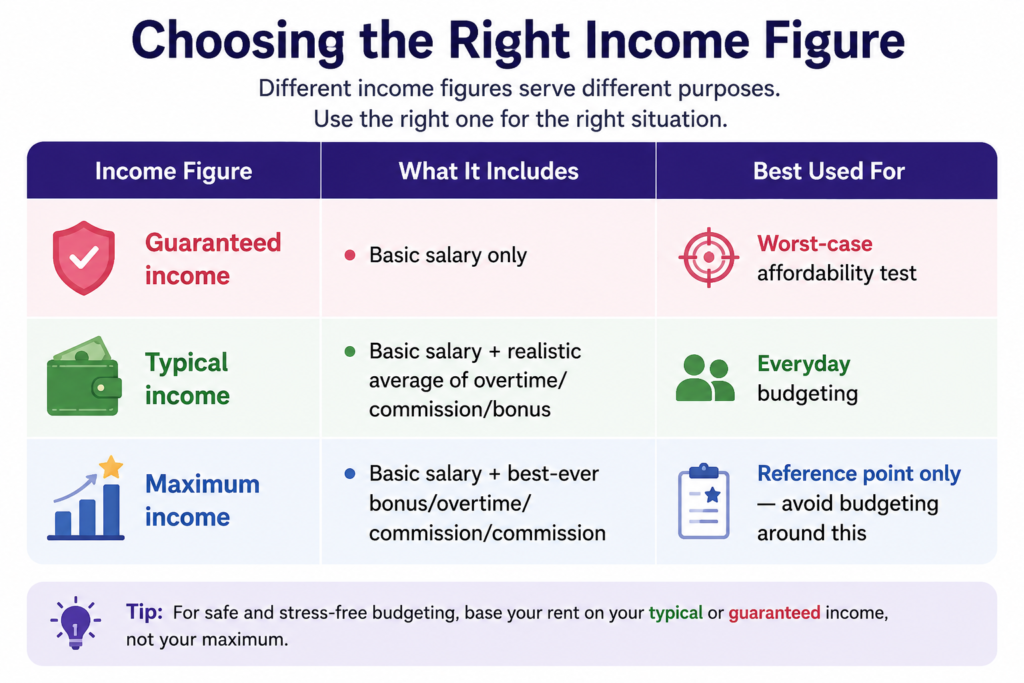
If your income includes overtime, commission, or bonuses, consider creating three income figures.
| Income Type | Calculation / Example | Total |
|---|---|---|
| Guaranteed income | Basic salary = £30,000 | £30,000 |
| Typical income | £30,000 + £3,500 average overtime + £2,000 average commission | £35,500 |
| Maximum income | Includes unusually high bonuses or overtime | £40,000 |
Do not build your normal rent budget around the maximum figure.
The typical figure is usually more useful for planning, while the guaranteed figure provides a conservative test.
Why Using Your Highest-Earning Month Can Be Misleading
Suppose your basic salary is £2,500 per month.
| Income Type | Amount |
|---|---|
| Salary | £2,500 |
| Overtime | £1,000 |
| Commission | £800 |
| Total | £4,300 |
It might be tempting to think:
“I earn more than £4,000 every month.”
But that may not be true.
| Income Type | Amount |
|---|---|
| Salary | £2,500 |
| Overtime | £200 |
| Commission | £150 |
| Total | £2,850 |
This is why annual or multi-month income history can be more useful than choosing your highest monthly payslip.
Variable income should be evaluated based on its pattern, not just its peak.
Read more: Rent Affordability Calculator Glasgow – Find Out How Much Rent You Can Afford How to Prepare Before Applying for a Rental
If overtime, bonuses or commission form a great part of your income, preparation can make the process smoother.
Check the advertised affordability requirement
Some property listings state an income multiple or referencing requirement.
If the rent is £1,200 per month and the stated requirement is 2.5 times annual rent:
£1,200 × 12 × 2.5 = £36,000
You can then compare this figure with the income that is likely to be accepted.
Ask whether variable income counts
Do not wait until after submitting an application.
Ask:
“Does your affordability assessment include regular overtime, bonuses or commission?”
This simple question can prevent confusion.
Gather your income evidence
Keep relevant payslips and employment information available.
If your variable income has been consistent, having several months or years of evidence may help explain your earnings.
Calculate affordability conservatively
Run your budget using basic salary first.
Then see how your regular variable income changes the result.
This can help you avoid choosing a property that only works when you receive an unusually large bonus.
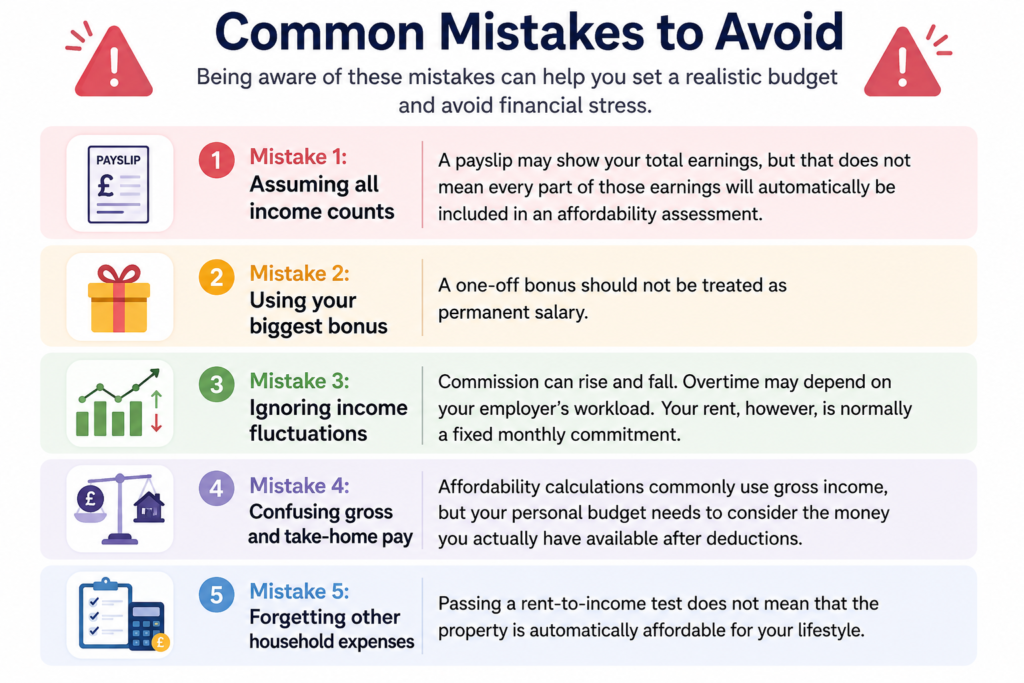
Common Mistakes Renters Make
| Mistake | Explanation |
|---|---|
| Mistake 1: Assuming all income counts | A payslip may show your total earnings, but that does not mean every part of those earnings will automatically be included in an affordability assessment. |
| Mistake 2: Using your biggest bonus | A one-off bonus should not be treated as permanent salary. |
| Mistake 3: Ignoring income fluctuations | Commission can rise and fall. Overtime may depend on your employer’s workload. Your rent, however, is normally a fixed monthly commitment. |
| Mistake 4: Confusing gross and take-home pay | Affordability calculations commonly use gross income, but your personal budget needs to consider the money you actually have available after deductions. |
| Mistake 5: Forgetting other household expenses | Passing a rent-to-income test does not mean that the property is automatically affordable for your lifestyle. |
Does overtime count as income for renting?
It can, but there is no universal rule that requires every landlord or referencing company to include it. Some assessments focus on guaranteed income, while others may consider consistent and documented variable earnings.
Does an annual bonus count toward rent affordability?
It may count if the referencing criteria allow bonuses to be included. A guaranteed or consistently documented bonus may be easier to assess than a discretionary payment.
Does commission count as income for tenant referencing?
Commission may be considered by some referencing providers, particularly when there is evidence of regular earnings. However, acceptance and calculation methods vary.
Can I use my P60 to prove my total income?
A P60 can help demonstrate your earnings for a tax year, but it does not guarantee that all income shown will be accepted in a particular affordability assessment.
Is overtime treated the same as salary?
Not necessarily. Basic contractual salary is generally more predictable than overtime. The treatment of overtime depends on the landlord or referencing provider.
What if my basic salary is below the required amount?
You may still have options depending on the landlord’s policy. They may consider accepted variable income, joint income, savings, or a guarantor.
Should I include my bonus when calculating my personal rent budget?
You can consider it, but it is safer not to depend heavily on income that is uncertain. A conservative budget based on guaranteed income can show whether you could still manage the rent if your bonus disappears.
Can two tenants combine their income?
Joint applications can often be assessed using household income, but the exact rules depend on the referencing process.
Do zero-hours or agency contracts count as income for renting?
They can, but they’re usually treated as less predictable than fixed-hours employment, even with a strong payslip history. Some landlords will ask for a guarantor regardless of income level in these cases.
How many months of payslips do referencing companies usually ask for?
This varies, but many providers request 3–6 months of payslips as a minimum, with some asking for up to 12 months if a large portion of your income is variable.
Final Thoughts: Should You Count Overtime, Bonuses and Commission?
The answer is yes for your own financial planning, but be more careful when it comes to formal rental referencing.
Overtime, bonuses and commission are real sources of income. However, they are often less predictable than a fixed salary.
A landlord or referencing provider may therefore ask:
- Is the income guaranteed?
- How long have you received it?
- How regularly is it paid?
- Can your employer confirm it?
- Has the amount been consistent?
- What evidence supports it?
- Would you still be able to pay the rent if the income fell?
There is no single approach used by every landlord or referencing company.
For example, some referencing systems use a standard income multiple, while individual providers can have different rules about which forms of variable income qualify. OpenRent currently uses a standard 2.5-times annual-rent income benchmark for tenants, but the overall referencing decision can involve other factors.
The safest approach is to calculate your rent affordability in two ways.
First, use your guaranteed income.
Then, calculate it again using your normal and well-supported variable income.
If the property is affordable using your basic salary alone, you have more breathing room. If you need every pound of overtime, commission or bonus just to reach the required threshold, it is worth being more cautious.
Ultimately, the goal should not simply be to pass a referencing check. The goal is to choose a rent that you can practically manage month after month.
Before applying for a property, check the specific affordability rules being used by the property owner or referencing provider. Your overtime, bonus or commission may help, but you should never assume that every type of variable income will be treated in exactly the same way.
For a quick starting point, you can also use a UK rent affordability calculator to compare your income with the rent you are considering and understand how different income levels affect your rental budget.