When Aisha signed for her one-bedroom flat in Manchester at £950 a month, she budgeted down to the pound: rent, deposit, energy, broadband, food. Then, three weeks after moving in, a brown envelope arrived from the council. Her council tax bill: £1,860 for the year — roughly £155 a month she had never factored in. Like countless others new to council tax for renters, she hadn’t even known to budget for it.
Aisha is not unusual. Council tax is the forgotten cost of renting. It is not optional, it is not small, and unlike your rent it is set by your local council rather than your landlord — which means many renters first meet it as an unpleasant surprise. This guide to council tax for renters explains exactly how it works in 2026: who has to pay, how the bands are worked out, what you will actually pay, every discount and exemption worth knowing, and how to fit it into your rent budget.
Quick answer: If you are 18 or over and rent your home as your main residence, you pay the council tax — not your landlord. The amount depends on your property’s valuation band (A to H in England and Scotland, A to I in Wales) and your council’s rates: the England average for a Band D home in 2026/27 is £2,392 a year. Live alone and you get 25% off; full-time students are exempt; and if you are on a low income you can apply for Council Tax Reduction. Scotland includes water charges in the bill; Northern Ireland uses a separate system called domestic rates.
Council tax for renters differs between England, Scotland, Wales and Northern Ireland. This guide reflects the position as of October 2026 and is general information, not financial or legal advice.
What Is Council Tax for Renters and What Does It Pay For?
Council tax is the main way local councils in England, Scotland and Wales fund local services. Your bill pays for things like rubbish collection, street lighting, local policing, fire services, schools and adult social care — and council tax for renters covers exactly the same services as for owner-occupiers. It has existed since 1993, when it replaced the short-lived community charge (the “poll tax”).
Three things decide your council tax for renters bill:
- Your property’s valuation band — every home is placed in a band based on what it was worth decades ago (more on this below).
- Your council’s rates — each local authority sets its own charge per band every year.
- Any discount or exemption you qualify for — and this is where renters can save real money.
A full council tax bill assumes two adults live in the property — the starting point for understanding council tax for renters. If fewer than two countable adults live there, discounts apply — which is why your household make-up matters as much as the property itself.
Do Renters Pay Council Tax, or Does the Landlord?
This is the question almost every first-time renter asks about council tax for renters, and the answer is refreshingly simple: the tenant usually pays. Under the legal “hierarchy of liability”, the person at the top of the list pays the bill — and a resident tenant sits near the very top, just below a resident owner-occupier. In practice, if you rent a whole property and live in it, the bill is yours.
| Your situation | Who pays the council tax? |
|---|---|
| You rent a whole flat or house (sole or joint tenancy) | You — joint tenants are jointly responsible for the full bill |
| You live with a partner | Both of you, jointly — even if only one name is on the bill |
| You rent a room in a shared house (HMO) where everyone has separate agreements | Usually the landlord — houses in multiple occupation are an exception |
| You are a lodger living with your landlord | Usually the landlord |
| The property is empty between tenancies | The landlord (as the owner) |
Two points about council tax for renters catch people out. First, your tenancy agreement cannot overrule the law on who is liable — if the council says you are the liable person, a clause claiming otherwise will not protect you (though you and your landlord can agree privately about who actually hands over the money). Second, if you move out mid-tenancy without properly ending it, you may stay liable until the tenancy legally ends — tell the council the day you move.
If you are ever unsure, contact your local council — they decide liability, and Shelter notes that you should challenge any bill that is not your responsibility.
How Council Tax Bands Work
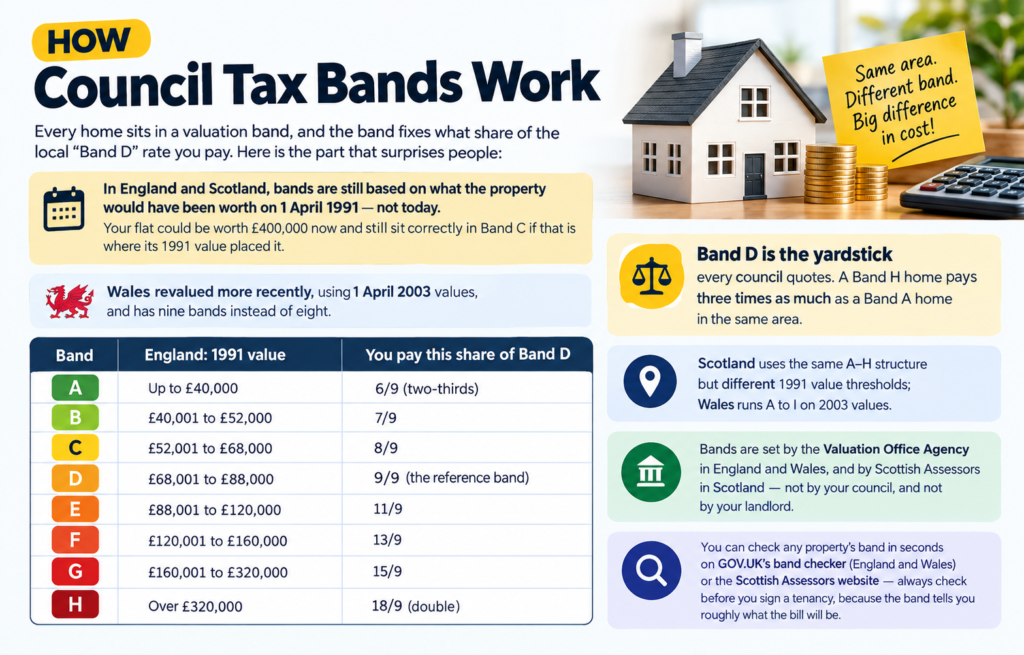
Every home sits in a valuation band, and the band fixes what share of the local “Band D” rate you pay. Here is the part that surprises people: in England and Scotland, bands are still based on what the property would have been worth on 1 April 1991 — not today. Your flat could be worth £400,000 now and still sit correctly in Band C if that is where its 1991 value placed it. Wales revalued more recently, using 1 April 2003 values, and has nine bands instead of eight.
| Band | England: 1991 value | You pay this share of Band D |
|---|---|---|
| A | Up to £40,000 | 6/9 (two-thirds) |
| B | £40,001 to £52,000 | 7/9 |
| C | £52,001 to £68,000 | 8/9 |
| D | £68,001 to £88,000 | 9/9 (the reference band) |
| E | £88,001 to £120,000 | 11/9 |
| F | £120,001 to £160,000 | 13/9 |
| G | £160,001 to £320,000 | 15/9 |
| H | Over £320,000 | 18/9 (double) |
Band D is the yardstick every council quotes. A Band H home pays three times as much as a Band A home in the same area. Scotland uses the same A–H structure but different 1991 value thresholds; Wales runs A to I on 2003 values. Bands are set by the Valuation Office Agency in England and Wales, and by Scottish Assessors in Scotland — not by your council, and not by your landlord.
You can check any property’s band in seconds on GOV.UK’s band checker (England and Wales) or the Scottish Assessors website — always check before you sign a tenancy, because the band tells you roughly what the bill will be.
Council Tax for Renters: How Much Will You Pay in 2026/27?
Council tax rises most years, and 2026/27 was no exception for council tax for renters. Official figures published in March 2026 show the average Band D bill in England is £2,392 a year — up £111 (4.9%) on the previous year, the fourth year running with rises of around 5%. In Wales the average Band D is £2,283 (up 5.2%).
But averages hide big regional gaps:
| Area (England) | Average Band D, 2026/27 | Rise on last year |
|---|---|---|
| London | £2,068 | +4.4% |
| Metropolitan areas (e.g. Greater Manchester, West Midlands) | £2,409 | +5.2% |
| Unitary areas | £2,490 | +5.3% |
| Shire areas | £2,452 | +4.6% |
| England average | £2,392 | +4.9% |
What does that mean for other bands? Applying the statutory band ratios to the England average gives a rough guide (your council’s actual figures will differ):
| Band | Approx. yearly bill (England average) | Approx. monthly (over 10 months) |
|---|---|---|
| A | £1,595 | £160 |
| B | £1,860 | £186 |
| C | £2,126 | £213 |
| D | £2,392 | £239 |
| E | £2,924 | £292 |
| F | £3,455 | £346 |
| G | £3,987 | £399 |
| H | £4,784 | £478 |
Approximate figures derived from the official England average Band D of £2,392 — check your council’s website for the exact bill.
The monthly column matters: most people pay over 10 months (April to January, with nothing due in February and March), so the direct debit looks bigger than a twelfth of the annual bill. You can ask your council to spread payments over 12 months instead, which many renters find easier to budget around.
Our council tax calculator can help you estimate your own bill before you commit to a property.
The 25% Single-Person Discount
Here is the single biggest saving on council tax for renters that most people miss: if you are the only adult counted as living in your home, your bill drops by 25%. On an average Band D bill, that is nearly £600 a year.
You qualify if you live alone, or if everyone else in the property is “disregarded” — legally not counted. That includes:
- full-time students
- people under 18
- people who are severely mentally impaired (with medical certification and a qualifying benefit)
- live-in carers (in specific circumstances)
Crucially, you must apply — the council tax for renters discount is not automatic. Contact your council as soon as you move in; if you have been paying the full rate while living alone, you can usually get it backdated to your move-in date.
Illustrative example — Daniel, Leeds. Daniel rents a Band B flat alone and has been paying the full £1,860 a year. Eight months after moving in, a colleague mentions the single-person discount. He applies to his council, his bill drops to £1,395 a year — and he gets a refund of the 25% he overpaid since moving in, worth about £310. One phone call, one form, £310 back.
If everyone in the household is disregarded (for example, a flat shared entirely by full-time students), the discount is 50% — and all-student households are fully exempt, as explained next.
Students and Council Tax: Who Pays What
When it comes to council tax for renters, students get the most generous treatment in the system — but the rules for mixed households cause endless confusion.
- All occupants are full-time students: the property is exempt — no bill at all. To count as full-time, your course must last at least one academic year and involve at least 21 hours of study a week.
- You are a student sharing with non-students: you are disregarded for the bill, which means you cannot be held liable for it — the non-student housemates are legally responsible. If only one non-student lives there, they can claim the 25% single-person discount.
- Part-time students: generally do count, so the normal rules apply.
Illustrative example — Grace, Nottingham. Grace shares a four-bedroom house with three friends. Three are full-time students; Grace graduated last year and works full-time. The three students are disregarded, so Grace counts as the only adult — she gets the 25% single-person discount, and the council can only pursue her for the remaining 75%. The students cannot be made jointly liable. The housemates agree in writing beforehand how to split the cost fairly.
Our student rent affordability guide covers the wider costs students should budget for.
Other Discounts, Exemptions and Reductions
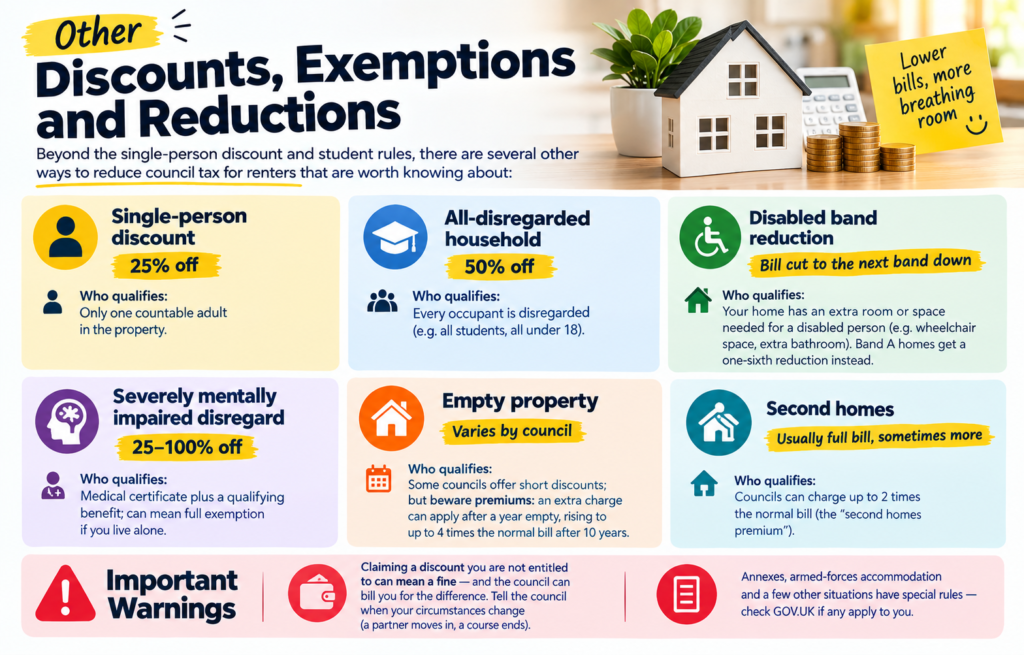
Beyond the single-person discount and student rules, there are several other ways to reduce council tax for renters that are worth knowing about:
| Discount or exemption | What you get | Who qualifies |
|---|---|---|
| Single-person discount | 25% off | Only one countable adult in the property |
| All-disregarded household | 50% off | Every occupant is disregarded (e.g. all students, all under 18) |
| Disabled band reduction | Bill cut to the next band down | Your home has an extra room or space needed for a disabled person (e.g. wheelchair space, extra bathroom). Band A homes get a one-sixth reduction instead |
| Severely mentally impaired disregard | 25–100% off depending on household | Medical certificate plus a qualifying benefit; can mean full exemption if you live alone |
| Empty property | Varies by council | Some councils offer short discounts; but beware premiums: an extra charge can apply after a year empty, rising to up to 4 times the normal bill after 10 years |
| Second homes | Usually full bill, sometimes more | Councils can charge up to 2 times the normal bill (the “second homes premium”) |
Two warnings. First, claiming a discount you are not entitled to can mean a fine — and the council can bill you for the difference. Tell the council when your circumstances change (a partner moves in, a course ends). Second, annexes, armed-forces accommodation and a few other situations have special rules — check GOV.UK if any apply to you.
Struggling to Pay? Council Tax Reduction and Support
Council tax is a priority debt — it is one of the bills you should never simply stop paying — but help exists if you are on a low income. Council Tax Reduction (sometimes still called council tax support) can cut your bill significantly, and in some cases to zero. Key points:
- You apply to your local council, not to the DWP — each council in England runs its own scheme with its own rules.
- Being on Universal Credit does not automatically reduce your bill. You must make a separate claim to the council — and do it promptly when you move onto Universal Credit, so the support continues without a gap.
- Scotland and Wales run national reduction schemes with more consistent rules; in Scotland you still pay water charges even with full reduction (with up to 35% off those charges).
If you fall behind, contact the council immediately — they can rearrange payments, spread them over 12 months, or point you to support. Ignoring the bill is the worst option: the council can take you to court, add costs, and ultimately arrange deductions from your wages or benefits, or send enforcement agents.
Our guides to rent affordability on benefits and affording rent on Universal Credit cover the wider support picture.
Council Tax for Renters: How to Pay Your Bill (and What Happens If You Don’t)
Your annual bill arrives in March, and you usually pay in 10 monthly instalments from April to January — nothing is due in February and March. Most people pay by Direct Debit, but you can also pay online, by phone, or in cash at PayPoint outlets, post offices and banks.
Practical tips for renters:
- Register with the council the day you move in. You are liable from your first day of residence — the bill will find you eventually, with backdated charges.
- Tell the council the day you move out, and give a forwarding address so any refund reaches you.
- Keep the bill somewhere safe — you will need the reference number for discounts, challenges and support claims.
- Check the band and the calculation before paying. Errors happen, and you have the right to query them.
If you genuinely cannot pay, speak to the council before you miss a payment — and free debt advice is available from Citizens Advice and StepChange.
Think Your Band Is Wrong? How to Challenge It
Because bands rest on decades-old valuations, mistakes happen — and a successful challenge can cut your bill every year you live there. In England and Wales, you challenge through the Valuation Office Agency; in Scotland, through your local assessor.
Before you challenge, do two checks (the approach popularised by MoneySavingExpert):
- The neighbours check — look up similar, ideally identical, properties on your street. If yours is in a higher band than comparable neighbours, that is a red flag.
- The valuation check — work out roughly what your home would have sold for in 1991 (England/Scotland) or 2003 (Wales), using old sold prices as a guide, and compare it with the band thresholds.
The serious warning: a challenge can move your band up as well as down — and it can affect your neighbours’ bands too. Only challenge if both checks suggest you are over-banded. You must keep paying your current bill while the challenge is decided.
Council Tax Across the UK: England, Scotland, Wales and Northern Ireland
Council tax for renters is devolved too, so the details change at the border — and Northern Ireland does not have council tax at all:
| England | Scotland | Wales | Northern Ireland | |
|---|---|---|---|---|
| System | Council tax | Council tax | Council tax | Domestic rates (no council tax) |
| Bands | A–H, based on 1 April 1991 values | A–H, based on 1 April 1991 values (different thresholds) | A–I, based on 1 April 2003 values | No bands — based on property capital value at 1 January 2005 |
| 2026/27 average (Band D) | £2,392 (+4.9%) | Set by each of 32 councils | £2,283 (+5.2%) | Bill = capital value × regional + district rates |
| Water charges | Billed separately by water companies | Included in the council tax bill, collected for Scottish Water | Billed separately by water companies | No domestic water charges |
| Single-person discount | 25% | 25% | 25% | Rate relief schemes exist instead |
| Low-income help | Council Tax Reduction (local schemes) | National Council Tax Reduction scheme | National Council Tax Reduction scheme | Housing Benefit / Rate Rebate |
A few things worth noting about council tax for renters outside England:
- Scotland: your council tax bill quietly includes your water and sewerage charges — so a Scottish bill looks higher than the English equivalent, but you are not paying a separate water bill. Each of the 32 councils sets its own rates, and letting agents must be on the Scottish letting agent register.
- Wales: nine bands (A–I) and the 2003 valuation make Welsh bands the most up to date in the UK.
- Northern Ireland: domestic rates are collected by Land & Property Services, combining a regional rate (set by the NI Assembly) and a district rate (set by your council). Help with rates is available through Housing Benefit or Rate Rebate if you get Universal Credit.
Fitting Council Tax Into Your Rent Budget
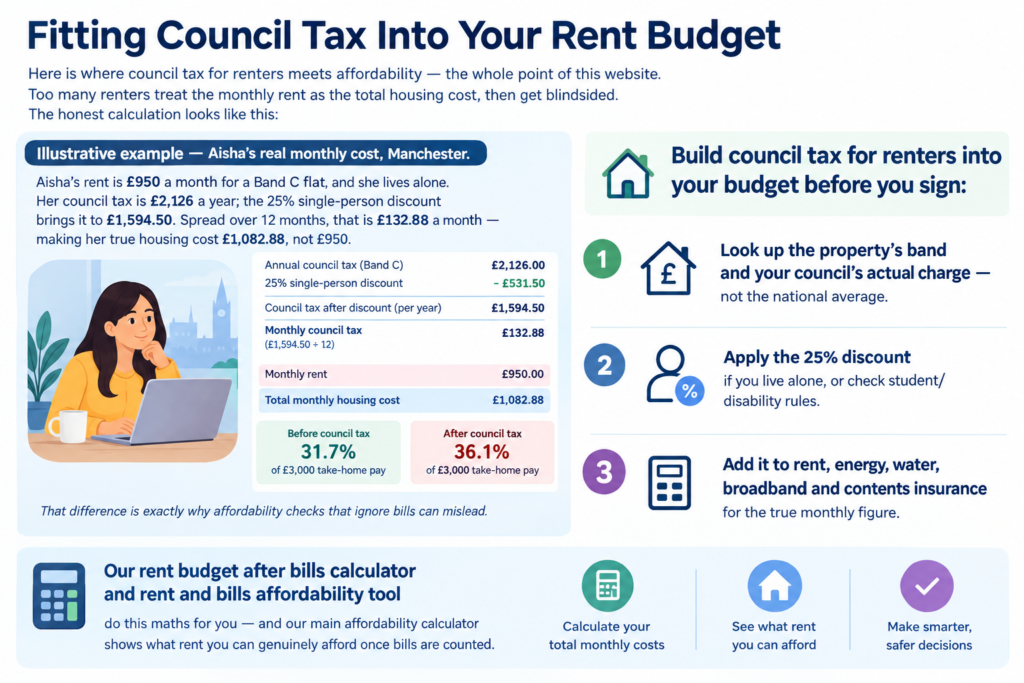
Here is where council tax for renters meets affordability — the whole point of this website. Too many renters treat the monthly rent as the total housing cost, then get blindsided. The honest calculation looks like this:
Illustrative example — Aisha’s real monthly cost, Manchester. Aisha’s rent is £950 a month for a Band C flat, and she lives alone. Her council tax is £2,126 a year; the 25% single-person discount brings it to £1,594.50. Spread over 12 months, that is £132.88 a month — making her true housing cost £1,082.88, not £950. Before council tax, rent was 31.7% of her £3,000 take-home pay; after it, 36.1%. That difference is exactly why affordability checks that ignore bills can mislead.
Build council tax for renters into your budget before you sign:
- Look up the property’s band and your council’s actual charge — not the national average.
- Apply the 25% discount if you live alone, or check student/disability rules.
- Add it to rent, energy, water, broadband and contents insurance for the true monthly figure.
Our rent budget after bills calculator and rent and bills affordability tool do this maths for you — and our main affordability calculator shows what rent you can genuinely afford once bills are counted.
Frequently Asked Questions
Do I have to pay council tax if I rent?
In almost all cases, yes. If you are 18 or over and rent your home as your main residence, you — not your landlord — are liable for council tax. The main exceptions are houses in multiple occupation (HMOs), where the landlord usually pays, and all-student households, which are exempt.
How do I find out my council tax band?
Look it up before you sign a tenancy. In England and Wales, use the free band checker on GOV.UK by entering the property’s postcode; in Scotland, use the Scottish Assessors website. The band is also printed on the council tax bill.
How much council tax will I pay each month?
It depends on the band and your council. As a rough guide for 2026/27, the England average works out at about £160 a month for Band A, £213 for Band C, £239 for Band D and £399 for Band G (paid over 10 months). Check your council’s website for the exact figure — and remember the 25% single-person discount if you live alone.
Can I get a discount if I live alone?
Yes — the single-person discount cuts your bill by 25%. You must apply to your council; it is not automatic. If you have been paying full price while living alone, you can usually get it backdated to when you moved in.
Do students pay council tax?
Full-time students are disregarded for council tax. If everyone in the property is a full-time student (a course lasting at least one academic year with 21+ hours of study a week), the property is exempt and no bill is due. Part-time students generally do count.
What if I live with students but I’m not one myself?
The students are disregarded, so only you count. If you are the only non-student, you can claim the 25% single-person discount — and the council can only pursue you, not your student housemates, for the bill. Agree in writing how you will split the cost.
Who pays council tax in a house share?
It depends on the setup. Joint tenants renting a whole property are jointly liable for the full bill. But if you rent a room in a house in multiple occupation (HMO) with separate agreements, the landlord is usually liable. If you receive a bill that is not your responsibility, contact the council.
What happens if I don’t pay my council tax?
Don’t ignore it — council tax is a priority debt. The council will send reminders, then can take you to court, add legal costs, and arrange deductions from your wages or benefits or send enforcement agents. If you are struggling, contact the council immediately: they can rearrange payments or direct you to Council Tax Reduction.
Can I challenge my council tax band?
Yes, through the Valuation Office Agency (England and Wales) or your local assessor (Scotland). First check that similar neighbouring properties are in lower bands and that your home’s 1991 (or 2003 in Wales) value fits a lower band. Warning: a challenge can move your band up as well as down, so only proceed if the evidence is strong — and keep paying your bill meanwhile.
What is Council Tax Reduction and how do I claim it?
Council Tax Reduction (also called council tax support) helps people on low incomes pay their bill and can reduce it substantially. In England each council runs its own scheme — you apply directly to your council, and claiming Universal Credit does not trigger it automatically. Scotland and Wales have national schemes.
Do I pay council tax on an empty property between tenancies?
As a tenant you are only liable while the property is your main residence — when it is empty, liability normally passes to the owner (your landlord). Note that councils can charge premiums on long-term empty homes, rising to up to four times the normal bill after 10 years in England.
Is council tax different in Scotland, Wales and Northern Ireland?
Yes. Scotland includes water and sewerage charges in the council tax bill, and each of its 32 councils sets its own rates. Wales uses nine bands (A–I) based on 2003 property values. Northern Ireland has no council tax at all — it uses domestic rates based on property capital values, collected by Land & Property Services. See the comparison table above.
Final Thoughts
Council tax for renters is the bill most often forgotten at budget time — and at roughly £160 to £480 a month depending on the band, it is far too big to be a rounding error. The good news is that the system is full of legitimate ways to pay less: check the band before you sign, claim the 25% single-person discount the day you move in, make sure student and disability rules are applied, and ask about Council Tax Reduction if money is tight.
Above all, treat council tax as part of the rent, not an afterthought. Add it to your rent, energy and water costs to find your true monthly housing cost — then check what you can afford with our rent affordability calculator, break it down with the rent budget after bills tool, and browse more practical help in our rent guides. A renter who budgets with council tax included never gets a nasty brown envelope.
Further Reading
- How Council Tax works — GOV.UK
- Check your Council Tax band — GOV.UK
- Council tax levels 2026 to 2027 — official statistics
- Help with council tax — Shelter England
- Citizens Advice also publishes guidance on who has to pay council tax — search “council tax” on citizensadvice.org.uk for their current advice pages.