Noah had found the perfect two-bedroom flat in Sheffield: £895 a month, a short walk from work, and a landlord who seemed friendly on the viewing. The letting agent emailed the tenancy agreement on a Friday evening and said, “Just sign it over the weekend, and we’ll get you the keys on Monday.” Noah nearly did — until a friend asked whether he’d actually read the bit about rent increases.
He hadn’t. And when he finally read it, the agreement was full of surprises: a 12-month “fixed term”, a clause demanding three months’ rent upfront, a £120 “check-in fee”, and a blanket ban on pets. Every one of those clauses is either unenforceable or outright illegal in England in 2026 — but Noah would never have known if he hadn’t looked.
This guide explains exactly what to check before you sign a tenancy agreement in the UK in 2026: what kind of tenancy you’re being offered, what your landlord must tell you in writing, the rent and deposit rules that protect you, the banned fees and unfair terms hiding in old templates, and the red flags that mean you should pause. It covers England in detail, with the key differences for Scotland, Wales and Northern Ireland.
Quick answer: Since 1 May 2026, all new private tenancies in England are rolling periodic tenancies — a “fixed term” in your agreement has no legal effect, rent increases need a statutory Section 13 notice, and your landlord must give you prescribed written information about the key terms before you sign. Never pay more than one month’s rent before signing, check every fee against the Tenant Fees Act, and remember: any clause contradicting your statutory rights is unenforceable, whatever the agreement says.
Rules differ between England, Scotland, Wales and Northern Ireland, and some changed in 2026. This guide reflects the position as of October 2026 and is general information, not legal advice.
Why Your Tenancy Agreement Deserves 30 Minutes of Your Time
A tenancy agreement is a legally binding contract. Once you sign, you are committed to paying the rent for the whole tenancy, and your landlord is committed to letting you live there on the agreed terms. Reading it properly before signing is the cheapest form of legal protection you will ever get.
The stakes got higher — and the paperwork got stranger — after the Renters’ Rights Act 2025. Its first phase took effect in England on 1 May 2026, and it rewrote several of the assumptions tenancy agreements used to rely on:
- Assured shorthold tenancies (ASTs) were abolished. New qualifying tenancies are rolling periodic tenancies from day one.
- Any fixed-term wording in a new agreement has no legal effect — and a landlord who “purports to let for a fixed term” can face a civil penalty of up to £7,000.
- Rent increases now need a statutory Section 13 notice — old contractual rent-review clauses no longer work.
- Your landlord must give you prescribed written information about the key terms before you sign.
The problem: many agreements in circulation are still old AST templates with the new rules bolted on — or worse, not bolted on at all. Your job before signing is to spot the leftovers.
What Kind of Tenancy Are You Actually Signing?
Before checking a single clause, confirm what legal animal your tenancy is. In England in 2026:
| Arrangement | Position in 2026 |
|---|---|
| Standard private rental (individual tenant) | Assured periodic tenancy — rolling, no fixed end date |
| An old AST still running | Automatically converted to a periodic assured tenancy on 1 May 2026 — no new agreement needed |
| Lodger living with a resident landlord | Excluded occupier — different, weaker rights; the RRA tenancy reforms don’t apply |
| Company let (tenant is a company, not a person) | Not an assured tenancy — old rules can still apply, fixed terms possible |
| Purpose-built student accommodation | Exempt from the RRA changes (ordinary student houses in the private sector are covered) |
| Annual rent above £100,000 | Outside the assured-tenancy regime entirely |
| Holiday let | Not a tenancy at all |
If your agreement still says “assured shorthold tenancy” or “fixed term of 12 months”, the label is out of date for a new England tenancy — but the agreement can still function as a periodic tenancy. What matters is that you understand you are not locked in for a fixed period: you can leave at any time by giving two months’ written notice.
Before you sign, it’s also worth confirming the property and landlord are legitimate. Our rental scams guide explains how to verify ownership and spot fake listings.
The Written Statement Your Landlord Must Give You
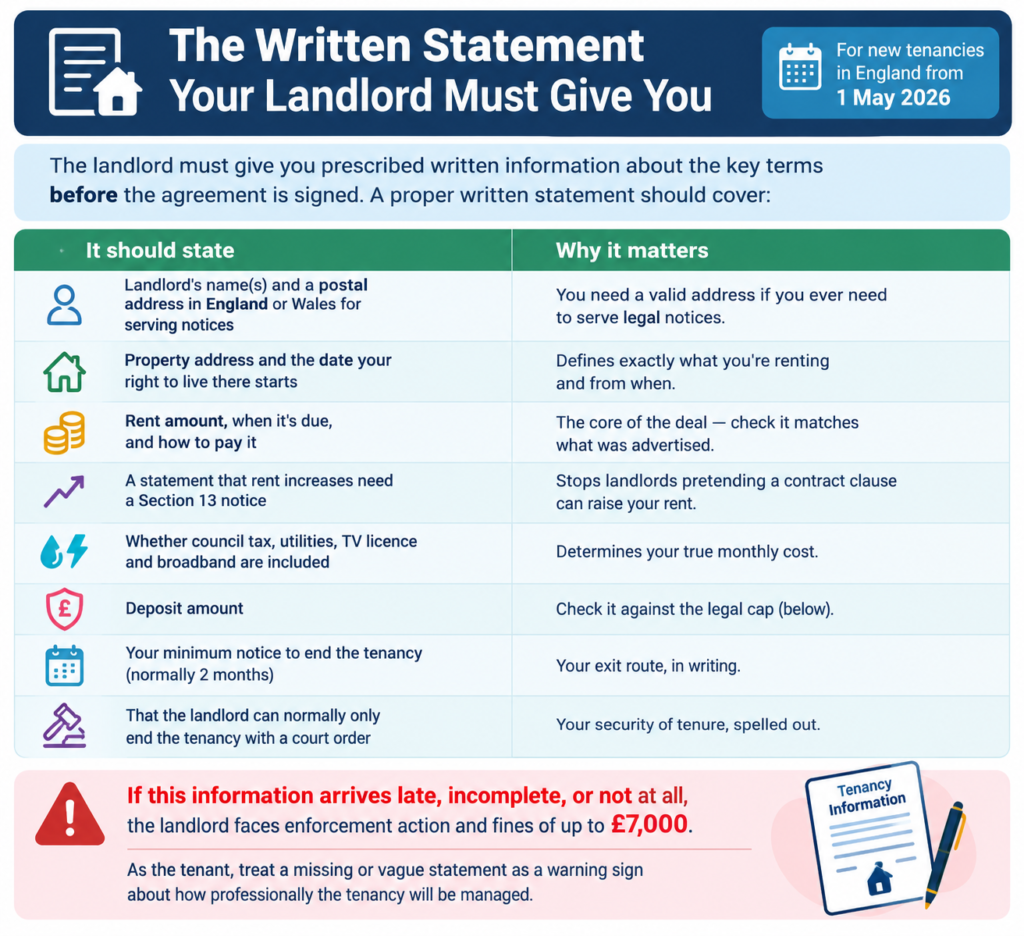
For new tenancies in England from 1 May 2026, the landlord must give you prescribed written information about the key terms before the agreement is signed. A proper written statement should cover:
| It should state | Why it matters |
|---|---|
| Landlord’s name(s) and a postal address in England or Wales for serving notices | You need a valid address if you ever need to serve legal notices |
| Property address and the date your right to live there starts | Defines exactly what you’re renting and from when |
| Rent amount, when it’s due, and how to pay it | The core of the deal — check it matches what was advertised |
| A statement that rent increases need a Section 13 notice | Stops landlords pretending a contract clause can raise your rent |
| Whether council tax, utilities, TV licence and broadband are included | Determines your true monthly cost |
| Deposit amount | Check it against the legal cap (below) |
| Your minimum notice to end the tenancy (normally 2 months) | Your exit route, in writing |
| That the landlord can normally only end the tenancy with a court order | Your security of tenure, spelled out |
If this information arrives late, incomplete, or not at all, the landlord faces enforcement action and fines of up to £7,000. As the tenant, treat a missing or vague statement as a warning sign about how professionally the tenancy will be managed.
Rent: The Five Things to Check
Rent is the heart of the agreement. Check these five points against what was advertised and what the law allows:
- The amount matches the advert. Since 2026, landlords and agents must not invite, encourage or accept offers above the published asking rent — rental bidding is banned. If the agreement shows a higher figure than the listing, challenge it.
- No rent demanded before signing. It is now unlawful for a landlord or agent to ask for or accept any rent before the tenancy agreement is signed.
- At most one month’s rent before the tenancy starts. Once signed, the most that can be demanded upfront is one month’s rent (or 28 days’ rent for shorter rent periods). A clause demanding three or six months upfront is unenforceable.
- The rent period is a month or less. Rent periods are capped at one month (or 28 days or less) — weekly or monthly payment cycles, nothing longer.
- Rent increases need a Section 13 notice. Increases are allowed at most once a year, with at least two months’ notice on the statutory form — and you can challenge the new rent at the First-tier Tribunal, which cannot set it higher than the landlord proposed. Any old-style “contractual rent review” clause in the agreement no longer has legal effect.
Worked example — Grace’s upfront demand: Grace agrees a flat in Manchester at £950 a month. Before she signs, the agent asks for three months’ rent (£2,850) upfront “because her credit file is thin”. That demand is banned: no rent can be asked for before signing, and after signing the maximum is one month (£950). Grace’s lawful upfront cost is her capped deposit plus, at most, one month’s rent. Our upfront cost calculator totals exactly what a legal move-in should cost.
For the full rules on challenging an increase once you’re in, see our guide to challenging a rent increase.
The Deposit: Caps, Protection and Paperwork
The agreement should state your deposit amount. Check it against the legal caps in England:
| Your annual rent | Maximum tenancy deposit |
|---|---|
| Below £50,000 per year | 5 weeks’ rent |
| £50,000 per year or more | 6 weeks’ rent |
To work out a week’s rent: monthly rent × 12 ÷ 52. Anything above the cap is a prohibited payment and must be refunded.
Two more deposit checks before you sign:
- Protection deadline: the deposit must be protected in one of the three government-approved schemes (DPS, TDS or mydeposits) within 30 days of the landlord receiving it, and you must receive the written “prescribed information” within the same 30 days.
- Holding deposit: if you paid one to reserve the property, it’s capped at one week’s rent — and the agreement should say whether it will be refunded or put towards your tenancy deposit or first rent.
Worked example — Noah’s deposit check: Noah’s Sheffield flat is £895 a month. One week’s rent is £895 × 12 ÷ 52 = £206.54, so his maximum lawful deposit is 5 × £206.54 = £1,032.69. The agent’s agreement asks for £1,250 — £217.31 too much. Noah asks for the excess back before signing, and checks the tenancy deposit protection guide so he knows how to verify the protection himself in the first weeks.
Run your own numbers with our rental deposit calculator before you pay a penny.
Banned Fees Hiding in Agreements
The Tenant Fees Act 2019 bans almost every fee landlords and agents used to charge in England. The rule is simple: if a payment isn’t on the official list of permitted payments, it’s banned — and any agreement clause requiring one is not binding on you, while the rest of the agreement still stands.
| Common clause | Legal position in England |
|---|---|
| “Administration/set-up / application fee” | Banned — any amount |
| Referencing or credit-check fee | Banned |
| Check-in or check-out / inventory fee | Banned |
| Compulsory professional cleaning fee | Banned (you must leave the property clean; you can’t be forced to hire a company) |
| Renewal or extension fee | Banned |
| Guarantor arrangement fee | Banned |
| Pet deposit or pet insurance requirement | Banned — would be a prohibited payment on top of the standard deposit cap |
| Late-rent “admin fee” | Banned — only interest is permitted, and only once rent is 14+ days overdue, capped at 3% above the Bank of England base rate |
| Fee for changing the tenancy at your request | Permitted but capped at £50 unless higher reasonable costs are evidenced |
Read every fee clause and ask: “Which permitted payment is this?” If the agent can’t answer, don’t pay it. Our letting agent fees guide lists the full permitted set and explains how to reclaim banned charges.
Unfair Terms: Clauses a Landlord Can’t Enforce
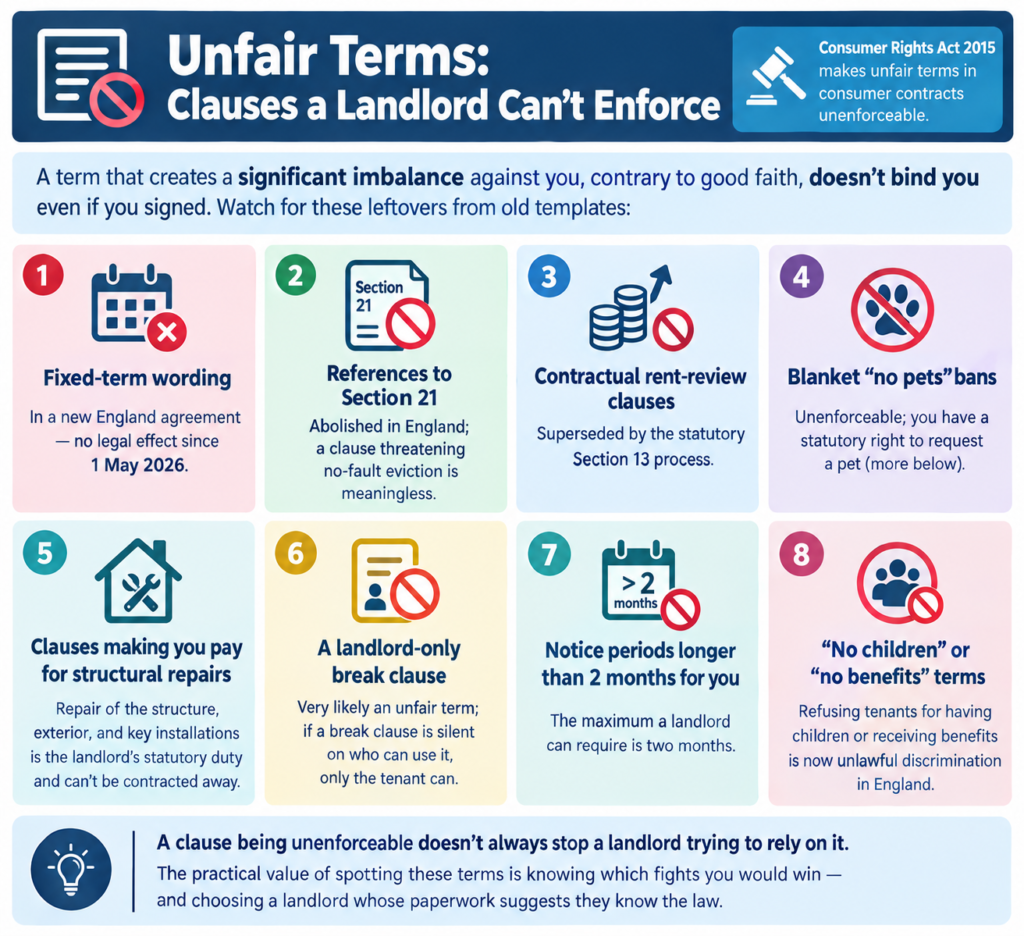
Beyond banned fees, the Consumer Rights Act 2015 makes unfair terms in consumer contracts unenforceable — a term that creates a significant imbalance against you, contrary to good faith, doesn’t bind you even if you signed. Watch for these leftovers from old templates:
- Fixed-term wording in a new England agreement — no legal effect since 1 May 2026.
- References to Section 21 — abolished in England; a clause threatening no-fault eviction is meaningless.
- Contractual rent-review clauses — superseded by the statutory Section 13 process.
- Blanket “no pets” bans — unenforceable; you have a statutory right to request a pet (more below).
- Clauses making you pay for structural repairs — repair of the structure, exterior, and key installations is the landlord’s statutory duty and can’t be contracted away.
- A landlord-only break clause — very likely an unfair term; if a break clause is silent on who can use it, only the tenant can.
- Notice periods longer than 2 months for you — the maximum a landlord can require is two months.
- “No children” or “no benefits” terms — refusing tenants for having children or receiving benefits is now unlawful discrimination in England.
A clause being unenforceable doesn’t always stop a landlord trying to rely on it. The practical value of spotting these terms is knowing which fights you would win — and choosing a landlord whose paperwork suggests they know the law.
Break Clauses: Mostly History in England
Break clauses used to let one or both parties end a fixed term early — typically at a six-month break point in a 12-month tenancy, with one or two months’ written notice and strict compliance with the wording.
In England, they’re now largely obsolete: any break clause in an agreement no longer has legal effect, because there are no fixed terms left to break. You simply give two months’ notice to leave your periodic tenancy whenever you like.
Two situations where break clauses still matter:
- Legacy tenancies signed before 1 May 2026 whose old fixed-term wording still governs the notice mechanics during any transitional period.
- Northern Ireland (and company lets / lodger arrangements outside the assured-tenancy regime), where fixed terms and break clauses still operate — read the clause’s exact notice and service requirements, because courts enforce them strictly.
Joint Tenancies vs Individual Room Contracts
If you’re renting with friends or strangers, the type of agreement changes your risk completely:
| Feature | Joint tenancy | Individual room contract |
|---|---|---|
| Agreement | One agreement, all tenants sign | Each person has their own agreement for their room |
| Rent liability | Joint and several — each tenant can be pursued for the full rent, not just their share | Liable only for your own rent |
| If one person leaves | One joint tenant’s notice normally ends the tenancy for everyone | Others’ tenancies continue; landlord finds a replacement |
| Damage | All tenants jointly liable | Liable for your room plus a fair share of communal areas |
Worked example — Ruby’s joint tenancy: Ruby and two friends take a three-bedroom house in Bristol at £1,800 a month, splitting it £600 each. One friend stops paying. Because it’s a joint tenancy, the landlord can lawfully demand the full £1,800 from Ruby alone — the private £600 split doesn’t bind the landlord. Before signing a joint tenancy, make sure you trust your housemates’ finances as much as your own. Our joint rent affordability calculator helps houseshares budget honestly.
If you’re sharing, also read our house share rent guide alongside the agreement.
Guarantor Clauses: Read Before Anyone Signs
If the agreement names a guarantor — usually a parent — the guarantor’s liability is defined by the guarantee, so read it as carefully as the tenancy itself:
- It must be executed as a deed: state it’s a deed, be signed, and the signature witnessed. If joint guarantors are named, all must sign, or it may bind none.
- Liability is limited to what’s written — rent arrears and/or damage — and can never exceed the tenant’s own liability.
- In a joint tenancy, a guarantor is typically liable for ALL the rent, not just their person’s share. Many parents don’t realise this until arrears land.
- Watch the duration: guarantees written for old fixed terms may not cover the periodic tenancy that replaced them after 1 May 2026 unless they expressly say so.
- Guarantors should check exactly who they cover, for how much, until when, and how the liability ends — and try to negotiate a cap.
Citizens Advice publishes free guidance for guarantors, and it’s worth sending the link to anyone asked to sign before they put pen to paper.
Documents You Should Receive Before Moving In
Beyond the agreement itself, tick off this paperwork before you get the keys:
| Document | Rule |
|---|---|
| Energy Performance Certificate (EPC) | Must be provided before the tenancy is agreed; the property must meet the minimum rating |
| Gas safety certificate | Annual check by a Gas Safe-registered engineer, provided before you move in |
| Electrical Installation Condition Report (EICR) | Renewed at least every 5 years; copy to you before occupation |
| Smoke and carbon monoxide alarms | Fitted on every storey (smoke) and where required (CO), tested on the day the tenancy starts |
| Deposit prescribed information | Within 30 days of the landlord receiving your deposit |
| Right to rent check | Done before the tenancy begins — covers every adult aged 18+ living there as their main home, not just named tenants |
Missing safety certificates aren’t just admin — they can restrict a landlord’s ability to enforce parts of the tenancy. Ask for copies and keep them with your agreement.
Pets, Children and Benefits: Your New Rights in 2026
Two Renters’ Rights Act changes should be reflected in — or at least not contradicted by — your agreement:
Pets. You have a statutory right to request to keep a pet in writing, describing the animal. The landlord must reply in writing within 28 days (longer if they reasonably need more information) and must not unreasonably refuse — a refusal can be reasonable if, say, the superior lease bans pets or the property is genuinely unsuitable. Blanket “no pets” clauses are unenforceable, and landlords cannot demand pet insurance or a separate pet deposit. You remain liable for any pet damage, deducted from the standard deposit. Our renting with pets guide walks through how to make the request.
Children and benefits. It is unlawful to refuse you because you receive benefits or have children — including “no DSS” or “no children” style advert language, which risks fines of up to £7,000. If a clause in the agreement tries to smuggle the same discrimination in, it won’t survive contact with the law.
Your 10-Minute Pre-Signing Checklist
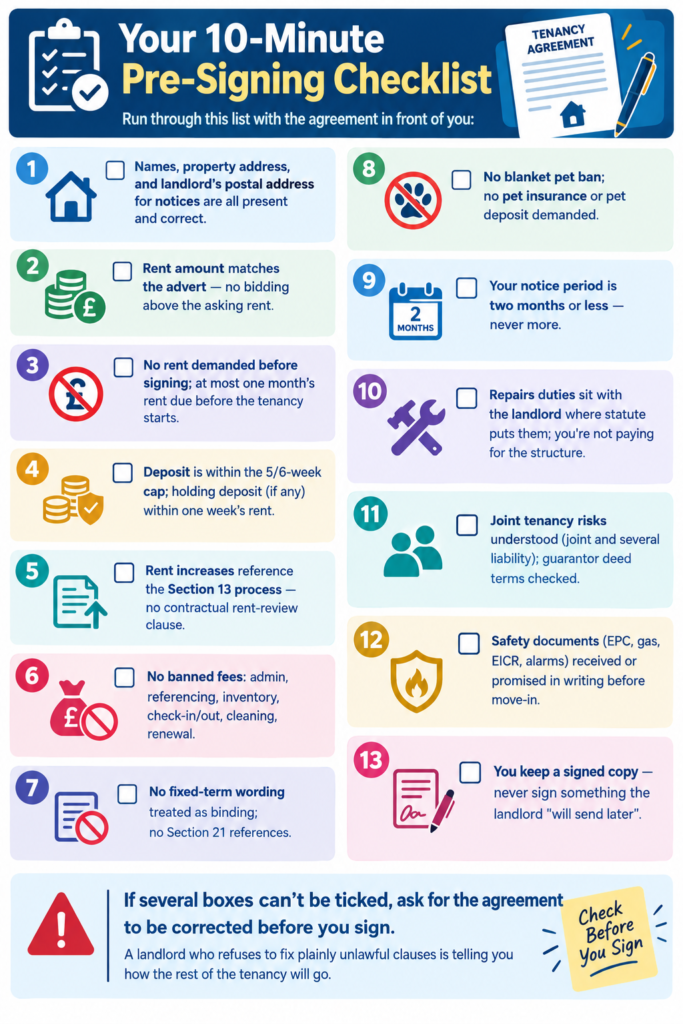
Run through this list with the agreement in front of you:
- ☐ Names, property address, and landlord’s postal address for notices are all present and correct.
- ☐ Rent amount matches the advert — no bidding above the asking rent.
- ☐ No rent demanded before signing; at most one month’s rent due before the tenancy starts.
- ☐ Deposit is within the 5/6-week cap; holding deposit (if any) within one week’s rent.
- ☐ Rent increases reference the Section 13 process — no contractual rent-review clause.
- ☐ No banned fees: admin, referencing, inventory, check-in/out, cleaning, renewal.
- ☐ No fixed-term wording treated as binding; no Section 21 references.
- ☐ No blanket pet ban; no pet insurance or pet deposit demanded.
- ☐ Your notice period is two months or less — never more.
- ☐ Repairs duties sit with the landlord where statute puts them; you’re not paying for the structure.
- ☐ Joint tenancy risks understood (joint and several liability); guarantor deed terms checked.
- ☐ Safety documents (EPC, gas, EICR, alarms) received or promised in writing before move-in.
- ☐ You keep a signed copy — never sign something the landlord “will send later”.
If several boxes can’t be ticked, ask for the agreement to be corrected before you sign. A landlord who refuses to fix plainly unlawful clauses is telling you how the rest of the tenancy will go.
Tenancy Agreement Rules Across the UK at a Glance
| Aspect | England | Scotland | Wales | Northern Ireland |
|---|---|---|---|---|
| Tenancy type | Assured periodic (since 1 May 2026) | Private residential tenancy (open-ended since 2017) | Occupation contract (since 1 Dec 2022) | Private tenancy |
| Written terms deadline | Prescribed info before signing | Written terms expected at outset | Written statement within 14 days of occupation | Statement of terms within 28 days |
| Fee bans | Tenant Fees Act 2019 | Fees effectively banned | Renting Homes (Fees etc.) (Wales) Act 2019 | Limited fee controls |
| No-fault eviction | Abolished 1 May 2026 | Effectively abolished | 6-month no-fault notice (s.173) still exists | Still possible with notice |
| Fixed terms | No legal effect in new tenancies | Not part of the PRT model | Fixed-term standard contracts exist | Still used |
Frequently Asked Questions
Do I have to sign a tenancy agreement, or can I rent without one?
You can have a tenancy without a signed written agreement — a tenancy can exist by conduct, and a tenancy of under three years doesn’t need to be a deed. But in England your landlord must still give you the prescribed written statement of key terms before the tenancy is agreed. Always insist on paperwork: without it, proving what was agreed becomes your word against theirs.
My agreement says “12-month fixed term”. Am I locked in for a year?
For a new tenancy in England signed after 1 May 2026, no — fixed-term wording in an assured tenancy has no legal effect, and you can leave at any time on two months’ written notice. The clause is a leftover from an old template. (Different rules can apply to company lets, lodgers and Northern Ireland tenancies, where fixed terms still operate.)
Can the landlord ask for six months’ rent upfront if I have a poor credit history?
No. Since 1 May 2026 in England, no rent may be demanded before the agreement is signed, and afterwards the maximum is one month’s rent before the tenancy starts. Thin credit files, self-employment and overseas status don’t create exceptions — agents who once used big upfront payments instead of referencing properly can no longer do so.
The agreement charges a £150 “check-in fee”. Do I have to pay it?
No. Check-in, check-out and inventory fees are banned payments under the Tenant Fees Act 2019 in England. A clause requiring one is not binding on you, and you can reclaim it if already paid. The rest of your agreement still stands.
Is a “no pets” clause in my tenancy agreement enforceable?
A blanket ban is unenforceable. You have a statutory right to request a pet in writing; your landlord must respond in writing within 28 days and can only refuse for reasonable grounds, such as a superior lease that bans pets. They can’t demand pet insurance or an extra pet deposit either.
What makes a tenancy agreement term “unfair”?
Under the Consumer Rights Act 2015, a term is unfair — and unenforceable — if it creates a significant imbalance in rights to your detriment, contrary to good faith. Examples include landlord-only break clauses, terms making you pay for structural repairs, and penalties disguised as fees. The Competition and Markets Authority enforces these rules.
Should I worry if the agreement doesn’t include the landlord’s address?
Yes — it’s a red flag. In England, the pre-signing written statement must include a postal address in England or Wales where you can serve notices. Without it, exercising your legal rights becomes needlessly difficult. Ask for it to be added before you sign.
My guarantor is being asked to cover my housemates’ rent too. Is that normal?
In a joint tenancy, unfortunately yes — a guarantor is typically liable for the whole rent, not just their person’s share. Make sure your guarantor understands this before signing the deed, checks the exact amount and duration of liability, and negotiates a cap if possible.
Can my landlord increase the rent whenever the agreement says so?
Not in England. Contractual rent-review clauses no longer have legal effect; increases need a statutory Section 13 notice, at most once a year, with at least two months’ notice. You can challenge the proposed rent at the First-tier Tribunal, which can’t set it above what the landlord asked for.
What documents must I legally receive before moving in?
At minimum: the prescribed written statement of key terms before signing; an Energy Performance Certificate before the tenancy is agreed; a gas safety certificate before move-in (where there’s gas); an Electrical Installation Condition Report before occupation; and deposit protection information within 30 days of paying your deposit. Smoke and CO alarms must be in place and tested on day one.
I signed an agreement with unlawful clauses. Is the whole agreement void?
No — unlawful or unfair clauses are severed. Banned fee clauses and unfair terms are simply not binding on you; the rest of the agreement continues. But document everything: keep the signed copy, note which clauses you challenged, and get advice from Shelter or Citizens Advice before relying on this in a dispute.
Do the same rules apply if I’m a lodger or renting from the council?
No. Lodgers with a resident landlord are excluded occupiers with far fewer protections, and council/housing-association tenants have secure or assured tenancies under different legislation. This guide covers private renting; check Shelter’s advice for your specific arrangement.
Final Thoughts
A tenancy agreement is the foundation your whole tenancy sits on — and in 2026, too many of them are built from pre-reform templates that no longer reflect the law. The 30 minutes you spend checking the rent rules, deposit caps, banned fees and unfair terms before signing can save you hundreds of pounds and months of disputes later. Remember the essentials: periodic tenancy, two months’ notice to leave, one month’s rent maximum upfront, a capped and protected deposit, and no clause — however official it looks — can override your statutory rights.
Before you commit, check the numbers work: our rent affordability calculator shows what rent your income supports, the rental deposit calculator confirms your legal upfront cost, and the moving house cost guide budgets the full move. And when the day comes to leave, our companion piece on ending your tenancy walks you through notice periods and getting your deposit back.
Further Reading
- GOV.UK — Tenant Fees Act: guidance for tenants — the official permitted-payments list and enforcement routes.
- Shelter England — Private renting advice — free, in-depth guidance on agreements, deposits and your rights.
- Citizens Advice — Renting a home — practical help with tenancy agreements and disputes.