
Renters’ Contents Insurance UK: Picture this: it’s 2 am on a Tuesday and a pipe bursts above your bedroom. By the time you wake up, your laptop, half your wardrobe and the mattress are soaked. Your landlord’s insurance will pay to fix the ceiling — but every ruined possession is yours to replace. Replacing a laptop, a phone, clothes, a TV and bedding at once could easily run to £4,000 or more. Could you find that money tomorrow?
This guide explains renters contents insurance in plain English: what it covers, what it doesn’t, what it actually costs in the UK right now, how it fits alongside your landlord’s responsibilities, and whether it’s worth paying for on a tight budget.
Quick Answer: Renters contents insurance covers your belongings — clothes, furniture, gadgets and appliances you own — against theft, fire, flooding and similar events in your rented home. It is not legally required in the UK, but your landlord can sometimes make it a condition of the tenancy agreement. Contents-only cover typically costs £50–£150 a year (around £5–£12 a month), and the average payout to a renter who claims is over £1,400 — far more than the premium. If you couldn’t comfortably replace your belongings from savings, it’s almost certainly worth it.
What Is Renters Contents Insurance?
Renters’ Contents Insurance UK— sometimes called tenants’ insurance — is a policy that protects the things inside your rented home that belong to you. MoneyHelper’s handy rule of thumb is: if you tipped your home upside down, contents insurance covers everything that would fall out. That includes your clothes, furniture, TV, laptop, phone, kitchenware, jewellery and anything else you would take with you when you move.
Crucially, it does not cover the building itself — the walls, roof, windows, fitted kitchen or bathroom. That’s buildings insurance, and it’s your landlord’s responsibility, not yours. Home insurance is really an umbrella term for these two halves: contents (your stuff) and buildings (the structure). As a tenant, you only ever need the contents half.
Is Renters Contents Insurance Legally Required When You Rent?
No. There is no legal requirement to have renters contents insurance anywhere in the UK — England, Scotland, Wales or Northern Ireland. This is confirmed by MoneyHelper, MoneySavingExpert and the Association of British Insurers’ industry data: home insurance of any kind is not a legal requirement (unlike buildings insurance, which mortgage lenders usually demand from homeowners — but you’re not the homeowner here).
That said, there is one wrinkle worth knowing. Some landlords ask tenants to take out renters contents insurance — particularly tenants’ liability cover — as a condition of the tenancy. They can recommend it, and if the requirement is written into your signed tenancy agreement, it may be enforceable, but it must still withstand unfair-terms scrutiny under consumer law. Always check your tenancy agreement for any insurance clause before you sign — and read our tenancy agreement guide so you know exactly what you’re agreeing to.
The takeaway: the law doesn’t force you, but if your contract asks for it, check the clause carefully and take professional advice if it looks unreasonable.
Who Insures What: You vs Your Landlord
One of the most common misunderstandings in renting is that the landlord’s insurance covers the tenant. It doesn’t. Your landlord’s policy protects what the landlord owns: the structure, fixtures, and any furniture or appliances they provided. Everything you own is your own responsibility.
| Item or risk | Whose insurance covers it? |
|---|---|
| The walls, roof, windows and structure | Landlord’s buildings insurance |
| Fitted kitchen, bathroom, built-in cupboards | Landlord’s buildings insurance |
| Sofa, white goods or curtains the landlord provided | Landlord’s contents/landlord insurance |
| Your clothes, shoes and personal items | Your contents insurance |
| Your furniture, TV, laptop, phone, gadgets | Your contents insurance |
| Damage you accidentally cause to the landlord’s property | Your tenants’ liability cover (usually an add-on) |
| Alternative accommodation if the home is uninhabitable | Your contents policy (check it includes this) |
Key point: If your landlord has buildings and contents cover for a furnished flat, that policy protects their furniture — not yours. You still need your own renters contents insurance policy for your belongings.
This split matters for repairs too. If a pipe bursts, your landlord must repair the pipe and the damaged ceiling under their repair obligations — see our landlord repairs guide for the full picture. But your ruined laptop and mattress? Only renters contents insurance covers those.
What Renters Contents Insurance Usually Covers
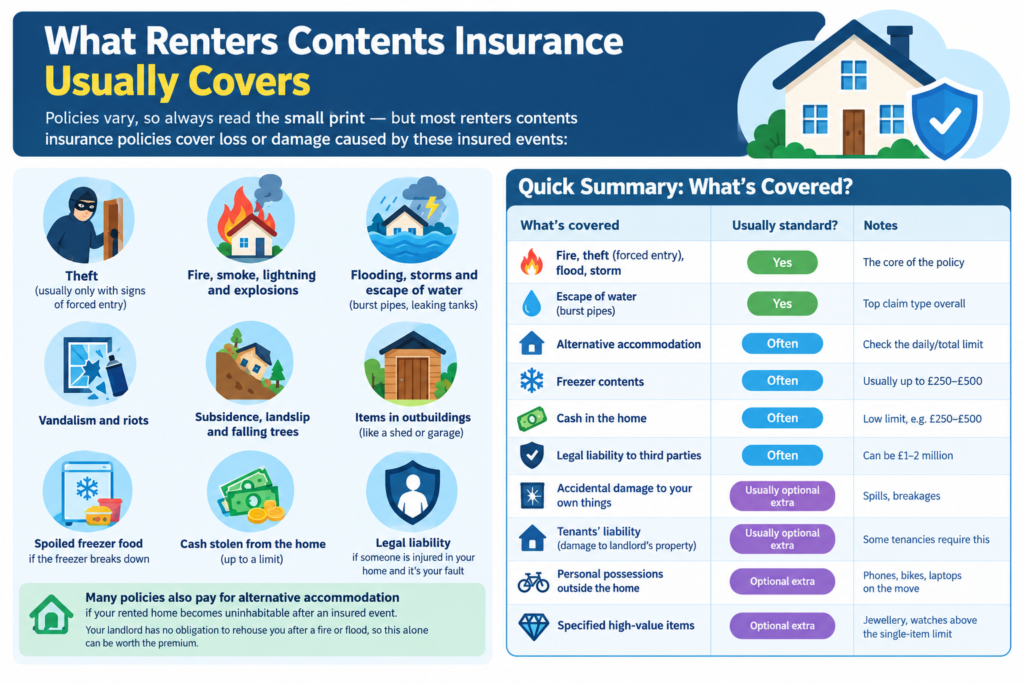
Policies vary, so always read the small print — but most renters contents insurance policies cover loss or damage caused by these insured events:
- Theft (usually only with signs of forced entry)
- Fire, smoke, lightning and explosions
- Flooding, storms and escape of water (burst pipes, leaking tanks)
- Vandalism and riots
- Subsidence, landslip and falling trees
- Items in outbuildings like a shed or garage
- Spoiled freezer food if the freezer breaks down
- Cash stolen from the home, up to a limit
- Legal liability if someone is injured in your home and it’s your fault
Many policies also pay for alternative accommodation if your rented home becomes uninhabitable after an insured event. Your landlord has no obligation to rehouse you after a fire or flood, so this alone can be worth the premium.
| What’s covered | Usually standard? | Notes |
|---|---|---|
| Fire, theft (forced entry), flood, storm | Yes | The core of the policy |
| Escape of water (burst pipes) | Yes | Top claim type overall |
| Alternative accommodation | Often | Check the daily/total limit |
| Freezer contents | Often | Usually up to £250–£500 |
| Cash in the home | Often | Low limit, e.g. £250–£500 |
| Legal liability to third parties | Often | Can be £1–2 million |
| Accidental damage to your own things | Usually optional extra | Spills, breakages |
| Tenants’ liability (damage to landlord’s property) | Usually optional extra | Some tenancies require this |
| Personal possessions outside the home | Optional extra | Phones, bikes, laptops on the move |
| Specified high-value items | Optional extra | Jewellery, watches above the single-item limit |
What Renters Contents Insurance Does NOT Cover
Knowing the exclusions is as important as knowing the cover. Standard policies will not pay for:
- Wear and tear — items that break down from age or lack of maintenance
- Deliberate damage — caused by you or anyone in your household
- Theft without forced entry — if the door was unlocked or left open, a claim may be rejected
- Mechanical breakdown — an appliance that simply stops working isn’t covered (though damage it causes might be)
- Your landlord’s belongings — their furniture and appliances in a furnished let
- Your flatmates’ possessions — each person needs their own policy (or a joint one if offered)
- Business equipment — working from home equipment used for business may be excluded unless declared
- Unoccupied homes — if the property is empty for more than 30–60 days, cover usually stops
- Computer viruses and data loss — damage to a laptop caused by a virus isn’t covered
Watch out: The most common reason renters’ claims are reduced or rejected is underinsurance — insuring your contents for £10,000 when they’d cost £25,000 to replace. Insurers can then apply “average” and pay only a proportion of any claim. Get the sum right (more on that below).
New-for-Old vs Indemnity: How Payouts Are Calculated
When you claim, the insurer replaces or pays for the item — but how much they pay depends on the policy type:
| New-for-old | Indemnity | |
|---|---|---|
| What you get | The cost of a new equivalent item today | The item’s current value, accounting for wear and tear |
| Example: 4-year-old TV | New TV of similar spec | A few hundred pounds less |
| Typical cost | Slightly higher premiums | Cheaper premiums |
| Best for | Electronics, appliances, furniture | Lower-value, older possessions |
New-for-old is the standard on most mainstream renters contents insurance policies and is usually worth the small extra cost. Indemnity policies look cheaper until you claim and discover the payout won’t buy a replacement. Always check which one your quote uses before comparing prices.
The Extras Worth Considering
Standard renters contents insurance handles the big disasters. But renters often find these optional extras the most useful:
- Accidental damage cover — spilling red wine on the landlord’s carpet, knocking the TV off its stand, cracking a mirror. Without it, “oops” moments aren’t covered.
- Tenants’ liability cover — pays for accidental damage to your landlord’s property and fittings (the wine-stained carpet again, or a scorched kitchen worktop). Some tenancy agreements require this, and losing a deposit over a £600 carpet makes it cheap insurance.
- Personal possessions cover — protects gadgets, jewellery and bikes when you take them outside the home. If your phone is snatched on the bus or your bike is stolen from the train station, this is what pays.
- Specified items cover — for individual valuables worth more than the policy’s single-item limit (often around £1,500, according to MoneyHelper). An engagement ring, a high-end watch or an expensive guitar should be listed individually.
- Legal expenses cover — can pay legal costs for tenancy disputes.
The extras each add a few pounds to the premium. Accidental damage and tenants’ liability are the two renters claim on most — Tesco’s claims data puts accidental loss as the second most common renter claim type (15%), just behind TVs.
Furnished, Unfurnished and Everything in Between
How much of your own stuff is in the property changes what you need:
- Unfurnished lets — everything inside is yours (or the landlord’s fittings like white goods). You need full renters contents insurance for your furniture, appliances and belongings.
- Furnished lets — the landlord insures their furniture. You cover only your personal items — clothes, gadgets, kitchenware, soft furnishings. Your sum insured will be lower, so the premium should be too.
- Part-furnished — the grey area. Go through the inventory item by item and only insure what belongs to you. The landlord’s appliances (washing machine, fridge) are their responsibility.
Tenants’ liability is most important in furnished lets, where there’s more of the landlord’s property to accidentally damage. A £10,000 liability limit (the figure used by standard tenant policies) costs little and could save your entire deposit.
How Much Does Renters Contents Insurance Cost in the UK?
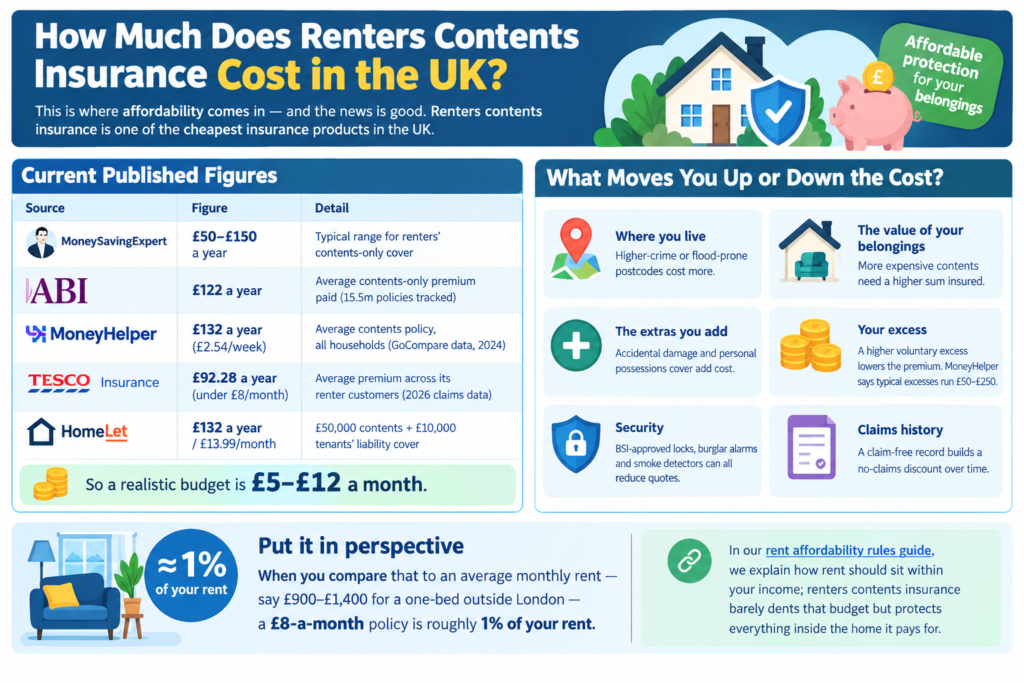
This is where affordability comes in — and the news is good. Renters contents insurance is one of the cheapest insurance products in the UK. Here are the current published figures, each from a named source:
| Source | Figure | Detail |
|---|---|---|
| MoneySavingExpert | £50–£150 a year | Typical range for renters’ contents-only cover |
| ABI (Q4 2025) | £122 a year | Average contents-only premium paid (15.5m policies tracked) |
| MoneyHelper (GoCompare data, 2024) | £132 a year (£2.54/week) | Average contents policy, all households |
| Tesco Insurance (2026 claims data) | £92.28 a year (under £8/month) | Average premium across its renter customers |
| HomeLet tenant policy | £132 a year / £13.99/month | £50,000 contents + £10,000 tenants’ liability cover |
So a realistic budget is £5–£12 a month. What moves you up or down that range?
- Where you live — higher-crime or flood-prone postcodes cost more
- The value of your belongings — more expensive contents need a higher sum insured
- The extras you add — accidental damage and personal possessions cover add cost
- Your excess — a higher voluntary excess (the amount you pay towards each claim) lowers the premium; MoneyHelper says typical excesses run £50–£250
- Security — BSI-approved locks, burglar alarms and smoke detectors can all reduce quotes
- Claims history — a claim-free record builds a no-claims discount over time
When you compare that to an average monthly rent — say £900–£1,400 for a one-bed outside London — a £8-a-month policy is roughly 1% of your rent. In our rent affordability rules guide, we explain how rent should sit within your income; renters contents insurance barely dents that budget but protects everything inside the home it pays for.
How to Work Out How Much Cover You Actually Need
When you get a quote, the insurer asks for the total replacement value of your contents — the sum insured. This is the maximum they’d pay out, and getting it wrong is the biggest mistake renters make.
The reliable way to do it: go room by room and price what it would cost to replace everything new (for new-for-old policies). Most insurers have free online contents calculators, and comparison sites like Confused.com and GoCompare offer them too. Here’s a realistic worked example.
Worked Example: Harriet Lloyd’s One-Bed Flat in Leeds
Harriet, 26, rents a one-bed flat for £850 a month. She walked through with a notebook and priced everything at today’s replacement cost:
| Room | Main items | Replacement value |
|---|---|---|
| Bedroom | Bed, mattress, wardrobe, bedding, clothes, shoes | £3,200 |
| Living room | Sofa, TV, games console, bookshelf, books, lamp | £2,900 |
| Kitchen | Small appliances, pots/pans, crockery, cutlery | £1,100 |
| Bathroom | Towels, toiletries, hair tools | £250 |
| Hallway/cupboards | Vacuum, iron, luggage, tools | £400 |
| Jewellery & watch | Engagement-style ring, watch (under £1,500 each) | £1,800 |
| Total | £9,650 |
Harriet was surprised: she’d have guessed £4,000. With accidental damage included, her quotes came in at £96 a year — £8 a month, about 0.9% of her rent. Her possessions are worth roughly 190 times her annual premium.
The national picture backs her up. Aviva’s How We Live report (March 2025) found the average UK household estimates its possessions at £58,210 — up 38% since 2019 — while fewer than one in three private renters has any contents cover at all. Across England, the private rented sector is 4.7 million households (19% of all households, per the English Housing Survey 2024–25). That’s millions of renters sitting on tens of thousands of pounds of unprotected belongings.
Seven Ways to Cut the Cost of Renters Contents Insurance
- Compare, compare, compare — insurers price the same risk very differently. Use comparison sites and quote direct, since some insurers (like Direct Line) don’t appear on comparison sites.
- Pay annually if you can — paying monthly typically adds around 6% to the cost (MoneyHelper). On a £120 policy that’s £7 back in your pocket.
- Raise your voluntary excess — agreeing to pay the first £250 instead of £100 of any claim lowers the premium. Just make sure you could actually afford the excess if you had to claim.
- Improve security — BSI-approved locks on doors and windows, a burglar alarm and smoke detectors can all trim quotes.
- Check what you already have — some packaged bank accounts include mobile phone and gadget cover. Don’t pay twice for the same protection.
- Build a no-claims bonus — every claim-free year usually earns a discount at renewal. Don’t claim for trivial amounts you’d rather pay yourself.
- Never auto-renew — loyalty is not rewarded. Get fresh quotes every year; even asking your current insurer to match a cheaper quote can work.
If you rent from a council or housing association, ask whether they offer a discounted tenants’ contents scheme — many have deals with insurers specifically for residents, sometimes added to your rent.
Is Renters Contents Insurance Worth It? The Affordability Maths
For most renters, this is the decisive question. Let’s run the numbers honestly — including the scenarios where it isn’t worth it.
Worked Example: Danny Okafor’s Affordability Test
Danny, 31, rents a room in a shared house in Manchester for £550 a month. His belongings are worth about £6,000. His renter’s contents insurance quote is £72 a year — £6 a month.
| Measure | Figure |
|---|---|
| Annual rent | £6,600 |
| Annual contents premium | £72 |
| Premium as % of annual rent | 1.1% |
| Premium as % of contents value | 1.2% |
| Cost of one replaced laptop + phone | £1,400+ |
| Months of premiums to equal one laptop | 233 months (19 years) |
For the price of a takeaway coffee each month, Danny covers £6,000 of belongings. If you’re already stretching to afford the rent — check our affordability calculator guide — £6 a month is unlikely to be the thing that breaks the budget, while one burglary absolutely could.
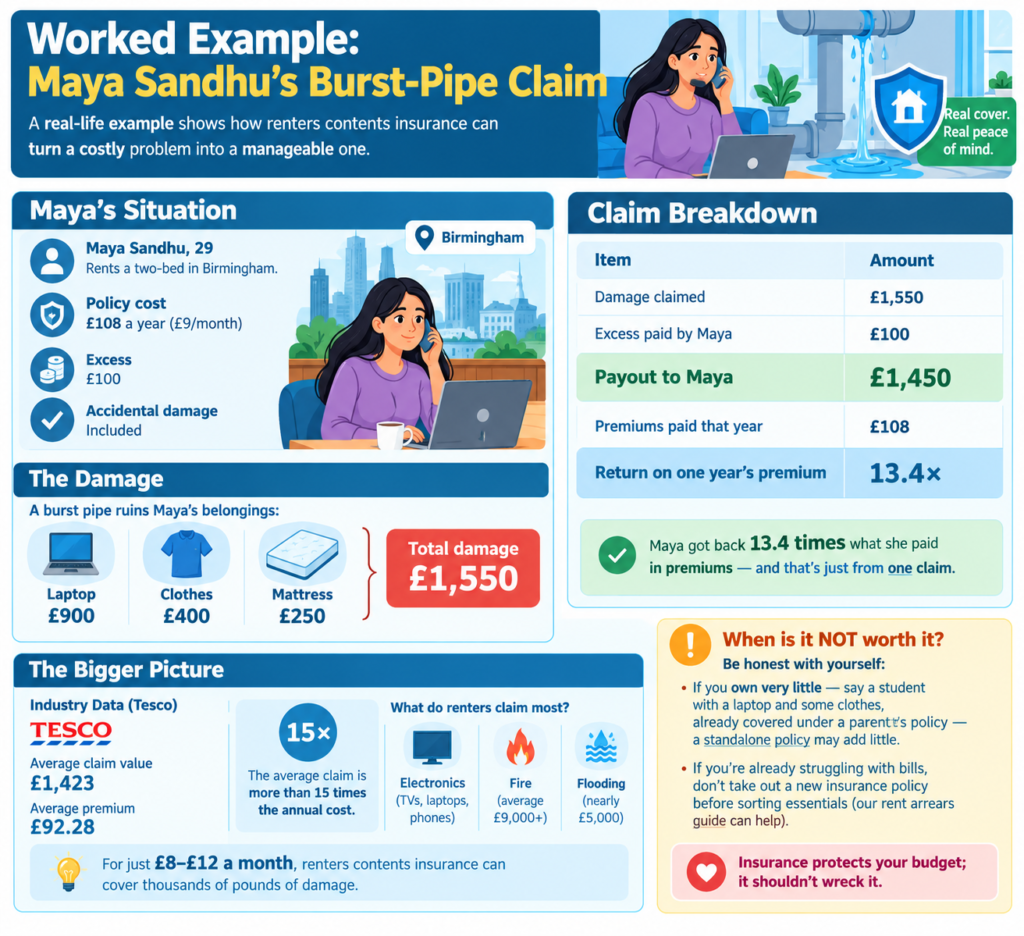
Worked Example: Maya Sandhu’s Burst-Pipe Claim
Maya, 29, rents a two-bed in Birmingham. Her policy costs £108 a year (£9/month) with a £100 excess and accidental damage included. A burst pipe ruins her £900 laptop, £400 of clothes and a £250 mattress — £1,550 of damage.
| Amount | |
|---|---|
| Damage claimed | £1,550 |
| Excess paid by Maya | £100 |
| Payout to Maya | £1,450 |
| Premiums paid that year | £108 |
| Return on one year’s premium | 13.4× |
Tesco’s industry data tells the same story at scale: the average renters contents insurance claim is worth £1,423, while the average renters contents insurance premium is just £92.28 — more than 15 times the annual cost. Electronics dominate renter claims (TVs, laptops and phones), but the biggest payouts are for fire (averaging over £9,000) and flooding (nearly £5,000).
When is it NOT worth it? Be honest with yourself: if you own very little — say a student with a laptop and some clothes, already covered under a parent’s policy — a standalone policy may add little. And MoneyHelper is blunt about priorities: if you’re already struggling with bills, don’t take out a new insurance policy before sorting essentials (our rent arrears guide can help). Insurance protects your budget; it shouldn’t wreck it.
Buying, Switching and Cancelling: Your Rights
- Cooling-off period: you get at least 14 days after buying to cancel and get a refund if the policy isn’t right — provided you haven’t claimed. This is a legal requirement for distance-sold insurance.
- Cancel anytime: you can ask your insurer to cancel at any point, but you may pay a cancellation charge (unless you’re at renewal or within the cooling-off period). If you’ve paid annually and haven’t claimed, you’ll usually get a refund for the unused months, minus fees. If you’ve claimed, you may have to pay the remaining monthly premiums.
- Moving home: contents policies usually transfer — tell your insurer your new address before you move. Premiums may change with the new postcode. See our ending your tenancy guide for moving checklists.
- No-claims bonus: claim-free years earn a discount, but cancelling mid-year usually means losing that year’s bonus.
- Struggling to pay? Don’t just cancel the direct debit — contact your insurer. They’re required to support customers in financial difficulty and may offer a repayment plan or reduced cover.
One warning: never let cover lapse accidentally between policies. If you’re switching, line up the new start date with the old end date. And fill in quote forms honestly — an error or missed detail can mean a future claim isn’t paid.
Renters in Special Situations
Students. Check your parents’ contents policy first — many insurers (including Aviva, with up to £12,000 of cover) extend protection to children studying away from home, sometimes at no extra cost. Limits and conditions vary by insurer, so check before assuming you’re covered. Specialist student policies exist too, and they’re often cheap because students own less.
Sharers and HMOs. Each tenant normally needs their own policy — your cover won’t protect your housemate’s laptop, and theirs won’t protect yours. Some insurers offer joint or household policies; otherwise, insure individually.
Council and housing association tenants. Ask your landlord about a discounted contents scheme — these are specifically designed for social renters and are often the cheapest way to get covered.
Furnished lets with “tenant must insure” clauses. If your tenancy agreement requires tenants’ liability cover, get it — but don’t pay for buildings cover you don’t need. The building is never your responsibility.
Renters in England under the new rules. The Renters’ Rights Act 2025 is reshaping tenancies in England — read our Renters’ Rights Act guide for what’s changing. Nothing in the Act makes contents insurance compulsory, but re-read any new-style agreement for insurance clauses.
FAQs
Do I legally need renters contents insurance in the UK?
No. Renters contents insurance is not a legal requirement for tenants anywhere in the UK. However, your landlord may make it — particularly tenants’ liability cover — a condition of your tenancy agreement, so always check the contract before you sign.
What’s the difference between renters’ contents insurance and landlord insurance?
Landlord insurance covers what the landlord owns: the building, fixtures, and any furniture or appliances they provided. Renters’ contents insurance covers what you own: your clothes, furniture, gadgets and personal belongings. The two policies complement each other but never overlap on the same items.
How much does renters contents insurance cost per month in the UK?
Typically £5–£12 a month. MoneySavingExpert puts the annual range at £50–£150; the ABI’s average contents-only premium was £122 a year in late 2025; and Tesco’s renter customers pay £92.28 a year on average. Your postcode, contents value and chosen extras move you up or down that range.
Does contents insurance cover my phone and laptop outside the home?
Not as standard. You need “personal possessions” cover as an optional extra for items taken outside the home. Without it, a phone stolen on the bus or a bike taken from the station won’t be covered.
What is the single-item limit?
Most policies cap payouts per item — often around £1,500 (MoneyHelper). If you own anything worth more than the limit, such as an engagement ring or expensive watch, list it individually as a “specified item” for full cover.
Does renters’ contents insurance cover accidental damage?
Usually not as standard — it’s an optional extra. That covers spills, breakages and knocked-over items. Tenants’ liability cover is the related add-on that pays for accidental damage to your landlord’s property, like a wine stain on their carpet.
Am I covered if I rent a furnished flat?
Your landlord’s insurance covers their furniture, not your belongings. You still need your own contents policy for your personal items — though your sum insured (and premium) will be lower. Tenants’ liability cover is especially sensible in furnished lets.
Can my landlord force me to get contents insurance?
They can ask, and they can write it into the tenancy agreement — but they cannot compel you under tenancy law, and any clause must be fair and transparent. If a clause seems unreasonable, get advice before signing.
What happens to my policy if I move to a new rental?
Tell your insurer before you move — most policies transfer to the new address, though the premium may change with the new postcode. Make sure there’s no gap between the old cover ending and the new one starting.
Can I cancel my contents insurance if I change my mind?
Yes. You have a minimum 14-day cooling-off period for a no-quibble cancellation after buying. After that you can still cancel anytime, but you may pay a cancellation fee, and you could lose that year’s no-claims bonus. If you’ve claimed, you may owe the remaining premiums.
Is contents insurance worth it if I don’t own much?
Add up the replacement cost room by room — most renters are surprised. If the total is a few thousand pounds and replacing it would hurt, a £6–£10-a-month policy is worth it. If you own very little or are covered under a parent’s policy, it may not be.
Does contents insurance affect my credit score or renting applications?
Buying contents insurance doesn’t affect your credit score. Paying monthly by direct debit is a credit agreement, so missed payments could be recorded — but the policy itself isn’t part of referencing or affordability checks.
Final Thoughts
Renters contents insurance is one of the cheapest financial safety nets in the UK: roughly 1% of your rent to protect tens of thousands of pounds of belongings. It’s not legally required; your landlord’s policy won’t cover your things, and the two claims you’re most likely to face — a stolen laptop or a burst pipe — are exactly what it pays for. The industry numbers make the case plainly: average renters contents insurance claim £1,423, average renters contents insurance premium £92.28.
The affordability angle is simple. If replacing your belongings would mean debt or hardship, £5–£12 a month is money well spent — fold it into your monthly budget alongside rent, council tax and energy bills so it’s accounted for from day one. If you genuinely own very little, or you’re covered under a parent’s policy, skip it and put the money towards an emergency fund instead.
Before you buy: price your contents room by room, check for tenants’ liability if your tenancy asks for it, consider accidental damage, compare at least three quotes, and never auto-renew. And if you’re still working out what you can afford overall, run your numbers through our rent affordability rules guide — knowing your true budget is the foundation everything else sits on.
Further Reading
- What is contents insurance? — MoneyHelper — the free, impartial guide to how contents cover works, excesses, single-item limits and cancelling
- How much is the average cost of home and contents insurance? — MoneyHelper — average premium figures and tips for cutting the cost
- Renters’ contents insurance — MoneySavingExpert — detailed renter-specific guide covering tenants’ liability, accidental damage and cheap quotes