A Section 8 eviction was the last thing Rohan expected — he was usually a day or two late with the rent — payday landed awkwardly — but the money always arrived. Then a stiff envelope dropped through the letterbox of his Manchester flat: “Notice seeking possession — Section 8, Housing Act 1988.” Ground 11 — persistent late payment. Four weeks’ notice.
His first thought was obvious: do I have to leave? The short answer — the most important sentence in this guide — is no. A Section 8 eviction notice is not an eviction in itself. It is the first step in a legal process, and only a court can end your tenancy. Since 1 May 2026, Section 21 “no-fault” evictions are gone in England: your landlord must prove a legal reason, follow strict rules, and convince a judge.
This guide gives general information about Section 8 eviction in England — it isn’t legal advice. If you’re facing court action, get free advice from Shelter, Citizens Advice or the Housing Loss Prevention Advice Service.
Quick Answer: Since 1 May 2026, Section 21 no-fault evictions have been abolished in England — your landlord can only evict you using Section 8 by proving one of the legal “grounds”. A notice is just the start: the court process realistically takes 6–10+ months, and you have strong rights along the way, including challenging invalid notices, paying down arrears to defeat Ground 8, asking the court for more time, and getting free legal advice. Don’t ignore the notice, don’t leave early, and never treat the date on the letter as your move-out date.
What Is a Section 8 Eviction Notice — and What Happened to Section 21?
A Section 8 eviction notice is a formal notice under the Housing Act 1988. It tells you your landlord intends to ask the court for possession of your home, and which ground(s) they rely on.
Until recently, landlords had an easier option: the Section 21 “no-fault” notice, which needed no reason. The Renters’ Rights Act 2025 abolished it on 1 May 2026 — any Section 21 served on or after that date is invalid, and landlords who misuse it face a civil penalty of up to £7,000. (More on the new law in our Renters’ Rights Act 2025 guide.)
A Section 8 eviction is now the only eviction route for assured periodic tenants in England — which covers most private renters. The difference between mandatory and discretionary grounds decides how much power the judge has — and how much power you have.
Since 1 May 2026, the prescribed form is Form 3A (replacing the old Form 3). A valid notice must contain your name, the property address, the ground number(s) with full wording and reasons, and the date the notice period ends. Get any of these details wrong and the landlord’s Section 8 eviction case can collapse before it starts.
A Section 8 notice does not end your tenancy. Your tenancy continues, and rent is still due, until you end it properly yourself (see our guide on ending your tenancy) or a court orders possession.
Section 8 Eviction Grounds: Mandatory vs Discretionary
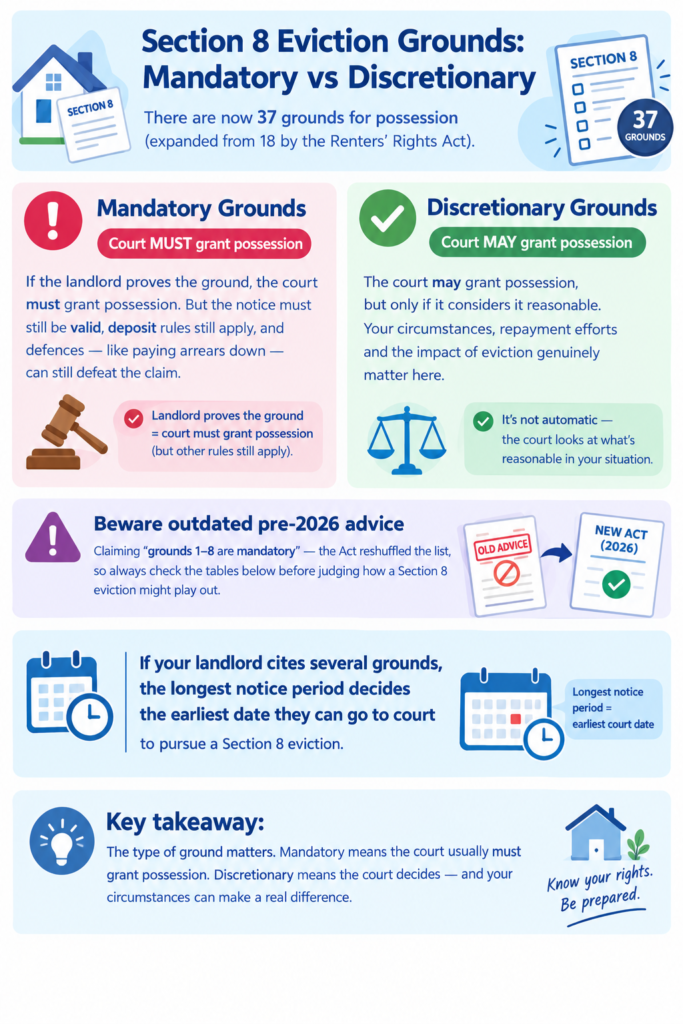
There are now 37 grounds for possession (expanded from 18 by the Renters’ Rights Act).
| Ground type | What it means for you |
|---|---|
| Mandatory | If the landlord proves the ground, the court must grant possession. But the notice must still be valid, deposit rules still apply, and defences — like paying arrears down — can still defeat the claim. |
| Discretionary | The court may grant possession, but only if it considers it reasonable. Your circumstances, repayment efforts and the impact of eviction genuinely matter here. |
Beware outdated pre-2026 advice claiming “grounds 1–8 are mandatory” — the Act reshuffled the list, so always check the tables below before judging how a Section 8 eviction might play out.
If your landlord cites several grounds, the longest notice period decides the earliest date they can go to court to pursue a Section 8 eviction.
Rent arrears grounds
| Ground | Notice period and key rule |
|---|---|
| 8 — serious arrears (mandatory) | 4 weeks. Needs 3+ months’ rent owed (13 weeks if you pay weekly) both when the notice is served and at the hearing. Drop below 3 months before the hearing and the ground fails. |
| 10 — any arrears (discretionary) | 4 weeks. Any rent unpaid at the notice date and still unpaid at the hearing. The judge weighs reasonableness. |
| 11 — persistent late payment (discretionary) | 4 weeks. A pattern of late payment — no arrears need be outstanding. This is Rohan’s situation. |
Ground 8 in depth. That double test — owed at the notice date and at the hearing — is your lifeline: pay arrears below 3 months’ rent before the hearing and the mandatory claim collapses. Our rent arrears guide has practical ways to get arrears under control.
Worked example — beating the Ground 8 threshold. Sana rents in Leeds for £950 a month. After losing her job she falls 3½ months behind: 3.5 × £950 = £3,325. Her landlord serves a Ground 8 notice. Before the hearing, her grandmother lends her £1,000, paid straight to the landlord: £3,325 − £1,000 = £2,325 still owed. That’s £2,325 ÷ £950 = 2.45 months’ rent — below the 3-month threshold, so Ground 8 fails. The landlord can still cite discretionary Grounds 10 or 11, but the judge sees shrinking arrears and real effort — exactly what the reasonableness test rewards.
Universal Credit delays don’t count. Arrears caused solely by delayed or unpaid UC housing element — where you were entitled to it — are disregarded for Ground 8. Keep UC journal messages, award letters and payment statements as evidence. Our Universal Credit affordability guide helps you budget around the monthly payment cycle.
Breach and antisocial behaviour grounds
| Ground | Notice period and key rule |
|---|---|
| 12 — breach of a tenancy term, e.g. unauthorised subletting, pets, alterations (discretionary) | 2 weeks. Fixing the breach counts heavily at the hearing. |
| 13 — deterioration of the property through neglect (discretionary) | 2 weeks |
| 15 — deterioration of the furniture (discretionary) | 2 weeks |
| 17 — false statement that induced the tenancy (discretionary) | 2 weeks |
| 7B — no right to rent after a Home Office notice (mandatory) | 2 weeks. Moves fast — get immigration advice immediately if you think there’s an error. |
| 14 — antisocial behaviour/nuisance (discretionary) | Immediate — court proceedings can start on the date of service. Covers your household and visitors too. Get advice the same day. |
| 7A — serious ASB: conviction, injunction breach, closure order (mandatory) | Immediate. The statute also sets tight service deadlines (reported as within 12 months of conviction, or 3 months of a closure order) — get specialist advice urgently. |
When the landlord wants the property back
| Ground | Notice period and key rule |
|---|---|
| 1 — landlord or close family moving in (mandatory) | 4 months. Not in the first 12 months of the tenancy. The intention must be genuine — misuse is a penalty offence, with council civil penalties up to £40,000. Report suspected abuse to your council. |
| 1A — landlord intends to sell (mandatory) | 4 months. Not in the first 12 months; 12-month re-letting restriction after sale. Kept brief here — see our Renters’ Rights Act 2025 guide for the full picture. |
| 2 — mortgage lender repossessing (mandatory) | 4 months. You may have rights against the lender too — get advice. |
| 6 — demolition or redevelopment (mandatory) | 4 months. The works must genuinely require you to leave. |
| Specialist grounds (probate, alternative accommodation etc.) | 2 months. Rare in ordinary tenancies. |
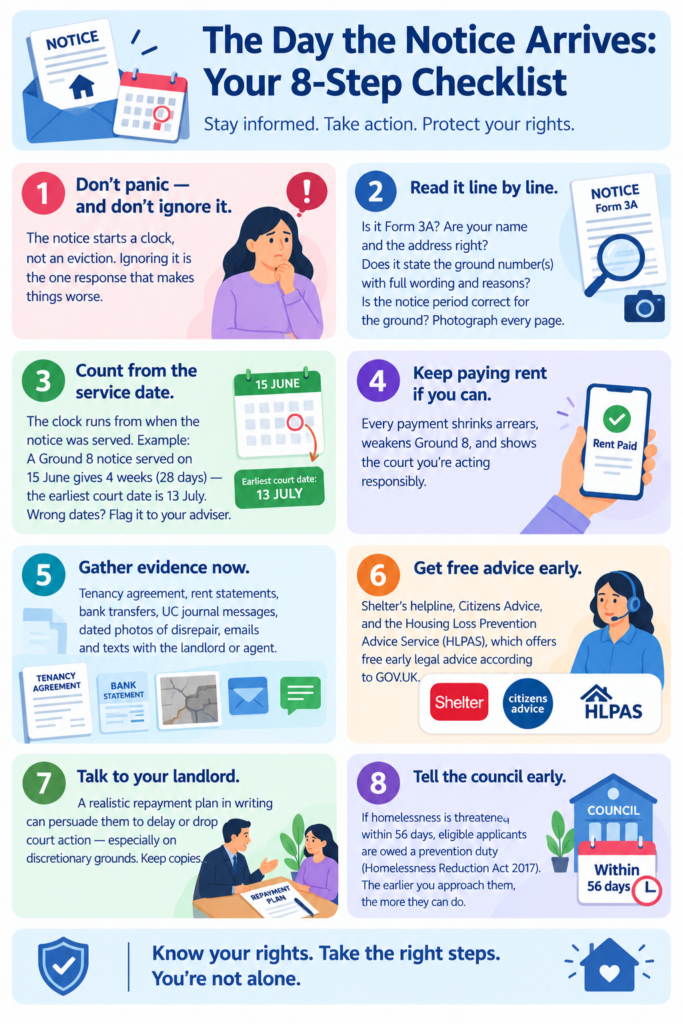
The Day the Notice Arrives: Your 8-Step Checklist
- Don’t panic — and don’t ignore it. The notice starts a clock, not an eviction. Ignoring it is the one response that makes things worse.
- Read it line by line. Is it Form 3A? Are your name and the address right? Does it state the ground number(s) with full wording and reasons? Is the notice period correct for the ground? Photograph every page.
- Count from the service date. The clock runs from when the notice was served. Example: a Ground 8 notice served on 15 June gives 4 weeks (28 days) — the earliest court date is 13 July. Wrong dates? Flag it to your adviser.
- Keep paying rent if you can. Every payment shrinks arrears, weakens Ground 8, and shows the court you’re acting responsibly.
- Gather evidence now. Tenancy agreement, rent statements, bank transfers, UC journal messages, dated photos of disrepair, emails and texts with the landlord or agent.
- Get free advice early. Shelter’s helpline, Citizens Advice, and the Housing Loss Prevention Advice Service (HLPAS), which offers free early legal advice according to GOV.UK.
- Talk to your landlord. A realistic repayment plan in writing can persuade them to delay or drop court action — especially on discretionary grounds. Keep copies.
- Tell the council early. If homelessness is threatened within 56 days, eligible applicants are owed a prevention duty (Homelessness Reduction Act 2017). The earlier you approach them, the more they can do.
How to Challenge an Invalid Section 8 Eviction Notice
An invalid Section 8 eviction notice means the court case built on it collapses. Check yours for:
- Wrong form — since 1 May 2026, it must be Form 3A, not the old Form 3.
- Vague grounds — the notice must give ground number(s), full wording and reasons. “You are in breach” without specifics isn’t enough.
- Short notice period — 4 weeks for Ground 8, 2 weeks for Ground 12, 4 months for Ground 1. Shorter than the ground requires means defective.
- Wrong details — wrong address or wrong tenant is fatal; a merely misspelled name usually isn’t.
- Bad dates — the notice end date must line up with the period counted from service.
- Defective service — keep evidence of how and when it actually arrived.
Shelter’s guidance is blunt: a landlord cannot usually evict you if the Section 8 eviction notice is wrong. Get an adviser to confirm — “usually” does heavy lifting.
The deposit protection block defeats more claims than any other technicality. The court can only grant a possession order if your deposit is protected in an approved scheme, the scheme rules were followed, and you received the prescribed information — on every ground except 7A and 14. Our tenancy deposit protection guide shows how to check.
Watch the court deadline. The landlord must start Section 8 eviction proceedings within 12 months of serving the notice, or start over with a fresh one. Transitional trap: for notices served before 1 May 2026, the deadline was the earlier of 12 months or 31 July 2026 — now passed. If your notice predates 1 May 2026 and no claim was issued by 31 July 2026, the notice is dead.
Defences That Can Win at the Court Hearing
You’ll receive the claim and a defence form. Fill it in and attend. Hearings are short — often around 10 minutes — and an absent tenant with no defence is the easiest Section 8 eviction case on the list for the landlord.
| Defence | How it helps you |
|---|---|
| Pay arrears below 3 months’ rent | Defeats mandatory Ground 8 — it fails its own threshold, as in Sana’s example |
| Disrepair counterclaim/set-off | Compensation for disrepair offsets arrears, potentially pulling them below the Ground 8 threshold |
| Deposit not protected / information not served | Blocks a possession order on every ground except 7A and 14 |
| UC-delay disregard | Arrears caused solely by UC housing-element delays are ignored for Ground 8 |
| Breathing space moratorium | Landlord must not serve a notice, issue a claim or apply for a warrant during the moratorium |
| Reasonableness argument (discretionary grounds) | Repayment plan, shrinking arrears, health or disability circumstances, impact on your household — argued with paperwork, not just words |
| Exceptional hardship plea | Up to 42 days to leave instead of the usual 14 |
The disrepair counterclaim is powerful: serious unfixed disrepair can be counterclaimed for compensation, set against your arrears. Document everything with dated photos and keep every repair request — our landlord repairs guide explains what counts.
Breathing space (the Debt Respite Scheme, including mental-health-crisis moratoriums) freezes the process. Tell your landlord and the court immediately if you’re in one.
Suspended Possession Orders and Payment Plans
Losing at the hearing doesn’t always mean leaving. With a suspended possession order, you stay — as long as you meet its conditions, usually current rent plus a fixed sum towards arrears, which pauses the Section 8 eviction.
Worked example — a suspended order. Daryl rents in Birmingham for £900 a month and owes £1,800 after reduced hours at work. The judge orders: £900 current rent plus £75 a month towards the arrears. £1,800 ÷ £75 = 24 months to clear the debt — a total payment of £975 a month. Pay £975 every month and he stays. Miss payments and the landlord can ask the court to enforce, usually without a full new hearing.
The alternative is an outright possession order: leave within 14 days, or up to 42 days for exceptional hardship — ask for the longer period if you need it. The court can also make a money order for the arrears plus the landlord’s court fee (£415) and legal costs. At the hearing, the judge may grant possession, suspend it, make a money order, adjourn, or dismiss — your defence and attendance shape which.
The Realistic Section 8 Eviction Timeline: Notice to Bailiffs
A Section 8 eviction takes months, not weeks — and that time is yours to use.
| Stage | What happens |
|---|---|
| Notice served | Form 3A; notice period runs 2 weeks to 4 months depending on the ground |
| Court claim | Landlord applies to the county court (forms N5 + N119, or online for arrears cases) — must be within 12 months of the notice |
| Hearing listed | You get the claim and a defence form; median claim-to-order is 8–11 weeks (Ministry of Justice data) |
| Hearing | Judge decides: possession, suspended order, money order, adjournment or dismissal — often around 10 minutes |
| Possession order date | 14 days to leave normally; up to 42 days for exceptional hardship |
| Warrant of possession | If you haven’t left, the landlord applies for a warrant |
| Bailiff notice | Form N54 served at least 14 days before the eviction date |
| Eviction | County court bailiffs carry it out (warrant valid 12 months, per Shelter Legal); High Court enforcement needs court permission and takes around 4–6 weeks |
Current court fees (rose on 13 July 2026):
| Court stage | Fee |
|---|---|
| Possession claim | £415 (was £404) |
| Warrant of possession | £152 |
End to end, the MoJ median from claim to repossession is 27–27.4 weeks — and that clock starts only when the claim is issued, after the notice period has run. Realistically 6–10+ months from a Section 8 eviction notice landing on your doormat to bailiffs. (Older articles quoting £404 are out of date.)
Bailiff Day: What Actually Happens
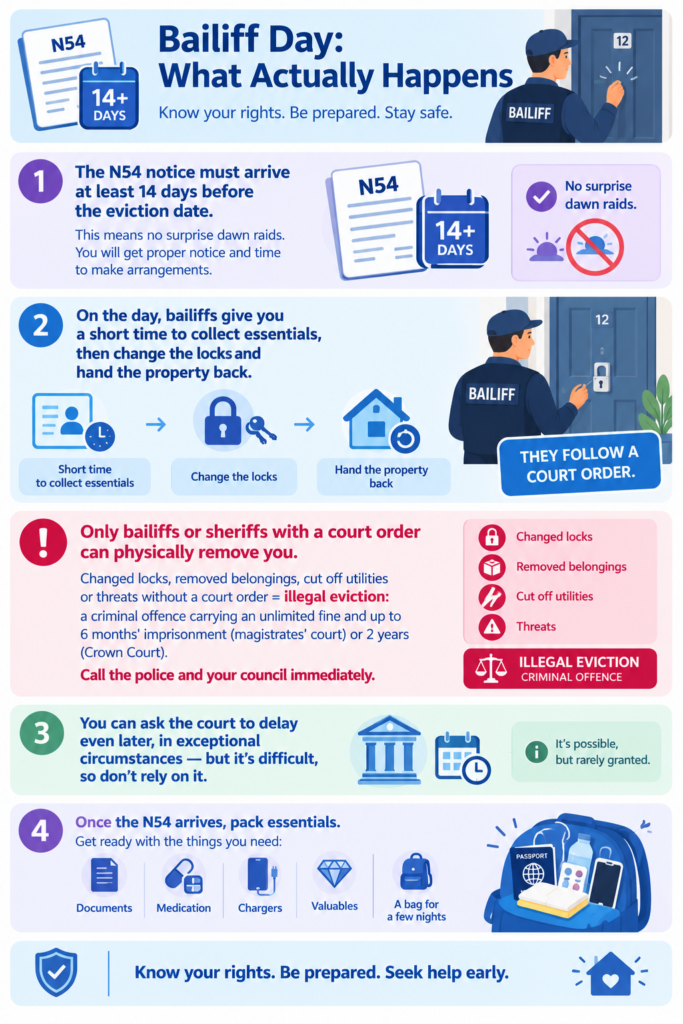
The N54 notice must arrive at least 14 days before the eviction date — no surprise dawn raids. On the day, bailiffs give you a short time to collect essentials, then change the locks and hand the property back.
- Only bailiffs or sheriffs with a court order can physically remove you. Changed locks, removed belongings, cut off utilities or threats without a court order = illegal eviction: a criminal offence carrying an unlimited fine and up to 6 months’ imprisonment (magistrates’ court) or 2 years (Crown Court). Call the police and your council immediately.
- You can ask the court to delay even later, in exceptional circumstances — but it’s difficult, so don’t rely on it.
- Once the N54 arrives, pack essentials: documents, medication, chargers, valuables, and a bag for a few nights.
Council Help, Money Support and Your Safety Net
Prevention duty. Threatened with homelessness within 56 days? Eligible applicants are owed practical help to stay put or find another home. Approach the council early — 56 days is a minimum, not a target.
Discretionary Housing Payments. On Housing Benefit or the UC housing element with a rent shortfall? Apply to your council for a DHP towards arrears or the shortfall. Since 1 April 2026, some councils call it the “Crisis and Resilience Fund – Housing Payments” — same help, new name.
The golden rule: don’t leave early. Your tenancy and rent liability continue until the legal end. Hand back the keys while you still have a defence, and the council may find you intentionally homeless — destroying your right to help. Shelter’s advice: stay until the bailiffs come, unless the council agrees an earlier date in writing. (If you want to end things on your own terms, do it properly — see our ending your tenancy guide.)
The Rest of the UK: Scotland, Wales and Northern Ireland
Everything above covers a Section 8 eviction in England only:
| Nation | How eviction works |
|---|---|
| England | Section 8 only (Section 21 abolished 1 May 2026); notice of 0–4 months depending on the ground; county court; realistically 6–10+ months end to end |
| Scotland | Private Residential Tenancy with 18 grounds; 28 days’ notice (tenancy of 6 months or less, or fault grounds such as 3+ months’ arrears or ASB) or 84 days otherwise; First-tier Tribunal, applied to within 6 months of the notice expiring; landlord must notify the local authority |
| Wales | Occupation contracts; Section 173 “no-fault” notice still in force — 6 months’ notice, not servable in the first 6 months of occupation (Form RHW16); shorter fault-based breach notices also exist |
| Northern Ireland | Notice to quit: 4 weeks (tenancy of 12 months or less), 8 weeks (1–10 years), 12 weeks (10+ years), in writing; only a court and the Enforcement of Judgments Office can remove you |
NI flag: longer bands (8 weeks / 4 months / 6 months / 7 months) have been proposed in the 2025 regulations, but as of October 2026 they aren’t confirmed in force — treat the 4/8/12-week position as current.
Final Thoughts
A Section 8 notice feels like the ground shifting under you — but it’s firmer than it looks. Since 1 May 2026 your landlord needs a valid ground, a valid notice and a judge’s agreement, and the process realistically takes the best part of a year. Use that time: check the notice for errors, pay down arrears — remember Sana’s £1,000 payment defeating a mandatory Ground 8 claim — get free advice early, and put everything to your landlord in writing. Never hand back the keys before you have to.
If money is the root cause, prevention beats cure. Our rent-to-income ratio calculator shows whether your rent is sustainable, and the income required to rent calculator shows what salary your next home needs. The cheapest eviction to fight is the one that never starts.
Frequently Asked Questions
Does a Section 8 notice mean I have to leave by the date on it?
No. The date on the notice is simply the earliest date your landlord can apply to court — not a move-out date, and it doesn’t end your tenancy. Only a court possession order (and its enforcement) can end it against your will. Rent remains due in the meantime.
How long does a Section 8 eviction take from start to finish?
Realistically 6–10+ months from service. The notice period alone runs 2 weeks to 4 months depending on the ground; the Ministry of Justice median from court claim to repossession is about 27 weeks; bailiffs must give at least 14 days’ notice before eviction. Defending the claim and busy court lists add time.
Can my landlord evict me for one month’s rent arrears?
They can serve a notice citing Ground 10 (any arrears) or Ground 11 (persistent late payment), but both are discretionary — the judge must find eviction reasonable, and small or shrinking arrears with a repayment plan rarely meet that test. The mandatory arrears ground, Ground 8, needs 3+ months’ rent owed both at the notice date and at the hearing.
My arrears were caused by Universal Credit delays. Does that matter?
Yes — it can be decisive. Arrears caused solely by delayed or unpaid UC housing element — where you were entitled to it — are disregarded for Ground 8. Keep UC journal messages, award letters and payment statements as evidence, and raise it in your defence.
My deposit was never protected. Can my landlord still evict me?
Almost certainly not through the courts. No possession order can be granted on any Section 8 ground — except 7A and 14 — unless your deposit is protected in an approved scheme, the scheme rules were followed, and you received the prescribed information. Raise it with your adviser immediately.
My landlord says they’re selling and cited Ground 1A. Can I challenge it?
Check the conditions: 4 months’ notice, not usable in the first 12 months of the tenancy, and the intention to sell must be genuine — misuse carries civil penalties up to £40,000, reportable to the council. A 12-month re-letting restriction also applies after sale. See our Renters’ Rights Act guide for the full picture.
Will the council rehouse me if I’m evicted?
If you’re eligible and threatened with homelessness within 56 days, the council owes you a prevention duty — help to stay or find somewhere else. Afterwards they assess priority need and whether you became homeless intentionally. Leaving voluntarily before you had to can trigger an “intentionally homeless” decision — which is why advisers say stay until the bailiffs come, unless the council agrees otherwise in writing.
Should I just leave before the court hearing to avoid the stress?
Almost never. Leaving early doesn’t erase arrears (a money order can still follow you) and it can destroy your right to council help via an intentional-homelessness finding. Your tenancy continues until its legal end — use those months to fix the situation.
What happens if I don’t go to the hearing?
The judge will likely grant the landlord what they asked for — hearings are short, often around 10 minutes, and an undefended case is the easiest to decide. Attend with your defence and evidence, and take up the free early legal advice available (including the Housing Loss Prevention Advice Service). If you genuinely can’t attend, tell the court in advance and ask for an adjournment.
Can my landlord change the locks or cut off my gas and electricity to force me out?
No — that’s an illegal eviction, a criminal offence punishable by an unlimited fine and up to 6 months’ imprisonment (magistrates’ court) or 2 years (Crown Court). Only bailiffs or sheriffs acting on a court order can physically remove you. Call the police and your council immediately if your landlord tries.
I live in Scotland, Wales or Northern Ireland. Does Section 8 apply to me?
No — Section 8 is England only. Scotland uses the First-tier Tribunal with 18 grounds and 28/84-day notices; Wales still has the 6-month Section 173 no-fault notice; Northern Ireland uses notices to quit of 4, 8 or 12 weeks depending on tenancy length. See the comparison table above and get nation-specific advice.
Where can I get free help with a Section 8 notice?
Shelter’s helpline and website guides, your local Citizens Advice, and the Housing Loss Prevention Advice Service (HLPAS), which offers free early legal advice according to GOV.UK. Approach your council’s housing team early too — the prevention duty applies when homelessness is threatened within 56 days. Don’t pay a claims company for what these services give free.
Further Reading
- GOV.UK — Evicting tenants in England: the official process — notice rules, court process, transitional deadlines and free legal advice (HLPAS).
- Shelter England — How much notice must a private tenant get? — notice periods by ground in plain tenant language.
- Shelter England — Section 8 notices and rent arrears — Ground 8 explained, including paying arrears down before the hearing.