
Council Housing UK:Megan is 31, works two cleaning jobs in Leeds, and shares a cramped two-bedroom flat with her mum, her sister and her four-year-old son. A two-bed private rental anywhere near her mum costs £950 a month or more — far beyond her wages — so a friend tells her to “get on the council list”. But who qualifies? How long does it take? Does working full time rule her out?
This guide explains exactly how to apply for council housing: what council housing is and who it is for, who is eligible (including immigration rules), how waiting lists and priority bands work, who gets “reasonable preference” by law, how bidding works, realistic wait times, rents versus private renting, Universal Credit and the bedroom tax, tenancy types across the four nations, challenging decisions, and what to do while you wait.
Quick answer: Council housing is allocated through your council’s housing register (the waiting list), and homes go to those with the greatest housing need — not whoever applied first. You apply online, supply documents, get placed in a priority band, and in most areas bid for homes through choice-based lettings. Waits range from months to many years: over 1.3 million households are waiting in England, and even top-priority applicants in pressurised areas can wait two years or more.
What is council housing, and who is it for?
Council housing UK is rented housing provided by local councils and housing associations at “social rents” — rents set by a government formula that are typically far below private market rents. You may also hear it called social housing; the two terms are used interchangeably, although strictly speaking “social housing” also covers housing association homes.
It is for people who cannot afford to buy or rent privately and have a genuine housing need: homelessness, overcrowding, unsuitable conditions, a medical condition the current home worsens, or simply unaffordable private rents. Being in work does not rule you out. The key point is scarcity — councils ration homes by need.
How to apply for council housing: the step-by-step process
If you’re wondering how to apply for council housing, the process is broadly the same everywhere in the UK, though the details (forms, band names, timescales) differ by council. There are five steps:
| Step | What happens | What you will need |
|---|---|---|
| 1. Check you are eligible | You confirm you meet the basic rules on age, immigration status and behaviour | ID and immigration documents |
| 2. Apply to the housing register | You complete the application, usually online through your council’s website (paper forms are available on request) | Details of your household, income, current housing, health conditions |
| 3. Provide evidence | The council checks your documents and may contact your landlord, doctor or employer | Proof of address, income, local connection, medical evidence if relevant |
| 4. Get assessed and banded | The council decides whether you qualify and places you in a priority band based on your housing need | Nothing — you wait for the decision letter |
| 5. Bid for homes or receive offers | You bid for advertised properties through choice-based lettings, or the council makes you direct offers | Regular bidding, and keeping your application up to date |
If you do not hear back within about a month of applying, chase the council — applications do go missing, and Shelter England advises contacting them if a month passes with no decision letter. Knowing how to apply for council housing also means knowing to follow up when things stall.
Who is eligible, and how to apply for council housing?
Councils check two things: whether you are eligible under the law, and whether you qualify under their own local rules (in England, councils set these under Localism Act 2011 powers, so details vary). Understanding these two tests is the foundation of how to apply for council housing — get them right and the rest of the process follows.
| Your situation | Can you apply? |
|---|---|
| British or Irish citizen | Yes |
| EU Settlement Scheme settled status (or right to reside) | Yes |
| Indefinite leave to remain | Yes |
| Refugee status or humanitarian protection | Yes |
| Right of abode, or leave as a stateless person | Yes |
| On a visa with “no recourse to public funds” (e.g. most work, study or visitor visas) | Usually no |
| Seeking asylum (claim not yet decided) | No |
| Aged 16 or over | Yes — most councils accept applications from 16 |
| Serious rent arrears or antisocial behaviour history | The council can refuse or suspend your application |
| Already a council or housing association tenant (applying to transfer) | Yes — existing social tenants are entitled to apply for a further allocation |
Immigration status is the most common reason applications are refused at this stage — and councils do get it wrong, so check any refusal against the rules and ask for a review if needed (see below). Income and savings can also matter: some councils set caps (Hounslow, for example, excludes households with over £50,000 income, over £50,000 savings, or any property owned in the UK or abroad), though thresholds differ. Getting this right is a critical part of how to apply for council housing successfully.
Key rule: Being in work does not disqualify you — allocation is by housing need. But if your income or savings could cover a private rent in your area, the council may decide you do not qualify.
Do you need a local connection?
Most councils require a local connection, but the definition and the length of time vary — one of the first things to check when learning how to apply for council housing in a new area. Typical rules are:
- Residence: you have lived in the area for a set period — commonly two years (e.g. Dorset) and up to five years in some London boroughs (e.g. Hounslow)
- Employment: you work in the area
- Family: close family members have lived in the area for the qualifying period
- Other strong ties: for example, you grew up there or need to be near specialist support
There are important exceptions. Councils should not insist on a residence period if you are escaping domestic abuse, and members of the Armed Forces (and bereaved spouses or civil partners) are protected by law from local connection requirements. In Scotland, the rules are different again: social landlords must not take account of how long you have lived in their area when allocating homes — a deliberate contrast with England and Wales.
If you do not have a local connection where you live now, consider how to apply for council housing through a neighbouring council where you do qualify — you can be on more than one housing register at the same time.
How do waiting lists work: bands, points and priority dates?
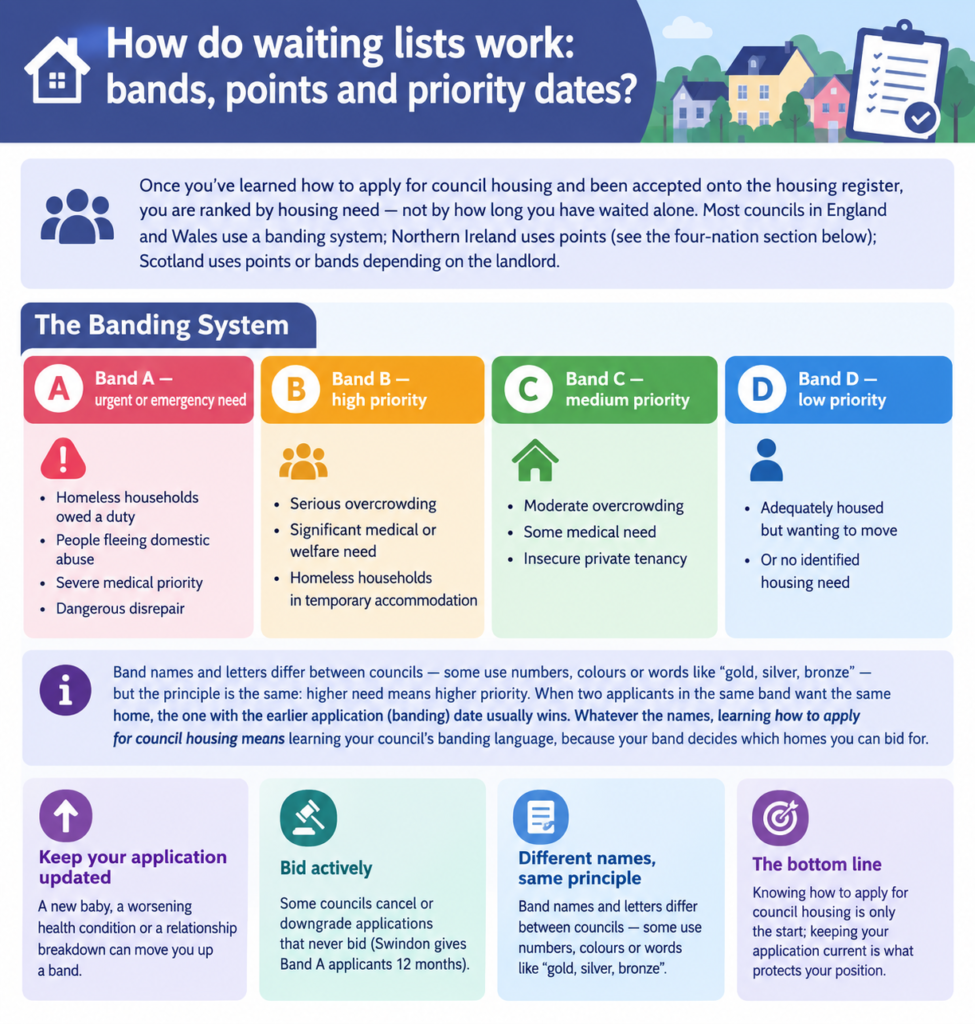
Once you’ve learned how to apply for council housing and been accepted onto the housing register, you are ranked by housing need — not by how long you have waited alone. Most councils in England and Wales use a banding system; Northern Ireland uses points (see the four-nation section below); Scotland uses points or bands depending on the landlord.
| Band | Who is typically in it |
|---|---|
| Band A — urgent or emergency need | Homeless households owed a duty, people fleeing domestic abuse, severe medical priority, dangerous disrepair |
| Band B — high priority | Serious overcrowding, significant medical or welfare need, homeless households in temporary accommodation |
| Band C — medium priority | Moderate overcrowding, some medical need, insecure private tenancy |
| Band D — low priority | Adequately housed but wanting to move, or no identified housing need |
Band names and letters differ between councils — some use numbers, colours or words like “gold, silver, bronze” — but the principle is the same: higher need means higher priority. When two applicants in the same band want the same home, the one with the earlier application (banding) date usually wins. Whatever the names, learning how to apply for council housing means learning your council’s banding language, because your band decides which homes you can bid for.
Keep your application updated — a new baby, a worsening health condition or a relationship breakdown can move you up a band. And bid actively: some councils cancel or downgrade applications that never bid (Swindon gives Band A applicants 12 months). Knowing how to apply for council housing is only the start; keeping your application current is what protects your position.
Which groups get “reasonable preference” by law?
In England, the law (section 166A(3) of the Housing Act 1996) requires every council’s allocation scheme to give “reasonable preference” to certain groups; Wales has an equivalent duty under the same Act, and Scotland has its own version in section 20 of the Housing (Scotland) Act 1987. Whatever your council calls its bands, these groups must be prioritised. Knowing whether you fall into one of these groups is a key part of how to apply for council housing — it determines how much priority you get.
| Reasonable preference group | What it means in plain English |
|---|---|
| People who are homeless | Homeless within the legal meaning of the Housing Act, including those owed a homelessness duty |
| People owed a homelessness duty | For example, households owed the prevention, relief or main housing duty by any council |
| People in insanitary, overcrowded or unsatisfactory housing | Severe disrepair, statutory overcrowding, or conditions seriously harming health |
| People who need to move on medical or welfare grounds | Including any grounds relating to disability — for example, a home that cannot be adapted for a wheelchair |
| People who need to move to a particular locality to avoid hardship | Where failing to move would cause hardship to them or someone else, e.g. to give or receive care |
Councils must also give additional preference — effectively, one band higher — to certain people within these groups who have urgent housing needs: serving members of the Regular Armed Forces (and those who served within the last five years), bereaved spouses and civil partners leaving service accommodation, and serving or former Reserve Forces members with a service-attributable serious injury, illness or disability. If you have an urgent need, say so clearly and provide evidence — understanding how to apply for council housing means making your need visible.
How does bidding work under choice-based lettings?
Once you know how to apply for council housing and you’re on the register, most councils advertise available homes through choice-based lettings: properties are listed (usually weekly, on the council’s lettings website), and applicants “bid” — register their interest — for the ones that suit their household. Bidding is not an auction; no money changes hands. It is simply how you say “I want to be considered for this home.”
A typical cycle, based on current council schemes such as Cherwell’s (updated January 2026), works like this:
- Homes are advertised for a set period — often about six days each week
- You can bid for a limited number of properties per cycle (commonly up to three)
- You may only bid for homes that match your assessed bedroom need and any restrictions on the advert
- When bidding closes, the council shortlists bidders in priority (band) order
- The highest-priority eligible bidder is nominated to the landlord, who makes a provisional offer
- Shortlisting results are published so you can see where you came
Some councils bid automatically for vulnerable applicants; others skip bidding for the highest-priority cases and make direct offers instead. Either way, learning how to apply for council housing is step one — understanding your council’s bidding rules is step two.
In Northern Ireland the system is similar but run through the Property News website: anyone on the waiting list can register interest in advertised homes before the Tuesday 5pm deadline, and the Housing Selection Scheme points decide who gets the offer.
Warning: Only bid for homes you would genuinely accept. Councils treat bidding as a serious expression of interest, and refusing a home you bid for can count against you (more on this below).
How long will you realistically wait?
This is the question everyone learning how to apply for council housing asks, and the honest answer is that it depends enormously on where you live, what size home you need and which band you are in. What is certain is that demand dwarfs supply. These are the most recent verified figures:
- 1.3 million households are on social housing waiting lists in England, while only 12,198 social rent homes were built across England in the year Shelter analysed — roughly 110 households waiting for every new home. At current building rates, Shelter calculated it would take 119 years to clear the lists (Shelter research, reported June 2026).
- Leeds: more than 27,000 households are on the housing register, over 5,000 of them in Band A (the highest priority) — and most Band A applicants wait over two years for an offer (Leeds City Council, 2026).
- Midlothian, Scotland: in Penicuik the average wait is around four years; 591 applicants have waited more than five years and 196 more than ten years (reported September 2026).
- As a rough national picture, average waits in England run around 1–5 years, with urgent cases housed faster and low-priority applicants in high-demand areas sometimes waiting far longer.
Treat any “average” with caution: a single person wanting a one-bed flat in London faces a very different wait from a family needing a four-bed house in an area with more stock. Ask your council for the realistic wait for your band and bedroom need in the areas you have chosen — they should be able to tell you. This is why understanding how to apply for council housing in your specific area matters more than national averages.
How much cheaper is council rent than private rent?
This is the main financial prize of council housing: social rents are set by a national formula and sit far below private market rents — especially in London and the South East.
| Area | Average social rent (per week) | Average private rent (per month) |
|---|---|---|
| England (average) | £113.69 | £1,459 |
| North East | £95.16 | £788 |
| London | £140.70 | £2,332 |
| Wales | — | £846 |
| Scotland | — | £1,013 |
| Northern Ireland | — | £874 |
Social rents: Regulator of Social Housing, general needs average at 31 March 2025 (up 8% on the year; local authority rents are lower on average than housing association rents). Private rents: ONS Price Index of Private Rents, August 2026 (Northern Ireland: June 2026).
Shelter’s analysis found the average new social letting in England costs about £105 a week (£457 a month) versus £1,285 a month privately — social tenants paying roughly £828 a month less (reported 2024; private rents have risen since).
Social rents can rise yearly but are capped: the ten-year settlement allows CPI inflation plus 1% — up to 4.8% for the year from April 2026 (September 2025 CPI of 3.8%, plus 1%). Service charges sit outside the cap.
Worked example — Tobias, Newcastle. Tobias is a single dad offered a two-bedroom council flat at £98 a week. His monthly rent is £98 × 52 ÷ 12 = £424.67. A similar two-bed flat from a private landlord in his area lets for around £800 a month. The council home saves him roughly £375 a month — about £4,500 a year — and the rent can only rise by the CPI+1% formula, not whatever the market will bear.
Worked example — Caitlin, London. Caitlin is offered a two-bedroom council flat at £150 a week: £150 × 52 ÷ 12 = £650 a month. The average private rent in London is £2,332 a month (ONS, August 2026, all property types). Even allowing for the crudeness of comparing averages, the council home costs her roughly £1,682 a month less — over £20,000 a year.
What happens when you get an offer?
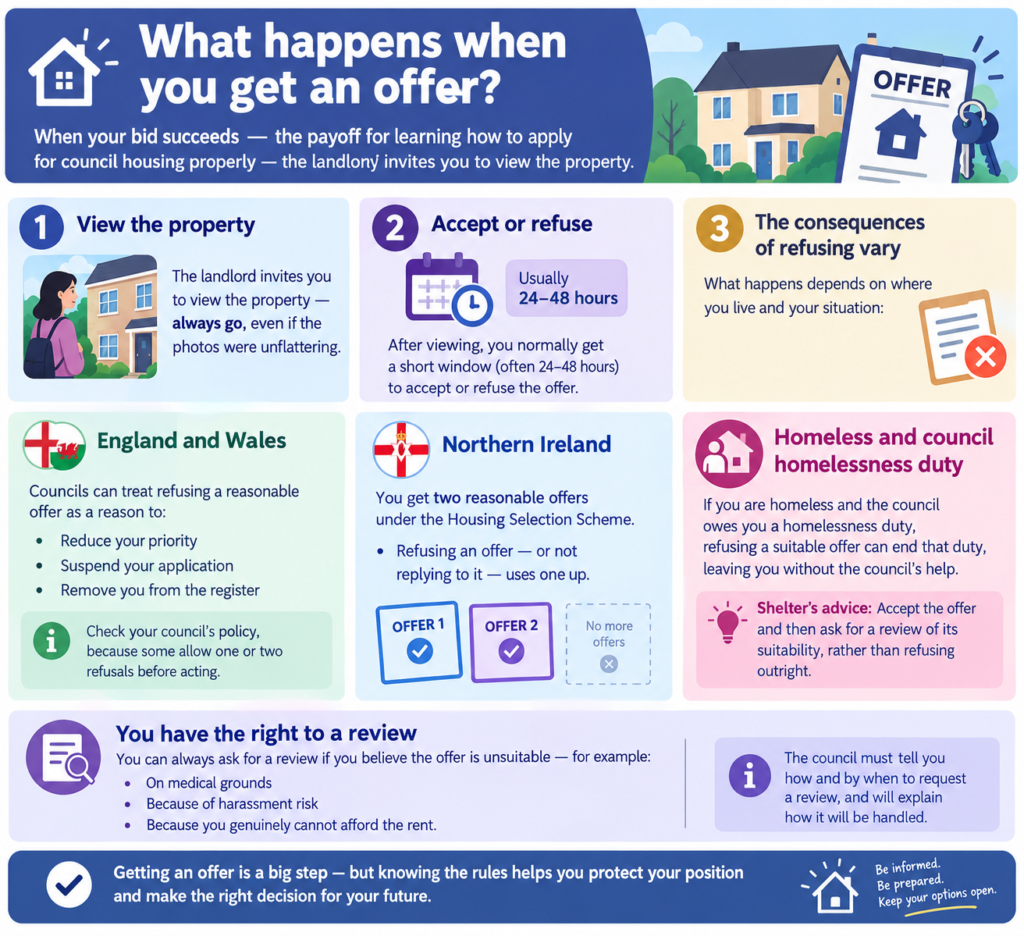
When your bid succeeds — the payoff for learning how to apply for council housing properly — the landlord invites you to view the property — always go, even if the photos were unflattering. After viewing you normally get a short window (often 24–48 hours) to accept or refuse, and the consequences of refusing vary:
- In England and Wales, councils can treat refusing a reasonable offer as a reason to reduce your priority, suspend your application or remove you from the register — check your council’s policy, because some allow one or two refusals before acting.
- In Northern Ireland, you get two reasonable offers under the Housing Selection Scheme. Refusing an offer — or not replying to it — uses one up.
- If you are homeless and the council owes you a homelessness duty, refusing a suitable offer can end that duty, leaving you without the council’s help. Shelter’s advice in this situation is clear: accept the offer and then ask for a review of its suitability, rather than refusing outright.
You always have the right to ask for a review if you believe the offer is unsuitable — for example, on medical grounds, because of harassment risk, or because you genuinely cannot afford the rent. The council must tell you how and by when to request it (usually within about three weeks). Knowing how to apply for council housing includes knowing your rights when something goes wrong.
How do Universal Credit, the bedroom tax and the benefit cap work for social tenants?
If you claim Universal Credit and rent from a council or housing association, your full rent plus eligible service charges is normally included in the housing costs element — unlike private renting, where help is capped at the Local Housing Allowance. The money is paid to you, so set up a direct debit (or ask for it to go straight to your landlord). Three rules can reduce what you get.
The bedroom tax (removal of the spare room subsidy). If your home has more bedrooms than the size criteria say you need, your eligible rent is cut by 14% for one spare bedroom or 25% for two or more. The size criteria allow one bedroom per adult (a couple shares), two children under 10, or two same-sex children under 16. Pension-age households are exempt; extra bedrooms are allowed for disability-related needs, overnight carers, foster carers and sanctuary scheme households. In Scotland, the Scottish Government fully mitigates the bedroom tax through Discretionary Housing Payments.
Worked example — Siobhan, bedroom tax. Siobhan and her partner rent a three-bedroom council house at £120 a week, but under the size criteria they need two bedrooms — one spare bedroom. Their Universal Credit housing element is reduced by 14%: £120 × 0.14 = £16.80 a week they must find from other income. Over a month that is £16.80 × 52 ÷ 12 = £72.80. Siobhan can ask the council for a Discretionary Housing Payment to cover the shortfall, or consider downsizing through a transfer.
The benefit cap. This limits total household benefits and is frozen for 2026/27: £22,020 a year for couples and lone parents outside London (£423.46 a week), £14,753 for single adults without children; £25,323 and £16,967 respectively in Greater London. The cap comes off your housing costs first, so check it before accepting a home. The government has also announced the removal of the two-child limit on Universal Credit (Autumn Budget 2025).
For a full walkthrough, see our Universal Credit rent affordability guide.
What kind of tenancy will you get? England, Wales, Scotland and NI compared
The name on the agreement — and some of the detail — depends on where in the UK you live. Do not mix the systems up: they come from different laws.
| Nation | What you will be offered | Security of tenure |
|---|---|---|
| England (council) | An introductory tenancy for the first 12 months, which automatically becomes a secure tenancy if you keep to the terms (the council can extend the trial by 6 months) | Secure tenants can only be evicted by court order with a proven ground; introductory tenants are easier to evict |
| England (housing association) | Usually an assured tenancy (sometimes fixed-term) | Strong long-term security, similar in practice to a secure tenancy |
| Wales | A secure occupation contract from a community landlord (council or housing association); new tenants may start on an introductory standard contract | The strongest form of security under the Renting Homes (Wales) Act 2016, in force since 1 December 2022 |
| Scotland | A Scottish Secure Tenancy | Strong long-term security; eviction only by court order on statutory grounds |
| Northern Ireland | A secure tenancy with the Housing Executive or a housing association | Long-term security comparable to council secure tenancies in England |
In practice: in England you cannot buy, sublet, take in lodgers or swap during the 12-month introductory period — those rights come with the secure tenancy. In Wales you are a “contract-holder”, and two successions are allowed (for example, a spouse followed by another family member), including a new right for carers. Everywhere, the home must remain your only or main home, and serious breaches — especially arrears and antisocial behaviour — can put any tenancy at risk.
What if you disagree with the council’s decision?
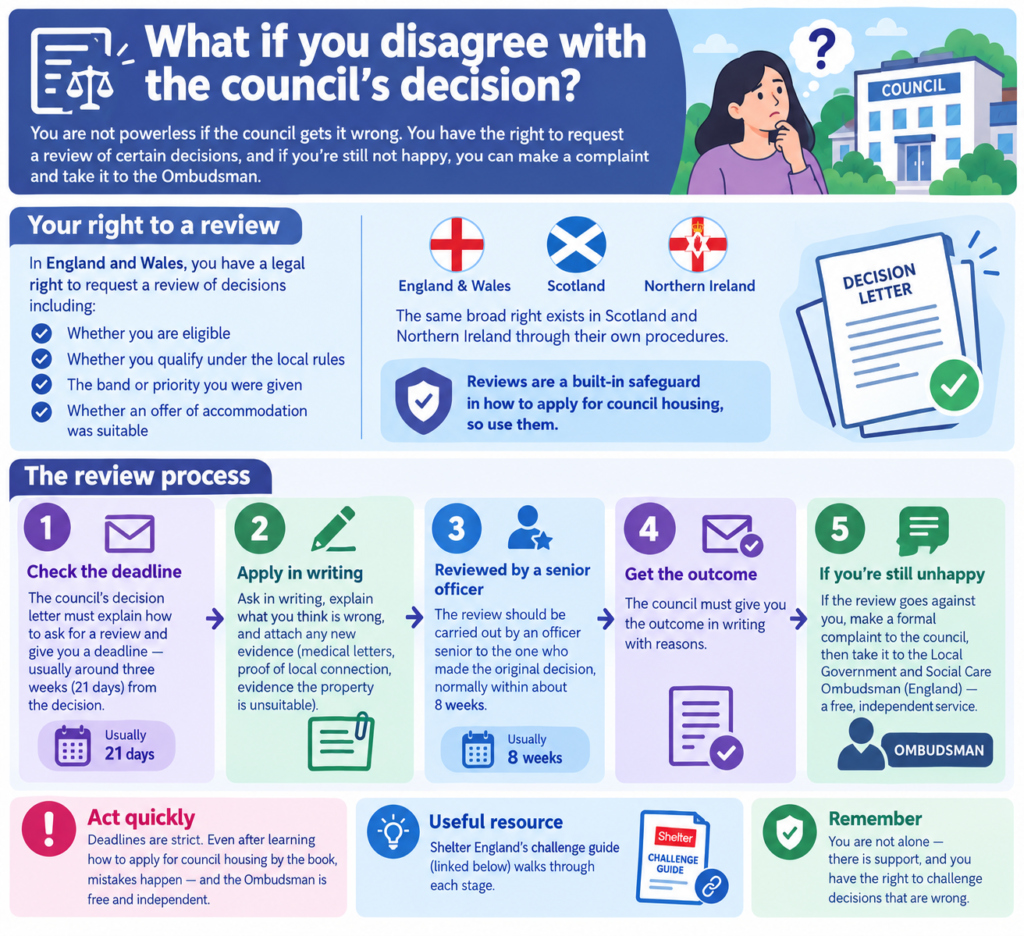
You are not powerless if the council gets it wrong. In England and Wales you have a legal right to request a review of decisions including: whether you are eligible, whether you qualify under the local rules, the band or priority you were given, and whether an offer of accommodation was suitable. The same broad right exists in Scotland and Northern Ireland through their own procedures. Reviews are a built-in safeguard in how to apply for council housing, so use them.
- The council’s decision letter must explain how to ask for a review and give you a deadline — usually around three weeks (21 days) from the decision
- Ask in writing, explain what you think is wrong, and attach any new evidence (medical letters, proof of local connection, evidence the property is unsuitable)
- The review should be carried out by an officer senior to the one who made the original decision, normally within about eight weeks
- The council must give you the outcome in writing with reasons
If the review goes against you, make a formal complaint to the council and then to the Local Government and Social Care Ombudsman (England) — a free, independent service. Shelter England’s challenge guide (linked below) walks through each stage. Act quickly: deadlines are strict. Even after learning how to apply for council housing by the book, mistakes happen — the Ombudsman is free and independent.
What should you do while you wait?
Waiting lists move slowly, so treat the wait as active time, not dead time. Once you know how to apply for council housing, these are the moves that keep your application strong:
| Option | What it does |
|---|---|
| Keep bidding and keep details updated | New bids, new evidence and changed circumstances are how you move up |
| Rent privately in the meantime | Often the fastest route to a suitable home; new rights under the Renters’ Rights Act 2025 apply |
| Ask the council for homelessness help | If you are threatened with homelessness, the council owes a prevention duty (usually 56 days) and then a relief duty |
| Apply for a Discretionary Housing Payment (DHP) | The council can top up your benefits to cover a rent shortfall, e.g. from the bedroom tax |
| Transfer or mutual exchange (existing social tenants) | Swap homes with another social tenant with your landlord’s permission, or apply for a transfer to a different property |
| Apply to housing associations directly | Some associations take direct applications alongside the council register |
| Widen your areas of choice | More areas on your application means more homes you can bid for |
If you rent privately while you wait, the Renters’ Rights Act 2025 has changed the landscape in England: Section 21 evictions were abolished on 1 May 2026, landlords cannot refuse you for receiving benefits or having children, deposits are capped at five weeks’ rent, rental bidding is banned, and a new Private Rented Sector Database opens on 15 December 2026 (£65 per property per year). See our tenancy agreements guide and our illegal eviction guide for your rights.
Falling behind on rent while you wait can damage a future application — arrears count as “unacceptable behaviour” in many schemes, so read our rent arrears guide early if you are struggling. Council tax and household bills continue wherever you live — and if a partner moves in, tell the council, as it changes your bedroom need (partner moving in guide).
Frequently asked questions
How do I apply for council housing?
Apply to your local council’s housing register (the waiting list), usually via an online form — paper forms are available on request. You will need ID, immigration documents, household and income details, and evidence of your housing situation and any medical needs.
Can I apply for council housing if I work full time?
Yes — allocation is based on housing need, not employment. Some councils set income or savings caps (e.g. £50,000 in Hounslow) and may decide you can afford to rent privately.
Can I apply if I am not a British citizen?
It depends on your status. British and Irish citizens, people with settled status or indefinite leave to remain, and refugees can usually apply. Most visa holders with no recourse to public funds, and asylum seekers awaiting a decision, cannot.
Do I need a local connection to the area?
Usually — most councils require you to have lived, worked or had close family in the area for two to five years. Exceptions include fleeing domestic abuse and Armed Forces connections. In Scotland, landlords must not consider how long you have lived in the area.
How long is the council housing waiting list?
It varies hugely. Over 1.3 million households are waiting in England; in Leeds most top-band applicants wait over two years, and in parts of Scotland average waits run to around four years. Ask your council for the realistic wait for your band and bedroom need.
What do the priority bands mean?
Bands rank applicants by housing need: Band A (or equivalent) is for urgent need such as homelessness or severe medical priority, with lower bands for less urgent situations. Higher bands are offered homes first; within a band, the earliest application date usually wins.
Can I turn down a council house offer?
You can, but councils may cut your priority, suspend or cancel your application for refusing a reasonable offer. In Northern Ireland you get two reasonable offers. If you are homeless and owed a duty, get advice first — refusing can end the council’s duty.
Can I be on more than one council waiting list?
Yes — you can apply to any council where you are eligible, and several registers can improve your chances. Check each council’s local connection and qualification rules first.
Will Universal Credit cover my council rent?
Normally your full rent plus eligible service charges is included in the housing costs element. It can be reduced by the bedroom tax (14% for one spare bedroom, 25% for two or more) and by the benefit cap, frozen for 2026/27.
Do I get a secure tenancy straight away?
In England, new council tenants usually start on a 12-month introductory tenancy that becomes secure if they keep to the terms. In Wales you get a secure occupation contract, in Scotland a Scottish Secure Tenancy, and in Northern Ireland a secure Housing Executive tenancy.
Can I swap my council home with another tenant?
Yes, through mutual exchange: two social tenants swap homes with both landlords’ permission, usually via an exchange service. You cannot usually exchange during an introductory tenancy, and the new home must suit your household size.
What can I do if the council refuses my application or gives me a low band?
Ask for a review within about three weeks, in writing, with new evidence. A senior officer must reconsider it and give written reasons. If that fails, complain to the council, then to the ombudsman.
Final Thoughts
Council housing remains the most affordable rented housing in the UK — the gap between a social rent and a private rent can be worth hundreds of pounds a month, every month, for as long as you live there. But it is not a quick fix: with over 1.3 million households waiting in England and new supply far behind demand, the system rewards those who apply early, evidence their need thoroughly, bid actively and keep their application up to date. The gap between a social rent and a private rent is the reason so many people want to know how to apply for council housing.
If Megan’s situation sounds like yours, start today: find your council’s housing register on GOV.UK, gather your documents, and apply. While you wait, check your budget with our Universal Credit rent affordability guide and our bills guide — and if problems arise meanwhile, our noisy neighbours guide and our ending your tenancy guide have you covered.
Further Reading
- Apply for council housing (GOV.UK) — the official starting point: eligibility and how to apply through your local council.
- How to get a council home (Shelter England) — step-by-step advice on applications, evidence and bidding.
- Challenge a council housing register decision (Shelter England) — how to ask for a review of a refusal, banding or unsuitable offer.