
Income for rent affordability is an important factor when finding a rental property in the UK. Finding a rental property in the UK can look straightforward until you reach the referencing stage. You may have enough money to pay the rent every month, but a landlord or letting agent may still ask you to prove that your income meets their affordability requirements.
This is where many renters become confused.
Does your salary count before or after tax? What about Universal Credit? Can pension income be included? What happens if you are self-employed? Does overtime count? What if you have two jobs? And what if your income changes from month to month?
The answer is that there is no single UK-wide formula used by every landlord or letting agent. Different landlords, agents and referencing providers can use different affordability policies. However, the basic idea is usually the same: they want evidence that your regular income is sufficient to cover the proposed rent.
Importantly, current government guidance says that when affordability is assessed, benefit income and pension income should be included and treated as income rather than automatically ignored. Landlords must also avoid discriminatory practices based on someone receiving benefits.
In this guide, we will look at what income can count, how affordability calculations work, examples using realistic figures, and what you can do if your income does not fit a standard affordability test.
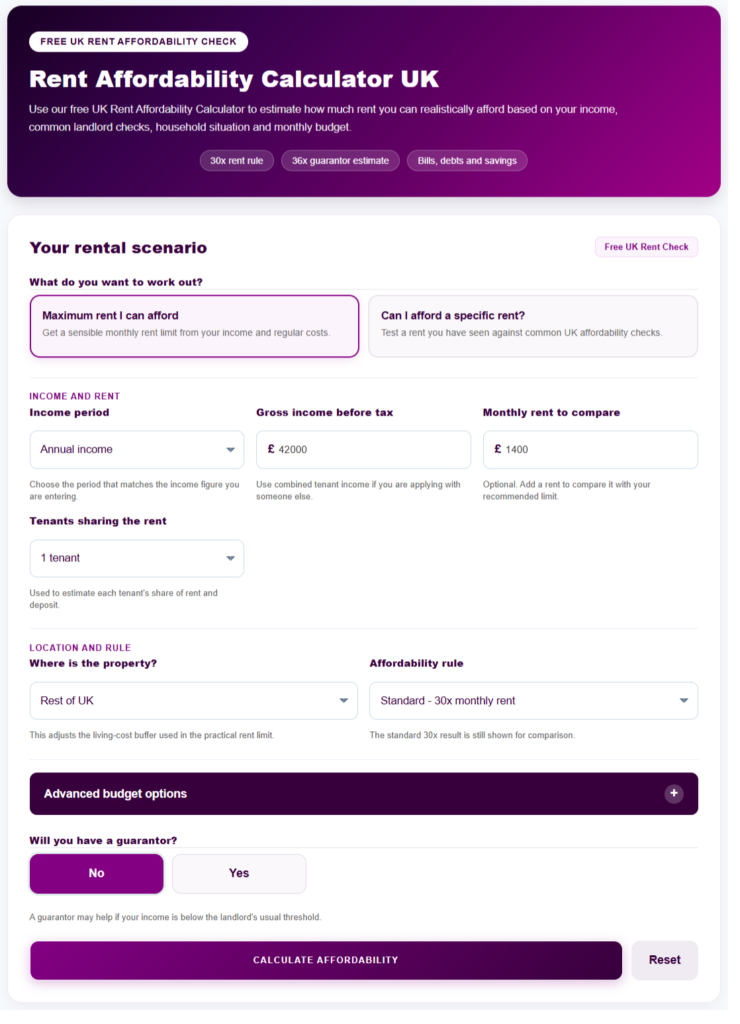
Click Here:Rent Affordability Calculator UK
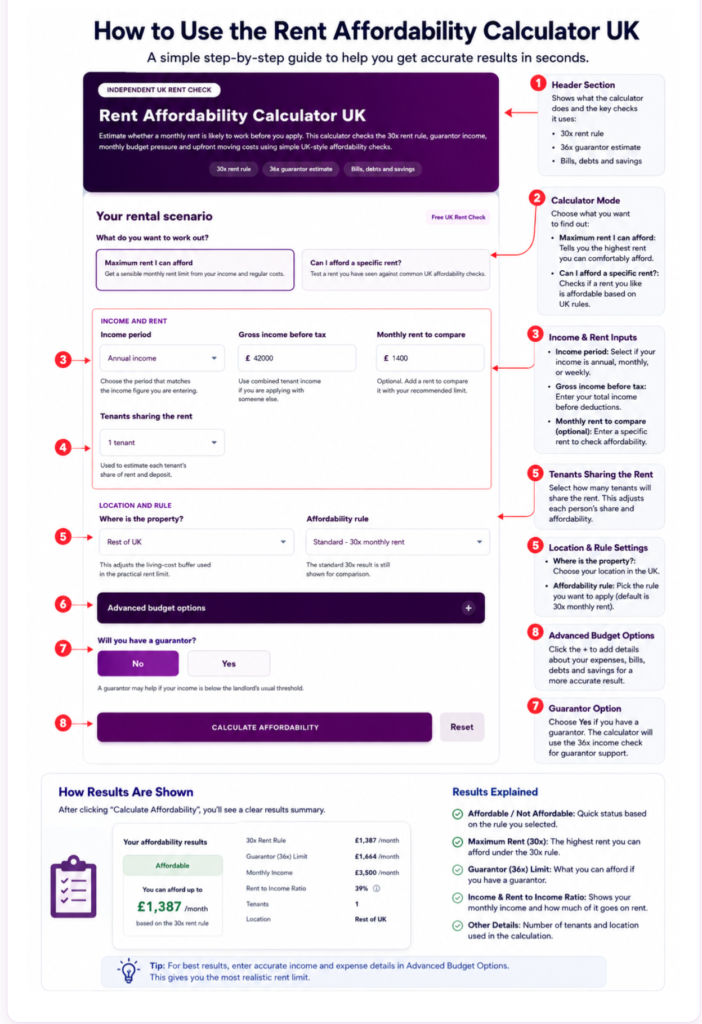
How to Use the Rent Affordability Calculator UK
What Is a Rent Affordability Check?
A rent affordability check is an assessment used to determine whether a prospective tenant appears financially capable of paying the rent.
Read more:University Marks Calculator: 7 Easy Ways to Calculate Your Overall Marks| Income / Financial Information |
|---|
| Your employment income |
| Self-employed income |
| Pension income |
| State benefits |
| Universal Credit |
| Regular bonuses or overtime |
| Income from more than one job |
| Certain investment or rental income |
| The income of a joint applicant |
| Existing financial commitments |
| Evidence such as payslips, bank statements or tax documents |
The exact checks vary.
For example, one letting agent might simply use an annual income multiple, while another may look more closely at your overall financial position.
A common type of affordability calculation is based on a multiple of the annual rent.
For example, suppose a property costs:
£1,200 per month
Annual rent:
£1,200 × 12 = £14,400
If the referencing policy requires annual income equal to 30 times the monthly rent:
£1,200 × 30 = £36,000
The applicant would therefore need around £36,000 of qualifying annual income under that particular test.
This is an example of a calculation method, not a universal legal requirement. Always check the specific affordability criteria being used for the property.
What Income Counts in a UK Rent Affordability Check?
The most important point is that qualifying income is not necessarily limited to your basic salary.
Depending on the landlord or referencing provider, several different sources may be considered.
At a Glance: Which Income Types Usually Count
| Income type | Usually counted? | Typical evidence needed |
| Employment salary | Yes | Payslips, P60, employer reference |
| Overtime | Sometimes — if regular | 3–6 months of payslips |
| Bonus/commission | Sometimes — if consistent | Payslips, P60, commission history |
| Self-employed profit | Yes, but on net profit, not turnover | SA302, tax year overview, accounts |
| Universal Credit | Yes (must be included per guidance) | Benefit award letter, bank statements |
| Other benefits (PIP, Child Benefit, Carer’s Allowance, etc.) | Yes | Official award letter |
| Pension (State/workplace/private) | Yes | Pension statement, award letter |
| Second job | Sometimes — if stable | Payslips from both employers |
| Rental income | Sometimes — net, not gross | Tenancy agreement, tax return |
| Savings | No — not treated as income | N/A |
Accepted Income vs Reliable Income
There is an important difference between income being received and income being accepted for an affordability calculation.
For example, imagine you receive:
- £30,000 basic salary
- £6,000 overtime
- £4,000 annual bonus
Your total earnings could be £40,000.
However, a referencing provider may not automatically treat the entire £40,000 as guaranteed income. They may look at how regular the overtime and bonus payments are and whether there is enough evidence to support them.
This is why renters should not simply add every payment they have received during the year and assume it will qualify.
A better approach is to separate your income into three categories:
Guaranteed income: Regular salary or other established income.
Regular variable income: Overtime, commission or freelance income that can be supported by a consistent history.
One-off income: Irregular bonuses, occasional payments or temporary earnings.
The more variable the income, the more important supporting evidence becomes.
When using an affordability calculator, it is therefore useful to understand whether the figure you enter represents your guaranteed income or your wider household income.
Employment Salary
For an employed tenant, salary is usually the easiest type of income to verify.
| Calculation | Amount |
|---|---|
| Sarah’s gross annual salary | £38,000 |
| Monthly rent | £1,100 |
| Annual rent | £1,100 × 12 = £13,200 |
| 30-times monthly rent test | £1,100 × 30 = £33,000 |
| Sarah’s salary compared with the test | £38,000 > £33,000 |
| Result | Sarah exceeds the affordability threshold |
So, assuming the referencing provider accepts her full salary, and there are no other issues, she would pass this particular income test.
Gross income or take-home income?
This is an important distinction.
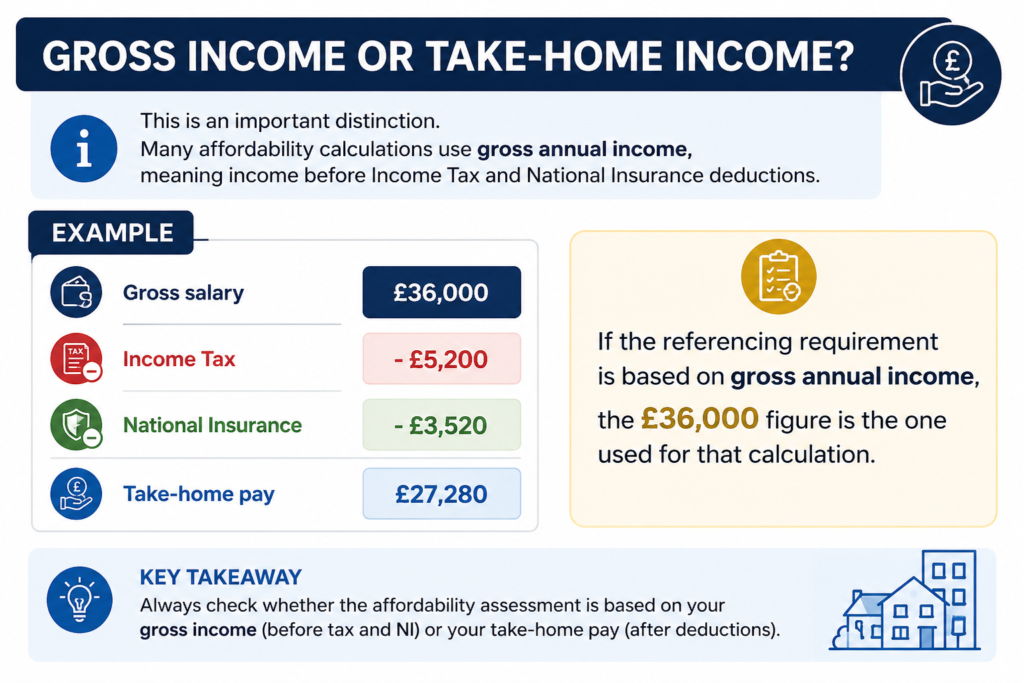
Many affordability calculations use gross annual income, meaning income before Income Tax and National Insurance deductions.
For example:
- Gross salary: £36,000
- Income Tax: deducted
- National Insurance: deducted
- Take-home pay: lower than £36,000
If the referencing requirement is based on gross annual income, the £36,000 figure is the one used for that calculation.
However, not every affordability assessment works in the same way, so you should check the criteria before assuming your take-home pay will be used.
2. Overtime
Overtime can sometimes count, but this is where affordability checks become less predictable.
A landlord may be comfortable counting overtime if it is:
- Regular
- Consistent
- Documented
- Expected to continue
| Income / Year | Amount |
|---|---|
| Basic salary | £30,000 |
| Regular overtime | £4,000 per year |
| Potential qualifying income | £34,000 |
| Year 1 overtime | £5,000 |
| Year 2 overtime | £1,000 |
| Current year overtime | £0 |
A referencing provider may be less willing to treat £5,000 as guaranteed income.
The key issue is consistency and evidence.
Do not automatically assume that every pound of overtime will be included.
Read more:Do Overtime, Bonuses, and Commission Count for Rent Affordability?3. Bonuses and Commission
Bonuses and commission can also create complications.
| Calculation / Income | Amount |
|---|---|
| Basic salary | £28,000 |
| Average annual commission | £8,000 |
| Total potential income | £36,000 |
| Monthly rent | £1,000 |
| 30-times calculation | £1,000 × 30 = £30,000 |
| Result at £1,000 rent | Basic salary alone (£28,000) does not meet £30,000; commission would be needed. |
| Monthly rent | £1,200 |
| 30-times calculation | £1,200 × 30 = £36,000 |
| Result at £1,200 rent | £36,000 total potential income meets the requirement. |
Now the commission becomes important.
Whether the £8,000 commission is accepted depends on the referencing policy and evidence available.
A provider may ask for:
- Recent payslips
- P60
- Employer confirmation
- Bank statements
- Previous commission history
The more variable your income, the more important supporting evidence becomes.
4. Self-Employed Income
Keyword add karne ke liye “income for rent affordability” ko naturally first line mein add kar sakti hain, baqi content same rahega:
Income for rent affordability is particularly important for self-employed candidates, who often worry that landlords will reject them automatically.
That is not necessarily the case.
The challenge is usually proving stable income.
A self-employed person does not always receive a fixed monthly salary, so a referencing provider may ask for documents such as:
- SA302
- Tax year overview
- Accounts
- Bank statements
- Accountant’s reference
- Evidence of ongoing contracts
- Business income records
The exact documents depend on the referencing company.
Example: self-employed applicant
Consider Ahmed, who runs a small web design business.
His taxable profits were:
- 2024/25: £31,000
- 2025/26: £34,000
Suppose the referencing company uses the average of the two years.
| Calculation | Amount |
|---|---|
| Income 1 | £31,000 |
| Income 2 | £34,000 |
| Combined income | £31,000 + £34,000 = £65,000 |
| Average annual income | £65,000 ÷ 2 = £32,500 |
| Monthly rent | £900 |
| 30-times rent test | £900 × 30 = £27,000 |
| Result | £32,500 exceeds £27,000 |
Ahmed’s average income of £32,500 would exceed the example requirement.
However, the important point is that business turnover is not automatically the same as personal income.
If Ahmed’s business receives £60,000 in sales but has £30,000 of allowable business expenses, the figure considered for an affordability assessment may be very different from £60,000.
Self-employed renters should therefore prepare evidence showing what they actually earn rather than simply presenting business turnover.
5. Universal Credit
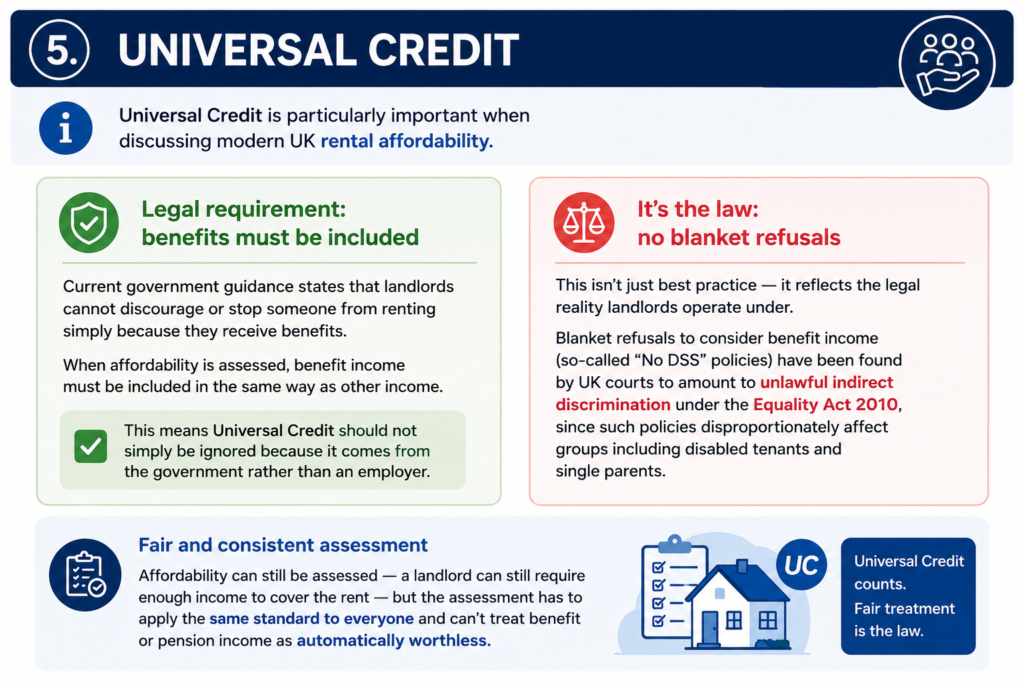
Universal Credit is particularly important when discussing modern UK rental affordability.
Current government guidance states that landlords cannot discourage or stop someone from renting simply because they receive benefits. When affordability is assessed, benefit income must be included in the same way as other income.
This means Universal Credit should not simply be ignored because it comes from the government rather than an employer.
This isn’t just best practice — it reflects the legal reality landlords operate under. Blanket refusals to consider benefit income (so-called “No DSS” policies) have been found by UK courts to amount to unlawful indirect discrimination under the Equality Act 2010, since such policies disproportionately affect groups including disabled tenants and single parents. Affordability can still be assessed — a landlord can still require enough income to cover the rent — but the assessment has to apply the same standard to everyone and can’t treat benefit or pension income as automatically worthless.
Example
| Calculation / Income | Amount |
|---|---|
| Employment income | £22,000 |
| Universal Credit | £7,200 per year |
| Total annual income | £22,000 + £7,200 = £29,200 |
| Monthly rent | £900 |
| Annual rent | £900 × 12 = £10,800 |
| 30-times rent test | £900 × 30 = £27,000 |
| Result | £29,200 exceeds £27,000 |
On this simplified calculation, Emma’s £29,200 total income would exceed the £27,000 threshold.
6 Rental Income
| Income | Amount |
|---|---|
| Salary | £32,000 |
| Net rental income | £6,000 per year |
| Potential qualifying income | £38,000 |
However, rental income is often more complicated than salary because landlords or referencing providers may want evidence of:
- Existing tenancy
- Bank statements
- Tax documents
- Mortgage costs
- Rental accounts
- Regular payment history
It is also important not to confuse gross rent received with actual income.
If a property produces £12,000 rent but £6,000 is spent on allowable costs and other relevant expenses, simply claiming £12,000 as disposable income could give a misleading picture.
HMRC recognises rental income as a form of taxable income in many circumstances.
7 Savings Are Not the Same as Income
Having substantial savings can make you financially secure, but savings are not necessarily treated as income.
Imagine two applicants.
| Applicant | Salary | Savings |
|---|---|---|
| Applicant A | £20,000 | £50,000 |
| Applicant B | £35,000 | £2,000 |
For an affordability test based on annual income, Applicant B may pass more easily even though Applicant A has much more money in the bank.
Why?
Because the test is measuring income, not simply wealth.
That does not mean savings are useless.
Savings can potentially help demonstrate financial strength or provide additional reassurance, and some landlords may have alternative requirements for applicants who do not meet their standard income test.
But you should not assume:
£50,000 savings = £50,000 annual income.
They are completely different things.
How to Calculate the Income Needed for Rent
| Monthly rent | Required annual income (×30) |
| £800 | £24,000 |
| £1,000 | £30,000 |
| £1,250 | £37,500 |
| £1,500 | £45,000 |
Read more:How Much Savings Should You Have Before Renting in the UK? (2026 Guide)A Realistic Example: £35,000 Salary
| Calculation | Amount |
|---|---|
| Annual income | £35,000 |
| Monthly rent | £1,100 |
| Annual rent | £1,100 × 12 = £13,200 |
| 30-times income test | £1,100 × 30 = £33,000 |
| Their income | £35,000 |
| Required income | £33,000 |
| Difference | £35,000 − £33,000 = £2,000 |
| Result | £2,000 above the required income |
So they are £2,000 above the example threshold.
But this does not necessarily mean the tenancy is guaranteed.
A referencing company may also look at employment status, credit history, previous rental history, and evidence of income.
What If Your Income Is Below the Requirement?
This is one of the biggest concerns for renters.
| Calculation | Amount |
|---|---|
| Your annual income | £28,000 |
| Required income | £30,000 |
| Difference | £2,000 below the requirement |
| Result | £28,000 < £30,000 |
You are £2,000 below the example income requirement.
That does not automatically mean you have no options.
Depending on the landlord and referencing provider, possible alternatives can include:
- A guarantor
- Joint application with another tenant
- Demonstrating additional qualifying income
- Providing stronger evidence of variable income
- Considering a cheaper property
- Paying rent in advance where acceptable
- Using a landlord’s alternative affordability assessment
However, paying rent in advance is not something you should assume will always be accepted, and you should be careful about committing large sums of money simply to overcome an affordability issue.
Joint Tenants and Combined Income
If two people rent together, their combined qualifying income may be considered.
| Calculation | Amount |
|---|---|
| Partner 1 income | £26,000 |
| Partner 2 income | £24,000 |
| Combined income | £26,000 + £24,000 = £50,000 |
| Monthly rent | £1,400 |
| Annual rent | £1,400 × 12 = £16,800 |
| 30-times requirement | £1,400 × 30 = £42,000 |
| Combined income | £50,000 |
| Difference | £50,000 − £42,000 = £8,000 |
| Result | £8,000 above the requirement |
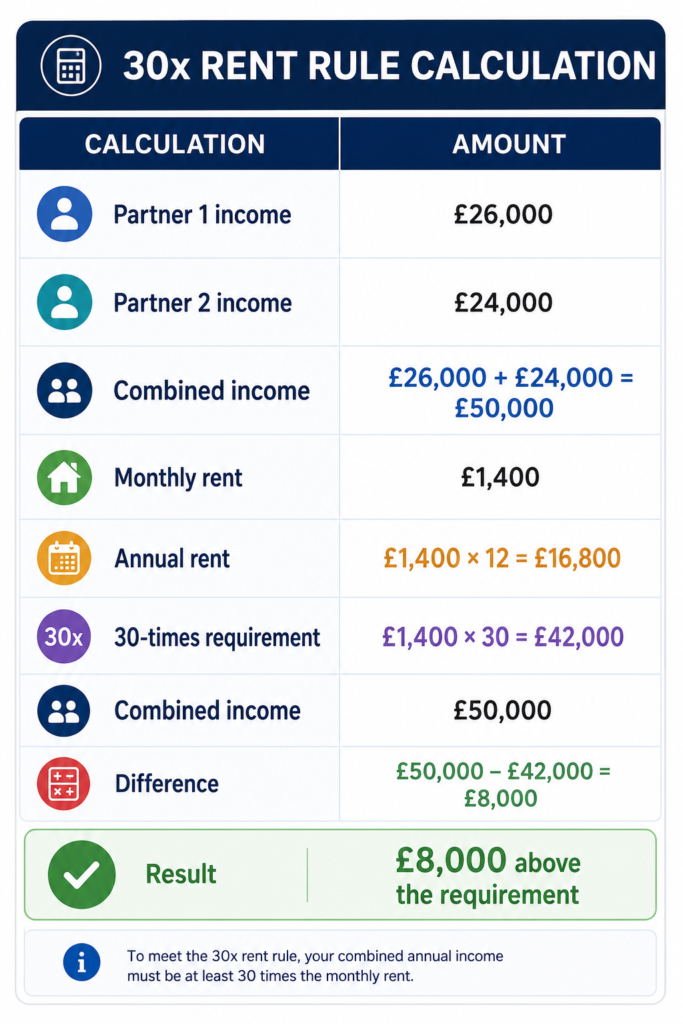
On this simplified calculation, the couple would be above the example income requirement.
This is why joint applications can significantly change affordability.
Example: One Salary Plus Benefits
| Calculation | Amount |
|---|---|
| Employment income | £24,000 |
| Universal Credit | £6,500 |
| Total income | £24,000 + £6,500 = £30,500 |
| Monthly rent | £950 |
| Annual rent | £950 × 12 = £11,400 |
| 30-times requirement | £950 × 30 = £28,500 |
| Total income | £30,500 |
| Difference | £30,500 − £28,500 = £2,000 |
| Result | £2,000 above the requirement |
If both sources qualify under the referencing provider’s policy, the household would meet this example income test.
What Documents May Be Used to Prove Income?
Knowing what counts as income is only half the process.
You also need to prove it.
| Applicant Type | Common Evidence |
|---|---|
| Employed applicants | Recent payslips |
| P60 | |
| Employment contract | |
| Employer reference | |
| Bank statements | |
| Tax documents | |
| Self-employed applicants | SA302 |
| Tax year overview | |
| Accounts | |
| Bank statements | |
| Accountant’s reference | |
| Business records | |
| Applicants receiving benefits | Benefit award letters |
| Official benefit statements | |
| Bank statements | |
| Other official evidence | |
| Applicants with pension income | Pension statements |
| Award letters | |
| Bank statements | |
| Pension provider documentation |
Government guidance also says landlords should not unreasonably refuse different forms of evidence, such as a bank statement, benefit letter or payslip, when establishing income.
Why Bank Statements Can Matter
Bank statements can help show that income is actually being received.
For example, someone may suggest :
“I earn £3,000 every month.”
But if their bank statements show irregular payments of £1,500, £2,000, and £3,800, the referencing company may want to understand why.
| This is particularly relevant for: |
|---|
| Freelancers |
| Contractors |
| Self-employed people |
| Commission-based workers |
| People with multiple jobs |
| People receiving variable benefits |
The goal is usually to establish whether the income is genuine and sustainable.
What About Freelancers and Contractors?
Freelancers can have perfectly healthy incomes but still struggle with traditional referencing systems because their earnings are not always identical every month.
| Calculation | Amount |
|---|---|
| January | £2,700 |
| February | £3,100 |
| March | £2,400 |
| April | £3,600 |
| May | £2,900 |
| June | £3,300 |
| Six-month total | £18,000 |
| Average monthly earnings | £18,000 ÷ 6 = £3,000 |
| Annualised estimate | £3,000 × 12 = £36,000 |
That looks strong.
But a referencing provider may not simply take the £36,000 figure. They may instead rely on tax returns, accounts, or other established evidence.
This is why freelancers should prepare documentation before applying.
Read more:What Salary Do You Need to Rent in the UK? Salary Guide 2026What Happens If Your Income Changes?
Variable income is one of the most difficult situations.
| Calculation | Amount |
|---|---|
| 2023/24 earnings | £30,000 |
| 2024/25 earnings | £34,000 |
| 2025/26 earnings | £39,000 |
| Total earnings | £30,000 + £34,000 + £39,000 = £103,000 |
| Average annual income | £103,000 ÷ 3 = |
This demonstrates why keeping historical income records can be valuable.
The same principle applies to bonuses, commissions, and self-employed earnings.
What Income Usually Causes the Most Problems?
The most difficult income to prove is generally not necessarily the lowest income.
Income is often difficult to verify or predict.
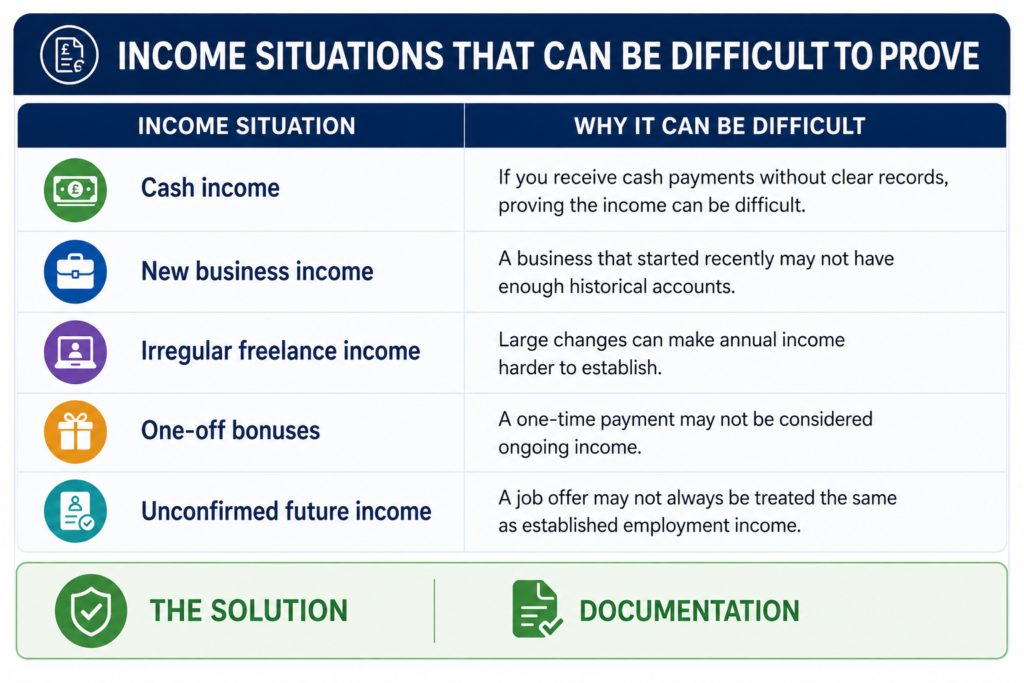
Examples include:
| Income Situation | Why It Can Be Difficult |
|---|---|
| Cash income | If you receive cash payments without clear records, proving the income can be difficult. |
| New business income | A business that started recently may not have enough historical accounts. |
| Irregular freelance income | Large Changes can make annual income harder to establish. |
| One-off bonuses | A one-time payment may not be considered ongoing income. |
| Unconfirmed future income | A job offer may not always be treated the same as established employment income. |
| The solution | Documentation |
How to Improve Your Chances of Passing an Affordability Check
If you are planning to rent soon, prepare your financial evidence before you start viewing properties.
Step 1: Calculate Your Annual Rent
Take the monthly rent and multiply it by 12.
Example:
£1,050 × 12 = £12,600
Step 2: Estimate the Income Requirement
Using a 30-times example:
£1,050 × 30 = £31,500
Step 3: Add Your Qualifying Income
| Calculation | Amount |
|---|---|
| Salary | £28,000 |
| Regular second job | £4,000 |
| Potential total income | £32,000 |
| Example threshold | £31,500 |
| Difference | £32,000 − £31,500 = £500 |
| Result | £500 above the example threshold |
Step 4: Prepare Evidence
Collect:
- Payslips
- P60
- Bank statements
- Employment documents
- Benefit evidence
- Pension evidence
- Self-employed tax documents
Step 5: Ask Before Paying Fees
Before proceeding with a property, ask the letting agent:
“What affordability Requirements do you use, and which types of income do you accept?”
This simple question can save a lot of time.
Questions to Ask the Letting Agent Before Applying
If you are unsure whether your income will meet the affordability requirements, asking the letting agent a few questions before applying can save time.
You could ask:
“What income multiple does your referencing provider use?”
“Do you calculate affordability using gross annual income?”
“Do you include Universal Credit, pension income or other benefits?”
“Is regular overtime or commission included?”
“Can income from two jobs be combined?”
“How is self-employed income assessed?”
“Can two joint tenants combine their income?”
“What documents will I need to provide?”
“What happens if my income is slightly below the required amount?”
“Is a guarantor accepted if I do not meet the standard affordability test?”
Getting these answers before submitting an application can help you understand the criteria and prepare the correct documents.
Income vs Affordability: They Are Not the Same
This distinction is extremely important.
Someone can have a high income and still have difficulty managing rent.
| Income / Financial Situation | Details |
|---|---|
| Annual salary | £45,000 |
| Large debt repayments | May affect affordability |
| Car finance | May affect affordability |
| Childcare costs | May affect affordability |
| Other rent or mortgage obligations | May affect affordability |
| High regular commitments | May affect affordability |
| Another person’s annual income | £35,000 |
but have very few financial commitments.
A basic income-multiple test could favour the £45,000 applicant, but real household affordability can be more complicated.
This is why renters should not use an income multiple as proof that they can comfortably afford a property.
Use it as a screening calculation, not as a complete household budget.
How Much Rent Can You Really Afford?
A useful personal calculation is to look beyond the landlord’s test.
| Calculation | Amount |
|---|---|
| Monthly take-home income | £2,800 |
| Proposed monthly rent | £1,000 |
| Income left after rent | £2,800 − £1,000 = £1,800 |
But you still need to pay:
- Council Tax
- Electricity
- Gas
- Water
- Internet
- Food
- Transport
- Insurance
- Mobile phone
- Debt payments
- Household expenses
- Savings
If these costs total £1,500, you would have only:
£1,800 − £1,500 = £300
That may technically pass a landlord’s affordability test but could still feel financially uncomfortable.
This is why renters should calculate personal affordability as well as referencing affordability.
Try a Rent Affordability Stress Test
Passing a referencing calculation is only one part of renting. Before committing to a property, it can be useful to test how your budget would cope if your expenses increased.
For example, imagine your monthly take-home income is £2,700 and your proposed rent is £950.
£2,700 − £950 = £1,750
Now subtract your regular household costs:
Expense Monthly amount Council Tax £150 Gas and electricity £150 Water £40 Food £350 Transport £180 Phone and internet £60 Insurance £50 Debt payments £200 Other essential costs £150 Total regular expenses:
£1,330
Money remaining:
£1,750 − £1,330 = £420
Now test what happens if your energy, food or transport costs increase by £150 per month.
Your remaining amount would fall to:
£420 − £150 = £270
This type of stress test can give you a more realistic picture of affordability than an income multiple alone.
Questions to ask yourself
Before choosing a property, consider:
- Could I still pay the rent if my income temporarily fell?
- Could I handle a £100–£200 increase in monthly household costs?
- Would I still have money available for emergencies?
- Can I continue saving each month?
- Could I afford the tenancy if overtime or commission stopped?
A property can meet a landlord’s affordability requirement while still being difficult for your personal budget. These are two different questions.
The Difference Between Passing and Being Comfortable
Consider two people.
| Person | Take-home Income | Rent | Other Monthly Expenses | Remaining |
|---|---|---|---|---|
| Person A | £2,500 | £900 | £1,300 | £300 |
| Person B | £2,500 | £750 | £1,300 | £450 |
Both may pass a formal affordability test.
But Person B has £150 more available every month.
Over one year:
£150 × 12 = £1,800
That is a meaningful difference.
So don’t choose a property simply because a referencing calculation says you qualify.
Read more:How Do Letting Agents Check Affordability in the UK? (2026 Guide)What If a Landlord Says Benefits Do Not Count?
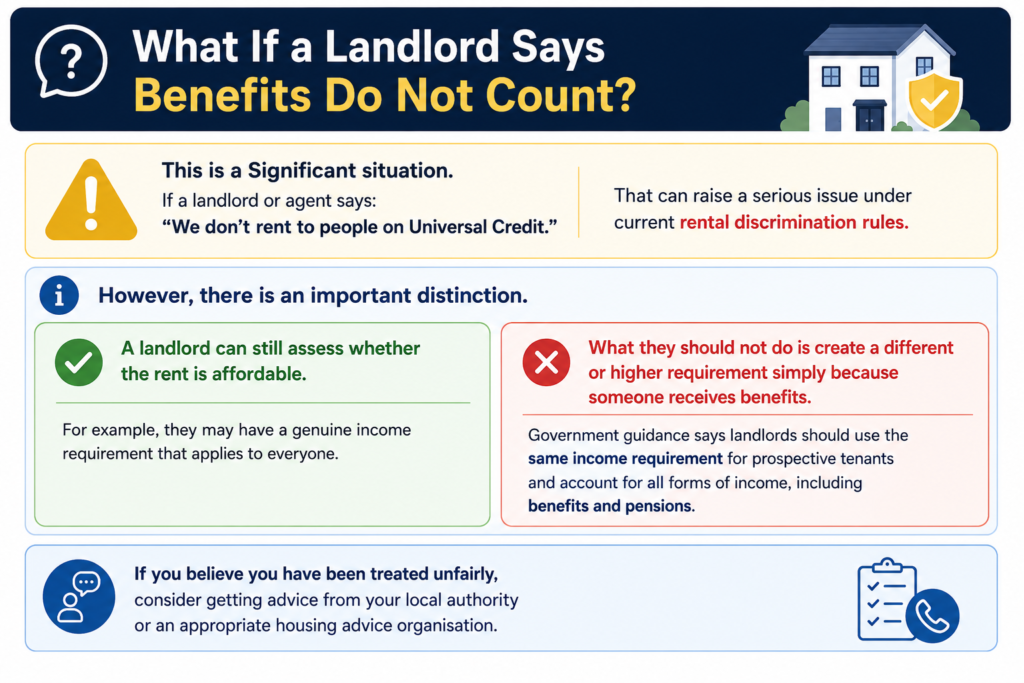
This is a Significant situation.
If a landlord or agent says:
“We don’t rent to people on Universal Credit.”
That can raise a serious issue under current rental discrimination rules.
However, there is an important distinction.
A landlord can still assess whether the rent is affordable.
For example, they may have a genuine income requirement that applies to everyone.
What they should not do is create a different or higher requirement simply because someone receives benefits. Government guidance says landlords should use the same income requirement for prospective tenants and account for all forms of income, including benefits and pensions.
If you believe you have been treated unfairly, consider getting advice from your local authority or an appropriate housing advice organisation.
Does salary count before or after tax?
Many rent affordability tests use gross annual income, meaning income before Income Tax and National Insurance. But the exact calculation depends on the referencing provider.
Does Universal Credit count as income?
Yes. Current government guidance says benefit income must be included when affordability is assessed rather than automatically ignored.
Does pension income count?
Yes. Pension income can form part of the income considered in an affordability assessment.
Does self-employed income count?
Yes, but you may need additional evidence such as tax documents, accounts or other proof of earnings.
Does overtime count
It can, particularly where it is regular and supported by evidence, but acceptance depends on the referencing policy.
Does commission count?
Potentially. Regular commission is easier to demonstrate than a one-off payment.
Does a second job count?
It can, provided the income is accepted and can be verified.
Do savings count as income?
Usually, savings should not be confused with annual income. Some landlords may consider savings as additional evidence of financial strength, but this depends on their policy.
What happens if I fail the affordability check?
You may have alternatives such as a guarantor, joint application, additional evidence, or choosing a property with lower rent.
Is there a legal UK-wide 30-times-rent rule?
No. A 30-times calculation is an example of a commonly used affordability method, not a universal legal rule that every landlord must use.
Final Thoughts
Understanding what income counts for a UK rent affordability check can make the rental process much less stressful.
The biggest mistake is assuming that affordability means salary only.
Depending on the circumstances and the referencing process, your financial picture may include employment income, self-employed earnings, pensions, benefits, second-job income, regular variable income and other verifiable sources.
At the same time, passing an income test does not automatically mean a property is affordable for your household.
For your own budget, calculate:
Monthly take-home income − rent − essential expenses = money left each month
Then consider whether the remaining amount gives you enough room for unexpected bills, savings and changes in your circumstances.
These figures can help you understand the type of income requirement you might encounter, but always confirm the actual affordability policy with the landlord, letting agent or referencing provider.
The strongest rental application is not simply the one with the highest salary. It is the one where the applicant can clearly show reliable income, provide the right evidence, and show that the proposed rent is practically manageable.