
Bad credit renting UK: Having a poor credit history can make renting a home in the UK feel much harder than it should. If you’ve got a County Court Judgment (CCJ), missed payments, an IVA, a bankruptcy on file, or simply a low credit score, it’s natural to worry that a landlord or letting agent will reject you on sight.
The good news: bad credit does not automatically stop you from renting in the UK. There’s no single “credit score to rent” that every landlord applies. Referencing agencies and letting agents each set their own criteria. Many will look well beyond your credit file — at your income, employment status, previous rental history, references, and whether a guarantor or rent guarantee insurance can cover the risk.
This guide covers how tenant referencing actually works in 2026, what a standard credit check for renting does and doesn’t show, how to find landlords who accept CCJs or an IVA, and how to work out whether a property is genuinely affordable before you apply.
Important: Rental rules can differ across England, Wales, Scotland and Northern Ireland. The legal changes mentioned in this guide, including changes from 1 May 2026, are particularly relevant to England.
Visit now:Rent Affordability Calculator UK
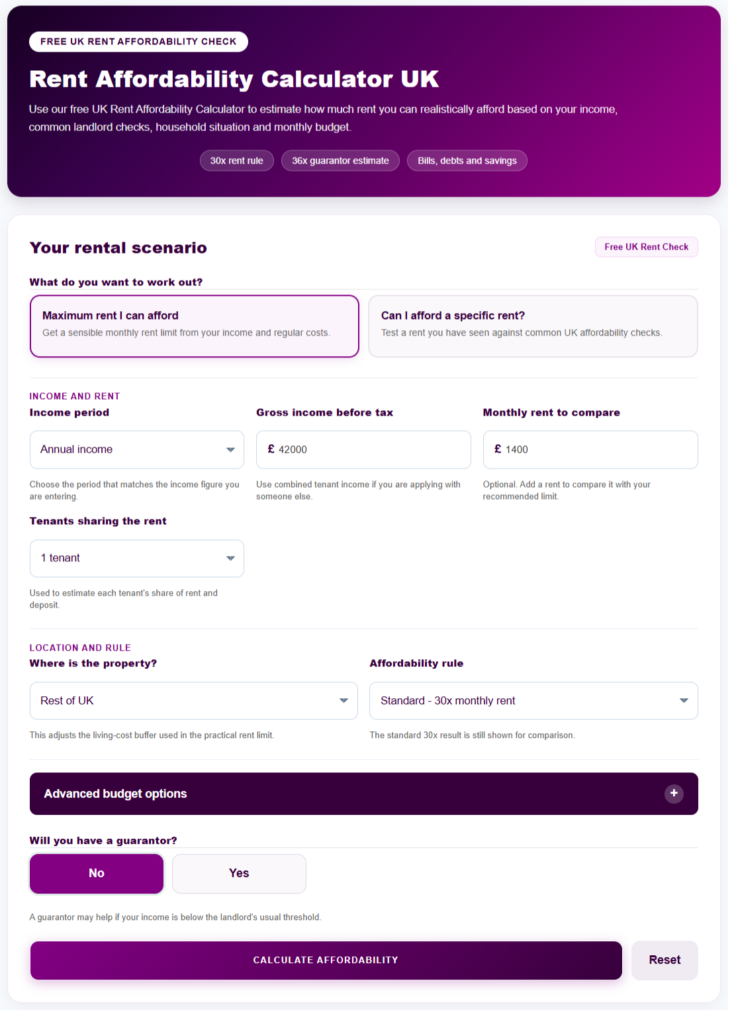
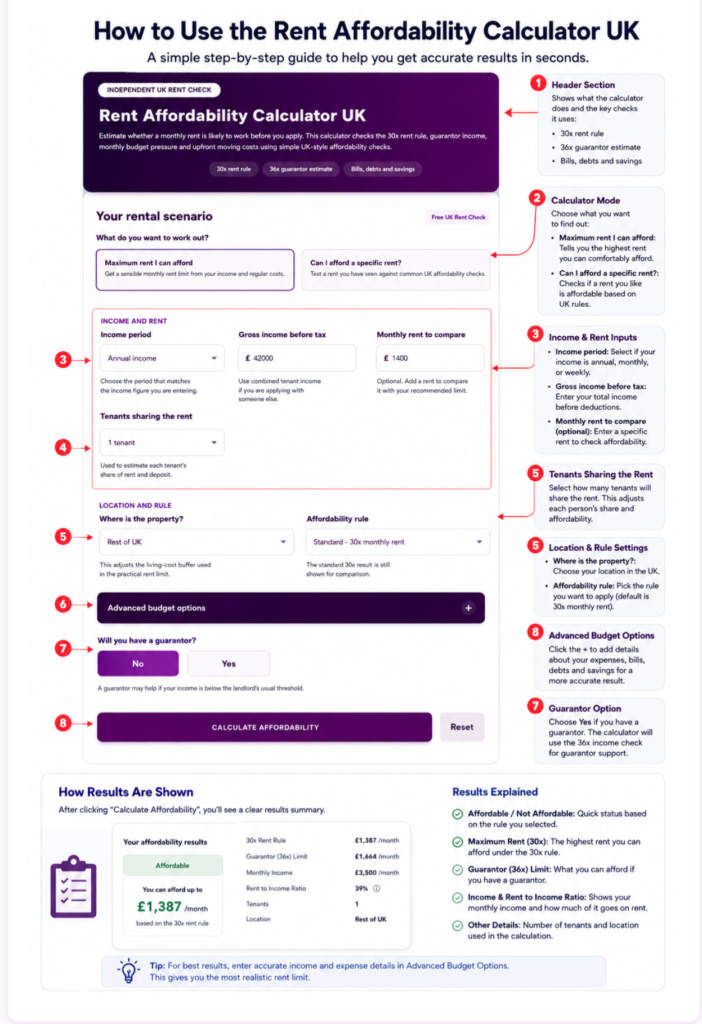
How to Use the Rent Affordability Calculator UK
Can You Rent with Bad Credit in the UK?
Yes, you can rent with bad credit in the UK.
There is no universal minimum credit score that every private landlord must accept. Bad Credit Renting UK depends on the landlord and letting agent, who can set their own referencing and affordability criteria, but a poor credit history does not automatically prevent you from renting.
A landlord may be more concerned if your credit file contains serious financial problems such as:
Bankruptcy
Unpaid debts
Missed loan or credit card payments
Defaults
However, the importance of each issue can vary.
For example, someone with an old, fully resolved CCJ and a stable income may present a very different level of risk from someone with several recent unpaid debts and an income that is not enough to cover the rent.
Landlords and agents usually consider whether they believe you can afford the property and pay the rent reliably. Shelter notes that there is no minimum credit score for private renting, although individual landlords and agents may set their own criteria.
That means your objective should not simply be to find a property that ignores credit checks. Instead, you should make your overall application as strong as possible.
Read more:How University Credits and Grades Work Together – Student GuideWhat Does “Bad Credit” Mean When Renting?
The phrase “bad credit” can mean different things.
A low credit score shown by a credit reference agency does not necessarily tell a landlord the whole story. Credit reference agencies can hold different information, and landlords may focus more on particular public records or affordability information than on the numerical score you see yourself.
Your credit history might be considered problematic if it shows:
| Credit Issue | Details |
|---|---|
| County Court Judgment (CCJ) | A County Court Judgment means a court has ordered you to repay money. A CCJ can make renting more difficult because it may indicate previous problems with debt repayment. However, having a CCJ does not necessarily mean every landlord will reject you. You may have a stronger application if you can demonstrate that the CCJ has been paid; it is old; your financial situation has improved; you have stable employment; you can comfortably afford the rent; and you can provide a guarantor if required. |
| Defaults | A default generally indicates that a debt was not paid according to the agreed terms.A landlord may view recent or multiple defaults as a warning sign, particularly when they are combined with affordability problems. |
| IVA | An Individual Voluntary Arrangement is a formal agreement with your creditors to repay debts over a set period, usually appearing on your credit file for six years. It’s more visible to landlords than an ordinary missed payment because it typically shows up on the same public-record searches that flag a CCJ. Some letting agents use automated referencing software that scores an IVA harshly regardless of context, which is one reason applying directly to a private landlord (see strategy 6 below) can help — you get the chance to explain that you’re keeping to the arrangement and that your disposable income after IVA payments still comfortably covers the rent. |
| Bankruptcy | Bankruptcy typically stays on your credit file for six years, though the formal bankruptcy order itself is usually discharged after 12 months. Agents with strict automated criteria may decline automatically; landlords assessing the application personally are more likely to weigh your current income and rent history alongside it.If you were discharged some time ago and have since built a track record of paying rent and bills on time, lead with that evidence rather than leading with the bankruptcy itself. |
| Missed payments | A standard soft-search rental credit check doesn’t usually itemise every missed credit card or loan payment the way a hard search for a mortgage application would. What it’s more likely to surface is the pattern behind those payments — defaults, CCJs, or a low overall score — rather than a line-by-line history. That’s worth knowing, because it means an isolated missed payment from several years ago is far less likely to sink an application than a cluster of recent defaults. |
What Do Landlords Check Before Renting to You?
A landlord or letting agent may carry out several checks before approving your application.
| These can include |
|---|
| Identity checks |
| Right to rent checks |
| Employment checks |
| Income or affordability checks |
| Previous landlord references |
| Credit checks |
| Bank statements or other proof of income |
Shelter explains that landlords and agents commonly check whether a Possible tenant is reliable and can afford the rent. They may request documents such as salary slips, bank statements, job information or benefit evidence.
Do landlords see your entire credit history?
Not necessarily.
In England, landlords and letting agents can only carry out a credit check with your permission, and the standard check is generally a soft search. It can reveal public information such as CCJs, bankruptcy or insolvency information, but it does not normally show every missed rent payment or every detail of your credit agreements.
A landlord may learn about previous rent problems through references or other information rather than the credit check itself.
Read more:Rent Affordability Calculator London – How Much Rent Can You Afford in London?Does a Bad Credit Score Automatically Mean Rejection?
No.
This is one of the most important things to know.
A landlord is interested in whether you are likely to pay the cost and meet the tenancy terms.
Imagine two applicants:
| Applicant A | Details |
|---|---|
| Credit history | Poor |
| Income | £3,500 per month |
| Rent | £900 per month |
| Employment | Permanent employment |
| Previous rent | Paid on time |
| Landlord reference | Strong landlord reference |
| Applicant B | Details |
|---|---|
| Credit history | Good |
| Income | £1,700 per month |
| Rent | £1,050 per month |
| Employment | Unstable employment |
| Previous rental reference | No previous rental reference |
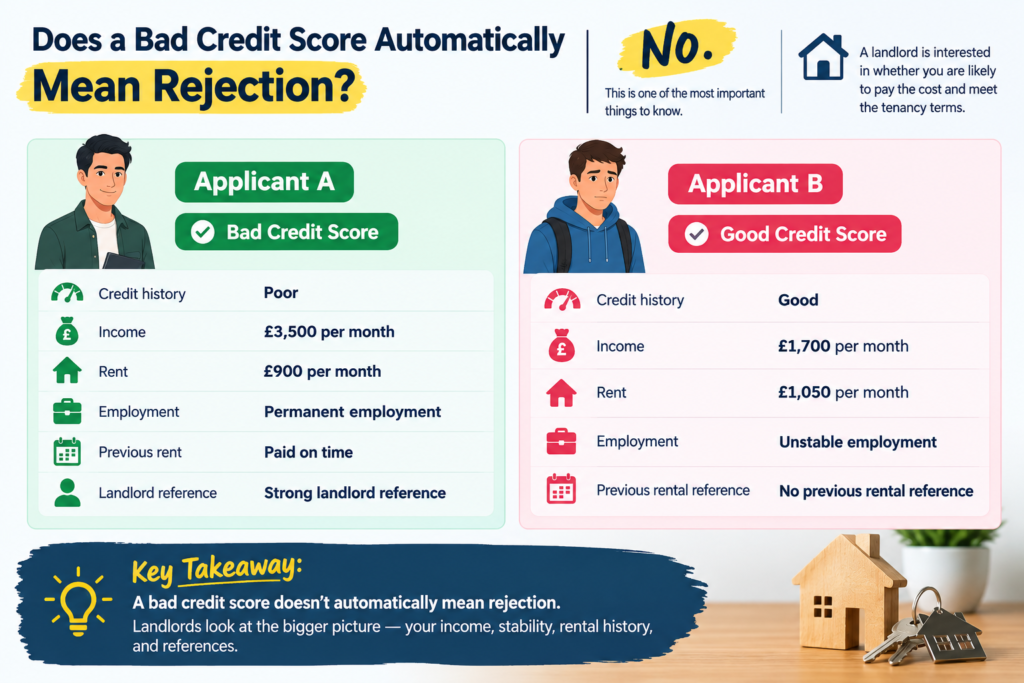
Applicant A may actually appear financially stronger despite having poorer credit.
This is why you should not assume that a low credit score makes renting impossible.
How Much Rent Can You Afford with Bad Credit?
Before applying for a property, calculate your affordability.
This is especially important when you have bad credit because you want to show a landlord that, despite your previous financial problems, your current situation is stable.
A simple starting point is:
Rent-to-income ratio = Monthly rent ÷ Monthly gross income × 100
Example calculation
| Calculation | Details |
|---|---|
| Gross monthly income | £3,000 |
| Monthly rent | £900 |
| Rent-to-income ratio | £900 ÷ £3,000 × 100 = 30% |
| Result | The rent represents 30% of your gross monthly income. |
That may be easier to demonstrate as affordable than a property costing £1,400 per month.
However, a percentage alone does not tell you whether a property is genuinely affordable.
You should also consider:
- Council Tax
- Gas and electricity
- Water
- Internet
- Transport
- Food
- Insurance
- Debt repayments
- Childcare
- Existing financial commitments
- Emergency savings
For example:
| Monthly income/expense | Amount |
| Gross monthly income | £3,000 |
| Rent | £900 |
| Council Tax | £150 |
| Utilities | £180 |
| Transport | £200 |
| Food | £300 |
| Debt repayments | £250 |
| Other essential costs | £250 |
| Remaining amount | £770 |
In this example, £900 rent may be reasonable based on the rent-to-income ratio, but the applicant should regularly check whether the remaining £770 comfortably covers everything else.
You can use a Rent Affordability Calculator to calculate how much cost may fit within your income and budget before you start applying for properties.
Before you apply for a property, give yourself a simple monthly budget test. Start with your take-home income rather than looking only at your gross salary, then subtract rent, Council Tax, utilities, food, transport, debt repayments, insurance and other regular commitments. What remains is the amount you have available for savings, unexpected costs and everyday spending. If the remaining amount is very small, the property may be too expensive even if you technically pass the landlord’s affordability test. Doing this calculation before applying can help you avoid wasting money on unsuitable properties and, more importantly, reduce the risk of falling into rent arrears after moving in.
Example: Renting with a CCJ
Let’s consider a practical example.
| James’s Rental Calculation | Details |
|---|---|
| Annual income | £32,000 per year |
| Approximate gross monthly income | £32,000 ÷ 12 = £2,666.67 |
| Monthly rent | £850 |
| Rent-to-income ratio | £850 ÷ £2,666.67 × 100 = 31.88% |
| Result | Approximately 31.9% of his gross monthly income would go towards rent. |
James also has an old CCJ.
Instead of hiding it, he explains the situation to the letting agent and provides:
- recent payslips;
- employment confirmation;
- bank statements where appropriate;
- evidence of previous rent payments;
- a previous landlord reference; and
- a guarantor.
The landlord may still decide that James represents an acceptable level of risk.
There is no guarantee of acceptance, but James has given the landlord evidence that his current financial position is stronger than his historical credit record suggests.
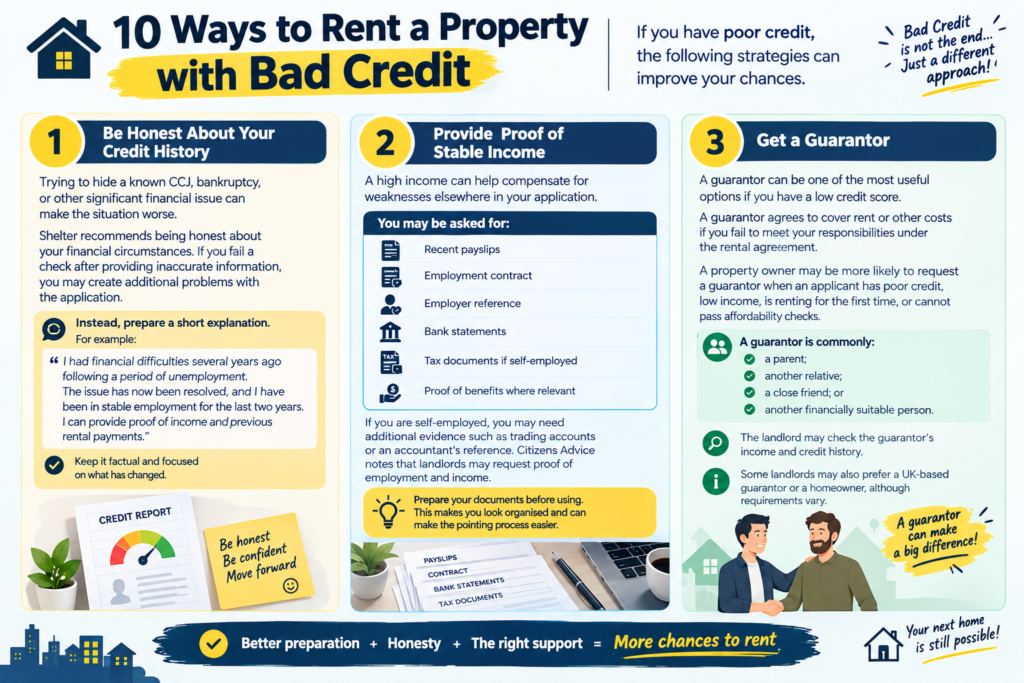
10 Ways to Rent a Property with Bad Credit
If you have poor credit, the following strategies can improve your chances.
1. Be Honest About Your Credit History
Trying to hide a known CCJ, bankruptcy, or other significant financial issue can make the situation worse.
Shelter recommends being honest about your financial circumstances. If you fail a check after providing inaccurate information, you may create additional problems with the application.
Instead, prepare a short explanation.
For example:
“I had financial difficulties several years ago following a period of unemployment. The issue has now been resolved, and I have been in stable employment for the last two years. I can provide proof of income and previous rental payments.”
Keep the explanation factual and focused on what has changed.
2. Provide Proof of Stable Income
A high income can help compensate for weaknesses elsewhere in your application.
| You may be asked for |
|---|
| Recent payslips |
| Employment contract |
| Employer reference |
| Bank statements |
| Tax documents if self-employed |
| Proof of benefits where relevant |
If you are self-employed, you may need additional evidence such as trading accounts or an accountant’s reference. Citizens Advice notes that landlords may request proof of employment and income.
Prepare your documents before using.
This makes you look organised and can make the pointing process easier.
3. Get a Guarantor
A guarantor can be one of the most useful options if you have a low credit score
A guarantor agrees to cover rent or other costs if you fail to meet your Responsibilities under the rental agreement.
A property owner may be more likely to request a guarantor when an applicant has poor credit, low income, is renting for the first time, or cannot pass affordability checks.
A guarantor is commonly:
- a parent;
- another relative;
- a close friend; or
- another financially suitable person.
The landlord may check the guarantor’s income and credit history.
Some landlords may also prefer a UK-based guarantor or a homeowner, although requirements vary.
Important warning for guarantors
Being a guarantor is a serious financial Responsibility.
The guarantor should carefully read both the rental agreement and guarantor agreement before approving. Depending on the wording, they may become responsible for rent arrears or other costs covered by the guarantee.
Read more:Ultimate 30x Rent Rule UK Guide – What It Means and How Letting Agents Calculate Affordability4. Consider a Rent Guarantor Scheme
If you do not have a family member or friend who can act as your guarantor, there may be other options.
Some Local authorities and charities operate rent guarantee schemes that can help people who struggle to provide a Personal guarantor.
Commercial guarantor companies also exist, but they normally charge a fee.
Before paying for such a service, check:
- the total cost;
- what the guarantee covers;
- whether the landlord accepts the company;
- whether there are additional charges;
- what happens if you miss a payment.
Shelter advises checking the terms and fees carefully when using commercial guarantor services.
| Feacture | Personal guarantor | Guarantor company/rent guarantee insurance |
| Who provides it | Parent, relative, or close friend | Commercial company, for a fee |
| Typical cost | Usually free | One-off or annual fee, often several hundred pounds |
| Credit check required | Often yes, on the guarantor | Sometimes, depending on provider |
| UK residency/homeowner status | Some landlords prefer this | Usually not required |
| Best suited to | Applicants with a willing, financially stable contact | Applicants without a suitable personal guarantor |
5. Show Your Previous Rent Payments
If your credit history is poor but you have consistently paid rent on time, this can be valuable evidence.
For example, you could provide:
- previous tenancy agreements;
- rent payment records;
- bank statements showing regular rent payments;
- a landlord reference.
This can help show that your credit problems have not prevented you from meeting your housing Responsibility.
Citizens Advice specifically notes that tenants who cannot obtain a reference may regularly be able to demonstrate their previous rent payments using documents such as rental agreements or bank statements.
6. Apply Directly to Private Landlords
A letting agent may use automated referencing criteria that can make it difficult for applicants with adverse credit history.
A private landlord may take a more personal approach.
That does not mean a private landlord will ignore your credit history. They may still want proof of income, references or other information.
However, you may have more opportunity to explain your circumstances directly.
Citizens Advice notes that renting directly from a landlord may sometimes involve fewer sources and the landlord may not require a credit check.
When searching, look for properties listed directly by landlords as well as those managed by agents.
7. Choose a More Affordable Property
One of the simplest ways to strengthen your application is to reduce the rent you are applying for.
| Property | Monthly Income | Monthly Rent | Rent-to-Income Ratio |
|---|---|---|---|
| Property A | £2,500 | £1,200 | £1,200 ÷ £2,500 × 100 = 48% |
| Property B | £2,500 | £850 | £850 ÷ £2,500 × 100 = 34% |
Even though both properties may technically be possible, Property B gives you much more breathing room.
If your credit history is already a concern, choosing a property that is comfortably affordable can make your overall financial profile more convincing.
8. Check Your Credit File Before Applying
Do not wait until a landlord runs a check to discover an error.
Check your credit reports before starting your property search.
Shelter identifies Experian, Equifax and TransUnion as the three main credit reference agencies and recommends checking your information and looking for mistakes.
| Look for |
|---|
| Incorrect addresses |
| Debts that are not yours |
| Incorrectly recorded defaults |
| Outdated information |
| Incorrect financial associations |
| Incorrect CCJ information |
If you find an error, contact the relevant credit reference agency or lender.
Correcting an error will not instantly transform your financial history, but it can prevent an incorrect record from harming your rental application.
9. Register on the Electoral Roll
Being registered to vote at your current address can help credit reference agencies verify your identity and address.
Housing explains that Credit Checking can search the electoral roll and that not being registered at your present address can sometimes create difficulties with checks.
If you have recently moved, check that your electoral registration information is correct.
This can be mainly useful for people who have recently moved in the UK or moved between deals.
10. Prepare a Strong Rental Application
Do not simply provide an application and hope for the best.
Organize a small “rental application pack”.
It could include:
| Personal information |
|---|
| Full name |
| Current address |
| Contact details |
Income evidence
- Recent payslips
- Employment confirmation
- Bank statements if requested
| Rental history |
|---|
| Previous landlord reference |
| Previous tenancy details |
| Evidence of rent payments |
Additional support
- Guarantor information
- Explanation of previous credit problems
- Evidence that debts have been resolved where appropriate
The objective is simple:
Make it easy for the property owner to see that you are a responsible renter today.
Don’t Apply Everywhere at Once
When renting with bad credit, applying for every property you like may not be the most practical approach. Before submitting an application, check the advertised rent against your income and ask whether the landlord accepts applicants with your particular circumstances. For example, if you know that an agent requires a specific income multiple and does not accept applicants with recent CCJs, there may be little benefit in paying a holding deposit and starting the process. A more selective approach allows you to concentrate your time and money on properties where your application has a realistic chance of meeting the stated requirements.
Can You Rent with a CCJ?
Yes, it is possible.
A CCJ can make renting harder because it may show up during a credit check, but it does not directly mean every landlord will reject you.
| Factor |
|---|
| How recent the CCJ is |
| Whether it has been paid |
| The amount involved |
| Your current income |
| Your rent-to-income ratio |
| Your previous rental history |
| The landlord’s referencing policy |
| Whether you have a guarantor |
For example, an applicant with one old paid CCJ, stable employment, and excellent rental history may be viewed differently from someone with several recent unpaid judgments.
The key is to demonstrate that your current financial circumstances are reliable.
Can You Rent with an IVA?
You may still be able to rent while you have an IVA.
However, some landlords or agents may have stricter policies when they see an IVA during referencing.
You can improve your position by showing:
- stable income;
- affordable rent;
- consistent previous rent payments;
- a guarantor if possible;
- evidence that you are managing your money responsibly.
Do not automatically assume that an IVA means you cannot rent.
Instead, ask the landlord or agent what their referencing criteria are before paying a holding deposit.
Read more: Rent vs Buy Calculator UK – Should You Rent or Buy a Home?Can You Rent After Bankruptcy?
Bankruptcy can create additional challenges, but it does not automatically prevent you from renting.
Some landlords may be cautious because bankruptcy indicates great financial difficulties.
However, your application may still be considered if you have:
- reliable employment;
- sufficient income;
- good recent rental history;
- a suitable guarantor;
- affordable rent.
If your financial situation has improved since bankruptcy, explain that clearly and provide evidence where appropriate.
What If You Have No UK Credit History?
Not having a UK credit history is different from having bad credit.
This can affect:
- international students;
- recent immigrants;
- people moving to the UK;
- people who have never borrowed money in the UK;
- people who have recently started working in the UK.
A lack of UK credit history does not necessarily mean you have a poor financial record.
| Supporting evidence |
|---|
| Employment contract |
| Payslips |
| Bank statements |
| Previous landlord references |
| Proof of savings |
| Guarantor |
| Evidence of overseas rental payments |
Shelter notes that credit scores from one country do not usually transfer directly to another, which can make renting more difficult for people who have not previously rented or built a credit history in the UK.
What If You Receive Universal Credit or Other Benefits?
Receiving benefits does not automatically mean you cannot rent privately.
Landlords and agents can ask about your ability to afford the rent, but they should not refuse someone simply because they receive benefits. Shelter states that landlords and agents should not refuse to rent to someone just because they claim benefits.
| Prepare evidence showing |
|---|
| Your benefit entitlement |
| Your other income |
| Your expected monthly rent |
| Your overall budget |
If there is a shortfall between your income and the rent, a guarantor or other support may become particularly important.
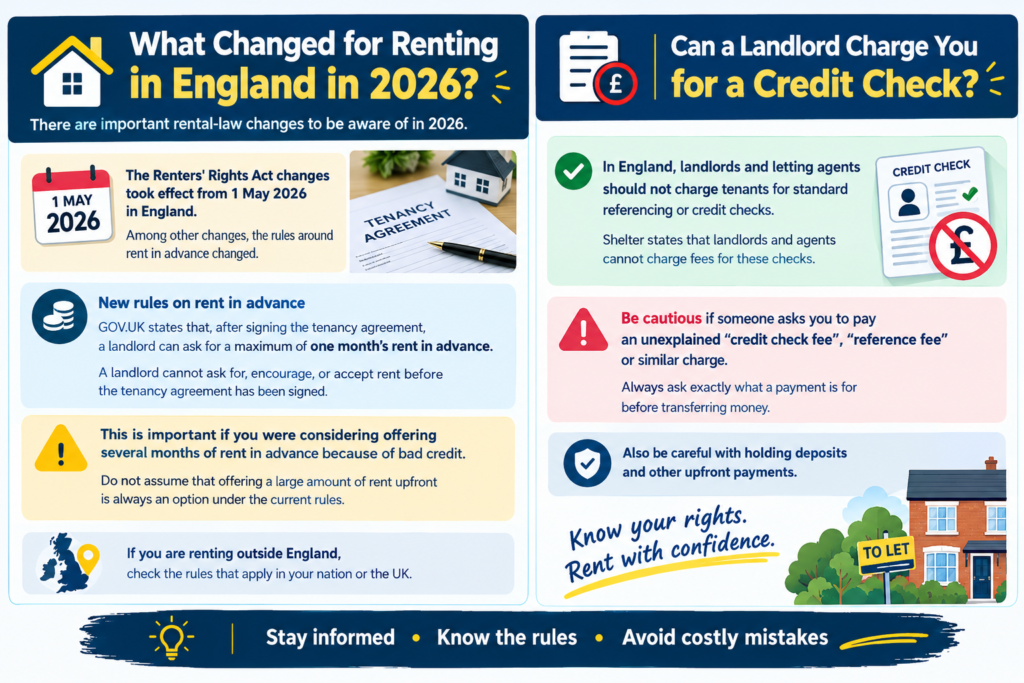
What Changed for Renting in England in 2026?
There are important rental-law changes to be aware of in 2026.
The Renters’ Rights Act changes took effect from 1 May 2026 in England. Among other changes, the rules around rent in advance changed.
GOV.UK states that, after signing the tenancy agreement, a landlord can ask for a maximum of one month’s rent in advance. A landlord cannot ask for, encourage, or accept rent before the tenancy agreement has been signed.
This is important if you were considering offering several months of rent in advance because of bad credit.
Do not assume that offering a large amount of rent upfront is always an option under the current rules.
If you are renting outside England, check the rules that apply in your nation or the UK.
Can a Landlord Charge You for a Credit Check?
In England, landlords and letting agents should not charge tenants for standard referencing or credit checks.
Shelter states that landlords and agents cannot charge fees for these checks.
Be cautious if someone asks you to pay an unexplained “credit check fee”, “reference fee” or similar charge.
Always ask exactly what a payment is for before transferring money.
Also be careful with holding deposits and other upfront payments.
What Happens If You Fail a Credit Check?
Not meeting a credit check does not automatically mean the end of your rental search.
First, ask the landlord or letting broker:
“Can you tell me what part of the mentioned requirements I did not meet?”
The problem could be:
- credit history;
- income;
- affordability;
- insufficient rental history;
- inability to provide a reference;
- employment status;
- identity verification.
Once you know the Cause, you can decide what to do.
For example:
| If referencing is flagged… | This may help |
| Poor credit history | A guarantor, or evidence the debt is resolved |
| Income too low for the rent | A cheaper property, or a guarantor to cover the gap |
| No previous landlord reference | An employer reference or character reference |
| No UK credit history | Employment contract, payslips, proof of savings |
| Failed identity or right-to-rent check | Passport, visa, or Home Office share code |
| Employment status (self-employed, new job) | Accountant’s reference, trading accounts, or an employment offer letter |
What About the Holding Deposit?
A holding deposit is different from a rental deposit.
If you provide accurate information and fail a credit or reference check, there are circumstances in which the holding deposit should be returned.
Shelter explains that a holding deposit should generally be returned if you fail credit, income or reference checks, provided you gave accurate information.
This is another reason to be honest about your financial history from the beginning.
If you knowingly provide inaccurate information and the landlord later discovers it, you could put your holding deposit at risk.
Read more:Guarantor for Renting in the UK –7 Best Essential Guides
Bad Credit vs Poor Affordability: Which Is Worse?
This is an important distinction.
Bad credit describes problems with your past or current financial record.
Poor affordability means your current income may not be sufficient for the rent and other living costs.
A landlord may be more comfortable with someone who has a historical credit problem but strong current affordability than someone with a clean credit record who cannot comfortably afford the property.
| Applicant | Monthly Income | Monthly Rent | Rent-to-Income Ratio | Additional Information |
|---|---|---|---|---|
| Sarah | £3,200 | £900 | £900 ÷ £3,200 × 100 = 28.1% | Sarah has an old default but has stable employment and a good rental history. |
| Mark | £2,200 | £1,200 | £1,200 ÷ £2,200 × 100 = 54.5% | — |
Mark has excellent credit.
But Mark’s rent takes more than half of his gross income.
This illustrates why you should consider both credit history and affordability.
How to Improve Your Credit Before Renting
If you are not moving immediately, use the time to strengthen your financial position.
Pay bills on time
Regular payments can help create a healthier financial record over time.
Reduce outstanding debts
Where possible, work towards reducing high-cost debts and overdue balances.
Check your credit reports
Look for mistakes and incorrect information.
Avoid unnecessary applications
Applying repeatedly for credit can complicate your financial situation.
Keep your address information updated
Make sure your accounts and electoral registration information are accurate.
Deal with outstanding financial problems
If you have serious debt problems, consider speaking to a Reliable debt adviser.
Improving credit is not an overnight process. Focus on Regular financial behaviour rather than trying to find a quick fix.
A Simple Rent Affordability Example for 2026
Suppose your final salary is:
£36,000
Monthly gross income:
£36,000 ÷ 12 = £3,000
You are considering a property costing:
£950 per month
| Step | Calculation / Details |
|---|---|
| Step 1: Calculate rent-to-income ratio | £950 ÷ £3,000 × 100 = 31.67% |
| Step 2: Estimate annual rent | £950 × 12 = £11,400 per year |
| Step 3: Compare annual rent with annual gross income | £11,400 ÷ £36,000 × 100 = 31.67% |
| Step 4: Consider other costs | You might also have:£160 Council Tax£180 utilities£250 food£180 transport£150 debt repayments£150 other essential costs |
Your actual affordability assessment should therefore go beyond the 31.67% ratio.
A rent affordability calculator can help you make a more complete estimate before you apply.
Questions to Ask a Landlord Before Applying
If you have bad credit, asking questions early can save you time and money.
Consider asking:
- Do you carry out credit checks?
- What are your income requirements?
- Do you accept tenants with CCJs?
- Would you consider a guarantor?
- Do you accept guarantor companies?
- What documents do you require?
- Do you require previous landlord references?
- What upfront payments are required?
- What is the total monthly cost including expected bills?
- What happens if I do not meet the Mentioning requirement?
If the landlord’s requirements are clearly Inappropriate, it may be better to move on before paying a holding deposit.
One practical step that is easy to overlook is checking the landlord’s basic criteria before paying a holding deposit. If you have a CCJ, IVA, bankruptcy, low income or limited UK rental history, ask whether these circumstances are accepted before starting the full referencing process. You can also ask what income multiple they use, whether a guarantor is acceptable and what documents they will need. A few questions at the beginning can save you from spending time preparing an application for a property that was unlikely to meet the landlord’s requirements in the first place.
What to do if your application is declined
If your application is declined, try to find out whether the decision was caused by credit history, affordability, employment, references or another part of the referencing process. These are different problems and may require different solutions. If affordability was the issue, looking at a lower-rent property may help. If the problem was your credit history, you could ask whether a guarantor or additional supporting evidence would be considered. If you were declined because of missing documents, make sure the next application includes the required evidence from the beginning. Understanding the actual reason for the decision is more useful than simply assuming that your credit score was the problem.
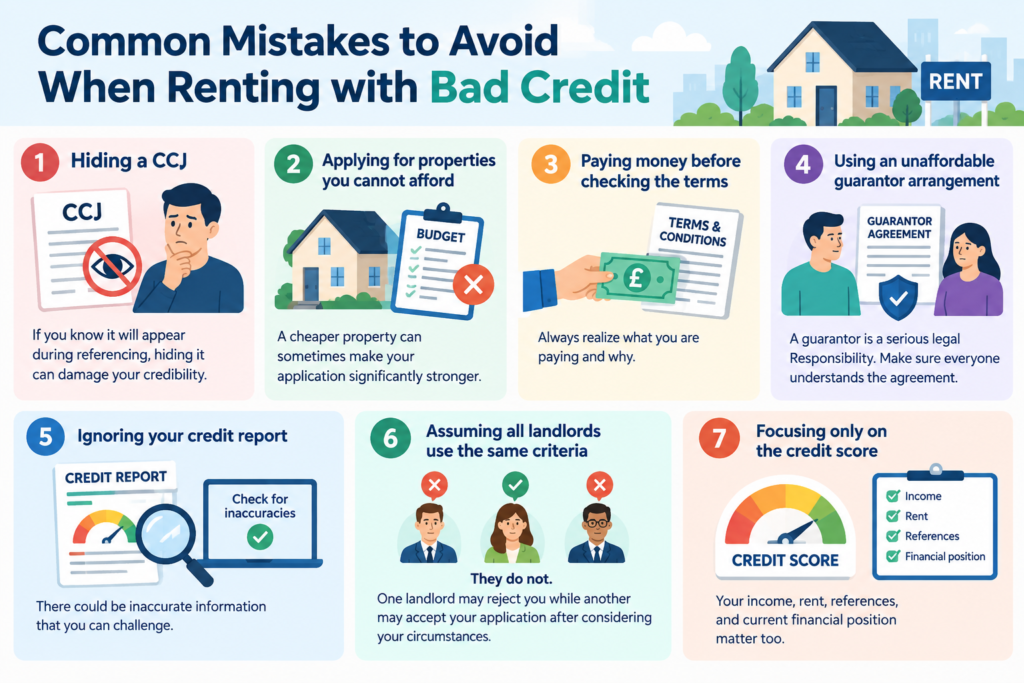
Common Mistakes to Avoid When Renting with Bad Credit
Mistake 1: Hiding a CCJ
If you know it will appear during referencing, hiding it can damage your credibility.
Mistake 2: Applying for properties you cannot afford
A cheaper property can sometimes make your application significantly stronger.
Mistake 3: Paying money before checking the terms
Always realize what you are paying and why.
Mistake 4: Using an unaffordable guarantor arrangement
A guarantor is a serious legal Responsibility. Make sure everyone understands the agreement.
Mistake 5: Ignoring your credit report
There could be inaccurate information that you can challenge.
Mistake 6: Assuming all landlords use the same criteria
They do not.
One landlord may reject you while another may accept your application after considering your circumstances.
Mistake 7: Focusing only on the credit score
Your income, rent, references, and current financial position matter too.
A Practical Strategy for Renting with Bad Credit
If you have bad credit and need to rent soon, follow this process.
| Step | Action | Details |
|---|---|---|
| Step 1 | Check your credit reports | Identify CCJs, defaults, bankruptcy information, and errors. |
| Step 2 | Calculate your affordable rent | Look at your income and essential expenses before choosing a property. |
| Step 3 | Prepare your documents | Have payslips, employment evidence, rental references and other supporting documents ready. |
| Step 4 | Prepare an explanation | If you have a significant credit problem, explain what happened and what has changed. |
| Step 5 | Find out the landlord’s criteria | Ask about credit checks, affordability and guarantor requirements before paying money. |
| Step 6 | Consider a guarantor | If your credit history is likely to cause a problem, a suitable guarantor may strengthen your application. |
| Step 7 | Apply selectively | Do not submit applications randomly. Target properties where your income and circumstances are likely to meet the requirements. |
| Step 8 | Keep your budget realistic | Do not choose a property that leaves you struggling every month simply because you have been accepted. |
Can I rent a house in the UK with bad credit?
Yes. Bad credit does not automatically stop you from renting a property in the UK. Landlords may consider your income, affordability, rental history, references, and whether you can provide a guarantor, alongside your credit history.
What credit score do I need to rent a house in the UK?
There is no single minimum credit score required for renting in the UK. Each landlord or letting agent can have different referencing and affordability requirements. A low credit score does not necessarily mean your application will be rejected.
Can I rent with a CCJ?
Yes, it is possible to rent with a CCJ. Your chances may depend on how recent the CCJ is, whether it has been paid, your current income, rental history, and the landlord’s referencing criteria. A suitable guarantor may also strengthen your application.
Can I rent with an IVA?
You may still be able to rent while you have an IVA. Some landlords and letting agents may apply stricter referencing criteria, but an IVA does not automatically prevent you from renting. Providing proof of stable income and affordability can help.
Can I rent after bankruptcy?
Yes, you may still be able to rent after bankruptcy. Some landlords may be cautious, but high current income, affordable rent, good rental references, and a suitable guarantor can improve your chances.
Will a landlord see all my debts?
Not necessarily. A standard rental credit check does not usually show every detail of your borrowing history. However, certain public financial information, such as CCJs and insolvency records, may appear. Landlords can also request other information as part of their referencing process.
Can I rent with bad credit and no guarantor?
Yes, although it may be more difficult with some landlords. You can improve your chances by choosing an affordable property, providing proof of income, showing previous rent payments, and explaining any financial problems honestly.
Can I rent privately with bad credit?
Yes. Renting directly from a private landlord may sometimes give you more opportunity to explain your circumstances. However, private landlords can still carry out checks and request proof of income, references or other evidence.
Can I rent with bad credit if I receive Universal Credit?
Yes. Receiving Universal Credit does not automatically prevent you from renting privately. You may need to demonstrate that your overall income and benefits are sufficient to cover the rent and other essential costs.
How can I prove I can afford rent if I have bad credit?
You can provide evidence such as recent payslips, employment information, bank statements where requested, benefit statements, previous rent payment records, and landlord references. A rent affordability calculation can also help you understand whether the property fits your budget.
What is a good rent-to-income ratio in the UK?
There is no single percentage that works for everyone, but a commonly used starting point is to compare monthly rent with gross monthly income. For example, if you earn £3,000 per month and rent is £900, your rent-to-income ratio is:
£900 ÷ £3,000 × 100 = 30%
You should still consider your bills, Council Tax, food, transport, debt repayments, and other expenses before deciding what you can actually afford.
Final Thoughts: Can You Rent with Bad Credit?
Yes, you can rent with bad credit in the UK.
A poor credit history can make the process more Difficult, but it does not automatically stop you from finding a home.
The strongest Method is to focus on the things you can control:
- choose an affordable property;
- demonstrate stable income;
- provide evidence of previous rent payments;
- be honest about your financial history;
- check your credit reports for errors;
- provide a suitable guarantor if necessary;
- prepare your documents before applying;
- understand the landlord’s referencing requirements.
Most importantly, remember that being accepted for a property and being able to comfortably afford it are two different things.
A landlord may approve you for a £1,100 monthly property, but that does not necessarily mean £1,100 is sensible for your personal budget.
Before applying, calculate your rent-to-income ratio and then look at your complete monthly budget, including bills, Council Tax, transport, food, debt repayments and other essential expenses.
If your credit history is poor, your goal should be to show a landlord that your current financial situation is stable, your rent is affordable, and you have a realistic plan for meeting your tenancy obligations.
That can make a much stronger case than simply hoping a landlord will ignore your credit history.