Rent-to-Income Percentage UK helps you understand how much of your monthly earnings goes toward rent. It is a simple but important way to check if a property is reasonably priced before moving in or examining your Present financial plan.
As it is regularly one of the highest monthly expenses, investing too much in it can leave less money for bills, food, savings, and unplanned expenses. Measuring your rent-to-income percentage helps you make smarter housing decisions and choose a cost amount that suits your lifestyle comfortably.
It can also help you prepare for changes in your Financial Support, such as Increasing Monthly bills, a Decrease in income, or unplanned costs. Knowing your rent-to-income percentage gives you a more practical view of your financial plan and helps you avoid investing in a rental property that may become difficult to pay over time.
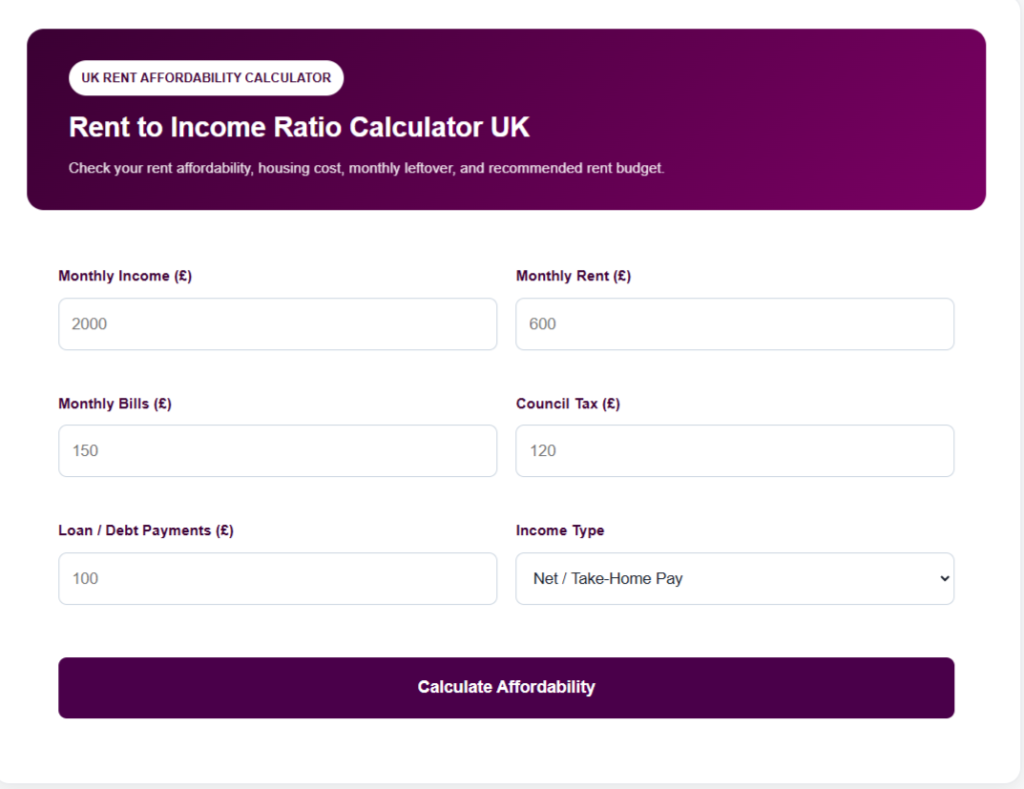
Visit Now: Rent to Income Ratio Calculator UK
Rent to Income Ratio Calculator UK-How to Use IT
What Is Rent-to-Income Percentage?
| Topic | Explanation |
|---|---|
| It Compares Rent With Income | The percentage compares your monthly rent with your monthly income. For example, if you earn £2,000 per month and pay £700 in rent, your rent takes up 35% of your income. |
| It Helps Measure Affordability | A lower percentage normally means you have more Remaining money for other important costs, such as food, monthly bills, Travel, savings, and loan repayments. A higher percentage may show that rent is putting pressure on your Financial plan. |
| It Is Used by Tenants and Letting Agents | Renters can use this figure to choose a suitable property, while letting brokers and property owners may use it during value-for-money checks to decide if a candidate can reasonably afford the rent. |
| It Supports Better Budget Planning | Learning your rent-to-income percentage makes it more Useful to plan your monthly payments. It helps you avoid choosing a property that leaves too little money for daily costs or unplanned costs. |
| It Can Change Over Time | Your percentage may increase if your costs go up or your income decreases. Checking it regularly can help you identify financial pressure early and make better housing decisions. |
Read more:Salary-to-Rent Ratio UK – How Much Should You Spend on RentHow to Calculate Your Rent-to-Income Ratio
Calculating your Rent-to-Income Percentage UK is simple. You only need your monthly rental payment amount and your monthly income. This calculation shows the percentage of your income that goes to rent each month.
Find Your Monthly Rent
Start with the total rent you pay each month. Use the rent amount shown in your rental agreement. Do not include separate costs such as monthly bills, local tax, internet, or parking, as they are included in your rent payment.
Find Your Monthly Income
Next, work out your total monthly income. Most people use their monthly take-home pay because it shows the money they actually receive after tax and National Insurance cuts. If you have more than one source of income, you can add them together when calculating your Rent-to-Income Percentage UK.
Use the Formula
Divide your monthly rent by your monthly income, then multiply the result by 100. This gives you your rent-to-income percentage.
Read more:GPA vs Percentage: 7 Essential Differences Every Student Should KnowRent-to-Income Percentage Formula
| Calculation Step | Explanation |
|---|---|
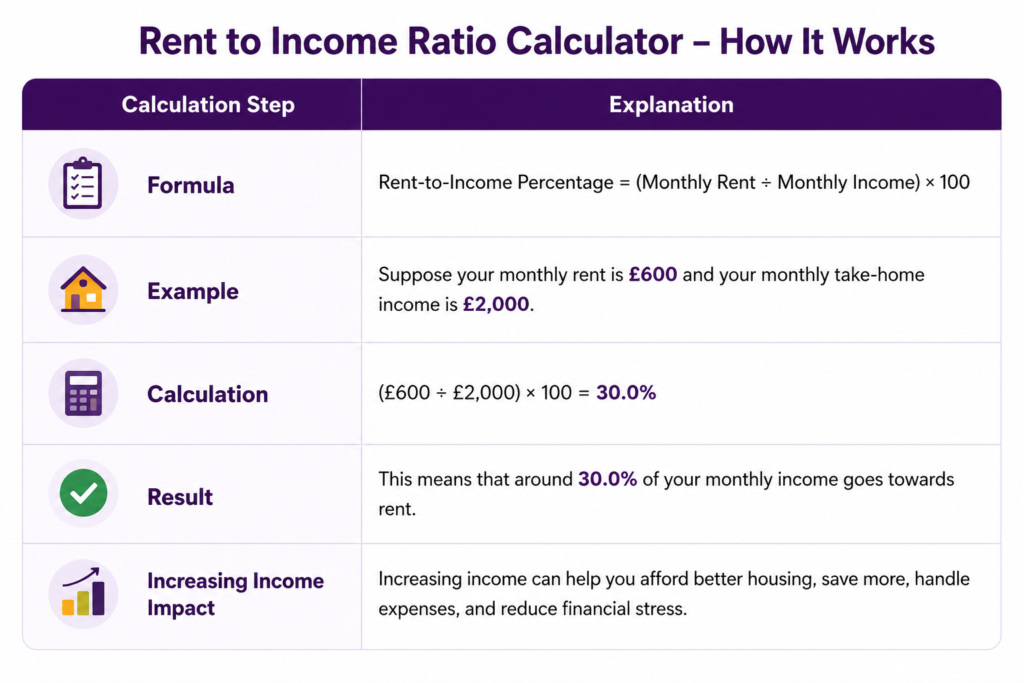
| Formula | Rent-to-Income Percentage = (Monthly Rent ÷ Monthly Income) × 100 |
| Example | Suppose your monthly rent is £800 and your monthly take-home income is £2,400. |
| Calculation | (£800 ÷ £2,400) × 100 = 33.3% |
| Result | This means that around 33.3% of your monthly income goes towards rent. |
| Remaining Income Usage | The remaining income can be used for bills, food, travel, savings, loan repayments, and other living costs. |
Read more:How Much Rent Can I Charge UK – Simple and Powerful Rent Pricing GuideWhat Is the Ideal Rent-to-Income Ratio in the UK?
There is no single rent-to-income percentage that works for everyone, but many people use 30% of monthly income as a general value-for-money rule. This means your monthly rent should generally take up no more than around 30% of your take-home income.
However, the right percentage depends on your income, location, household size, Loans, savings goals, and other regular costs. Someone with a higher income may be comfortable paying more than 30%, while someone with a lower income may need to keep costs below this level to manage other costs.
A Practical Budget Check Before Renting
Before choosing a rental property, do not look at the rent amount alone. Write down your expected monthly take-home income and subtract rent, council tax, energy bills, food, transport, phone costs, debt repayments, and regular subscriptions. Then check how much money is left. For example, a £900 monthly rent may look manageable on a £3,000 income because it represents 30%, but if your other essential costs use most of the remaining £2,100, the property may still put pressure on your budget. A realistic rent decision should leave you with enough money for everyday needs, savings, and unexpected expenses.
The 30% Rule Explained
The 30% rule proposes that households should aim to spend around 30% or less of their income on rent. For example, if your monthly take-home pay is £2,500, a rent payment of around £750 would equal 30% of your income.
This Standard is useful because it leaves about 70% of your income for other costs, including monthly bills, local tax, food, travel, loan repayments, savings, and emergencies. It is not a Legal requirement, but it can be a helpful starting point when setting a rental Financial plan.
| Topic | Explanation |
|---|---|
| 30% Rent Rule in the UK | For many renters, especially those living in London and other high-cost areas, saving rent below 30% of income may not be practical. High rental prices can mean that people spend 35%, 40%, or even more of their monthly income on housing. |
| Rent Above 30% Does Not Always Mean Unaffordable | If your rent is above 30%, it does not instantly mean the property is too costly. The key question is if you can still cover your important costs, save regularly, manage loan payments, and deal with unplanned costs without financial pressure. |
| Managing Higher Rent Costs | If costs leave very little money after your other monthly costs, a less expensive property, shared Housing, or a different location may be worth considering. |
How Much of Your Salary Should Go on Rent?
As a general rule, many people aim to spend around 30% or less of their monthly income on rent. This can leave enough money for other important costs, including bills, food, travel, savings, loan repayments, and unplanned costs. But the right amount depends on your personal Financial plan. In higher-cost areas, renters may need to use more than 30% of their earnings. Before choosing a property, check if you can comfortably manage all your regular costs after paying rent.
Rent Percentage Based on Take-Home Pay
Take-home pay is the money you receive after Income Tax, National Insurance, pension Payments, and other cuts. For personal Financial planning, this is usually the most useful income number because it shows the money actually available in your bank account.
For example, if your monthly take-home pay is £2,400 and your rent is £800, your rent-to-income percentage is 33.3%. This means one-third of your available monthly income goes to rent.
Using take-home pay can give you a more practical picture of Reasonable cost, especially if you have other monthly Responsibilities such as loan repayments, childcare costs, or savings goals.
| Topic | Explanation |
|---|---|
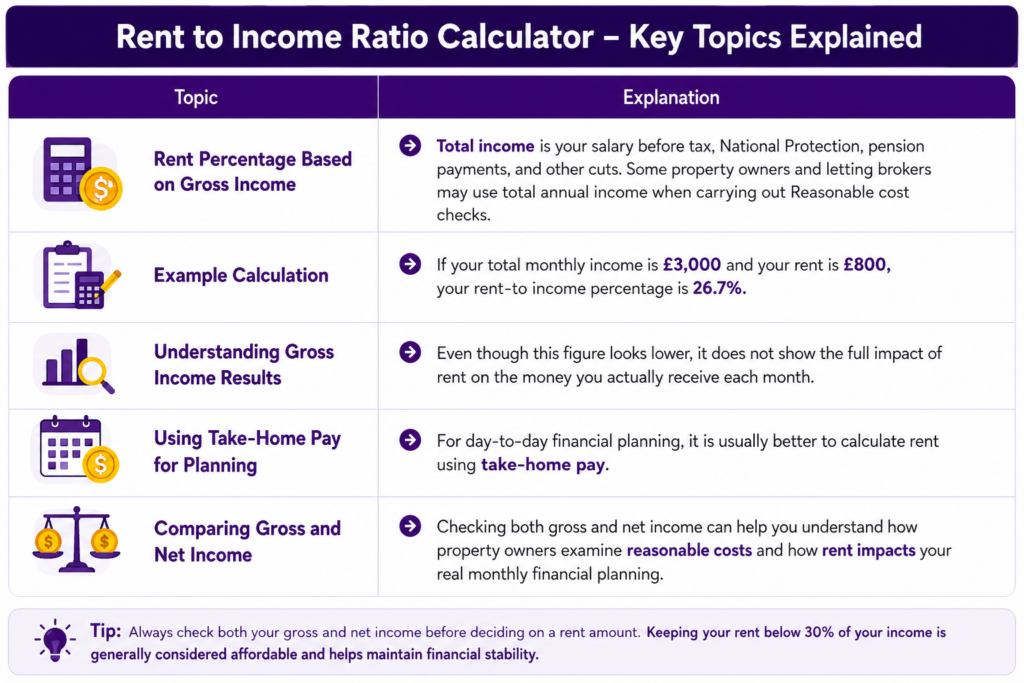
| Rent Percentage Based on Gross Income | Total income is your salary before tax, National Insurance, pension payments, and other cuts. Some Property owners and letting brokers may use total annual income when carrying out Reasonable cost checks. |
| Example Calculation | If your total monthly income is £3,000 and your rent is £800, your rent-to-income percentage is 26.7%. |
| Understanding Gross Income Results | Even though this figure looks lower, it does not show the full impact of rent on the money you actually receive each month. |
| Using Take-Home Pay for Planning | For day-to-day Financial planning, it is usually better to calculate rent using take-home pay. |
| Comparing Gross and Net Income | Checking both gross and net income can help you understand how Property owners examine reasonable costs and how rent impacts your real monthly Financial planning. |
Read more:Guarantor for Renting in the UK –7 Best Essential GuideWhy a High Rent-to-Income Ratio Can Be Risky
A high rent-to-income ratio means a large part of your monthly income goes to rent. While this may be Necessary in some areas, it can make your Financial plan more difficult to manage and leave less financial Freedom each month.
Less Money for Savings
When costs take up too much of your income, it can be difficult to create critical savings or save for future aims. This may include saving for a holiday, education, a car, a pension period, or a house deposit.
Difficulty Paying Unexpected Bills
Unplanned costs can happen at any time, such as a car repair, Dental services, higher energy bills, or an urgent household cost. If most of your income is already used for rent and important bills, these costs can become harder to manage.
Higher Risk of Debt
A tight monthly Financial plan may lead some people to rely on credit cards, Negative balances, or loans to cover regular living costs. Over time, this can create financial commitments and additional pressure through interest charges and repayments.
Reduced Ability to Buy a Home
Saving for a house deposit can be challenging when a high proportion of your income goes on rent. You may have less money available for savings, while high monthly costs can also make it harder to meet Home loan Reasonable cost requirements in the future.
Use the Emergency Expense Test
One practical way to test a rental budget is to imagine an unexpected expense happening next month. You might need to pay for a car repair, replace a broken appliance, cover a higher energy bill, or deal with an urgent family expense. If paying the rent would leave you unable to handle a £200–£500 unexpected cost without using a credit card or borrowing money, your housing budget may already be too tight. This simple test can give you a better understanding of affordability than looking at the rent percentage alone.
Is It Okay to Spend More Than 30% of Income on Rent?
| Topic | Explanation |
|---|---|
| Spending More Than 30% on Rent | Spending more than 30% of your income on rent is not always a problem. The 30% rule is helpful advice, but it does not show every person’s income, location, or financial situation. In some parts of the UK, especially areas with high rental prices, paying more than 30% may be difficult to avoid. |
| Important Factor After Paying Rent | The most important factor is whether you can cover your important expenses, save some money, and manage unplanned costs after paying rent. |
| When Paying 35% to 40% May Be Manageable | Paying 35% to 40% of your income on rent may be manageable if you have a stable income, low loan payments, and enough money left after rent for bills, food, transport, savings, and emergencies. |
| Example of Manageable Higher Rent | A person with a higher salary may be able to spend 40% on rent while still having a comfortable amount left each month. It may also be Reasonable if you share household costs with a partner, have low Regular travel expenses, or do not have major loan repayments. |
| Signs Your Rent Is Too Expensive | Your rent may be too costly if it leaves you finding it difficult to pay regular bills, relying on credit cards or Negative balances, missing savings goals, or struggling with small unplanned costs. |
| Warning Signs of Financial Pressure | It can also be a warning sign if you cannot manage rent after a small change in income or an increase in household expenses. |
| Possible Solutions | If your rent is putting constant pressure on your financial plan, it may be worth considering a less expensive property, shared Housing, or a location with lower rental costs. |
How to Reduce Your Rent-to-Income Percentage
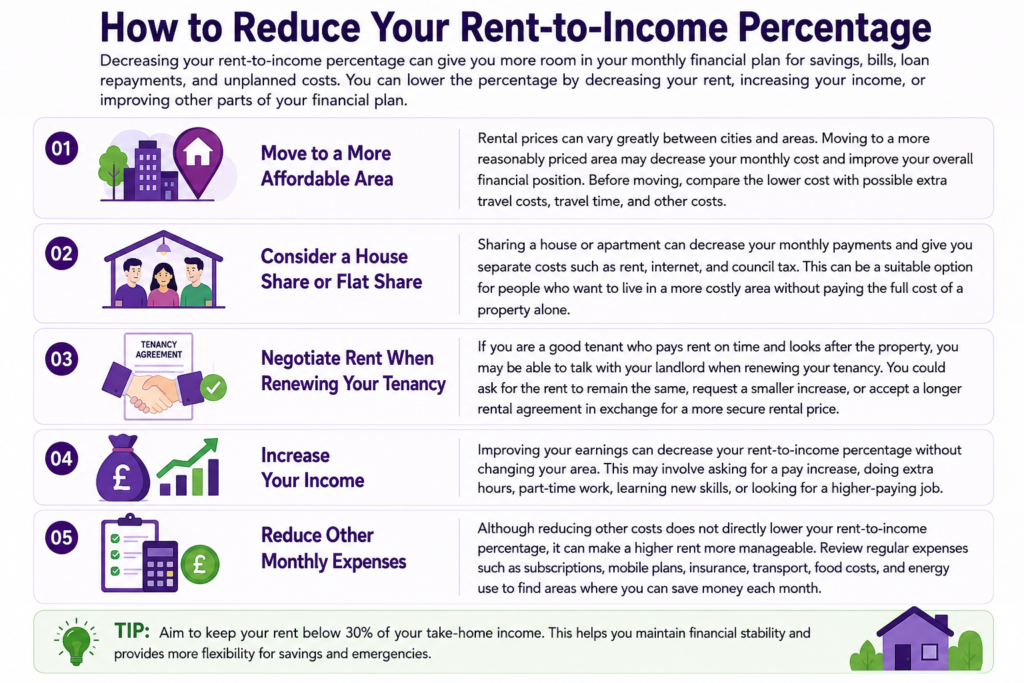
Decreasing your rent-to-income percentage can give you more room in your monthly Financial plan for savings, bills, loan repayments, and unplanned costs. You can lower the percentage by decreasing your rent, increasing your income, or improving other parts of your Financial plan.
Move to a More Affordable Area
Rental prices can vary greatly between cities and areas. Moving to a more reasonably priced area may decrease your monthly cost and improve your overall financial position. Before moving, compare the lower cost with possible extra travel costs, travel time, and other costs.
Consider a House Share or Flat Share
Sharing a house or apartment can decrease your monthly payments and give you separate costs such as rental payments, internet, and local tax. This can be a Suitable option for people who want to live in a more costly area without paying the full cost of a property alone.
Negotiate Rent When Renewing Your Tenancy
If you are a protected renter who pays rent on time and looks after the property, you may be able to talk with your Property owner when continuing your Rental agreement. You could ask for the rent to remain the same, request a smaller increase, or accept a longer rental agreement in exchange for a more Secure rental price.
Increase Your Income
Improving your earnings can decrease your rent-to-income percentage without changing your area. This may involve asking for a pay increase, using extra hours, Learning Part-time work, learning new skills, or looking for an increased-earning job.
Reduce Other Monthly Expenses
Although decreasing other costs does not directly lower your rent-to-income percentage, it can make a higher rent easier to handle. Study regular costs such as Plans, mobile devices, protection, transport, food Costs, and energy use to identify areas where you can save money each month.
Read more:House Share Rent Calculator UK – 7 Best Rent Split TipsRent-to-Income Ratio vs Debt-to-Income Ratio
Rent-to-income ratio and debt-to-income ratio are both useful financial standards, but they look at different parts of your Financial plan. Understanding the difference can help you measure if your rent and general monthly payments are reasonably priced.
| Topic | Explanation |
|---|---|
| What Is a Rent-to-Income Ratio? | A rent-to-income ratio shows the Amount of your earnings that goes to costs each month. It focuses only on housing costs and helps you decide if a rental property suits your Financial plan. |
| Rent-to-Income Example | If your monthly income is £2,400 and your rent is £800, your rent-to-income ratio is 33.3%. |
| What Is a Debt-to-Income Ratio? | A debt-to-income ratio shows how much of your earnings goes to monthly loan Payments. This may involve card payments, car loans, student loan Payments, Negative balances, and other loan payments. |
| Debt-to-Income Example | If you earn £2,400 per month and pay £400 towards debts each month, your debt-to-income ratio is 16.7%. |
The Main Difference
The main difference is that the rent-to-income ratio only calculates rent, while the debt-to-income ratio measures your regular loan repayments. Rent is normally not included as a loan, although both rent and loan payments impact how much money you have left each month.
Why Both Ratios Matter
A person may have a reasonably priced rent-to-income ratio but continue to face challenges in financial terms because of high loan repayments. For example, paying 30% of income on rent may seem manageable, but adding large loan or credit card payments can put pressure on the rest of the Financial plan.
Checking both ratios gives you a point of view of your Money. It helps you understand if you can comfortably pay rent, manage loans, save money, and cover everyday living costs.
Rent-to-Income Percentage Examples in the UK
The examples below show how your rent-to-income percentage can change depending on your monthly take-home pay and rent amount. They use the following calculation:
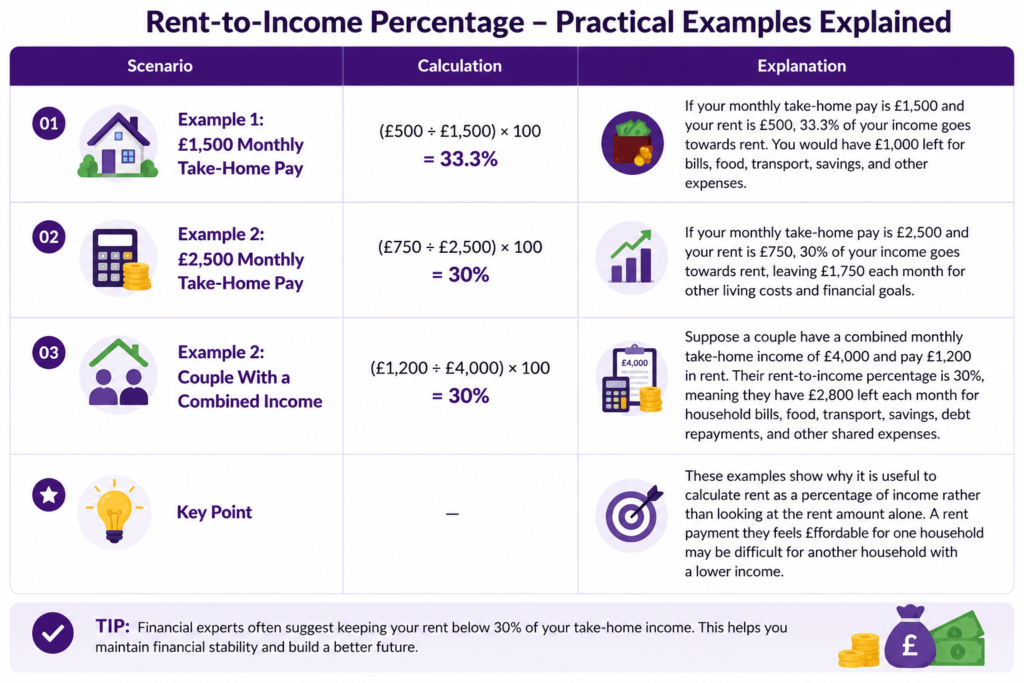
Rent-to-Income Percentage = (Monthly Rent ÷ Monthly Take-Home Pay) × 100
| Example | Calculation | Explanation |
|---|---|---|
| Example 1: £1,500 Monthly Take-Home Pay | (£500 ÷ £1,500) × 100 = 33.3% | If your monthly take-home pay is £1,500 and your rent is £500, one-third of your monthly income goes towards rent. You would have £1,000 left for bills, food, transport, savings, and other expenses. |
| Example 2: £2,500 Monthly Take-Home Pay | (£750 ÷ £2,500) × 100 = 30% | If your monthly take-home pay is £2,500 and your rent is £750, 30% of your income goes towards rent, leaving £1,750 each month for other living costs and financial goals. |
| Example 3: Couple With a Combined Income | (£1,200 ÷ £4,000) × 100 = 30% | Suppose a couple has a combined monthly take-home income of £4,000 and pays £1,200 in rent. Their rent-to-income percentage is 30%, meaning they have £2,800 left each month for household bills, food, transport, savings, debt repayments, and other shared expenses. |
| Key Point | — | These examples show why it is useful to calculate rent as a percentage of income rather than looking at the rent amount alone. A rent payment that feels affordable for one household may be difficult for another household with a lower income. |
Read more:30x Rent Rule UK – What It Means and How Letting Agents Calculate AffordabilityHow Much Rent Can I Afford on My Salary?
A simple way to calculate reasonably priced rent is to use the 30% rule. Multiply your monthly take-home pay by 30% to find a rent amount that may fit comfortably within your Financial plan. But this is only a starting point. Your ideal rent may be lower if you have loan repayments, childcare costs, high transport costs, or savings goals.
Rent Affordability Table by Monthly Income
| Monthly Take-Home Income | Rent at 30% | Rent at 35% | Rent at 40% |
| £1,500 | £450 | £525 | £600 |
| £2,000 | £600 | £700 | £800 |
| £2,500 | £750 | £875 | £1,000 |
| £3,000 | £900 | £1,050 | £1,200 |
| £4,000 | £1,200 | £1,400 | £1,600 |
| £5,000 | £1,500 | £1,750 | £2,000 |
Rent at 30% is often considered a comfortable target, while 35% to 40% may be manageable for some people depending on their other monthly expenses. If your rent would be above 40% of your take-home pay, review your full budget carefully before committing to a property.
Use a Rent-to-Income Calculator
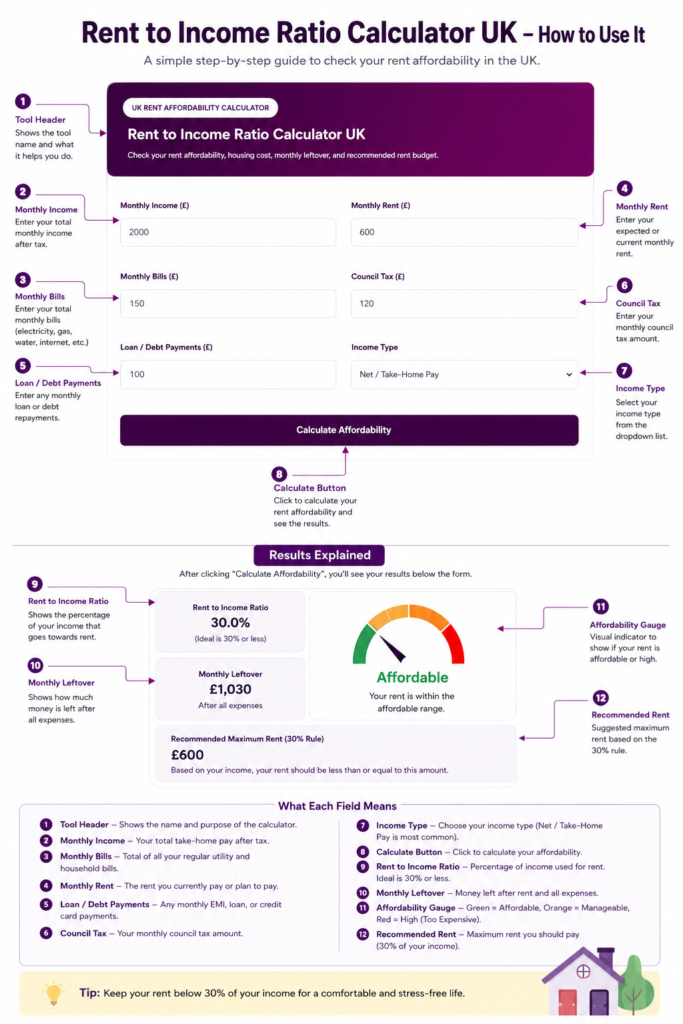
A rent-to-income calculator makes it easier to check how much of your salary goes to your monthly payment. Simply enter your monthly income and monthly housing payment, and the calculator will show your rent-to-income percentage.
You can also use the calculator in reverse by entering your income and a target percentage, such as 30%, 35%, or 40%, to calculate the maximum Monthly payment you may be able to manage. This can help you set a practical property-search Financial plan and compare different rental options before making a decision.
Check Your Budget Before Signing a Tenancy
It is worth calculating your rent-to-income percentage before paying a holding deposit or signing a tenancy agreement. A property can look affordable during a viewing, but your financial situation may feel very different once the first month includes rent, deposit-related costs, council tax, utility bills, moving expenses and household essentials. Calculate the expected monthly rent first, then list your regular expenses and check how much money would remain. Doing this before committing can help you avoid choosing a property that looks affordable on paper but becomes difficult to maintain after you move in.
Is 30% of Income Too Much for Rent?
Spending 30% of your income on rent is often seen as a reasonable guideline. It can leave around 70% of your income for bills, food, transport, savings, debt repayments, and other living costs. However, whether it is affordable depends on your personal budget and financial commitments.
Can I Rent a Property If My Income Is Low?
Yes, you may still be able to rent a property with a low income, but affordability checks can be more difficult. You may need to look for lower-cost properties, consider shared accommodation, use a guarantor, or show evidence of savings and other income sources.
Do Landlords Check Gross Income or Net Income?
Many landlords and letting agents use gross annual income for affordability checks because it is easy to verify through payslips and employment records. However, you should use your net or take-home income when planning your personal budget because this is the money you actually receive after tax and deductions.
What Is the Maximum Rent I Should Pay?
A common target is around 30% of your monthly take-home pay. Some people may be able to manage 35% to 40%, depending on their debts, savings, household size, and other regular expenses. If rent takes more than 40% of your income, review your full budget carefully before committing.
Does Universal Credit Count as Income for Renting?
Universal Credit may count as income for renting, but acceptance depends on the landlord, letting agent, and their affordability policy. You may need to provide award letters, bank statements, and evidence of any other income. Some landlords may also ask for a guarantor or rent paid in advance.
Is Rent Included in the Debt-to-Income Ratio?
Rent is usually not included in a debt-to-income ratio because it is a housing cost rather than a debt repayment. However, rent should still be included when reviewing your overall monthly budget because it has a major impact on how much money you have left after essential costs.
Should I Calculate Rent Using Monthly or Annual Income?
You can use either monthly or annual income, as long as you use the matching rent figure. For example, compare monthly rent with monthly income or annual rent with annual income. Monthly calculations are usually easier for budgeting because most bills and rent payments are paid each month.
Should I Include Bills When Calculating My Rent-to-Income Percentage?
Normally, the calculation uses your rent payment only. However, you should also review council tax, utility bills, internet, parking, service charges, and transport costs separately before deciding whether a property is affordable.
Can a Guarantor Help Me Rent a Property?
A guarantor can help if your income does not meet a landlord’s affordability requirements. The guarantor agrees to cover rent payments if you cannot pay, so they usually need to have a stable income, good credit history, and sometimes be a UK homeowner.
What Happens If My Rent Increases?
If your rent increases, your rent-to-income percentage will also increase unless your income rises at the same time. Recalculate your ratio after any rent increase to see whether your budget is still manageable and whether you need to reduce other costs or consider different housing options.
Conclusion
Finding the right rent level is about more than choosing a property you can manage today. It is about choosing a home that gives you permission to pay your bills, manage everyday costs, save for the future, and deal with unplanned costs without putting too much pressure on your Money.
Using your rent-to-income percentage can help you make a more informed decision. While the 30% advice is a useful starting point, the best cost amount depends on your take-home pay, loan, household costs, savings aims, and lifestyle. Some people may be comfortable spending A little more, while others may need to keep rent lower to protect their Financial plan.
Before approving a rental agreement, calculate how much of your income will go to rent and review your full monthly Financial plan. If the rent leaves you with enough money for important costs, savings, and emergencies, it is more likely to be a Practical choice in the long term.