
£25,000 Salary Rent UK: Earning £25,000 a year in the UK can make renting possible. However, the type of property and location you can afford will depend heavily on your monthly take-home pay, existing bills, savings goals, and whether you are renting alone or sharing with others.
After Income Tax and National Insurance, a £25,000 salary in the UK normally works out at roughly £1,750 to £1,850 per month, depending on your tax code and pension contributions. A common financial planning guideline is to spend no more than 30% to 35% of your take-home income on rent. On this basis, a practical monthly rent budget may be around £525 to £650.
However, many landlords and letting agents use a different affordability check for applicants earning £25,000 a year. They often look at your gross annual income and may require it to be at least 30 times the monthly rent. With a £25,000 annual salary, this could mean qualifying for rent of around £830 per month before bills. Although you may pass this landlord affordability check, paying the maximum amount could leave very little money for council tax, energy bills, food, transport, debt repayments, and unexpected expenses.
Click Here:Rent Affordability Calculator UK
How to Use the Rent Affordability Calculator UK
What Does a £25,000 Salary Mean After Tax in the UK?
A £25,000 annual salary is your total gross salary, meaning the amount you earn before deductions such as Income Tax, National Insurance, and workplace pension contributions. Your actual spending plan should be based on your net salary, also known as your take-home pay.
Here is what a £25,000 salary may mean in practical terms:
| Category | Details |
|---|---|
| Gross annual salary | £25,000 per year before deductions. |
| Estimated monthly gross pay | About £2,083 per month before tax and other deductions. |
| Income Tax | Most employees receive a tax-free allowance, meaning part of their income is not subject to Income Tax. The remaining taxable income is generally charged at the basic rate. |
| National Insurance contributions | Employees generally pay National Insurance on earnings above the relevant threshold. These contributions are normally deducted automatically through PAYE. |
| Estimated annual take-home pay | After Income Tax and National Insurance, take-home pay is generally around £21,000 to £22,000 per year before pension deductions. |
| Estimated monthly take-home pay | This is usually around £1,750 to £1,850 per month. The exact amount can vary depending on your tax code, pension contributions, student loan repayments, and other deductions. |
| Weekly take-home pay | You may receive roughly £400 to £425 per week after standard deductions. |
| Pension contributions can reduce take-home pay | If you are enrolled in a workplace pension, a percentage of your salary may be paid into your pension each month. This can slightly reduce your monthly spending money, but it helps you build long-term savings. |
Read more:Hours and Wage Calculator UK – Ultimate Pay Guide 2026How Much Rent Can You Afford on a £25,000 Salary?
On a £25,000 salary, the amount of rent you can afford depends on whether you use your gross income, take-home pay, or a landlord’s affordability calculation. While you may qualify for a higher rent amount, the most comfortable option is usually one that leaves enough money for bills, food, travel, savings, and unexpected costs.
Read more:How Much Rent Can I Charge UK – Simple and Powerful Rent Pricing GuideThe 30% Rent-to-Income Rule Explained
| Category | Details |
|---|---|
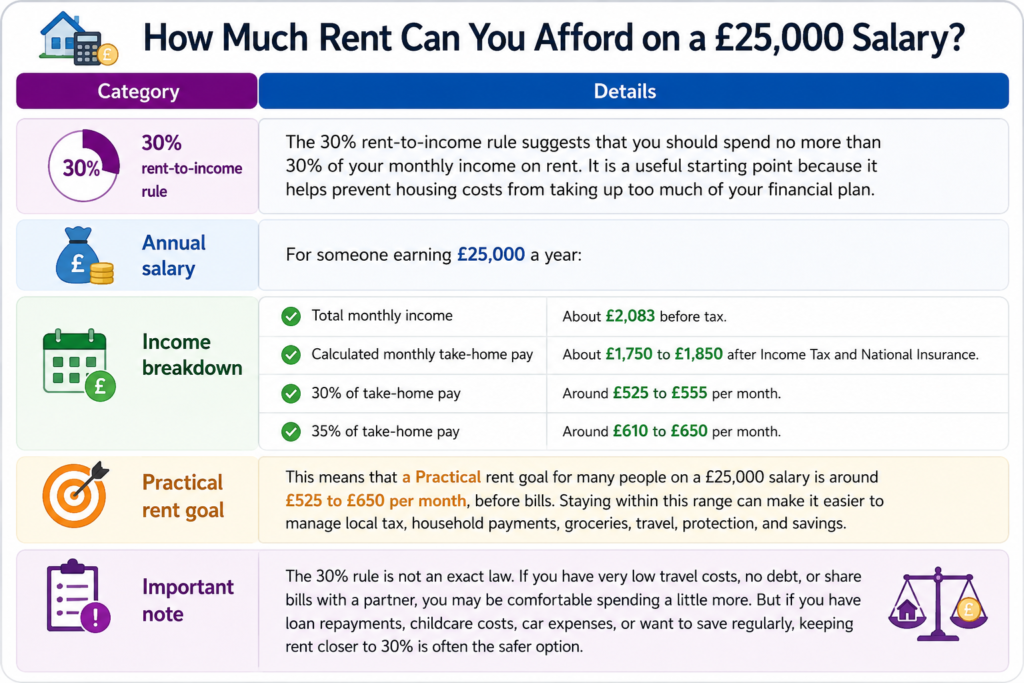
| 30% rent-to-income rule | The 30% rent-to-income rule suggests that you should spend no more than 30% of your monthly income on rent. It is a useful starting point because it can help prevent housing costs from taking up too much of your budget. |
| Annual salary | For someone earning £25,000 a year: |
| Total monthly income | About £2,083 before tax. |
| Calculated monthly take-home pay | About £1,750 to £1,850 after Income Tax and National Insurance. |
| 30% of take-home pay | Around £525 to £555 per month. |
| 35% of take-home pay | Around £610 to £650 per month. |
| Practical rent goal | For many people earning £25,000 a year, a practical rent target may be around £525 to £650 per month, before bills. Staying within this range can make it easier to manage council tax, household expenses, groceries, travel, insurance, and savings. |
| Important note | The 30% rule is not a legal requirement. If you have very low travel costs, no debt, or share household bills with a partner, you may be comfortable spending a little more. However, if you have loan repayments, childcare costs, car expenses, or regular savings goals, keeping rent closer to 30% may be a safer option. |
Lastly, keeping rent below 30% may be a better choice.
Maximum Rent Based on Gross Monthly Income
Property owners and letting agents often use your gross income, rather than your take-home pay, when assessing whether you can afford a rental property. A common affordability rule is that your annual income should be at least 30 times the monthly rent.
With an annual salary of £25,000, the calculation looks like this:
| Calculation | Amount |
|---|---|
| Annual gross income | £25,000 |
| Maximum monthly rent (30-times income rule) | About £833 per month |
| Maximum annual rent | About £10,000 per year |
This means you may be approved for a rental property costing up to around £830 per month, depending on the landlord, your credit history, employment status, guarantor, and any other household income.
However, being approved for £830 per month does not automatically mean that you can comfortably afford it within your lifestyle. If your take-home pay is around £1,800 per month, a rent of £830 would use nearly half of your monthly income before you have paid for household bills. This could make it more difficult to save money or cover unexpected expenses.
Read more:Guarantor for Renting in the UK –7 Best Essential GuideAffordable Rent Based on Your Take-Home Pay
| Category | Monthly Rent Budget | Details |
|---|---|---|
| Low-pressure budget | £450–£550 | Allows more room for savings, loan payments, travel, and unexpected costs. |
| Balanced budget | £550–£650 | A practical target for someone renting a single room, sharing an apartment, or living in a lower-cost area. |
| Higher-cost budget | £650–£750 | May work if you have low bills, share costs with someone else, or have few major financial commitments. |
| Maximum landlord-approved level | Around £830 | May be possible on paper, but could put pressure on your monthly budget once bills and other living costs are included. |
£25,000 Salary Rent Affordability Table
A £25,000 annual salary works out to approximately £2,083 per month before tax. After Income Tax and National Insurance deductions, your estimated take-home pay may be around £1,750 to £1,850 per month, depending on your individual circumstances.
The table below shows how much rent you could afford at different percentages of your gross monthly income and estimated take-home pay.
| Percentage of Income Spent on Rent | Rent Based on Gross Monthly Income (£2,083) | Rent Based on Estimated Take-Home Pay (£1,800) | What It May Mean for Your Budget |
| 25% | £521 per month | £450 per month | A comfortable option that leaves more money for bills, savings, travel, and unexpected costs. |
| 30% | £625 per month | £540 per month | Often considered a sensible rent target for a balanced monthly budget. |
| 35% | £729 per month | £630 per month | May be manageable if you have low debt, limited travel costs, or share household bills. |
| 40% | £833 per month | £720 per month | A higher-risk level that can make budgeting harder once bills and other living costs are included. |
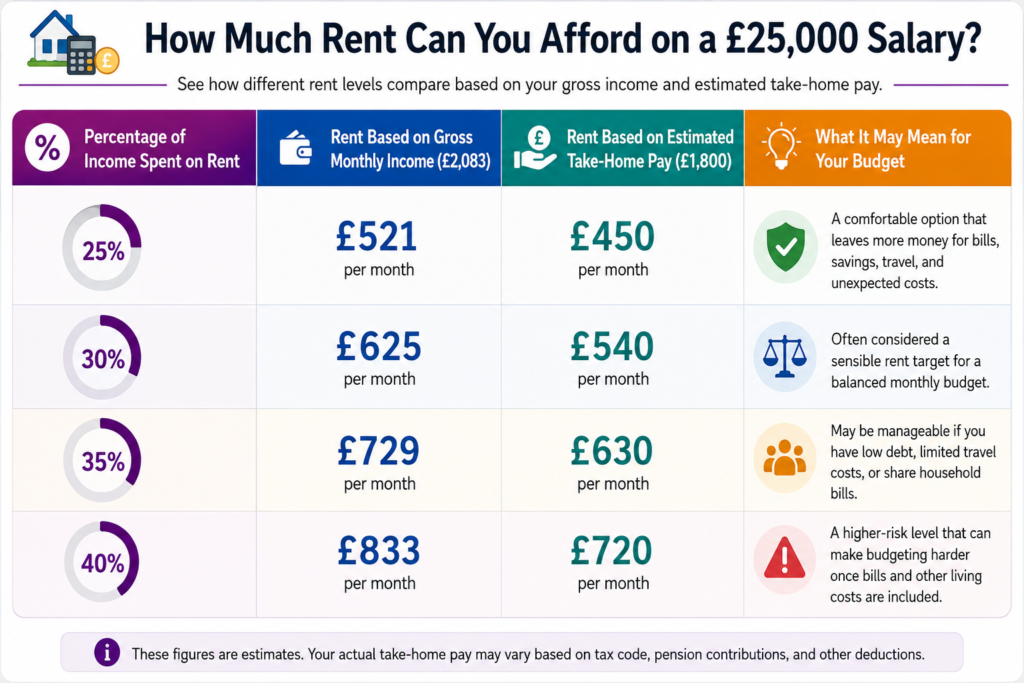
Monthly Rent You Can Afford at 25%, 30%, 35% and 40% of Income
Using your gross income, a £25,000 salary could allow rent of around £521 to £833 per month. This is often the figure property owners and letting agents consider when carrying out affordability checks.
However, your take-home pay is more important when deciding what you can comfortably manage in real life. Based on an estimated net monthly pay of around £1,800, a more secure rent range is usually between £450 and £630 per month.
Spending 25% to 30% of your take-home pay on rent is generally considered a more financially comfortable option. At this level, you are more likely to have sufficient money left for council tax, gas and electricity, internet, groceries, transport, insurance, loan repayments, and savings.
A rent level of 35% may still work for some renters, particularly if they share bills or have few other costs. Once rent reaches 40% of take-home pay, however, your budget can become more limited. You may still qualify for the property, but you could have less money available if your energy bills increase, your income changes, or an unexpected expense arises.
Read more:House Share Rent Calculator UK – 7 Best Rent Split TipsCan You Rent a One-Bed Flat on a £25,000 Salary?
Whether you can afford a one-bedroom apartment on a £25,000 salary depends mainly on where you live, how much rent costs locally, and whether you are renting alone or sharing household costs. With an estimated take-home pay of around £1,750 to £1,850 per month, a practical rent budget is usually around £550 to £650 per month before bills.
You may be approved for rent of up to roughly £830 per month under a typical landlord affordability check, but paying this much could leave limited money for council tax, household expenses, food, travel, savings, and emergencies. For this reason, rent affordability should be based on your overall monthly budget, not only on the maximum rent a landlord is prepared to accept.
Renting in London on a £25,000 Salary
| Category | Details |
|---|---|
| Renting alone in London | Renting a one-bedroom flat alone in London on a £25,000 salary is usually very difficult. Average rents are significantly higher than what most people on this income can comfortably afford, especially in central and well-connected areas. |
| Possible ways to rent in London | A £25,000 salary may still make renting in London possible if you choose one of the following options: |
| Option 1 | Rent a room in a house share or shared apartment. |
| Option 2 | Live with a partner, friend, or family member and share the rent and monthly household expenses. |
| Option 3 | Look in outer London areas where rental costs may be lower than in central locations. |
| Option 4 | Consider locations outside London with good rail connections, but remember to include commuting costs in your budget. |
| Option 5 | Use a guarantor if a landlord’s affordability check requires a higher income. |
| Most realistic option | A house share is often the most realistic option because it can reduce rent, council tax, energy bills, internet costs, and other household expenses. It may also help you save money instead of spending most of your income on housing. |
Renting Outside London on a £25,000 Salary
Outside London, renting a one-bedroom flat may be more achievable, particularly in lower-cost towns, smaller cities, and areas further from major city centres. In some locations, you may find small apartments, one-bedroom flats, or small terraced houses within a monthly budget of around £550 to £700.
However, rents can still be high in popular cities, coastal areas, and locations with strong transport links. Even outside London, it is important to consider the overall cost of living rather than looking only at the advertised rent.
| Monthly Expense | Include in Your Budget |
|---|---|
| Council tax | ✓ |
| Gas and electricity | ✓ |
| Water bills | ✓ |
| Broadband and mobile phone costs | ✓ |
| Food and household shopping | ✓ |
| Travel, fuel, parking, or train fares | ✓ |
| Contents insurance | ✓ |
| Debt repayments or subscriptions | ✓ |
| Savings and emergency funds | ✓ |
If a one-bedroom flat costs more than around £650 to £700 per month before bills, renting alone on a £25,000 salary may feel restrictive unless you have very low other expenses.
Compare the Total Cost Before Choosing a Property
When you are comparing two rental properties, don’t automatically choose the one with the lower advertised rent. Instead, calculate the total monthly cost of living at each property. For example, a £575 property may look cheaper than a £650 property, but if the first property has higher energy costs, expensive transport, or additional household charges, the difference may be much smaller than expected. Write down the rent, estimated bills, council tax, and commuting costs for each property and compare the final monthly figure. This gives you a clearer picture of which home actually fits your £25,000 salary budget and can help you avoid choosing a property that looks affordable at first but becomes expensive after all regular costs are included.
Read more:Rent Affordability Calculator London – How Much Rent Can You Afford in LondonShared Accommodation vs Renting Alone
Shared housing is often the more affordable option for someone earning £25,000 per year. Instead of paying the full cost of an apartment alone, you can share the rent and many household bills with other renters.
| Option | Typical Cost Pressure | Main Advantages | Main Considerations |
|---|---|---|---|
| Renting a room in a shared house | Usually lower | Lower rent, shared bills, easier to save money, and often more locations available | Less privacy, shared kitchen and bathroom, and possible differences in lifestyle |
| Sharing a flat with one person | Moderate | More privacy than a house share, shared bills, and potentially a better location | You depend on the other person paying their share |
| Renting a one-bedroom flat alone | Higher | Full privacy, control over your space, and no shared household rules | Higher rent, full responsibility for bills, and less room for savings |
For many people earning £25,000 a year, renting a room or sharing a flat can be a financially sensible choice, especially in more expensive areas. Renting alone may be practical in lower-cost parts of the UK, but it is important to choose a property that still leaves enough money for essential expenses and regular savings.
A Practical Affordability Check Before You Rent
Before applying for a rental property, do a simple monthly affordability check rather than looking at the advertised rent alone. For example, if your take-home pay is around £1,800 per month and the property costs £600 in rent, you still need to account for council tax, energy, water, internet, food, transport, and other regular expenses.
A useful way to test a property is to calculate your total housing cost first:
Rent + Council Tax + Energy + Water + Internet = Monthly Housing Cost
For example, a property with £600 rent might cost around £850–£950 per month after essential household bills, depending on the property and your circumstances. You should then compare this figure with your take-home pay and check how much money remains for food, transport, savings, debt repayments, and unexpected expenses.
Try the “£100 Increase” Test
One practical way to check whether a property is too expensive is to imagine that your rent increases by £100 per month. If you can still comfortably pay your essential bills and put some money into savings, your budget may have some flexibility. If an extra £100 would force you to stop saving or struggle with basic expenses, the original rent may already be close to your limit.
This test is useful because your financial situation can change after moving. Energy costs can increase, commuting can cost more than expected, and unexpected expenses can appear. Choosing a property that is slightly below your maximum budget can therefore give you a useful financial buffer.
Check the Move-In Cost, Not Just the Monthly Rent
Monthly affordability is only one part of renting. Before moving, you may need money for the deposit, first month’s rent, moving costs, furniture, and other household essentials. For example, at £600 monthly rent, a five-week deposit would be roughly £692, before considering the first month’s rent or other moving expenses.
Therefore, a sensible renter should ask two questions before applying:
- Can I afford this property every month?
- Do I have enough savings to move in without using expensive borrowing?
If the answer to either question is no, consider a cheaper property, a house share, or a location with lower overall living costs.
Practical takeaway: Don’t choose a property simply because a landlord’s affordability check says you qualify. Choose a rent that leaves enough room in your budget to handle normal living costs and unexpected expenses throughout the year.
Example Monthly Budget on a £25,000 Salary
A £25,000 salary may provide an estimated monthly take-home pay of around £1,800 after standard Income Tax and National Insurance deductions. Your actual take-home pay may vary depending on your tax code, workplace pension contributions, student loan repayments, and other deductions.
The budget below provides an example for someone renting a room or a modest property in one of the more expensive parts of the UK. It shows how rent, bills, food, transport, and savings could fit within a typical monthly income.
Typical Monthly Living Costs in the UK
| Monthly Expense | Example Cost | Notes |
|---|---|---|
| Take-home pay | £1,800 | Estimated monthly income after tax and National Insurance |
| Rent | £600 | A moderate rent target for a shared property or lower-cost area |
| Council tax | £100 | May be lower when shared between tenants; discounts may apply in some situations |
| Gas and electricity | £120 | Costs can vary depending on property size, energy use, and season |
| Water | £35 | Often shared or included in some rental arrangements |
| Broadband and mobile phone | £45 | Combined estimate for internet and a basic mobile plan |
| Groceries and household items | £250 | Covers food, toiletries, cleaning products, and basic household shopping |
| Transport | £150 | Could include fuel, bus fares, train travel, parking, or commuting costs |
| Contents insurance | £15 | Optional but useful for protecting personal belongings |
| Personal spending | £150 | Covers clothes, entertainment, subscriptions, gifts, and small unexpected purchases |
| Savings or emergency fund | £150 | Money set aside for future goals or unexpected costs |
| Total monthly spending | £1,615 | |
| Money left after expenses | £185 | Available for extra savings, debt repayments, or unexpected costs |
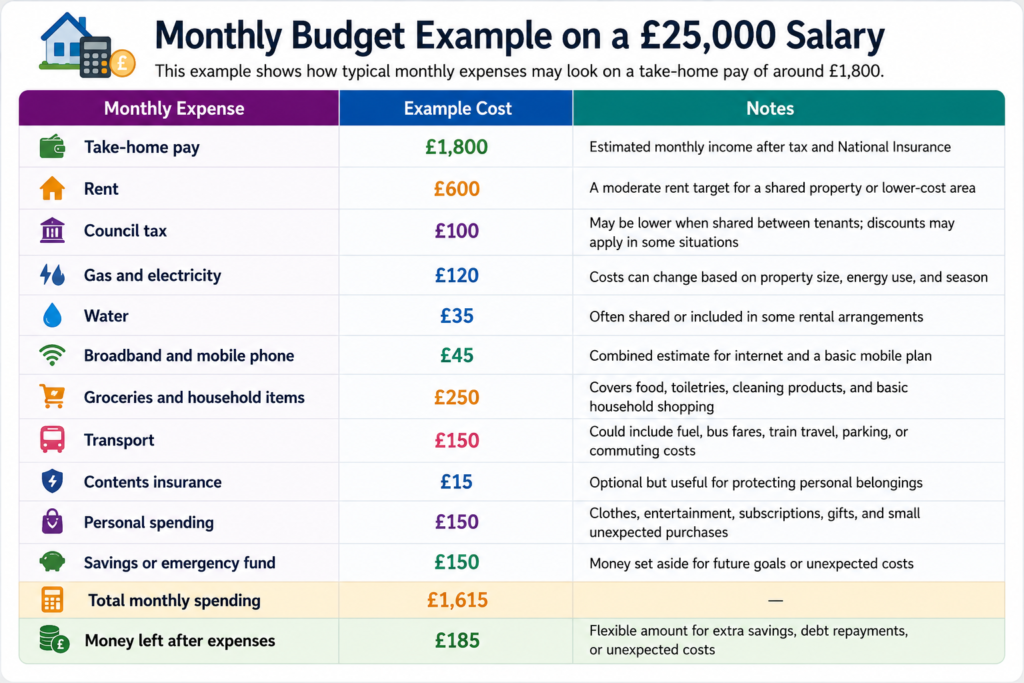
Rent, Bills, Food, Transport and Savings Breakdown
In this example, rent takes up £600 per month, which is around one-third of a £1,800 take-home income. This leaves enough room for essential household bills, food, travel, personal spending, and regular savings.
The most important factor is usually rent. A £100 increase in rent can quickly reduce the amount available for savings or unexpected expenses. For example, if rent rises from £600 to £700 per month, the money left in this budget would fall from £185 to around £85 per month.
Sharing housing can make a major difference because it may reduce not only rent but also council tax, energy bills, water charges, and internet costs. In contrast, renting alone means you are responsible for all household bills, even if your rent is within the amount approved by a landlord.
Read more:Rent vs Buy Calculator UK – Should You Rent or Buy a HomeHow Much Money Could You Have Left Each Month?
The amount you have left each month depends largely on your rent and other living costs. Based on an estimated take-home pay of £1,800 per month, here is a simple comparison:
| Monthly Rent | Estimated Money Left After Typical Costs* | Budget Pressure |
|---|---|---|
| £500 | Around £285 | More comfortable, with better room for savings and emergencies |
| £600 | Around £185 | Balanced, but still requires sensible spending |
| £700 | Around £85 | Tight budget with limited flexibility |
| £800 | Around £15 | High financial pressure, with very little room for emergencies or savings |
*These estimates assume other monthly costs of approximately £1,015, including bills, food, transport, insurance, personal spending, and savings.
A rent budget of around £550 to £650 per month may be a more manageable range on a £25,000 salary. This can leave some money available for savings and unexpected expenses without putting too much pressure on your everyday budget. If your rent is closer to £700 or more, reducing other expenses, sharing household costs, or increasing your income may help you maintain a more stable financial situation.
Tips to Make Renting Affordable on a £25,000 Salary
| Tip | Details |
|---|---|
| Set a Realistic Rent Limit Before You Search | Try to keep rent within £550 to £650 per month before bills, where possible. Although a landlord may approve you for a higher amount, choosing a lower rent gives you more room for food, travel, savings, and unexpected costs. |
| Include Bills When Comparing Properties | Do not compare properties based on rent alone. Add Council Tax, gas, electricity, water, internet, and transport costs before deciding whether a property suits your financial plan. A lower-cost apartment with high energy bills may cost more overall. |
| Build an Emergency Fund Before Moving | Moving costs can include an advance payment, first month’s rent, removals, furniture, and household setup costs. Saving one to three months of essential expenses can help you manage unexpected bills after moving. |
| Avoid Spending Too Much on Rent | Spending more than 35% of your take-home pay on rent can put pressure on your budget. If costs are high in your chosen area, consider a house share, a smaller property, or a location slightly further from the city centre. |
| Improve Your Chances of Passing Affordability Checks | Keep proof of income ready, such as payslips, bank statements, employment details, and identity documents. A good credit history, stable employment, savings, or a guarantor may also improve your chances of being accepted by a landlord. |
Read more:30x Rent Rule UK – What It Means and How Letting Agents Calculate AffordabilityWhat Is the Maximum Rent I Can Afford on a £25,000 Salary?
A typical landlord affordability calculation may allow rent of up to around £830 per month, based on a gross annual income of £25,000. However, a more comfortable personal rent budget is often around £550 to £650 per month before bills, depending on your other expenses.
Can I Rent a Flat on £25,000 a Year?
Yes, but it depends on where you live. In lower-cost towns and cities, you may be able to rent a studio or one-bedroom flat. In expensive locations, particularly London, renting alone may be difficult and shared accommodation may be more realistic.
Is £25,000 Enough to Live Alone in the UK?
It can be enough to live alone in a lower-cost area if your rent is manageable and you have limited debt or major financial commitments. However, living alone becomes much harder if rent is above £700 per month before bills, as you will also need to cover council tax, utilities, food, transport, and savings on your own.
How Much Rent Can I Afford If I Earn £25,000 Before Tax?
A £25,000 salary equals around £2,083 per month before tax. At 30% of gross monthly income, this works out to around £625 per month in rent. At 40%, it would be around £833 per month, although this may put pressure on your budget after tax and bills.
Do Landlords Check Gross Salary or Take-Home Pay?
Most landlords and letting agents check your gross annual salary before tax. A common requirement is that your annual income should be around 30 times the monthly rent. However, you should use your take-home pay when deciding what rent is genuinely affordable for you.
Can I Rent With a £25,000 Salary and No Guarantor?
Yes, you may be able to rent without a guarantor if your income meets the landlord’s affordability requirement, you have stable employment, a suitable credit history, and the required documents. A guarantor may be requested if the rent is high compared with your income, you have limited rental history, are self-employed, or do not meet the agency’s affordability criteria.
Is It Better to Rent a Room or a Flat on £25,000?
Renting a room is usually the more affordable choice because you can share rent, council tax, energy bills, water, and broadband costs. Renting a flat alone offers more privacy but can place greater pressure on your budget. A room or shared flat may be the better option if you want to save money or live in a more expensive area.
How Much Should I Spend on Rent and Bills Combined?
A useful target is to keep rent and essential household bills at around 40% to 50% of your take-home pay where possible. On an estimated take-home pay of around £1,800 per month, this means aiming to keep combined housing costs at roughly £720 to £900 per month. If your total rent and bills are much higher than this, you may have less money available for food, transport, savings, and unexpected expenses.
Will a Student Loan or Pension Contribution Affect How Much Rent I Can Afford?
Yes. Student loan repayments and workplace pension contributions are deducted from your pay before you receive it, so they reduce your actual take-home income. If you have these deductions, your real monthly spending power could be £50 to £150 lower than the standard £1,750 to £1,850 estimate, which means your comfortable rent budget may need to sit closer to the £450 to £550 range rather than £650.
How Much Deposit Will I Need on a £25,000 Salary?
Most landlords in the UK ask for a deposit equal to five weeks’ rent, along with the first month’s rent in advance. On a rent of £600 per month, this could mean setting aside around £1,290 before moving in. Building this amount in savings ahead of time is often more important than the monthly rent figure itself when planning affordability.
Can I Improve My Rent Affordability Without Increasing My Salary?
Yes. Options include choosing a shared property instead of renting alone, moving slightly further from city centres or transport hubs, reducing non-essential monthly subscriptions, or using a guarantor to access properties that would otherwise require a higher income. Each of these can shift your effective affordability without changing your gross salary.
Conclusion
Finding reasonably priced housing on a £25,000 salary is possible, but it depends greatly on where you live, your monthly expenses, and whether you live alone or share accommodation. In high-priced cities, renting a room in a shared house may be the most suitable option, while smaller areas may offer more flexibility for a one-bedroom apartment.
Before applying for a property, calculate your monthly take-home pay and set a clear rent budget. Try to keep your rent within a practical portion of your income while leaving enough money for household bills, food, travel, savings, and unexpected costs. A practical budget can help you choose a home that remains affordable not only on move-in day, but throughout the year. Savings and unexpected costs. A practical budget can help you choose a home that feels affordable not only on move-in day but throughout the year.