
Average Rent UK 2026: Finding the right rental property starts with understanding how much rent you should expect to pay. If you are moving to London, Manchester, Birmingham, Glasgow, or another UK city, knowing the latest rental prices helps you plan your finances effectively.
According to the latest UK rental market data, the average monthly private rent across the UK reached about £1,383 in May 2026, while new rental agreement rents averaged around £1,321 per month. Rent growth has slowed compared to previous years but remains above historical averages.
This guide explains:
- Latest average rent in the UK
- Average rent by city
- Rent affordability calculations
- Rent formulas
- Real-life examples
- Monthly and annual rent calculations
- Budgeting tips
About This Data
Figures in this guide are drawn from published rental market data, including the Office for National Statistics (ONS) Price Index of Private Rents and Zoopla’s Rental Market Report, cross-checked against current listing averages. Regional and city figures are rounded to the nearest £5–£50 for readability and are intended as a general benchmark — actual asking rents in any specific street or building can vary from these averages by 10–20% depending on condition, floor level, and exact location. Figures were last checked against source data in May–June 2026; rental markets shift monthly, so treat this as a directional guide rather than a live quote.
Click Here:Rent to Income Ratio Calculator UK
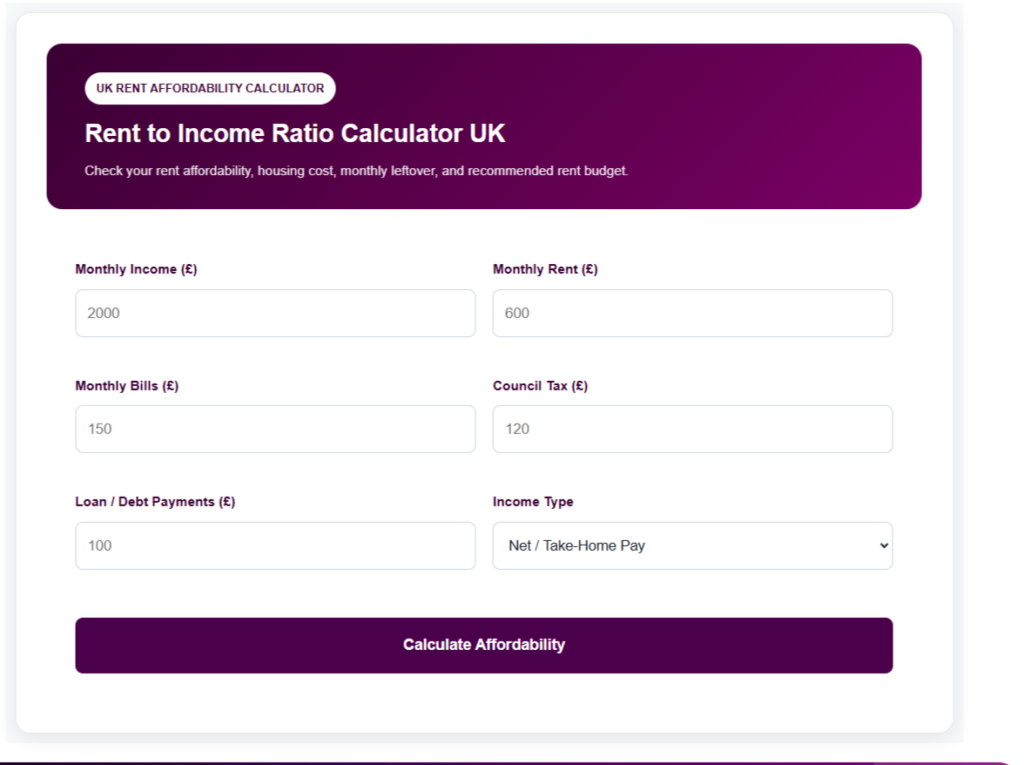
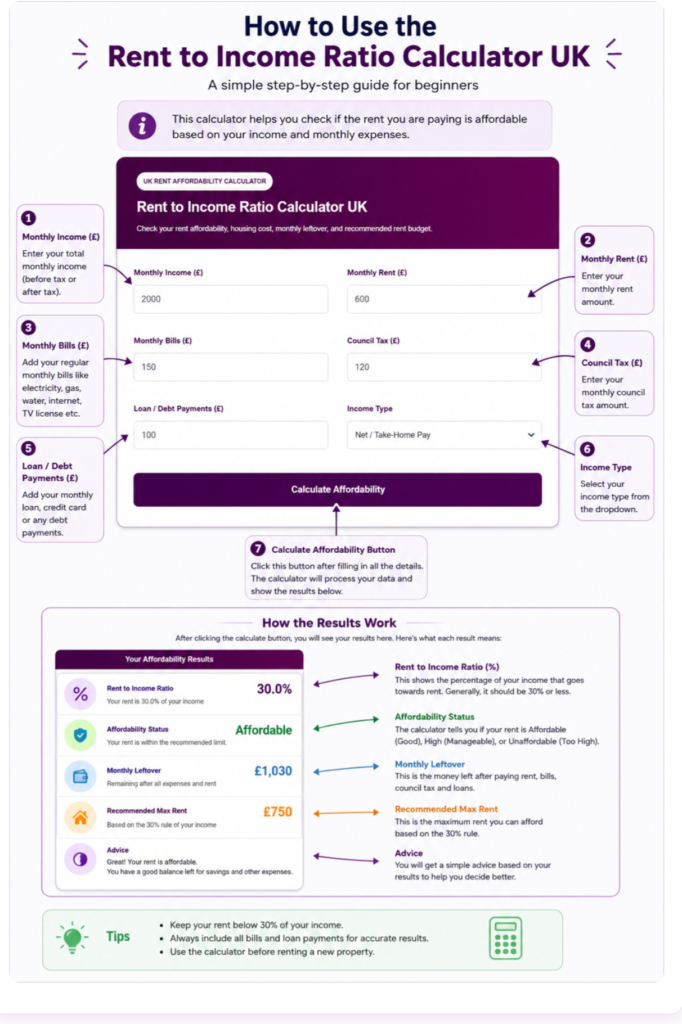
How to Use the Rent to Income Ratio Calculator UK
What Is the Average Rent in the UK in 2026?
Average Rent UK 2026: The average cost of renting a private property in the UK has continued to rise in 2026, although the pace of growth has slowed compared with previous years. According to the Office for National Statistics (ONS), the average monthly private rent in the UK is about £1,383, representing an annual increase of around 3.3%.
The exact amount you pay will depend on several factors, including your location, the property’s size, local demand, and the type of rental agreement. Rent in major cities such as London is significantly higher than the national average, while many areas in the North of England, Scotland, and Wales remain more affordable.
Data from Zoopla also shows that newly agreed rental contracts average around £1,321 per month. This figure reflects the current rental market for new tenants and indicates that rental price growth is starting to balance after several years of rapid increases.
Read more: University Academic Regulations Explained – Rules Every Student Should KnowBelow is an overview of the average monthly private rent across the UK:
| Region | Average Monthly Rent (2026) |
|---|---|
| United Kingdom | £1,383 |
| England | £1,438 |
| Scotland | £1,019 |
| Wales | £834 |
| Northern Ireland | Around £875 |
These numbers are national median values and should be used as a general overview. Rental prices can vary greatly between cities, areas, and property types, so it’s always important to compare local records before making a decision.
Average Rent by Major UK Cities (2026)
Rental prices vary greatly across the UK, with factors such as local demand, job opportunities, travel links, and housing availability all affecting the cost of renting. London remains the most costly city, while many cities in the North of England, Scotland, and the Midlands offer more affordable rental options.
The table below provides an overview of the estimated average monthly rent in some of the UK’s major cities during 2026.
| City | Average Monthly Rent |
| London | £2,150–£2,385 |
| Manchester | £1,300 |
| Birmingham | £1,100 |
| Bristol | £1,450 |
| Leeds | £1,000 |
| Liverpool | £900 |
| Glasgow | £980 |
| Edinburgh | £1,350 |
| Nottingham | £1,000 |
| Sheffield | £900 |
| Leicester | £950 |
| Newcastle | £900 |
City-by-City Overview
London
London rents run 55–70% above the national average, driven by limited housing supply and constant demand from professionals and international workers. The gap between areas is significant: a one-bedroom flat in Zone 1 can cost £2,200+, while the same property in Zones 4–6 may rent for £1,400–£1,700. Renters who work at least part of the week remotely can regularly save £400–£600/month by choosing outer London districts like Croydon, Walthamstow, or Ilford over central postcodes.
Manchester
Manchester rents rose faster than almost any other UK city between 2021 and 2025, driven by technology and media industry hiring and a large student population (over 100,000 students across its universities). Areas like Salford Quays and Ancoats now command rents close to inner London prices, while outer areas such as Stockport or Wythenshawe remain 20–30% cheaper.
Birmingham
Birmingham’s average rent is close to the national UK average, making it one of the more balanced markets for professionals moving for work. HS2-related regeneration around the city centre has pushed up rents in areas like Digbeth and the Jewellery Quarter, while outer suburbs remain comparatively affordable.
Bristol
Bristol’s rents are pushed up by tight housing supply and strong demand from the technology and aerospace industries. It’s one of the few cities outside London where average one-bedroom rents regularly exceed £1,300, and competition for well-located flats can be intense, especially near the harbourside and Clifton.
Leeds
Leeds provides some of the best value among the UK’s “core cities” — professional-level salaries with rents roughly 30% below Bristol’s. The city’s large student population (three universities) keeps demand for shared housing high, particularly in Hyde Park and Headingley.
Liverpool
Liverpool has some of the lowest rents of any major UK city relative to local salaries, making it attractive for first-time renters and young professionals. The Waterside and city-centre apartment market has grown quickly, but costs there still undercut comparable apartments in Manchester or Leeds.
Glasgow
Glasgow’s rents remain below those in the Scottish capital, Edinburgh, giving renters access to a major city economy without Edinburgh-level costs. Scotland’s rent tribunal rules (through the First-tier Tribunal) also differ from England’s, which is important when comparing rental agreements across the border.
Edinburgh
Edinburgh rents are pushed higher by a long-term shortage of rental stock — partly due to the popularity of short-term/holiday lets in the city centre. Areas like Leith and Gorgie offer more affordable options while staying within walking or a short bus ride of the centre.
Nottingham
Nottingham benefits from a large student population and growing job base (including gaming and biotech firms), keeping rents relatively stable compared to nearby Leicester and Derby while providing similar job access.
Sheffield
Sheffield regularly ranks among the more affordable UK cities with a population over 500,000, thanks to a larger housing supply relative to demand. Its two universities support a stable rental market without driving prices sharply upward.
Leicester
Leicester’s diverse economy (logistics, textiles, and a growing university sector) keeps demand for rental housing wide-ranging rather than concentrated in one area, which helps keep average rents stable.
Newcastle
Newcastle provides some of the lowest big-city rents in the UK, helped by a lower cost of living overall and steady but moderate demand growth. It’s frequently cited in national affordability rankings as one of the best-value cities for renters with professional salaries.
Read more:Rent Affordability Calculator Birmingham 2026 – Check Your Rental BudgetAverage Rent by Property Type
| Property Type | Average Monthly Rent |
|---|---|
| Studio | £900–£1,300 |
| 1 Bedroom | £1,000–£1,500 |
| 2 Bedroom | £1,300–£1,900 |
| 3 Bedroom | £1,700–£2,700 |
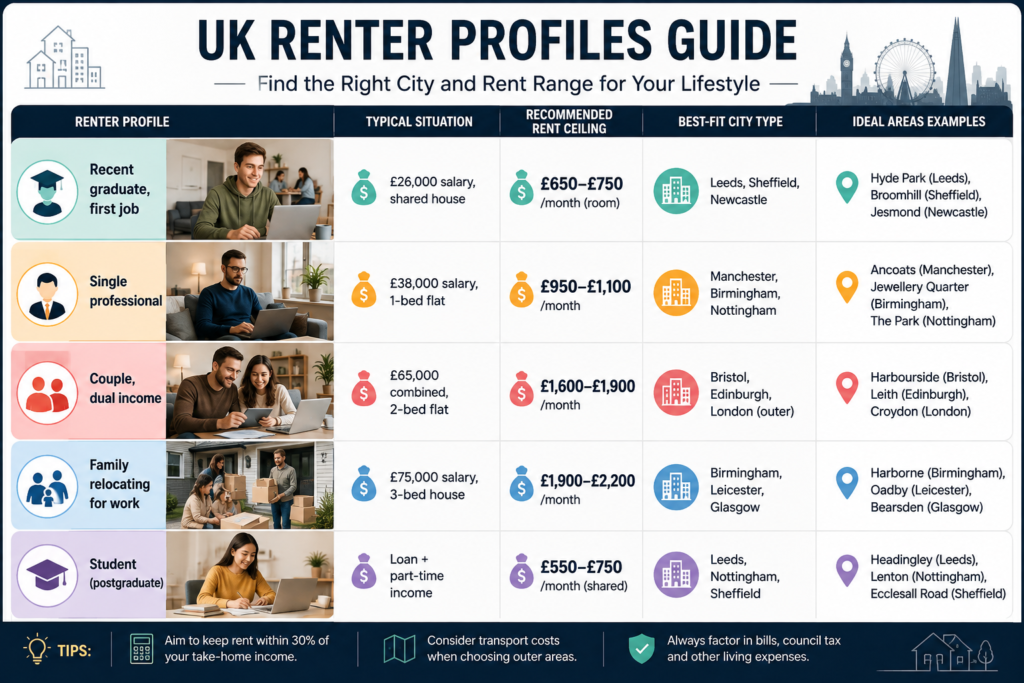
Rent Affordability by Renter Type: Real Scenarios
| Renter Profile | Typical Situation | Recommended Rent Ceiling | Best-Fit City Type |
| Recent graduate, first job | £26,000 salary, shared house | £650–£750/month (room) | Leeds, Sheffield, Newcastle |
| Single professional | £38,000 salary, 1-bed flat | £950–£1,100/month | Manchester, Birmingham, Nottingham |
| Couple, dual income | £65,000 combined, 2-bed flat | £1,600–£1,900/month | Bristol, Edinburgh, London (outer) |
| Family relocating for work | £75,000 salary, 3-bed house | £1,900–£2,200/month | Birmingham, Leicester, Glasgow |
| Student (postgraduate) | Loan + part-time income | £550–£750/month (shared) | Leeds, Nottingham, Sheffield |
Example scenario: A couple earning a combined £58,000/year and looking at a £1,500/month two-bedroom apartment would be spending roughly 31% of gross income on rent — within the commonly advised 30–35% range, but tight once council tax and bills (see budget table above) are added. Checking the numbers before signing is worth the ten minutes it takes.
Before You Rent: Check the Full Monthly Cost
A property that looks affordable based on rent alone may become expensive once all monthly costs are added. Before agreeing to a tenancy, work out the full monthly housing cost, including rent, council tax, gas and electricity, water, internet, contents insurance, and regular travel costs. For example, a flat advertised at £1,000 per month could easily cost £1,350 or more each month after essential household expenses are included. It is also worth checking the upfront costs, such as the tenancy deposit, first month’s rent, moving expenses, and any other permitted charges. A useful approach is to calculate your total housing cost first and then compare it with your take-home income, rather than looking at the advertised rent in isolation. This gives you a more realistic picture of whether the property fits comfortably within your budget.
How Is Rent Affordability Calculated?
Most UK landlords use an affordability ratio.
| Formula | Details | Example |
|---|---|---|
| Formula 1 | Monthly Income Required = Monthly Rent × 2.5 | Monthly Rent = £1,000Required Income= £1,000 × 2.5= £2,500/month |
| Formula 2 | Annual Salary RequiredAnnual Salary = Monthly Rent × 30 | ExampleMonthly Rent = £1,200Annual Salary= £1,200 × 30= £36,000 |
Many letting agencies require tenants to earn 30 times the monthly rent annually.
Rent-to-Income Ratio Formula
Financial experts generally recommend spending no more than 30–35% of your income on rent.
Formula
Rent Ratio (%) = (Monthly Rent ÷ Monthly Income) × 100
Example
Income = £3,500
Rent = £1,100
Rent Ratio
= (1,100 ÷ 3,500) × 100
= 31.4%
This is generally considered affordable.
Weekly Rent Formula
Many UK rental properties are advertised using weekly rental prices.
Formula
Monthly Rent = Weekly Rent × 52 ÷ 12
Example
Weekly Rent = £350
Monthly Rent
= 350 × 52 ÷ 12
= £1,516.67
Annual Rent Formula
Formula
Annual Rent = Monthly Rent × 12
Example
Monthly Rent = £1,250
Annual Rent
= 1,250 × 12
= £15,000
Deposit Calculation
Most landlords request a deposit of up to five weeks’ rent, subject to legal limits in England for many tenancies.
Formula
Deposit = Weekly Rent × 5
Example
Weekly Rent = £300
Deposit
= 300 × 5
= £1,500
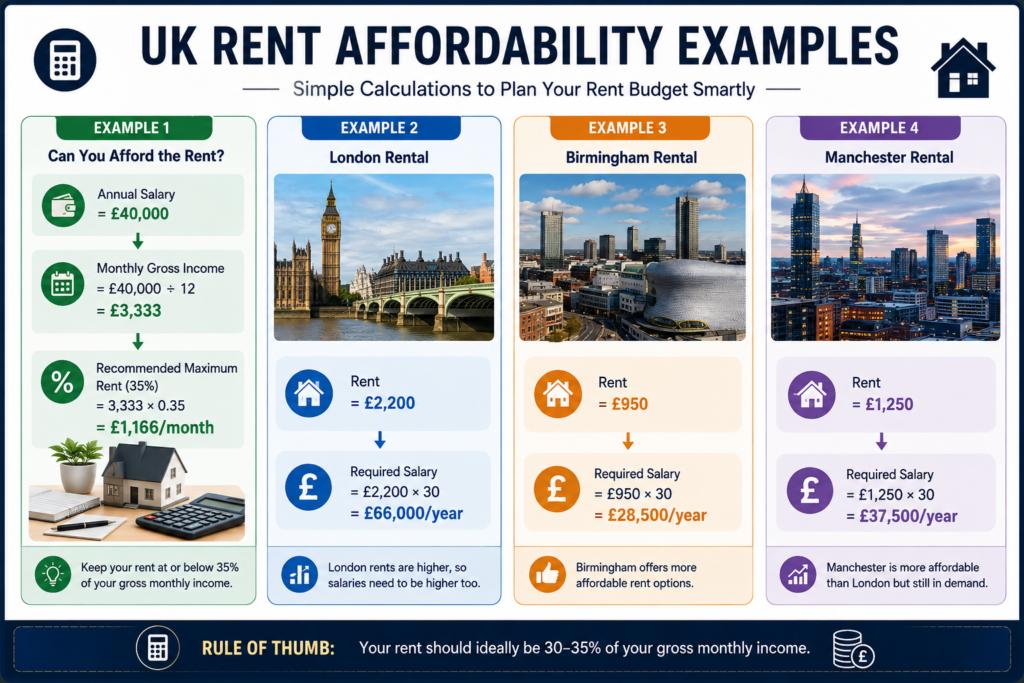
Example 1 – Can You Afford the Rent?
Annual Salary = £40,000
Monthly Gross Income
= £40,000 ÷ 12
= £3,333
Recommended Maximum Rent (35%)
= 3,333 × 0.35
= £1,166/month
Example 2 – London Rental
Rent = £2,200
Required Salary
= £2,200 × 30
= £66,000/year
Example 3 – Birmingham Rental
Rent = £950
Required Salary
= £950 × 30
= £28,500/year
Example 4 – Manchester Rental
Rent = £1,250
Required Salary
= £1,250 × 30
= £37,500/year
Monthly Housing Budget Example
| Expense | Monthly Cost |
|---|---|
| Rent | £1,200 |
| Council Tax | £180 |
| Electricity & Gas | £160 |
| Water | £40 |
| Internet | £35 |
| Contents Insurance | £20 |
| Total Housing Cost | £1,635 |
Read more: Rent Affordability Calculator Manchester – Calculate Affordable Rent (2026 Guide)Why Rent Differs Between UK Cities
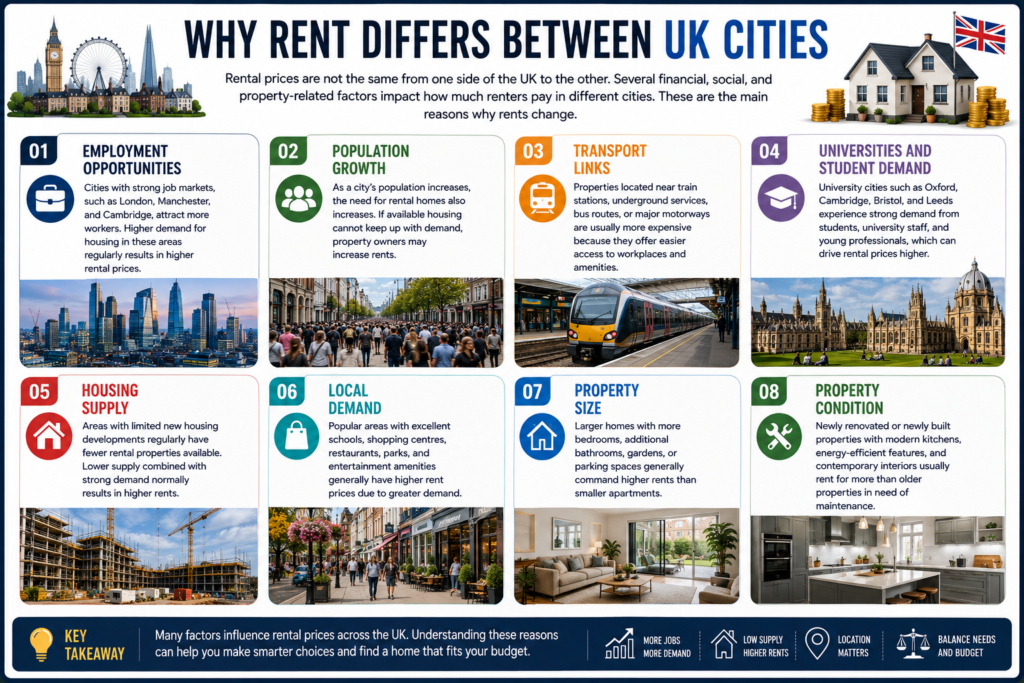
Rental prices are not the same across the UK. Several financial, social, and property-related factors affect how much renters pay in different cities. These are the main reasons why rental costs vary.
Employment Opportunities
Cities with strong job markets, such as London, Manchester, and Cambridge, attract more workers. Higher demand for housing in these areas often results in higher rental prices.
Population Growth
As a city’s population increases, the demand for rental homes also increases. If available housing cannot keep up with demand, property owners may increase rents.
Transport Links
Properties located near train stations, Underground services, bus routes, or major motorways are usually more expensive because they offer easier access to workplaces and other services.
Universities and Student Demand
University cities such as Oxford, Cambridge, Bristol, and Leeds experience strong demand from students, university staff, and young professionals, which can drive rental prices higher.
Housing Supply
Areas with limited new housing developments often have fewer rental properties available. Lower supply combined with strong demand normally results in higher rents.
Local Demand
Popular areas with excellent schools, shopping centres, restaurants, parks, and entertainment services generally have higher rental costs due to greater demand.
Property Size
Larger homes with more bedrooms, additional bathrooms, gardens, or parking areas generally command higher rents than smaller apartments.
Property Condition
Recently renovated or newly built properties with modern kitchens, energy-efficient features, and updated interiors usually rent for more than older properties that require maintenance.
How to Check If a Rental Property Is Good Value
Average rent figures are useful for comparison, but they should not be the only factor when deciding whether a property is reasonably priced. Compare at least three or four similar properties in the same area with a similar number of bedrooms and similar condition. Check what is included in the rent, how much council tax is likely to be, the property’s energy efficiency, transport costs, and whether you will need to spend extra on parking or commuting. A £1,100 property that requires expensive daily travel may cost more overall than a £1,200 property closer to work. Looking at the total cost of living in the property, rather than rent alone, can help you make a more practical rental decision.
Tips to Reduce Your Rent
If you are looking to save money on housing, this practical advice can help you find a more affordable rental property without giving up too much comfort or convenience.
Share Accommodation
Renting a property with friends, family members, or housemates allows you to share the rent and household costs, making monthly living expenses much lower.
Rent Outside the City Centre
Properties located in outer-city areas or on the outskirts of a city are often significantly cheaper than those in central locations. Good public transport can make commuting to and from work both easy and cost-effective.
Compare Multiple Letting Agents
Don’t settle for the first property you find. Compare listings from different letting agents and property websites to find the best value for your budget.
Negotiate a Longer Tenancy
Some property owners are prepared to offer lower monthly rent if you agree to sign a longer rental agreement, as this provides them with stable, long-term tenants.
Search During Quieter Rental Periods
Rental demand is often lower during the autumn and winter months. During these quieter periods, property owners may be more open to negotiating rent or offering additional benefits.
Check Whether Bills Are Included
Some rental properties include utility bills, council tax, internet, or other services in the monthly payment. A rental with utilities included can sometimes be more affordable than paying these costs separately.
Consider Nearby Commuter Towns
Living in a commuter town instead of a major city can significantly reduce your rent while still providing easy access to work through rail or bus connections.
Improve Your Tenant Profile
Having a good credit history, stable income, references from previous landlords, and the ability to move in quickly can make you a more attractive renter, increasing your chances of negotiating a lower rent.
Look for Newly Advertised Properties
Newly listed properties often receive the most attention. Contacting property owners or agents early may give you more room to negotiate before demand increases.
Set a Realistic Budget
Aim to spend no more than 30% to 35% of your monthly income on rent. This can help ensure you can comfortably manage other living costs and avoid financial stress.
Key Takeaway
Reducing your rent isn’t just about finding a cheaper property—it’s also about choosing the right location, comparing options, negotiating where possible, and understanding your total housing costs. With careful planning and flexibility, you can secure a home that fits both your lifestyle and your budget.

Benefits of Understanding Average Rent in the UK
| Benefit | Description |
|---|---|
| Create a Realistic Budget | Understanding lower rental prices helps you plan your monthly costs and avoid spending more than you can comfortably afford. |
| Compare Different Cities | You can easily compare rental costs across the UK to find a city that matches your budget and lifestyle. |
| Avoid Overpaying | Knowing the average market rent helps you identify overpriced properties and negotiate a better deal with property owners or letting agents. |
| Plan Your Move | Whether you are moving for work, study, or family, average rent data helps you estimate your housing costs before moving. |
| Improve Rent Affordability | By comparing your income with rental costs, you can choose a property that keeps your rent at a manageable percentage of your monthly earnings. |
| Make Better Financial Decisions | Understanding rental costs helps you balance housing expenses with other important costs such as utilities, transport, groceries, and savings. |
| Choose the Right Property Type | Information about rental prices allows you to compare the costs of studios, apartments, shared houses, and family homes to find the best option for your needs. |
| Negotiate with Confidence | If you know the average rent in a particular area, you will be in a stronger position to negotiate a fair rental price. |
| Prepare for Additional Costs | Researching rental prices also encourages you to consider related costs such as council tax, utility bills, deposits, and moving expenses. |
| Find Better Value for Money | Comparing rents in nearby towns or outer areas can help you find similar properties at lower prices while still enjoying good transport links and local services. |
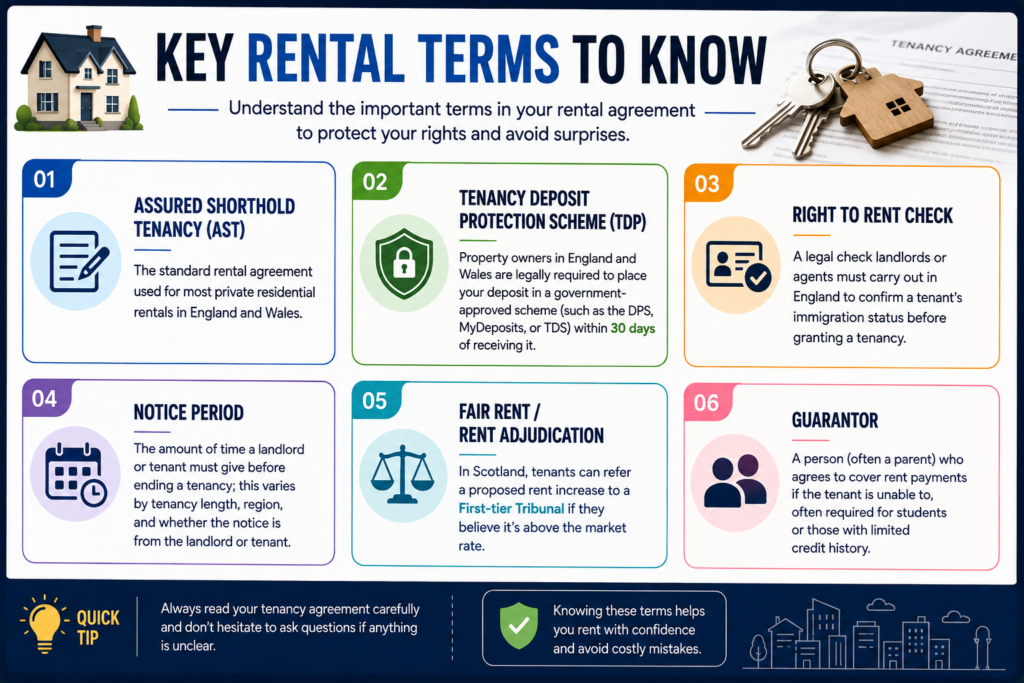
Key Rental Terms to Know
Assured Shorthold Tenancy (AST) – the standard rental agreement used for most private rentals in England and Wales.
Tenancy Deposit Protection Scheme (TDP) – property owners in England and Wales are legally required to place your deposit in a government-approved scheme (such as the DPS, MyDeposits, or TDS) within 30 days of receiving it.
Right to Rent check – a legal check that landlords or agents must carry out in England to confirm a tenant’s immigration status before granting a tenancy.
Notice period – the amount of time a landlord or tenant must give before ending a tenancy. This varies depending on the tenancy type, region, and whether the notice is given by the landlord or tenant.
Fair rent/rent adjudication – in Scotland, tenants can refer a proposed rent increase to a First-tier Tribunal if they believe it is above the market rate.
Guarantor – a person (often a parent) who agrees to cover rent payments if the tenant is unable to pay. Guarantors are often required for students or people with limited credit history.
Read more:Income Required to Rent Calculator UK – Find the Salary You Need (2026 Guide)
1. What is the average rent in the UK in 2026?
The average private rent in the UK is approximately £1,383 per month, although rental prices vary considerably depending on the city, region, and property type.
2. Which UK city has the highest rent?
London remains the UK’s most expensive rental market, with average monthly rents typically exceeding £2,000, and many central areas averaging more than £2,300 per month
3. What salary do I need to rent a £1,500 property?
Many landlords use the 30× affordability rule.
Calculation:
Annual Salary = Monthly Rent × 30
= £1,500 × 30
= £45,000 per year
4. What percentage of income should go towards rent?
Financial experts generally recommend spending 30% to 35% of your monthly income on rent to maintain a healthy budget and cover other living expenses.
5. How do I convert weekly rent into monthly rent?
Use the following formula:
Monthly Rent = Weekly Rent × 52 ÷ 12
For example:
Weekly Rent = £300
Monthly Rent = £300 × 52 ÷ 12 = £1,300
6. Is rent higher in London than the rest of the UK?
Yes. London has the highest average rental prices in the UK due to strong demand, higher salaries, excellent transport links, and limited housing supply. Most other UK cities offer significantly lower average rents.
7. Does the number of bedrooms affect rent?
Yes. In general, larger properties with more bedrooms, bathrooms, gardens, or parking spaces cost more to rent than studios or one-bedroom flats.
8. Are utility bills included in the monthly rent?
It depends on the tenancy agreement. Some rental properties include bills such as electricity, gas, water, internet, or council tax, while others require tenants to pay these separately. Always check what is included before signing a tenancy.
9. Can I negotiate the rent with a landlord?
Yes. Some landlords may agree to reduce the rent, especially if you have a strong tenant profile, can move in quickly, or are willing to sign a longer tenancy agreement.
10. How can I find cheaper rental properties in the UK?
You can reduce your housing costs by comparing multiple letting agents, searching outside city centres, considering commuter towns, sharing accommodation, and looking for properties during quieter rental periods when demand is lower.
11. Is my deposit protected by law?
Yes. In England and Wales, landlords must place your deposit in a government-approved tenancy deposit scheme within 30 days of receiving it, and must give you details of which scheme is being used. If this doesn’t happen, you may be entitled to compensation of up to three times the deposit amount.
12. How much notice does a landlord need to give before ending a tenancy?
This depends on the tenancy type and region. For an Assured Shorthold Tenancy in England, landlords typically must give at least two months’ notice under a Section 21 notice, though rules are tightening under ongoing rental reform. Scotland and Northern Ireland have separate notice period rules, so it’s worth checking the specific regulations for your tenancy location before assuming a standard notice period applies.
Final Thoughts
The UK rental market in 2026 remains strong, although annual rent growth has slowed compared with the sharp increases seen in previous years. The average private rent is now around £1,383 per month, but costs vary greatly by region, with London sitting well above the national average, while many cities in the Midlands, North, Scotland, and Wales remain more affordable.
Before signing a rental agreement, calculate your affordable rent using the formulas in this guide, include additional housing costs such as council tax and utilities, and compare rents across nearby areas to find the best value for your budget.