
Viewing a Rental Property: Sienna has two evenings free this week to find a new home. The first flat she views in Leeds looks perfect in the photos: bright living room, freshly painted walls, £925 a month. She is ready to say yes on the spot. Then, standing in the bathroom, she notices a musty smell behind the new paint, the extractor fan does nothing, and the agent cannot answer who the landlord’s deposit protection scheme is. She walks away — and is glad she did when she reads the next flat more carefully. Sienna’s story is exactly why knowing what to look for when renting a property matters — the photos never tell the whole story.
The viewing is the only moment you get to inspect a home before you are legally and financially tied to it — which is why knowing what to look for when renting a property matters so much. An hour of careful checking now can save you a year of damp, disputes and unexpected bills. This guide gives you the full viewing checklist for renting in the UK in 2026: what to research before you go, what to inspect room by room, which documents to ask for, the questions that separate good landlords from bad ones, the red flags that mean you should leave, and how the Renters’ Rights Act 2025 has changed the rules on bidding and upfront money.
Quick answer: What to look for when renting a property — at a rental viewing, check the EPC rating and council tax band before you go, inspect every room for damp, mould and damage, test the taps, heating, lights and appliances, confirm smoke and carbon monoxide alarms are fitted and working, and ask to see (or be told) the gas safety record, electrical safety report, EPC and deposit scheme details. Never hand over money or sign anything at a viewing. Since 1 May 2026 in England, landlords cannot accept rent above the advertised amount, and they cannot ask for more than one month’s rent in advance.
What to look for when renting a property: research before the viewing
The smartest checking happens before you ever step inside. If you’re wondering what to look for when renting a property, start with thirty minutes of desk research — it lets you arrive with a shortlist of questions instead of discovering problems later. Look up the property’s Energy Performance Certificate, which by law must be shown in the advert — a low rating (F or G) means the home cannot legally be let in most cases, and a D or E means you should expect higher heating bills. Check the council tax band so you know the real monthly cost on top of the rent, walk or use a map to confirm the commute at the time you would actually travel it, and search the street name for any red flags such as flood warnings, repeated police incidents or planned building works. It is also worth checking average rents for similar homes nearby, so you can tell whether the asking price is fair. Viewing a Rental Property is easier when you complete these checks beforehand.
| Before you go | What to check | Why it matters |
|---|---|---|
| EPC rating | Must be E or above (shown in the advert) | F and G rated homes generally cannot be let; D and E mean higher bills |
| Council tax band | Look it up for the exact address | Can add £100+ a month depending on the band and area |
| Commute | Test the route at your real travel time | A “20-minute commute” can be 45 minutes at rush hour |
| The street | Walk it, day and evening if you can | Noise, litter, lighting and neighbours tell you a lot |
| Local services | GP surgery, shops, schools, bus stops | A cheap rent can cost you hours if nothing is nearby |
| Comparable rents | Check 5–6 similar listings | Protects you from overpaying and informs negotiation |
| Bills estimate | Energy, water, broadband for that home type | See our bills guide |
What to take with you
You do not need much, but the right kit turns a rushed tour into a proper inspection. A phone is your most important tool: use it for photos, short videos of anything broken or damp, and a torch if the cupboards are dark. Take a printed or saved copy of your checklist, a notebook or phone note with your questions, and the details of the listing so you can check the description against reality. Bring photo ID only if you are confident you want to proceed — you should not be asked to hand over money or documents at the door. A second pair of eyes helps enormously, so take a friend or family member if you can. Packing the right kit is part of knowing what to look for when renting a property.
| Item | What it is for |
|---|---|
| Phone (camera + torch) | Photos and video of damp, damage and appliances for your records |
| This checklist | Keeps you systematic so you don’t forget rooms or questions |
| Listing details | Compare the advert’s claims (furnished? parking? bills included?) with what you see |
| Tape measure | Check whether your bed, sofa and white goods will actually fit |
| Charger | Test plug sockets in every room quickly |
| Your questions | The 15 questions below — don’t rely on memory under pressure |
What should you check outside the property?
Start before you go in. When you’re deciding what to look for when renting a property, the exterior tells you a lot before you’ve even stepped inside. Stand across the street and look at the roof for slipped or missing tiles, then check the gutters and downpipes for blockages, sagging or leaks — overflowing gutters are a classic cause of damp inside. Look at the brickwork and render for cracks or crumbling, and check wooden window frames and doors for rot. At the front and back doors, test the locks yourself: a flimsy Yale-type latch with no deadbolt is a weak spot. If there is a garden, ask who maintains it — if the answer is “you do”, that is fine, but it should be in the tenancy terms, not a surprise. In a block of flats, look at the communal areas: clean, well-lit hallways suggest a landlord or management company that takes maintenance seriously, while overflowing bins and broken entry systems suggest the opposite.
How should you inspect each room?
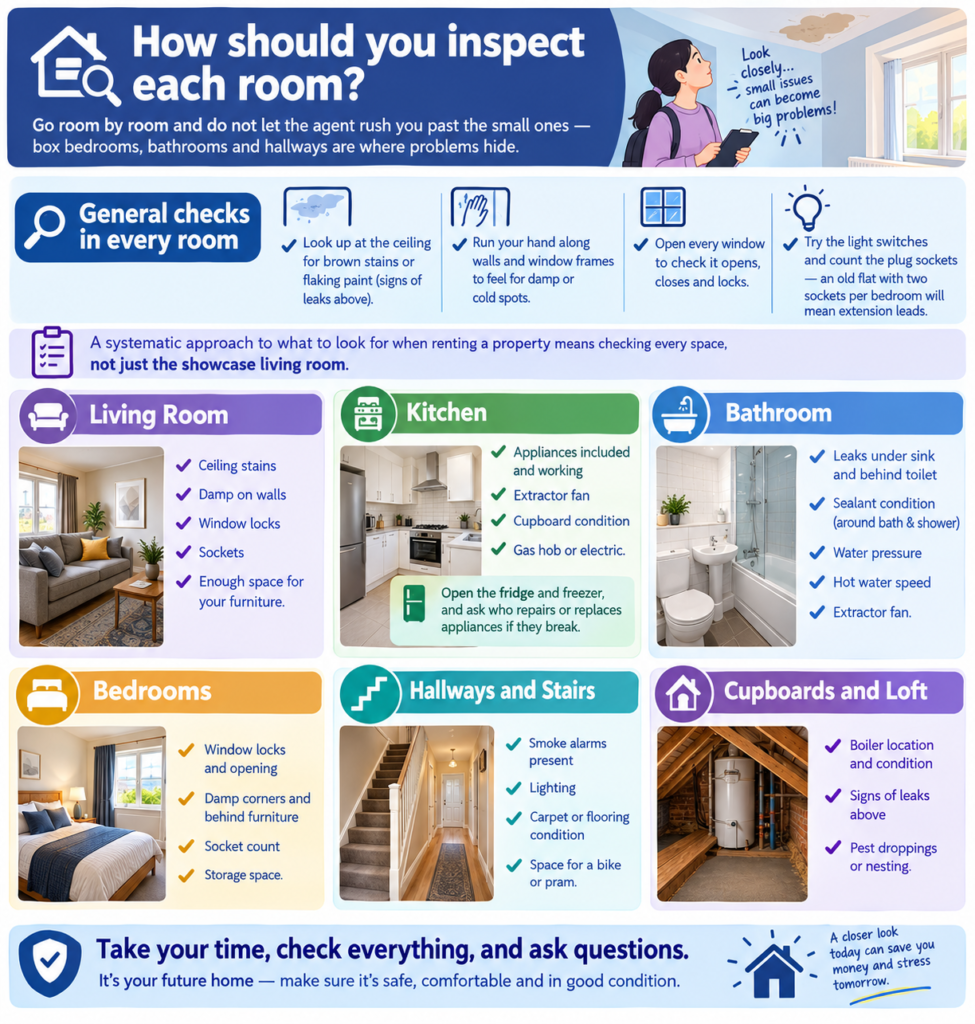
Go room by room and do not let the agent rush you past the small ones — box bedrooms, bathrooms and hallways are where problems hide. A systematic approach to what to look for when renting a property means checking every space, not just the showcase living room. In every room, look up at the ceiling for brown stains or flaking paint (signs of leaks above), run your hand along walls and window frames to feel for damp or cold spots, and open every window to check it opens, closes and locks. Try the light switches and count the plug sockets — an old flat with two sockets per bedroom will mean extension leads everywhere. In the kitchen, check which white goods are included and whether they are the landlord’s or the current tenant’s; open the fridge and freezer, and ask who repairs or replaces appliances if they break. In the bathroom, look behind the toilet and under the sink for leaks, check the sealant around the bath and shower for black mould, and run the shower to test pressure and how long hot water takes to arrive.
| Room | Your checks |
|---|---|
| Living room | Ceiling stains, damp on walls, window locks, sockets, enough space for your furniture |
| Kitchen | Appliances included and working, extractor fan, cupboard condition, gas hob or electric |
| Bathroom | Leaks under sink and behind toilet, sealant condition, water pressure, hot water speed, extractor fan |
| Bedrooms | Window locks and opening, damp corners and behind furniture, socket count, storage space |
| Hallways and stairs | Smoke alarms present, lighting, carpet or flooring condition, space for a bike or pram |
| Cupboards and loft | Boiler location and condition, signs of leaks above, pest droppings or nesting |
How do you spot damp, mould and pests?
Damp is the single most common misery in rented homes, and it is also the easiest to hide with a quick coat of paint. Trust your nose first: a musty, earthy smell in a freshly decorated room is a warning. Touch walls under windows and behind doors — bubbling, flaking or newly repainted patches often cover damp. Look for black spot mould on sealant, around windows and in corners, and check for condensation running down panes, which means poor ventilation. Ask directly whether the property has had damp or condensation problems before, and watch the reaction as much as the answer. For pests, open kitchen cupboards and check near the boiler and under sinks for droppings, chewed packaging or dead insects — landlords are responsible for infestations that were there when you moved in or that come from the structure of the building, as our pest control guide explains.
Warning: If the property smells musty, has visible black mould across whole walls, or the agent brushes off your damp questions, treat it as a serious red flag. Under the landlord’s repair duties, damp caused by the structure (leaking roofs, rising damp, broken gutters) is their responsibility to fix — but living with it while you argue about it is miserable. See our landlord repairs guide for how repair duties work once you are a tenant.
How do you test the plumbing, heating and hot water?
This takes five minutes and tells you more than almost anything else at a viewing. Turn on every tap and flush every toilet: water should run clear, drain away without gurgling, and the cupboards under sinks should be dry underneath. Turn the shower on fully — is the pressure strong enough to live with, and does hot water arrive within a reasonable time? Ask how the property is heated (gas central heating, electric storage heaters, heat pump) and who the energy supplier is, then find out the average monthly bills from the current tenant or the agent. Switch the heating on if you can and check that radiators warm up, and ask when the boiler was last serviced — an old, unserviced boiler is both expensive to run and a safety concern. If the home has electric storage heaters, remember they are far costlier to run than gas central heating; our energy bills guide for renters explains what different heating types cost.
What should you check about the electrics and appliances?
You are not expected to be an electrician, but a few simple tests catch the dangerous stuff. Flick every light switch and look for flickering, buzzing or scorch marks around sockets — all signs of wiring problems. Count the sockets per room and check they sit firmly in the wall. If white goods are included (washing machine, fridge, dishwasher, oven), switch each one on and confirm it actually runs; note which ones belong to the landlord, because they are the ones the landlord must repair or replace. Look at the fuse box: a modern consumer unit with labelled switches and trip switches is reassuring, while an ancient fuse box with rewireable fuses suggests the wiring may be just as old. Ask when the last electrical safety inspection was done — in England, an Electrical Installation Condition Report (EICR) must be renewed at least every five years, and you are entitled to ask for the result. These simple checks are an essential part of what to look for when renting a property — faulty electrics are dangerous and expensive to fix.
What safety features must a rental property have?
Safety checks are non-negotiable, and the viewing is your chance to verify them with your own eyes. In England, there must be a working smoke alarm on every storey and a carbon monoxide alarm in any room with a fixed combustion appliance such as a boiler or wood burner (gas cookers are exempt). Press the test button on each alarm while you are there. Identify your fire escape route — in a flat above the ground floor, ask what the plan is if the stairs are blocked. Check every external door has a proper lock (a five-lever mortice deadlock is the insurance standard many policies expect), that ground-floor windows have locks, and that there are no signs of a break-in the agent is glossing over. In a house in multiple occupation, look for fire doors that close properly and extinguishers or a fire blanket in the kitchen. If anything on this list is missing, ask the agent to confirm in writing that it will be fitted before you move in — and follow up by email so you have proof. Safety is the most important part of what to look for when renting a property — never compromise on it.
Key rule: The landlord must give you copies of the gas safety record, the electrical safety report and the Energy Performance Certificate at or before the start of the tenancy. If an agent cannot even tell you these documents exist at the viewing, that tells you everything about how the tenancy will be managed. Our landlord safety certificates guide lists every certificate a landlord must hold.
Which documents should you ask to see?
You will not see every certificate at the viewing, but you should always ask for them and judge the landlord by the answer. The four essentials in England are: the gas safety record (renewed every year by a Gas Safe registered engineer, where there is gas), the Electrical Installation Condition Report (at least every five years), the Energy Performance Certificate (valid for ten years, minimum rating E), and the name of the government-approved tenancy deposit protection scheme your deposit will go into. Also ask what tenancy type you will be offered — since 1 May 2026, new tenancies in England are assured periodic tenancies with no fixed term and no end date. From 15 December 2026, England’s new “Register your rental property” service starts opening region by region (West Midlands first), so it is reasonable to ask whether the landlord is registered under the scheme that applies where the property sits — Scotland, Wales and Northern Ireland already run their own landlord registers. Our deposit protection guide explains the three approved schemes and the 30-day protection deadline.
What are the 15 questions to ask the agent or landlord?
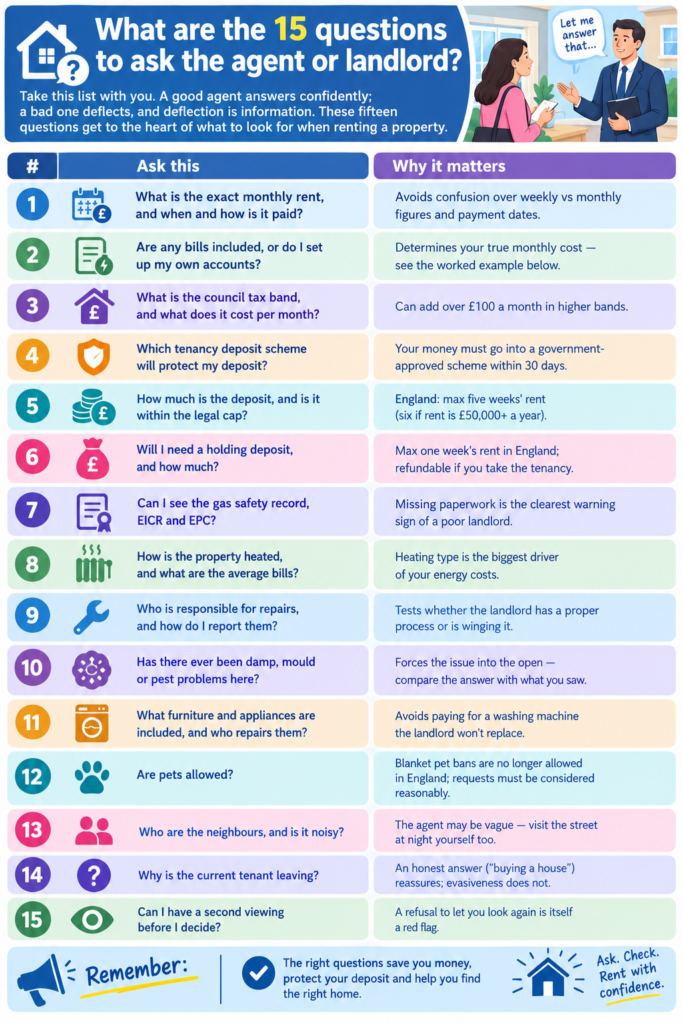
Take this list with you. A good agent answers confidently; a bad one deflects, and deflection is information. These fifteen questions get to the heart of what to look for when renting a property.
| # | Ask this | Why it matters |
|---|---|---|
| 1 | What is the exact monthly rent, and when and how is it paid? | Avoids confusion over weekly vs monthly figures and payment dates |
| 2 | Are any bills included, or do I set up my own accounts? | Determines your true monthly cost — see the worked example below |
| 3 | What is the council tax band, and what does it cost per month? | Can add over £100 a month in higher bands |
| 4 | Which tenancy deposit scheme will protect my deposit? | Your money must go into a government-approved scheme within 30 days |
| 5 | How much is the deposit, and is it within the legal cap? | England: max five weeks’ rent (six if rent is £50,000+ a year) |
| 6 | Will I need a holding deposit, and how much? | Max one week’s rent in England; refundable if you take the tenancy |
| 7 | Can I see the gas safety record, EICR and EPC? | Missing paperwork is the clearest warning sign of a poor landlord |
| 8 | How is the property heated, and what are the average bills? | Heating type is the biggest driver of your energy costs |
| 9 | Who is responsible for repairs, and how do I report them? | Tests whether the landlord has a proper process or is winging it |
| 10 | Has there ever been damp, mould or pest problems here? | Forces the issue into the open — compare the answer with what you saw |
| 11 | What furniture and appliances are included, and who repairs them? | Avoids paying for a washing machine the landlord won’t replace |
| 12 | Are pets allowed? | Blanket pet bans are no longer allowed in England; requests must be considered reasonably |
| 13 | Who are the neighbours, and is it noisy? | The agent may be vague — visit the street at night yourself too |
| 14 | Why is the current tenant leaving? | An honest answer (“buying a house”) reassures; evasiveness does not |
| 15 | Can I have a second viewing before I decide? | A refusal to let you look again is itself a red flag |
What are the red flags that mean you should walk away?
Some problems are negotiable — a dripping tap, a scuffed wall. These are not. If you see several of these together, leave and keep looking, however tempting the rent looks. Learning what to look for when renting a property means knowing when to walk away.
| Red flag | Why it is serious |
|---|---|
| Widespread black mould or a strong musty smell | Indicates structural damp; miserable to live with and hard to resolve |
| No smoke or carbon monoxide alarms | Illegal in England and a direct threat to your life |
| Agent cannot name the deposit scheme or show safety certificates | Suggests the landlord ignores legal duties you will rely on |
| Pressure to pay money or sign at the viewing | Classic sign of a scam or an agent who does not respect the rules |
| Refusal to allow a second viewing | They may be hiding something that shows up on a longer look |
| Another “tenant” showing you round with no landlord details | You may be looking at an unauthorised sublet with no legal protection |
| Visible structural damage, sagging ceilings or severe leaks | Repairs will be disruptive, slow and possibly never finished |
| The advert’s rent, size or furnishings don’t match reality | If the listing was misleading, the tenancy management will be too |
Should you book a second viewing — and can you trust a video viewing?
Yes to the second viewing, and be cautious with the video one. A second viewing at a different time of day reveals what the first hid: traffic noise at rush hour, how dark the flat is in the evening, whether the neighbours’ music starts at 10pm, and how the street feels after dark. If you are relocating and cannot visit twice, a live video viewing is better than nothing — but insist it is live, not a pre-recorded tour. Ask the person filming to open cupboards, run the taps, show you the view from each window and film the street outside; a recorded video can hide damp, noise and the state of the communal areas. Never agree to take a property on photos alone, and if the agent pressures you to decide before someone else “snaps it up”, treat that as the red flag it is. Noise is one of the most common reasons tenancies turn sour, so read our noisy neighbours guide before you commit to a home you have only seen once.
What should you never do at a viewing?
The rules here are absolute. Never hand over money at a viewing — no cash deposit, no “holding fee” to secure the property, no bank transfer to the agent’s personal account. Shelter and Citizens Advice both warn that paying before you have seen a property, or being asked to pay to get a viewing at all, is a hallmark of rental fraud. Never sign a tenancy agreement, holding deposit agreement or any other paperwork on the spot; always take documents away, read them properly, and check them against our tenancy agreement guide before you commit. Never hand over copies of your passport or bank statements to someone who has not verified who they are — identity documents in the wrong hands enable fraud. And never feel embarrassed about asking “too many” questions or taking photos: a legitimate landlord expects scrutiny, while a scammer relies on your politeness. If anything feels wrong, walk away and read our rental scams guide before you look further.
Worked example — Rory’s holding deposit: Rory finds a £850-a-month flat in Sheffield and the agent asks for a holding deposit while referencing checks are done. The legal maximum in England is one week’s rent. Weekly rent = £850 × 12 ÷ 52 = £196.15. So the most the agent can ask for is £196.15. The agent must hold it for 15 calendar days (unless you agree otherwise in writing), and it must be refunded or put towards your first rent or deposit if you take the tenancy. If Rory pulls out without good reason or gives false information, the agent can keep it — but they must explain why in writing within 7 days. Rory’s example shows why knowing what to look for when renting a property includes checking the maths on every fee.
How does the Renters’ Rights Act 2025 change the rules at the viewing stage?
Since 1 May 2026, the viewing stage in England works differently — and entirely in your favour. Rental bidding is banned: the advert must state one specific rent, and the landlord or agent cannot ask for, encourage or accept anything above it — even if you offer more voluntarily. Breaches can bring a £7,000 civil penalty, so if an agent hints that “another applicant is offering over the asking price”, report it to the council. The days of six months’ rent demanded upfront are also over: no rent can be requested or accepted before the tenancy agreement is signed, and afterwards the landlord can require at most one month’s rent in advance (28 days for shorter rental periods), with penalties of up to £5,000 for breaches. Tenancy deposits remain capped at five weeks’ rent where the annual rent is below £50,000 (six weeks above that). Note that asking for a lower rent is still perfectly legal — the ban only stops bidding above the advertised figure, so pointing out issues you found at the viewing remains a fair negotiating tactic. Our letting agent fees guide sets out every charge that is and is not allowed.
Key rule (England, from 1 May 2026): The advertised rent is the ceiling, not the starting bid. And the maximum lawful cash you can be asked for before moving in is one month’s rent in advance plus a capped deposit — nothing more, and nothing before you sign. Keep this rule in mind — it’s central to what to look for when renting a property in England.
Worked example — Owain’s deposit: Owain agrees to take a £1,100-a-month flat in Bristol after the viewing. First, check the deposit is lawful. Weekly rent = £1,100 × 12 ÷ 52 = £253.85. The five-week cap = £253.85 × 5 = £1,269.23. The landlord asks for £1,300 — that is over the cap and unlawful in England, so Owain asks for it to be corrected to £1,269.23. His total maximum upfront payment is then one month’s rent (£1,100, after signing) plus the deposit (£1,269.23) = £2,369.23. For the full list of permitted charges, see GOV.UK’s guidance on fees you can be charged as part of a tenancy. Owain’s example shows what to look for when renting a property when it comes to deposits — always do the maths yourself.
How do the rules differ in Scotland, Wales and Northern Ireland?
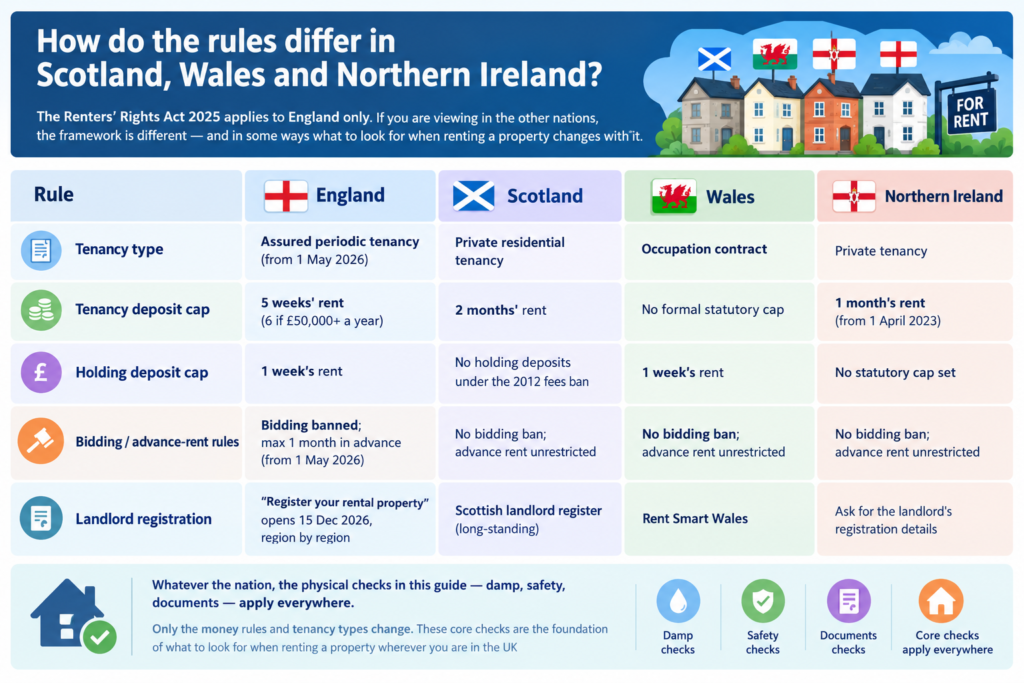
The Renters’ Rights Act 2025 applies to England only. If you are viewing in the other nations, the framework is different — and in some ways what to look for when renting a property changes with it.
| Rule | England | Scotland | Wales | Northern Ireland |
|---|---|---|---|---|
| Tenancy type | Assured periodic tenancy (from 1 May 2026) | Private residential tenancy | Occupation contract | Private tenancy |
| Tenancy deposit cap | 5 weeks’ rent (6 if £50,000+ a year) | 2 months’ rent | No formal statutory cap | 1 month’s rent (from 1 April 2023) |
| Holding deposit cap | 1 week’s rent | No holding deposits under the 2012 fees ban | 1 week’s rent | No statutory cap set |
| Bidding / advance-rent rules | Bidding banned; max 1 month in advance (from 1 May 2026) | No bidding ban; advance rent unrestricted | No bidding ban; advance rent unrestricted | No bidding ban; advance rent unrestricted |
| Landlord registration | “Register your rental property” opens 15 Dec 2026, region by region | Scottish landlord register (long-standing) | Rent Smart Wales | Ask for the landlord’s registration details |
Whatever the nation, the physical checks in this guide — damp, safety, documents — apply everywhere. Only the money rules and tenancy types change. These core checks are the foundation of what to look for when renting a property wherever you are in the UK.
Which property is really cheaper? A worked example
Two flats can look £225 apart on the rent and end up costing nearly the same once bills, deposits and upfront cash are counted. Yasmin is choosing between two two-beds in Leeds after viewing both. Yasmin’s comparison shows what to look for when renting a property beyond the headline rent — the true cost is what matters.
Flat A: £925 a month, EPC rating D, tenant pays all bills. Her realistic bill estimate: energy £110, water £38, broadband £25 = £173 a month. True monthly cost = £925 + £173 = £1,098. Deposit (five-week cap) = £925 × 12 ÷ 52 × 5 = £1,067.31. Cash needed before moving in = first month (£925) + deposit (£1,067.31) = £1,992.31. Flat A shows what to look for when renting a property when bills aren’t included — the headline rent is only the starting point.
Flat B: £1,150 a month, EPC rating C, all bills included. True monthly cost = £1,150 — fixed, whatever energy prices do. Deposit = £1,150 × 12 ÷ 52 × 5 = £1,326.92. Cash needed before moving in = £1,150 + £1,326.92 = £2,476.92. Flat B shows the other side of what to look for when renting a property — an all-inclusive rent removes the bill uncertainty.
| Flat A (bills extra) | Flat B (bills included) | |
|---|---|---|
| Advertised rent | £925/month | £1,150/month |
| Likely bills | £173/month | £0 (included) |
| True monthly cost | £1,098 | £1,150 |
| Deposit (5-week cap) | £1,067.31 | £1,326.92 |
| Cash needed upfront | £1,992.31 | £2,476.92 |
| Yearly cost | £13,176 | £13,800 |
Flat A is £52 a month cheaper (£624 a year) — but only if Yasmin’s £173 bill estimate holds. A cold winter in a D-rated flat could easily wipe that out. Flat B costs more but the figure is guaranteed. There is no universally right answer: if your budget is tight and you are disciplined with heating, Flat A wins; if you want cost certainty, Flat B wins. The point is to do this maths for every shortlist, not just compare headline rents. Our guide to the bills renters pay helps you build realistic bill estimates.
Frequently Asked Questions
How long should a rental viewing take?
At least 20–30 minutes for a proper inspection. If the agent tries to rush you through in ten minutes, that is a warning sign — a good landlord wants you to look carefully. You need time to check everything on your list of what to look for when renting a property.
Should I take photos at a rental viewing?
Yes. Photos and short videos of every room, plus close-ups of any damage, damp or broken fittings, protect you twice: they help you compare properties afterwards, and they are evidence of the property’s condition if there is a deposit dispute later.
Can a letting agent charge me for a viewing?
No. Charging for viewings has been banned in England since the Tenant Fees Act 2019, and equivalent bans exist in Scotland and Wales. Anyone asking you to pay to see a property is breaking the rules — walk away.
What does the EPC rating tell me as a renter?
The Energy Performance Certificate rates the home’s energy efficiency from A (best) to G (worst). Homes rated F or G generally cannot be let in England. A D or E rating is legal but usually means higher heating bills, so factor that into your budget.
How do I check if a landlord is legitimate?
Ask for the landlord’s full name and contact details, check they are on the relevant landlord register (Scotland, Wales and Northern Ireland have long-standing schemes; England’s opens from 15 December 2026), and confirm the deposit will go into a government-approved protection scheme. Never pay money to someone who will not identify themselves.
What is the maximum deposit a landlord can ask for?
In England, five weeks’ rent where the annual rent is below £50,000 (six weeks above that). Scotland caps deposits at two months’ rent, Northern Ireland at one month’s rent, and Wales has no formal statutory cap. Always do the maths yourself — see Owain’s worked example above.
Can I offer more than the advertised rent to secure a property?
In England, no — and the landlord cannot accept it either. Since 1 May 2026, rental bidding is banned: the advertised rent is the maximum. Offering more will not help your application and the agent must not encourage it.
Should I view a property more than once?
If you can, yes. A second viewing at a different time of day shows you noise levels, natural light, parking and how the street feels in the evening — things a single daytime visit hides.
Is it safe to take a property after only a video viewing?
It is risky. A live video call where you direct the camera is far better than a pre-recorded tour, but video cannot show you smells, draughts, noise or the true state of the street. If you must decide remotely, ask for a live walkthrough and request close-ups of anything you are unsure about.
What should I do if I spot damp during a viewing?
Ask the agent about it directly and ask for the answer in writing, with a commitment to fix it before you move in. Minor condensation from poor ventilation is manageable; widespread black mould or structural damp is a reason to walk away. Photograph everything you see.
Do I need to pay anything on the day of the viewing?
No. You should never hand over money at a viewing. A holding deposit (max one week’s rent in England) can only come later, once you have decided to proceed, and must be refundable or put towards your tenancy. Anyone demanding cash on the spot is a red flag — and knowing what to look for when renting a property means spotting this one immediately.
Final Thoughts
A viewing is an inspection, not a sales pitch. The agent’s job is to show you the home at its best; your job is to look past that — at the walls, the paperwork, the alarms, the bills and the answers to your questions. The renters who end up happiest are not the ones who found the cheapest flat, but the ones who found a sound flat with a landlord who answers questions properly and has the certificates to prove it. Take this checklist with you, take photos, take your time, and never let urgency push you into handing over money or signing on the spot. Knowing what to look for when renting a property is what separates a sound decision from an expensive mistake.
Before you decide, run the numbers properly: use our rent affordability calculators to check the true monthly cost fits your budget, read our guide to negotiating rent if the asking price looks high, and make sure you understand what your tenancy agreement should contain before you sign anything.
Further Reading
- Shelter England’s checklist for viewing a property — a printable checklist to take with you
- GOV.UK’s guidance on fees you can be charged as part of a tenancy — the official list of permitted payments, updated for the 2026 rules
- Citizens Advice’s guide to tenancy agreements — what documents your landlord must give you and what your agreement should cover